SenseNova U1.6 Benchmarks: +7% Self-Correction Gain
The benchmark picture for U1.6 can be stated in one sentence: there is a single core set of numbers, and all of it is vendor-reported. This article does not vouch for SenseTime; it lays out the source, the method and the limits of each figure — what the 86.04-to-92.28 test is, how the +7% is calculated, whose scores sit behind the +10% aesthetics claim, and why no third-party board can rank U1.6 against its rivals today.
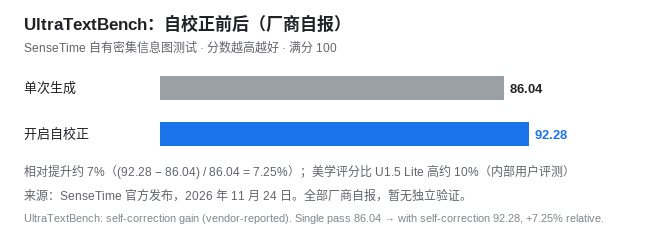
UltraTextBench: 86.04 to 92.28
| Configuration | UltraTextBench score | Note |
|---|---|---|
| U1.6 Lite, single pass | 86.04 | No self-correction, one generation |
| U1.6 Lite, self-correction on | 92.28 | After self-check and redraw |
| Relative gain | ~+7% | (92.28 − 86.04) / 86.04 = 7.25% |
UltraTextBench is SenseTime's own dense-infographic test, measuring generation quality on text-heavy images such as posters, charts and manuals. Same model, same test — the only difference is whether self-correction is on: 86.04 for a single pass, 92.28 with self-correction, a gain of 6.24 points, or about 7% in relative terms. The meaning of that number is specific: self-correction genuinely lifts text accuracy on the vendor's own test. But its limits are equally specific: SenseTime wrote the test and scored it, with no third-party replication, so the score says how the model performs in its own exam hall and nothing more.
The +10% aesthetics claim: read the fine print
The other figure in the announcement is aesthetics: U1.6 scores about 10% higher than U1.5 Lite. This claim rests on weaker ground than the last one — it comes from SenseTime's internal user evaluation, whose method is undisclosed: no sample size, no scoring rubric, no word on whether prompts and generation settings were held constant. Directionally it supports the "the new generation looks better" story, but as evidence it is not even as auditable as UltraTextBench. Quote it together with "internal evaluation, method undisclosed", or a vendor claim is being passed off as a measurement.
Self-correction runs at most 5 rounds
Self-correction does not loop forever. According to the secondary source PromptLab, it runs at most 5 rounds: each round the model checks its output against the prompt and redraws, and after the fifth round it stops whether or not issues remain. The cap belongs in a benchmarks discussion because it sets the cost boundary of self-correction — the 92.28 score costs up to five times the generation work. The official announcement does not publish how rounds relate to latency or compute, so there is no checkable figure yet for how much extra time self-correction costs in practice.
Why no third-party board compares
As of November 25, 2026, Artificial Analysis, LiveBench and LMArena have all yet to list U1.6. That means no shared board can put U1.6 and rivals such as Seedream 5.5 or Ideogram 4.6 on the same score table — not because U1.6 lost, but because it has not entered the field. For background, rivals' AA scores can be noted: Seedream 5.5 at 1,135 text-to-image and 1,159 editing, Ideogram 4.6 at Rapidata 1,892, Kling Image 4.0 at AA 1,181/1,183, and GPT Image 2.6 at AA 1,261/1,210. But those numbers belong to other models on other boards and say nothing about where U1.6 stands. The first genuinely comparable third-party score will be AA's first listing of U1.6, which this site's 8-hour tracking loop will watch for.
Reference: Hugging Face — sensenova/SenseNova-U1.6-8B-MoT (model card) · ChainAIWire — "SenseTime SenseNova U1.6 Self-Correction Open" · AI.info — SenseNova U1.6 image-text self-correction report (rewritten and organized by ModelBrief; all benchmark figures are vendor-reported, and AA has not listed U1.6)