Clairic Benchmarks: Vendor-Run Evals, No Public Board Yet
Clairic's benchmark story is one set of numbers, and all of it is vendor-run: four internal eval tables, with no independent score of any kind. Cloudflare itself says "there are no public extraction benchmarks yet" and asks readers to take the evals as "directional guidance". The numbers first, then their limits.
Four internal eval tables (Cloudflare blog, Nov 18, 2026)
| Eval | Preview | Clairic | Clairic-flash | D1.2 + OCR | ScaleDown |
|---|---|---|---|---|---|
| Fresh text fields (96 requests, max 336) | 295 | 335 | 328 | 304 | 259 |
| Mixed-input fields (36 requests, max 226) | 207 | 221 | 213 | 116 | 156 |
| Tracked customer assertions (139 request shapes, max 1,263) | 1,033 | 1,263 | 1,263 | 973 | 653 |
| Synthetic receipt fields (text + images, max 576) | 369 | 576 | 576 | 397 | 280 |
Numbers are correct fields / total fields. All four tables are small-scale: 96 requests, 36 requests, 139 request shapes, one set of synthetic receipts — the typical size of an internal eval, not a public board. explainx.ai and neticslabs put the caveat plainly: "treat those tables as vendor evals".
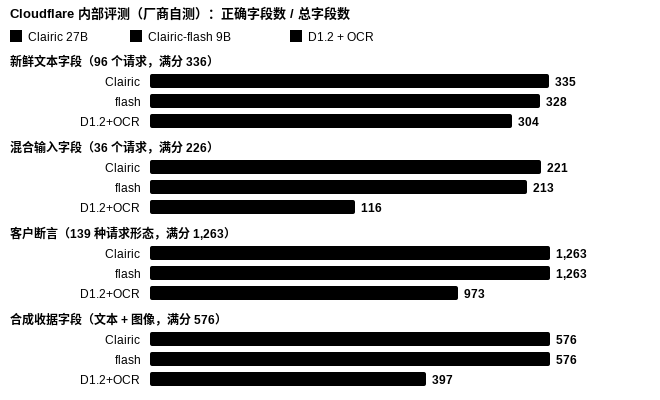
335/336: the only table that separates the field
Fresh text fields is the most informative of the four tables: Clairic 335/336 (one field wrong), flash 328/336 (eight wrong), D1.2 + OCR 304/336, ScaleDown 259/336, the preview 295/336. Its value is not that "335 is high" but that it is the only table where all five parties separate: GA beats the preview by 40 fields, D1.2 + OCR by 31, ScaleDown by 76. Mixed-input fields at 221/226 is the second table that separates: Clairic beats flash by 8 fields and D1.2 + OCR by 105.
The other side of the coin: at 96 requests and 336 fields the sample is small, and one field is 0.3 percentage points — the 7-field gap between 335 and 328 (about 2 percentage points) sits within small-sample noise. The correct statement is "in Cloudflare's own evals, Clairic's text-field correct count is higher than flash and both baselines" — don't write it as "Clairic's extraction accuracy is 99.7%", a wording that implies a public board's methodology where no public board exists.
1,263/1,263 and 576/576: perfect scores that do not separate the two models
On customer assertions and synthetic receipts, both models score full marks at once. A perfect score here is the eval's ceiling, not proof of perfection: those two tables cannot measure any difference between Clairic and Clairic-flash — the 27B flagship ties the 9B cheaper tier on assertions and on receipts. The right reaction to a perfect score is not "Clairic is perfect" but "this table has topped out": to tell the two models apart, look at the text fields (335 vs 328), latency (flash about 2x faster) and price ($0.24 vs $0.10).
The other side of the coin: the perfect scores do say something about Cloudflare's rival baselines — D1.2 + OCR manages 973/1,263 on assertions (about 77%) and ScaleDown 653/1,263 (about 52%), and 397/576 vs 280/576 on receipts. In other words, the relative position inside Cloudflare's own evals is clear — the new models sit above both baselines; what is unclear is whether that relative position holds on a public eval, because no public eval exists.
The rival baselines are pipelines, not like-for-like models
D1.2 + OCR is not one model, it is a pipeline: Liquid AI's D1.2 model with Apple Vision OCR; ScaleDown Extract is an extraction product. Cloudflare compares its end-to-end model against other people's "model + OCR pipeline" and "product" — not a like-for-like comparison. The most suspect number is D1.2 + OCR's 116/226 on mixed-input fields (about half): a pipeline containing OCR losing half its fields on mixed input very likely loses them at the OCR stage rather than the model stage — but the eval does not split the loss, so don't credit all 105 fields to model capability. The correct statement is "higher than the D1.2 + OCR pipeline and ScaleDown Extract in Cloudflare's own evals", not "beats D1.2 / ScaleDown".
"Image errors from 207 to 0": true only inside Cloudflare's own evals
Cloudflare says image errors fell from 207 to 0 on its internal benchmarks — that claim holds only inside its own internal-eval wording, with no independent reproduction and no public benchmark to check it against. It is consistent with the mixed-input improvement from 207 to 221 correct fields (preview to GA), but the "down to 0" wording itself has no published error definition or counting method to verify. Don't write it as "zero image-extraction errors".
AA / LiveBench / LMArena: no scores
Extraction models are not on those LLM boards, and neither Clairic nor Clairic-flash has a score on AA / LiveBench / LMArena — don't write any AA / LiveBench / LMArena score. There is also no public extraction benchmark at all: Cloudflare's own words are "there are no public extraction benchmarks yet". This site's 8-hour tracking loop will watch for the first public extraction benchmark and the first independent reproduction.
FAQ
Is 335/336 a high score?
High inside Cloudflare's own evals: one field wrong, 40 more correct than the preview, 31 more than D1.2 + OCR. But it is a small-sample self-run eval — 96 requests, 336 fields — with no public board to compare against, so don't write it as "extraction accuracy 99.7%".
Does 1,263/1,263 prove Clairic is perfect?
No. Clairic and Clairic-flash score full marks at once, which is exactly what shows the table cannot tell the two models apart — a perfect score is the eval's ceiling, not proof of perfection. To separate the two models, look at the text fields, 335 vs 328, latency and price.
Does "beats D1.2" hold up?
Not without a qualifier. Every number is a Cloudflare self-run eval with no independent reproduction; D1.2 + OCR is a "model + OCR pipeline" and ScaleDown Extract is a product, neither a like-for-like model comparison. The correct statement is "higher than the D1.2 + OCR pipeline and ScaleDown Extract in Cloudflare's own evals".
Does Clairic have an independent score?
No. AA / LiveBench / LMArena have no listing; and there is no public extraction benchmark at all (Cloudflare's own admission). Every benchmark and latency number is vendor-run.
Reference: Cloudflare blog — An updated Clairic and Clairic-flash are now open-weight · explainx.ai — Cloudflare Clairic Open Weights: 27B vs Clairic-Flash 9B · neticslabs — Cloudflare open-weights Clairic extraction models · Cloudflare Clairic topic page (rewritten and organized by ModelBrief; facts per the Cloudflare blog)