 Cloudflare Clairic: The Topic Page
Cloudflare's extraction-model pair Clairic (27B, Qwen3.8-27B backbone) and Clairic-flash (9B, Qwen3.5-9B backbone), released open-weight on November 18, 2026 — first, the positioning: November 18 is not the first time the name appeared. Clairic previewed on October 19; this release graduates from that preview, with a redesigned architecture, a new flash tier and open weights, the Workers AI API and Apache 2.0 open weights live the same day; prices are $0.24/$0.10 per 1M input tokens, both $0.10 on promotion until December 1; but there is no independent score of any kind — every benchmark and latency number is Cloudflare's own, and Cloudflare itself says "there are no public extraction benchmarks yet"; the two perfect scores, 1,263/1,263 and 576/576, are identical for both models and cannot tell Clairic from Clairic-flash apart. This page collects the official specs, the ways to try it, a pricing breakdown and 6 in-depth reviews — with unverified claims clearly marked.
01Key facts
What is confirmed: Clairic and Clairic-flash are Cloudflare's extraction models — they do not write prose, they return typed values against a caller-supplied schema, with confidence scores, character spans and null probabilities; the November 18 release graduates from the October 19 preview with a redesigned architecture, a new flash tier and open weights; API and weights both went live the same day under Apache 2.0; but every benchmark and latency number is vendor-run, with no independent score of any kind.
- Released
- 2026-11-18 (Wednesday, blog published 22:00 UTC): the Cloudflare blog "An updated Clairic and Clairic-flash are now open-weight, from the new Workers AI Superintelligence team" the same day; Workers AI (@cf/cloudflare/clairic, @cf/cloudflare/clairic-flash) and Hugging Face weights live the same day
- Developer
- Cloudflare, the Workers AI superintelligence team — the launch post re-introduces the team as "the frontier AI research team behind Clef, Clairic, and lots more"; Cloudflare calls itself a "neolab"
- Positioning
- Extraction models, Cloudflare's "System One" class: given a state (text/JSON, optionally with images or PDFs) plus a schema of typed fields, they return typed values — text, number, date, time, datetime, duration, boolean, enum, object, list, plus three special field types, compute, estimate, forecast; each value carries a confidence score, character spans and a null probability; they do not write prose
- Clairic
- 27B multimodal, base model Qwen3.8-27B; text + image + PDF input (up to 4 images/PDF pages per request); context window 65,536 tokens (Workers AI docs wording)
- Clairic-flash
- 9B multimodal, base model Qwen3.5-9B; same inputs and field types as Clairic; context window undisclosed — this round verified only Clairic's 65,536 on the docs page; do not paste that number onto flash
- Architecture redesign
- Redesigned after the preview: ordinary text/number fields now use parallel slot autoregressive generation instead of a single forward pass; special heads trained for estimates, forecasts, durations, calculated dates and explicit arithmetic; the typed API (confidence, spans, probabilities) is unchanged
- New PDF support
- The GA release adds PDF input: up to 4 images/PDF pages per request; embedded inputs max 4 MiB each / 8 MiB combined; remote media URLs are not accepted
- Benchmarks
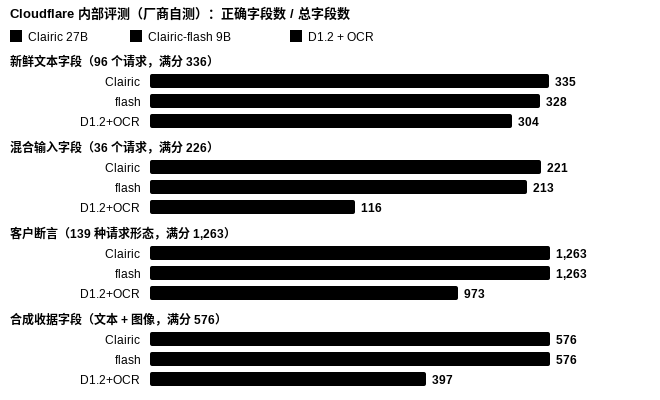
- Four internal evals, all Cloudflare self-reported: fresh text fields 335/336, mixed-input fields 221/226, tracked customer assertions 1,263/1,263, synthetic receipt fields 576/576 (Clairic; flash scores 328/336, 213/226, 1,263/1,263, 576/576); no independent score of any kind, and Cloudflare itself says "there are no public extraction benchmarks yet"
- Latency
- Six workloads, p50/p95, all Cloudflare self-measured (full HTTP response time from Cloudflare's own server): Clairic p50 358–691 ms, flash p50 155–393 ms, flash roughly 2x faster; sub-second on every published set (see section 12)
- Price
- Clairic $0.24 / Clairic-flash $0.10 per 1M input tokens; input tokens only, Cloudflare absorbs the output-token cost; promotional pricing until December 1, 2026: both models $0.10, Clairic resumes at $0.24 on Dec 1 (the Workers AI docs page reads "58% off until Dec 1")
- API
- Workers AI, model IDs @cf/cloudflare/clairic / @cf/cloudflare/clairic-flash; Worker binding (env.AI.run), REST API, AI Gateway; the API schema is unchanged from the preview endpoint
- Weights / licence
- Open weights on Hugging Face: Cloudflare/clairic, Cloudflare/clairic-flash, PyTorch + Transformers, with local Python request helpers and xgrammar schema constraints, including clair_head.safetensors typed-output components; licence Apache 2.0 (LICENSE file and model card agree on both repos); no quantized builds (no GGUF/AWQ builds listed)
- Access
- Workers AI and Hugging Face weights; no other third-party host listing found this round (no OpenRouter / fal / Together listing)
- Independent scores
- No AA / LiveBench / LMArena entry (extraction models are not on those LLM boards); and no public extraction benchmark exists to check against — Cloudflare's own words are "there are no public extraction benchmarks yet"
- Preview endpoint migration
- The preview endpoint @cf/cloudflare/clairic automatically upgrades in place to the new 27B model for existing users (no code change needed); the old 9B model moved to the @cf/cloudflare/clairic-flash endpoint
- Early traction
- Hugging Face as of Nov 23, 2026: the clairic repo 727 downloads / 282 likes (repo created 2026-10-16, the count includes the preview period); clairic-flash 638 downloads / 78 likes (repo created 2026-11-12) — five days in, traction is still low
- Free tier
- Not verified: this round's research did not confirm whether Workers AI offers a free tier for Clairic — do not claim one exists
- Search interest
- Google Autocomplete is thin but non-zero: in English "clairic extraction model" suggests (5th), "cloudflare clairic" only echoes itself; in Chinese "clairic cloudflare" suggests (3rd); vs/price/api/flash and 评测/价格/是什么 suffixes show no suggestions in either locale; one Google Trends attempt returned HTTP 411, no data obtained
- Media coverage
- The Cloudflare blog (Nov 18) + explainx.ai (Nov 19, the deepest piece) + the vitejs.cn full Chinese translation (Nov 19) + neticslabs (Nov 20–21) + inite.ai (Nov 20); no TechCrunch / The Verge / Reuters / Bloomberg-tier English coverage, no Jiqizhixin / Xinzhiyuan / QbitAI / ITHome-tier Chinese coverage
02Quick comparison
Clairic is the 27B flagship, flash the 9B cheaper tier: the price differs 2.4x, latency about 2x; but across the four internal evals, the two models score identically on 1,263/1,263 and 576/576 — those two evals cannot tell them apart at all, and only the text-field table (335 vs 328) and latency separate them; D1.2 + OCR and ScaleDown Extract are Cloudflare's own baselines, not like-for-like model comparisons.
| Model | Parameters & backbone | Context | Internal evals (vendor-run) | Price (per 1M input tokens) |
|---|---|---|---|---|
| Cloudflare Clairic | 27B multimodal, Qwen3.8-27B | 65,536 tokens | 335/336 · 221/226 · 1,263/1,263 · 576/576 | $0.24 ($0.10 until Dec 1) |
| Cloudflare Clairic-flash | 9B multimodal, Qwen3.5-9B | Undisclosed | 328/336 · 213/226 · 1,263/1,263 · 576/576 | $0.10 |
| Clairic preview (Oct 19) | 9B (the version at the time) | Not in this round's research | 295/336 · 207/226 · 1,033/1,263 · 369/576 | Not in this round's research |
| Liquid D1.2 + Apple Vision OCR | Pipeline baseline (not one model) | Not in this round's research | 304/336 · 116/226 · 973/1,263 · 397/576 | Not in this round's research |
| ScaleDown Extract | Extraction-product baseline | Not in this round's research | 259/336 · 156/226 · 653/1,263 · 280/576 | Not in this round's research |
The four evals, in order: fresh text fields (96 requests), mixed-input fields (36 requests), tracked customer assertions (139 request shapes), synthetic receipt fields; all Cloudflare's own evals, with D1.2 pipelined with Apple Vision OCR and ScaleDown Extract as the rival baselines — pipeline vs model, not like-for-like. Full breakdown in section 12.
03Charts
Correct fields across the four internal evals for Clairic, Clairic-flash and D1.2 + OCR: the first two evals still show a gap, the last two are perfect for both new models — the further down the chart, the more the two coloured bars are the same length, and that is the point: perfect scores do not separate the two models.
04Top 3 reads
Short on time? Start with these three: what an extraction model actually is, what the four internal eval tables can and cannot prove, and how input-only billing works — all three take apart the line "open weights, $0.10, perfect scores".
05Timeline
The name appeared on October 19, but that was an API-only 9B preview with weights promised as "soon"; November 18 is the real release: a redesigned architecture, a new 27B flagship and flash tier, and open weights. Don't merge the two into one event.
- Oct 19, 2026
Clairic preview launches: the Cloudflare blog "Introducing Clairic, a new System One class of extraction models" goes live; the 9B version at the time, hosted on Workers AI (@cf/cloudflare/clairic), with open weights promised as "soon".
- Nov 18, 2026
Updated Clairic and Clairic-flash go open-weight: the Cloudflare blog "An updated Clairic and Clairic-flash are now open-weight, from the new Workers AI Superintelligence team" (published 22:00 UTC, updated Nov 19) goes live; both Workers AI endpoints and both Hugging Face weight repos (Cloudflare/clairic, Cloudflare/clairic-flash) go live the same day; the preview endpoint upgrades automatically to the new 27B model, and the 9B model moves to the -flash endpoint.
- Nov 19, 2026
explainx.ai publishes its report (a 27B-vs-9B comparison table and a price table, with an explicit "treat those tables as vendor evals" caveat); vitejs.cn publishes a full Chinese translation of the Cloudflare blog (eval tables, latency framing and the Dec 1 promotion).
- Nov 20–21, 2026
inite.ai (Nov 20) and neticslabs (Nov 20–21) publish reports, both explicitly noting that Cloudflare itself says no public extraction benchmark exists yet and the numbers are its own.
- Nov 22, 2026
First independent hands-on test appears: flavicopes publishes a hands-on test: asked the standard price from a six-sentence release note, the 27B Clairic answers $0.10 (correct: $0.24) at only 50.2% confidence with no character-span grounding, though valid reads true; the 9B flash answers the same question correctly (73.9%); trimmed to a single field and a single sentence, the 27B model answers correctly at 98.6% confidence; the pricing table in the screenshot and the PDF gets all three values right (flash $0.10, standard $0.24, promotion ending Dec 1, 2026). Limits: one author, one question set, six short sentences — not a public-benchmark reproduction.
- Nov 23, 2026
This site's research: Google Autocomplete shows "clairic extraction model" 5th in English and "clairic cloudflare" 3rd in Chinese; one Google Trends attempt returns HTTP 411, no data obtained; no tier-1 English or Chinese coverage found.
- Nov 24, 2026
This site's topic page goes live (this page). As of publication: Clairic-flash's context window is undisclosed; the free tier is unverified; no quantized weights; the Dec 1 promotion cliff is pending a tracking recheck.
06Official specs
As published (Cloudflare blog, Nov 18, 2026; the Clairic / Clairic-flash model cards; the Workers AI docs page). Undisclosed items are written as "undisclosed", not guessed; items marked "this site's estimate" are computed by this site from published numbers, not official figures.
- Status
- Released (open-weight release, 2026-11-18; API and weights live the same day; Oct 19 was the preview)
- Model ID
- @cf/cloudflare/clairic / @cf/cloudflare/clairic-flash (Workers AI)
- Positioning
- Extraction models (Cloudflare's "System One" class): return typed values against a schema, no prose; each value carries a confidence score, character spans and a null probability
- Clairic parameters
- 27B multimodal, base Qwen3.8-27B; text + image + PDF input
- Clairic-flash parameters
- 9B multimodal, base Qwen3.5-9B; same inputs and field types as Clairic
- Context
- Clairic 65,536 tokens (Workers AI docs wording); Clairic-flash undisclosed
- Input
- Text, images, PDFs; up to 4 images/PDF pages per request; embedded inputs max 4 MiB each / 8 MiB combined; remote media URLs not accepted
- Field types
- Text, number, date, time, datetime, duration, boolean, enum, object, list, plus the special types compute, estimate, forecast
- Architecture
- Redesigned after the preview: parallel slot autoregressive generation for ordinary text/number fields; special heads trained for estimates, forecasts, durations, calculated dates and explicit arithmetic; the typed API (confidence, spans, probabilities) is unchanged
- API
- Workers AI: Worker binding (env.AI.run), REST API, AI Gateway; the API schema is unchanged from the preview endpoint
- Weights
- Open weights on Hugging Face: Cloudflare/clairic, Cloudflare/clairic-flash, PyTorch + Transformers, with local Python request helpers and xgrammar schema constraints, including clair_head.safetensors typed-output components; no quantized builds (no GGUF/AWQ builds listed)
- Licence
- Apache 2.0 (the LICENSE file and model card agree on both repos); note: the weights are open, the hosted service itself is Cloudflare's
- Price
- Clairic $0.24 / Clairic-flash $0.10 per 1M input tokens; input tokens only; promotional pricing until Dec 1, 2026: both models $0.10, Clairic resumes at $0.24 on Dec 1
- Benchmarks
- Four internal evals, all Cloudflare self-reported (fresh text fields 335/336, mixed-input fields 221/226, customer assertions 1,263/1,263, synthetic receipt fields 576/576); no independent score of any kind; Cloudflare's own words are "there are no public extraction benchmarks yet"
- Latency
- Six workloads, p50/p95, all Cloudflare self-measured (full HTTP response time on Cloudflare's own server): Clairic p50 358–691 ms, flash p50 155–393 ms; sub-second throughout
- Free tier
- Not verified: this round's research did not confirm whether Workers AI offers a free tier for Clairic
- Access
- Workers AI and Hugging Face weights; no other third-party host listing found this round
- Family
- Cloudflare's System One family: Clef (the team's other model, no topic yet) and Clairic; the team calls itself the Workers AI superintelligence team, Cloudflare calls itself a "neolab"
07How to try it: three routes
Both models opened two routes on launch day — the Workers AI API and the Hugging Face weights — with AI Gateway for production use that needs observability. There is no chat interface: an extraction model does not write text, so trying it means handing it a document and a schema and reading back the typed values.
1Workers AI API (main route)
Call it on Workers AI, model IDs @cf/cloudflare/clairic / @cf/cloudflare/clairic-flash; bind it in a Worker with env.AI.run or use the REST API. A request carries one state (text/JSON, optionally with images or PDFs) plus a schema of typed fields, and one call returns a typed value per field (with confidence, character spans and null probabilities). Billed per input token: Clairic $0.24, flash $0.10 per 1M tokens, both $0.10 until Dec 1; input tokens only. See our comparisons and deployment article.
2Hugging Face weights (self-hosting route)
Apache 2.0 weights are public on Hugging Face: Cloudflare/clairic, Cloudflare/clairic-flash, usable with PyTorch + Transformers, with local Python request helpers and xgrammar schema constraints. Note this is datacenter-class self-hosting: 27B/9B multimodal weights with no quantized builds — no laptop run. See our comparisons and deployment article.
3AI Gateway (production route)
Workers AI's AI Gateway can sit in front of Clairic calls for caching, rate limiting and usage observability — extraction workloads are usually batch document processing, where the gateway's cache saves input-token spend on repeated documents directly. The free tier is unverified — go by what Cloudflare's official pages actually say about gateway and Workers AI free allowances. See our comparisons and deployment article.
Also: preview users, note that the @cf/cloudflare/clairic endpoint has automatically upgraded to the new 27B model, and the 9B model now lives on the @cf/cloudflare/clairic-flash endpoint; and don't treat flash's context window as 65,536 — it is undisclosed.
08Pricing
There is one price line and two numbers: Clairic $0.24 per 1M input tokens, Clairic-flash $0.10 — and because an extraction model only returns typed values, its output is a few numbers plus confidence scores, Cloudflare charges input tokens only and absorbs the output cost. Prices are the Nov 18, 2026 launch figures (the blog and the Workers AI docs page agree); the checkout page price is authoritative; and the Dec 1 promotion end is a cliff: both models are $0.10 today, Clairic resumes at $0.24 on Dec 1.
| Model | Price | Basis |
|---|---|---|
| Clairic | $0.24 / per 1M input tokens | $0.10 promotional price until Dec 1 (58% off, Workers AI docs wording); input tokens only |
| Clairic-flash | $0.10 / per 1M input tokens | Promotion and list price are the same; input tokens only |
Price it per document
An extraction model's bill is priced per document, not per chat turn. Assume a receipt or invoice runs about 1,000 tokens: Clairic costs $0.00024 per document, 10,000 documents $2.40; flash costs $0.0001 per document, 10,000 documents $1.00; during the promotion Clairic is also $0.0001 per document, 10,000 documents $1.00. A 10,000-token commercial lease: $0.0024 per document on Clairic, $0.001 on flash. One call at Clairic's full 65,536-token context: about $0.0157 (about $0.0066 during the promotion, computed by this site from 65,536 tokens).
Why there is no output price
An extraction model writes no prose — its output is a few typed values plus confidence scores, character spans and null probabilities, so there is no "how many tokens were generated" to bill for, and Cloudflare charges input tokens only, saying it absorbs the output cost (Cloudflare's "System One pricing principles"). Comparing its per-million-token sticker price directly against a chat model's input-plus-output price list will mislead: a chat model's bill is usually dominated by output, while an extraction model has no output line at all. The right unit of comparison is the total cost of extracting one document, not the per-million-token sticker.
The Dec 1 cliff: budget at $0.24
The promotion ends December 1, 2026: Clairic goes from $0.10 back to $0.24, a 2.4x rise; flash stays at $0.10. At publication (Nov 24) only 7 days remain — any long-term Clairic budget built on $0.10 breaks on Dec 1. This site's 8-hour tracking loop will recheck the Workers AI pricing page on and after Dec 1; until then, budget at $0.24 and treat $0.10 as a time-limited offer.
Preview endpoint migration: no code change, but the bill changes
The preview endpoint @cf/cloudflare/clairic automatically upgraded from the 9B model to the new 27B model: existing users get the new model with no code change, but billing moves from the 9B tier to the 27B tier — still $0.10 during the promotion, $0.24 after Dec 1. The old 9B model moved to the @cf/cloudflare/clairic-flash endpoint; to keep the 9B price and latency, switch to the -flash endpoint.
Free tier and discounts: the free tier is unverified
This round's research did not confirm whether Workers AI offers a free tier for Clairic. Don't write "free trial" or "free tier" — there are no numbers behind them. The only confirmed discount is the $0.10 promotion on both models until Dec 1. No third-party host has listed the models either, so there is no second quote to compare against.
Official pages: Cloudflare blog — An updated Clairic and Clairic-flash are now open-weight (price and API wording) · Workers AI docs — clairic model page (65,536 tokens, $0.10 promotion until Dec 1) · Hugging Face — Cloudflare/clairic (model card)
09First hands-on reviews
All from the first wave, Nov 18–22, including the first independent hands-on test: the source of the facts is the Cloudflare blog, and third parties restate, cross-check and flag the wording — the most valuable flag is the one explainx.ai and neticslabs both write: "treat those tables as vendor evals". Every entry carries a verdict badge; "Read on this site" opens our rewritten deep-dive article, with the original source at the end.
Cloudflare blog: the launch notice and the source of every core fact
Verdict: Launch facts confirmed; the benchmark and latency tables are official wording, but all self-measuredSource: Cloudflare blog, Nov 18, 2026 Original →
The blog "An updated Clairic and Clairic-flash are now open-weight, from the new Workers AI Superintelligence team" is the launch-day official notice: the Qwen3.8-27B / Qwen3.5-9B backbones, parallel slot autoregressive generation and special heads, the four internal eval tables, the six-workload p50/p95 latency table, the prices ($0.24/$0.10, both $0.10 until Dec 1), the API model IDs, the Apache 2.0 weights and the preview endpoint migration all come from here. The blog itself says "there are no public extraction benchmarks yet" and asks readers to take the eval numbers as "directional guidance".
Read on this site → (original ModelBrief rewrite)
explainx.ai: the deepest piece, and the source for the 27B-vs-9B table
Verdict: The deepest English analysis; the vendor-reported nature of the eval tables is explicitly flaggedSource: explainx.ai, Nov 19, 2026 Original →
explainx.ai's piece is the deepest so far: the 27B-vs-9B comparison table, the price table and the eval tables are all covered, with an explicit note to "treat those tables as vendor evals".
Read on this site → (original ModelBrief rewrite)
neticslabs: restates the "no public extraction benchmark" caveat
Verdict: A second confirmation of the launch facts; the wording caveat is stated most plainly hereSource: neticslabs, Nov 20–21, 2026 Original →
neticslabs' release report states the limitation Cloudflare itself admits: no public extraction benchmark exists yet, and the numbers are its own. Its value is restating the blog's own caveat once more — read that line before reading the eval tables.
Read on this site → (original ModelBrief rewrite)
inite.ai: release report
Verdict: A third confirmation of the launch facts; no new numbersSource: inite.ai, Nov 20, 2026 Original →
inite.ai's piece is a straight release report: sizes, a price table and the eval tables, with the same vendor self-reported caveat, and no new numbers or independent testing. Its value is cross-confirmation — four sources agree on the core facts (date, sizes, prices, eval scores).
Read on this site → (original ModelBrief rewrite)
vitejs.cn: the only Chinese coverage (a full translation of the blog)
Verdict: A full Chinese translation, not original reporting; the Chinese pages' source of factsSource: vitejs.cn, Nov 19, 2026 Original →
vitejs.cn's piece is a full Chinese translation of the Cloudflare blog, including the eval tables, the latency framing and the Dec 1 promotion — the only Chinese coverage found, but it is a translation, not original reporting. The Chinese pages have no Chinese press to cite for now; the 8-hour tracking loop will watch for the first Chinese tier-1 pickup.
Read on this site → (original ModelBrief rewrite)
Hugging Face model cards: the final source for the licence and technical detail
Verdict: Apache 2.0 confirmed; backbones, input limits and local-inference detail come from hereSource: Hugging Face, Nov 18, 2026 clairic model card → · clairic-flash model card →
The model cards are the final source for technical detail: the Qwen3.8-27B / Qwen3.5-9B backbones, the Apache 2.0 licence, PyTorch + Transformers, local Python request helpers, xgrammar schema constraints, the clair_head.safetensors typed-output components, and the 4-image/page and 4 MiB / 8 MiB input limits. The HF API as of Nov 23: clairic 727 downloads / 282 likes, flash 638 downloads / 78 likes.
Read on this site → (original ModelBrief rewrite)
Sanity glossary: preview-era content, now stale
Verdict: Covers the preview only; its open-weights wording is outdated — don't use it as launch evidenceSource: Sanity glossary, Oct 22, 2026 Original →
Sanity's "What is Clairic?" glossary page, written Oct 22, covers only the preview model: it says open weights are intended to release "soon", which was already outdated by Nov 18. It works as a category explainer, but not as launch evidence; this page does not cite its launch wording.
Chinese and tier-1 coverage: one translation only
Verdict: No original tier-1 English or Chinese coverage foundSource: This site's search, Nov 23, 2026
This site's Nov 23, 2026 search found no TechCrunch / The Verge / Reuters / Bloomberg / Wired / Ars Technica English coverage, and no Jiqizhixin / Xinzhiyuan / QbitAI / ITHome original Chinese coverage — the only Chinese coverage is vitejs.cn's full translation. The Chinese pages have no Chinese press to cite for now; the 8-hour tracking loop will watch for the first tier-1 Chinese pickup.
flaviocopes: the first independent hands-on test — confidence and spans are the reliability signal
Verdict: First independent hands-on test; one author, one question set, six short sentences — not a public-benchmark reproductionSource: flaviocopes, Nov 22, 2026 Original →
The author put both models through a six-sentence release note and asked for the standard price: the 27B Clairic answered $0.10 (the correct figure is $0.24) with only 50.2% confidence and no character-span grounding, though valid still read true; the 9B flash answered the same question correctly, at 73.9% confidence. Trimmed to a single field and a single sentence, the 27B model answered correctly at 98.6% confidence. The pricing table in both the screenshot and the PDF came back with all three values right: flash $0.10, standard $0.24, promotion ending Dec 1, 2026. The author's takeaway is that confidence scores and character spans are the key signals for whether an answer can be trusted — and on this question the smaller model beat the larger one. The limits travel with the result: one author, one question set, six short sentences — not a reproduction of any public benchmark. It speaks directly to this site's watch item on an independent check of the 1,263/1,263 and 576/576 perfect scores, but a single hands-on probe is not a verdict on those two eval tables.
10Articles: our deep dives
The six articles below are original ModelBrief rewrites and reorganization — restructured with added conclusions and buying advice, with facts and numbers checked against the original sources. Read them on this site; each ends with its original source.
11Related topics
Topic pages for the other LLMs on this site. Baseten Bison-1 is the site's other "System One" niche-model topic (a decision model — same family of "no prose, only structured results" as extraction models) and the most useful comparison; Gemini Decision 1 is the site's other queued decision-model topic and is not live yet, so it is not linked here; the two pages will cross-link once it launches.
 Baseten Bison-1Released Nov 20, 2026 · Baseten's decision model, Gemma 4 backbone, AA Decision Index 76, #1, $0.10 per 1M input tokens, open weights. The topic page covers official specs, pricing, benchmark analysis and 6 deep dives.
USA · LLM · GA · Nov 18, 2026
 Gemini 4 NeonReleased Nov 18, 2026 · Google's Gemini 4 Neon, AA score 61, third place, $3/$15 per million tokens, 1M context. The topic page covers official specs, pricing, benchmark analysis and 6 deep dives.
USA · LLM · GA · Nov 17, 2026
 GPT-6.2 SolReleased Nov 17, 2026 · OpenAI's GPT-6.2 Sol, AA score 57, #11, $2/$10 per million tokens unchanged, 1.05M context. The topic page covers official specs, pricing, a tier guide and 6 in-depth reviews.
USA · LLM · GA · Nov 17, 2026
 MAI Code 2Released Nov 17, 2026 · Microsoft's in-house coding flagship, launched at Ignite; Microsoft reports a four-benchmark average at 98% of GPT-6.1 Sol at about 40% of the cost, live in GitHub Copilot.
USA · LLM · Open Weights · Released Nov 20, 2026
 Inkling 2 MiniReleased Nov 20, 2026 · Thinking Machines Lab's open-weight recurrent model, 26.4B parameters with only 3.4B active per token, AA score 20.1, API $0.15/$0.50 per million tokens. The topic page covers official specs, pricing, benchmarks and 6 deep dives.
China · LLM · GA · Nov 16, 2026
 Qwen4-MaxGenerally available Nov 16, 2026 · Pay-as-you-go API $1.50/$4.50, official Work360 52.69, 2.4T architecture; plus Token Plan pricing and 18 in-depth reviews and comparisons.
China · LLM · Open Weights · Weights Open Nov 5, 2026
 Kimi K3.1 ProWeights opened Nov 5, 2026 · Moonshot AI's flagship open-weight model, 2.8T/104B MoE, 1M context; AA v5.0.2 47, the strongest open model. The topic page covers official specs, pricing, benchmark analysis and 8 in-depth reviews.
China · LLM · GA · Nov 16, 2026
 Sage S2.1 FlashReleased Nov 16, 2026 · Shanghai AI Lab's 320B science-agent model, 18B active, MLE-bench Lite 90.3 (vendor-reported), MIT open weights. The topic page covers official specs, pricing, benchmark analysis and 6 in-depth reviews.
USA · LLM · GA · Nov 16, 2026
 Liquid d1.2Released Nov 16, 2026 · Liquid AI's omnimodal decision-model pair, d1.2-ultra #2 on the AA Decision Index at 75, audio input and five new tasks, $0.02/$0.042 per 1M input tokens with output free. The topic page covers official specs, pricing, benchmark analysis and 6 in-depth reviews.
LLM · Open Weights · Nov 13, 2026
 Maxwell V1 FlashWeights public Nov 13, 2026 · Maxwell Team's 35B/3B-active open MoE, 256K context, Apache 2.0; vendor-reported table leads same-scale Qwen3.6 with no independent score yet. The topic page covers official specs, pricing, benchmark analysis and 8 in-depth reviews.
ModelBrief homeAll topicsBack to the home page: browse all model topics by release date — LLMs, image models and video models.
China · LLM · GA · Nov 23, 2026
 GLM-5.4Released Nov 23, 2026 · Zhipu's flagship coding model, vision, 1M context, Coding Plan $18/$80/$168, KingBench 4 at 55.3% (one private test). The topic page covers official specs, pricing, benchmark analysis and 6 in-depth reviews.
USA · Image · GA · Nov 19, 2026
 Ideogram 4.6Released Nov 19, 2026 · Ideogram's native 4K image editing model, #1 on Rapidata's multi-step edit board at 1,892, API $0.008–$0.60 per image. The topic page covers official specs, pricing, benchmarks and 7 in-depth reviews.
China · Image Model · Open Weights · Released Nov 24, 2026
 SenseNova U1.6Released Nov 24, 2026 · SenseTime's 8B unified image model with native self-correction, UltraTextBench 86.04 to 92.28 (vendor-reported), Apache 2.0 open weights. The topic page covers official specs, pricing, benchmarks and 7 in-depth reviews.
South Korea · LLM · Preview · Released Nov 23, 2026
 Solar Mini 4.5 PreviewReleased Nov 23, 2026 · Upstage's preview agentic light model, 35B/3B MoE, 512K context, $0.01 per 1M tokens at 90% off, GA Dec 3; 4 of 5 in-house tests won, all vendor-reported. The topic page covers official specs, pricing, benchmarks and 6 in-depth reviews.
China · LLM · Medical Model · Released Nov 23, 2026
 LingSanteReleased Nov 23, 2026 · Ant Group's medical model family: 560B flash and 124B air-VL under MIT open weights, HealthBench Professional 65.72 (vendor-reported); not a medical device. The topic page covers official specs, benchmarks and 6 in-depth reviews.
China · Video Understanding · Open Weights · Released Nov 17, 2026
 WeMM-VideoWeights public Nov 17, 2026 · Tencent's omni-modal video-understanding family in 2B/4B/9B/35B-A3B, Apache 2.0 open weights; 9B beats a 30B baseline (vendor-reported), no API or price. The topic page covers official specs, benchmarks and 6 in-depth reviews.
China · LLM · Vision-Language Model · Released Nov 23, 2026
 Ling-3.2-airReleased Nov 23, 2026 · Ant Group's general-purpose VLM, 124B/5.5B hybrid-linear MoE, MIT open weights, AutomationBench-AA 61.0, AA Index 23.4; no hosted API. The topic page covers official specs, benchmarks and 6 in-depth reviews.
More indexes: All models · All Cloudflare models · All LLMs
12Benchmarks: mostly vendor-run; perfect scores do not separate the two models
Clairic's benchmark story is one set of numbers, and all of it vendor-run: four internal eval tables plus a six-workload latency table. Cloudflare itself says "there are no public extraction benchmarks yet" and asks readers to take the evals as "directional guidance". The numbers first, then their limits.
Four internal evals (Cloudflare blog, Nov 18, 2026, all self-reported)
| Eval | Preview | Clairic | Clairic-flash | D1.2 + OCR | ScaleDown |
|---|---|---|---|---|---|
| Fresh text fields (96 requests, max 336) | 295 | 335 | 328 | 304 | 259 |
| Mixed-input fields (36 requests, max 226) | 207 | 221 | 213 | 116 | 156 |
| Tracked customer assertions (139 request shapes, max 1,263) | 1,033 | 1,263 | 1,263 | 973 | 653 |
| Synthetic receipt fields (text + images, max 576) | 369 | 576 | 576 | 397 | 280 |
Numbers are correct fields / total fields; all from the Cloudflare blog, with no independent reproduction. Rival baselines: Liquid AI's D1.2 pipelined with Apple Vision OCR, and ScaleDown's Extract product.
Perfect scores do not separate the two models
Customer assertions 1,263/1,263, synthetic receipts 576/576 — both models score identically on both. A perfect score here is the eval's ceiling, not proof of perfection: those two tables cannot measure any difference between Clairic and Clairic-flash. Only two evals separate them: fresh text fields, 335 vs 328 (7 fields, about 2 percentage points), and mixed-input fields, 221 vs 213 (8 fields). What really separates the two models is latency (flash about 2x faster, see below) and price ($0.24 vs $0.10). Don't write "1,263/1,263 proves Clairic is perfect" — both models scoring full marks at once is exactly what shows the table cannot tell them apart.
The rival baselines are pipelines, not like-for-like models
D1.2 + OCR is not one model, it is a pipeline: Liquid AI's D1.2 model with Apple Vision OCR; ScaleDown Extract is an extraction product. Cloudflare compares its end-to-end model against other people's "model + OCR pipeline" and "product" — not a like-for-like comparison. D1.2 + OCR's 116/226 on mixed-input fields (about half) is very likely lost at the OCR stage rather than the model stage. The correct statement is "higher than the D1.2 + OCR pipeline and ScaleDown Extract in Cloudflare's own evals", not "Clairic beats D1.2 / ScaleDown".
"Image errors from 207 to 0": true only inside Cloudflare's own evals
Cloudflare says image errors fell from 207 to 0 on its internal benchmarks — that claim holds only inside its own internal-eval wording, with no independent reproduction and no public benchmark to check it against. It is consistent with the mixed-input improvement from 207 to 221 correct fields (preview to GA), but the "down to 0" wording itself has no published error definition or counting method to verify.
Latency: six workloads, p50/p95 (Cloudflare self-measured)
| Workload | Clairic p50 / p95 | Clairic-flash p50 / p95 |
|---|---|---|
| Fresh text fields (96) | 358 / 736 ms | 155 / 328 ms |
| Fresh image fields (48) | 453 / 976 ms | 305 / 605 ms |
| Commercial leases (180) | 691 / 803 ms | 379 / 519 ms |
| Loan pricing (600) | 395 / 407 ms | 188 / 192 ms |
| Traffic forecasting (114) | 532 / 585 ms | 243 / 261 ms |
| Expense audit, development (60) | 632 / 742 ms | 393 / 512 ms |
All six p50 and p95 figures sit under 1 second (the highest is image fields on Clairic at p95 976 ms, still under a second); flash's p50 runs about half of Clairic's (155 vs 358 ms, 188 vs 395 ms), about 2x faster. The methodology: full HTTP response time on Cloudflare's own server, all fields in the request — vendor-measured, not third-party measured. Full breakdown in our latency article.
Don't count sibling model Clef's board scores as Clairic's
AIMultiple's System One Index (78 decision models) updated on Nov 26 lists Cloudflare models: Clef at a composite 50.88, Clef Flash at 43.24 — but those belong to a different model from the same team. Clef is a decision model (pick among given options, return probabilities); Clairic is an extraction model (return typed values against a schema). Similar names, different jobs, and the board tests classification, bias and browser automation, not extraction. So Clef's scores are not Clairic's scores, and Clairic still has no independent score of any kind. Cloudflare's "there are no public extraction benchmarks yet" still stands.
Full tally: our benchmarks article →
13Comparisons
vs the preview (Oct 19 → Nov 18: 295 to 335/336)
| Dimension | Preview (Oct 19, 2026) | GA Clairic (Nov 18, 2026) |
|---|---|---|
| Parameters | 9B (the version at the time) | 27B, Qwen3.8-27B backbone |
| Architecture | Single forward pass (old architecture) | Parallel slot autoregressive generation + special heads |
| Fresh text fields (/336) | 295 | 335 |
| Mixed-input fields (/226) | 207 | 221 |
| Customer assertions (/1,263) | 1,033 | 1,263 |
| Synthetic receipt fields (/576) | 369 | 576 |
| PDF input | Not mentioned | New (up to 4 pages per request) |
| Weights | Promised "soon", not open | Apache 2.0, open |
| Cheaper tier | None | New Clairic-flash 9B |
All of the above progress comes from Cloudflare's own evals, with no independent reproduction; "image errors from 207 to 0" holds only inside Cloudflare's own eval wording. See our comparisons and deployment article.
vs D1.2 + OCR (the pipeline baseline in Cloudflare's own evals)
Fresh text fields 335 vs 304 (Clairic ahead by 31 fields), mixed-input fields 221 vs 116 (ahead by 105 fields, nearly double), customer assertions 1,263 vs 973, synthetic receipts 576 vs 397. The widest gap is mixed-input fields — D1.2 + OCR manages only 116/226, about half; but the baseline is a "model + OCR pipeline", and the eval does not split where the loss sits (the OCR stage or the model stage), so don't credit all 105 fields to model capability. The correct statement is "higher than the D1.2 + OCR pipeline in Cloudflare's own evals", not "beats D1.2". See our comparisons and deployment article.
vs ScaleDown Extract (the product baseline in Cloudflare's own evals)
Clairic leads on all four evals: 335 vs 259, 221 vs 156, 1,263 vs 653, 576 vs 280; the widest gap is customer assertions (1,263 vs 653, nearly double). But ScaleDown Extract is an extraction product, not a single model — its eval conditions (schema wording, field definitions, whether it was the same run) were not published, so this comparison reads as "relative position inside Cloudflare's own evals", not as a verdict on ScaleDown Extract's capability. See our comparisons and deployment article.
vs a general LLM + parser (the most common alternative)
The standard approach without an extraction model is: a general LLM generates JSON, then a parser validates the format, fills defaults and fixes errors. An extraction model folds those three steps into the model: the output is typed values by construction (with confidence, spans and null probabilities), no parser safety net needed; special heads handle estimates, forecasts and arithmetic; parallel slot generation emits many fields at once. But there are no numbers for this comparison: Cloudflare has not benchmarked Clairic against any general LLM, and this page invents no "how much more accurate than a general LLM" claim. Selection advice: fixed fields, batch processing and a need for confidence scores and null probabilities suit an extraction model; open-ended fields and anything that needs reasoning and writing belongs on a general LLM. See our comparisons and deployment article.
14What's missing (as of Nov 23)
- Any independent score: no AA / LiveBench / LMArena listing; no public extraction benchmark (Cloudflare's own admission)
- An independent reproduction of the four internal eval tables and the six latency figures: so far only Cloudflare's own wording; the first single-author, single-question hands-on test arrived Nov 22 (see section 09), not a public-benchmark reproduction
- Clairic-flash's context window: undisclosed (only Clairic's 65,536 was verified)
- A free tier: whether Workers AI offers one for Clairic is unverified
- Quantized weights (GGUF/AWQ and the like): not listed at launch; HF has full-precision weights only
- A post-Dec 1 price recheck: whether Clairic resumes at $0.24 on schedule, pending a recheck of the Workers AI pricing page on and after Dec 1
- Third-party hosting: no listing beyond Workers AI found this round (no OpenRouter / fal / Together)
- Tier-1 English coverage: no TechCrunch / The Verge / Reuters / Bloomberg / Wired / Ars Technica piece found
- Tier-1 Chinese coverage and hands-on tests: no Jiqizhixin / Xinzhiyuan / QbitAI / ITHome piece found; the only Chinese coverage is vitejs.cn's full translation
- HF download growth: only 727 / 638 downloads five days after launch (including the preview period), traction still low
- Stale Workers AI docs copy: the model page still reads "in preview", at odds with the Nov 18 GA release
- A topic for Clef, the team's sibling model: not yet evaluated for a topic
- The numbers comparison with Gemini Decision 1: waits for that topic page to go live
15Rumor check
Most confusion about Clairic comes from seven places: the perfect scores, the rival baselines, the first appearance, local runs, the free tier, the word "open source" and flash's context window — clarified one by one below.
Not true "1,263/1,263 proves Clairic is perfect"
Both models score full marks at once: Clairic and Clairic-flash tie at 1,263/1,263 on customer assertions and 576/576 on synthetic receipts. A perfect score here is the eval's ceiling, not proof of perfection — those two tables cannot measure any difference between the two models. Only the text-field table (335 vs 328) and latency separate them.
Not true "Clairic beats D1.2 / ScaleDown"
An unqualified "beats" overstates it: every number is a Cloudflare self-run eval with no independent reproduction; D1.2 + OCR is a "model + OCR pipeline" and ScaleDown Extract is a product, neither a like-for-like model comparison. The correct statement is "higher than the D1.2 + OCR pipeline and ScaleDown Extract in Cloudflare's own evals".
Not true "Clairic first appeared on Nov 18"
The name appeared on Oct 19: the preview was already live on Workers AI (the 9B version), and Nov 18 graduates from that preview — a redesigned architecture, a new 27B flagship and flash tier, and open weights. Writing Nov 18 as the first appearance merges the GA release with the first appearance into one event.
Not true "It runs locally on a laptop"
27B/9B multimodal weights with no quantized builds — datacenter-class self-hosting, not laptop-class. Don't write "runs on a laptop".
Unverified "There is a free tier to try as much as you like"
This round's research did not confirm whether Workers AI offers a free tier for Clairic. Don't write "free trial" or "free tier" — there are no numbers behind them; go by what Cloudflare's official pages actually say.
Partly true "Clairic is open source"
The weights are open on Hugging Face under Apache 2.0, but the weights are what is open — the hosted service itself is Cloudflare's. Calling it "open source" without that distinction is incomplete; keep the Apache 2.0 licence and attribution requirements for commercial use.
Unverified "Clairic-flash's context is also 65,536"
65,536 is Clairic's window (Workers AI docs wording); flash's context window is undisclosed. Don't paste Clairic's number onto flash — this page and the site's articles assign flash no context number.
16FAQ
What is Clairic?
Cloudflare's extraction model: you give it a document (text, image or PDF) and a schema of typed fields, and it returns typed values — text, numbers, dates, booleans and the rest — with confidence scores, character spans and null probabilities, instead of writing prose. See our extraction-model explainer.
What is the difference between Clairic and Clairic-flash?
27B vs 9B: Clairic is the flagship on the Qwen3.8-27B backbone at $0.24 per 1M input tokens; flash is the cheaper tier on Qwen3.5-9B at $0.10, about 2x faster. On evals they are nearly identical (both score 1,263/1,263 and 576/576 at once), with only the text-field table, 335 vs 328, separating them; flash's context window is undisclosed. See section 02.
How much does Cloudflare Clairic cost?
Clairic $0.24, flash $0.10 per 1M input tokens; input tokens only, Cloudflare absorbs the output cost. Promotional pricing until Dec 1, 2026: both models $0.10, then Clairic resumes at $0.24. On a 1,000-token document, one extraction costs about $0.00024 on Clairic, about $0.0001 on flash. The free tier is unverified. See our pricing breakdown.
Is Clairic open source? What is the licence?
The weights are open on Hugging Face under Apache 2.0 (Cloudflare/clairic, Cloudflare/clairic-flash), usable with PyTorch + Transformers. Note the weights are what is open — the hosted service itself is Cloudflare's. See section 06.
Can I run it locally? On a laptop?
Self-hosting works, but not at laptop scale: 27B/9B multimodal weights with no quantized builds is datacenter-class hardware. See our comparisons and deployment article.
What can Clairic read? Does it take PDFs?
Text, images and PDFs: up to 4 images/PDF pages per request; embedded inputs max 4 MiB each / 8 MiB combined; remote media URLs are not accepted. See section 06.
Are the benchmarks independent?
No. Cloudflare's internal evals and latency numbers are all vendor-run, and Cloudflare itself says "there are no public extraction benchmarks yet"; AA / LiveBench / LMArena have no listing. Don't count sibling decision model Clef's AIMultiple score (50.88) as Clairic's — that is a different model. See section 12.
What happened to the preview endpoint? Do existing users need to change code?
No code change is needed, but the bill changes: the @cf/cloudflare/clairic endpoint has automatically upgraded to the new 27B model, and the 9B model moved to the @cf/cloudflare/clairic-flash endpoint; to keep the 9B price and latency, switch to the -flash endpoint. See our pricing breakdown.
17Sources
Every fact on this page comes from the public sources below (the Cloudflare blog and model cards published Nov 18, 2026; Hugging Face API data as of Nov 23, 2026; this site's research on Nov 23, 2026, fact-checked Nov 24, 2026).
Official
- Cloudflare blog — "An updated Clairic and Clairic-flash are now open-weight, from the new Workers AI Superintelligence team" (launch notice, architecture redesign, four eval tables, six latency figures, prices, API model IDs, Apache 2.0 weights, preview endpoint migration, "no public extraction benchmarks yet") Published Nov 18
- Cloudflare blog — "Introducing Clairic, a new System One class of extraction models" (preview launch notice) Published Oct 19
- Hugging Face — Cloudflare/clairic model card (Qwen3.8-27B backbone, Apache 2.0, PyTorch + Transformers, xgrammar, clair_head.safetensors) Read directly Nov 23, 2026
- Hugging Face — Cloudflare/clairic-flash model card (Qwen3.5-9B backbone, Apache 2.0) Read directly Nov 23, 2026
- Cloudflare Workers AI docs — clairic model page (65,536-token context, $0.10 promotion until Dec 1, then $0.24; page copy still reads "in preview") Read directly Nov 23, 2026
English reporting
- explainx.ai — "Cloudflare Clairic Open Weights: 27B vs Clairic-Flash 9B" (27B-vs-9B comparison table, price table, the "treat those tables as vendor evals" caveat) Nov 19
- neticslabs — "Cloudflare open-weights Clairic extraction models" (restates the "no public extraction benchmark" caveat) Nov 20–21
- inite.ai — "Cloudflare open-weights Clairic extraction models" Nov 20
- flaviocopes — Clairic hands-on test (first independent hands-on test: the 27B model misstates the standard price as $0.10 at 50.2% confidence with no span; the 9B flash answers the same question correctly; a single field and a single sentence gets the 27B model to 98.6% confidence; the screenshot and PDF pricing tables get all three values right) Nov 22
- Sanity glossary — "What is Clairic?" (Oct 22, preview-era; open-weights wording outdated, category explainer only) Oct 22
Chinese reporting
- vitejs.cn — "Cloudflare 发布开源权重 Clairic 模型" (full Chinese translation of the Cloudflare blog, with eval tables, latency framing and the Dec 1 promotion) Nov 19
- This site's research, Nov 23, 2026: Google Autocomplete shows "clairic extraction model" 5th in English and "clairic cloudflare" 3rd in Chinese, with no suggestions for vs/price/api/flash or 评测/价格/是什么 suffixes in either locale; one Google Trends attempt returned HTTP 411, no data obtained; no tier-1 English or Chinese coverage found; HF API: clairic 727 downloads / 282 likes, flash 638 downloads / 78 likes