 Inkling 2 Mini: The Topic Page
The smallest member of Thinking Machines Lab's Inkling 2 family: a 26.4B-parameter looped MoE that activates only 3.4B per token, released November 20, 2026 with Apache 2.0 open weights on day one, with Tinker, OpenRouter, vLLM and SGLang live the same day. The honest conclusion first: its Artificial Analysis index of 20.1 is a tie with Qwen3.8-27B, not a win; every benchmark score on this page other than the independent tests from AA, Plotly, SMF Clearinghouse, CyberQ, aireiter, LookAtMyQuant, Kingy, kalpakjian, PetronellaTech, Spring Prompt, LiveBench, LMArena, BenchLeader and ARC Prize is vendor-reported and not yet independently reproduced; Chinese output has clipped phrasing and mixed languages; and the 1M context is an architecture cap, with Tinker's serving configuration still unverified.
01Key facts
What is confirmed: an open-weights model that fits on a laptop, whose selling point is local running and coding — not chart position; its AA score is a tie with Qwen3.8-27B.
- Released
- 2026-11-20 (Thinking Machines Lab blog "Introducing Inkling 2 Mini"; weights, Tinker, OpenRouter, vLLM and SGLang all live the same day)
- Developer
- Thinking Machines Lab (founded by Mira Murati, former OpenAI CTO)
- Architecture
- 24-layer decoder-only looped MoE; the middle 12 layers (blocks 2–3, layers 6–17) run 3× on shared weights, for 48 layer applications per token; 128 experts per layer, 8 routed per token; hybrid local/global attention
- Parameters
- 26.4B total, 3.4B active per token; 5.4B effective activations once looping is counted; AA counts 5.4B active and 3.1B unique weights per text token — the three numbers measure different things, see section 06
- Context
- 1M-token architecture cap; OpenRouter lists 1.05M; whether Tinker serves Mini at 1M is unverified (sibling Small is 64K/256K only on Tinker)
- Input / output
- Input: text, image. Output: text. A general-purpose model focused on agents, tool use and coding
- Training
- Two-thirds of experts pruned mid-training (384 → 128 per layer), then "healed" with 1T tokens distilled from a larger internal Inkling model; SFT + RL 2.2T tokens over 2,000 steps; native NVFP4 training (expert layers), last 4 layers MXFP8, NVIDIA GB300
- Weights
- A single checkpoint of about 20GB, Apache 2.0; Hugging Face repo
thinkingmachines/Inkling-2-Mini; a Model Acceptable Use Policy is also linked (terms unread) - Local hardware
- 1× NVIDIA DGX Spark; or Apple silicon with ≥32GB unified memory (MacBook / Mac mini / Mac Studio, via Ollama); other GPUs: ≥32GB VRAM recommended
- Price
- Tinker: $0.15 in / $0.50 out / $0.015 cached input per 1M tokens (per AA and OpenRouter; Tinker's own pricing page not yet read directly); OpenRouter the same price
- Benchmarks
- Artificial Analysis index 20.1, tied with Qwen3.8-27B (AA evaluated it itself); Vals Index 46.5% (third-party index, vendor-reported score); Plotly DataAnalyticsBench independent test 36/43 (84%, grade B), below Small's 39/43; all other 48 vendor-table scores are vendor-reported; SMF Clearinghouse ran both models on the same 157-question Cold Iron set: Mini 90/157 (57.3%), Small 147/157 (93.6%)
- Access
- Tinker (Playground + API + fine-tuning), Hugging Face weights, OpenRouter; day-0 local inference on vLLM, SGLang, Ollama, Unsloth, llama.cpp, MLX and more
- Knowledge cutoff
- Not published by the lab
02Quick comparison
Where it stands among peers: AA Index, price, context and open weights, side by side.
| Model | AA Index | Price (input · output, per 1M tokens) | Context | Open weights |
|---|---|---|---|---|
| Inkling 2 Mini | 20.1 | $0.15 / $0.50 (Tinker) | 1M tokens (architecture cap; Tinker config unverified) | Yes (Apache 2.0) |
| Qwen4-Max | 43 | $1.50 / $4.50 | 1M tokens | No |
| Inkling 2 Small | 31 | $0.30 / $1.00 (Tinker) | 1M tokens (architecture cap; Tinker 64K/256K) | Yes (Apache 2.0) |
| Kimi K3.1 Pro | 46 | $2 / $10 | 1M tokens | Yes (custom license) |
| Tencent Hunyuan Hy4 | 35 | ¥6 / ¥18 (list; 50% off through Dec 31) | 1M tokens | Yes (Tencent Hy License 1.0) |
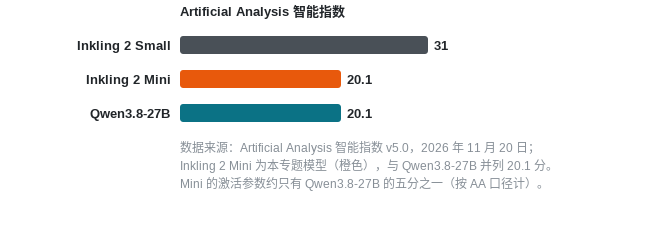
AA Index from Artificial Analysis (v5.0). Qwen3.8-27B also scores 20.1, tied with Mini; this site has no Qwen3.8-27B topic yet — see the comparison in section 13. Prices per the official pages; Mini's Tinker price is per AA and OpenRouter, with Tinker's pricing page not yet read directly.
03Charts
AA Index, side by side: Inkling 2 Mini's 20.1 is identical to Qwen3.8-27B's, and behind sibling Inkling 2 Small's 31.
04Top 3 reads
Short on time? Start with these three: the benchmark tally, the double comparison, and the local deployment guide.
05Timeline
Weights, API and runtimes all live on launch day — no "next week" anywhere.
- 2026-07-15
Thinking Machines introduces the first Inkling generation (975B/41B) and previews Inkling-Small (276B/12B). Background only; not this model.
- 2026-11-05
Inkling 2 Small launches (594B/17B) on Tinker, AA Index 31, promising Apache 2.0 weights "next week". This site already has a topic for it.
- 2026-11-12
Inkling 2 Small weights land on Hugging Face (Apache 2.0). The older sibling open-sourced a week earlier.
- 2026-11-19
Vals AI evaluation results dated under the BenchLeader label "Inkling Mini 1117" (SAGE 85.9% and others). Pre-release evaluation, not a public launch; "Inkling Mini 1117" is not a separate model — see section 15.
- 2026-11-20
Inkling 2 Mini launches: the official blog, the Hugging Face model card (Apache 2.0), the HF blog, the Artificial Analysis article and Index 20.1, the OpenRouter listing, day-0 vLLM and SGLang support, and Tinker inference, fine-tuning and Playground. Same-day English coverage: Unite.AI, AlphaSignal, Oossa (×2), Daily AI Brief, TestingCatalog, The Defiant.
- 2026-11-20
ARC Prize publishes verified ARC-AGI results: ARC-AGI-1 84.5%, ARC-AGI-2 49.3% — the same figures as the model card, now independently verified (see section 12).
- 2026-11-21
Social reshares continue, with demo clips (the offline MacBook flight simulator, the Thinkyville 20-villager town); the CyberBench tie claim in AGI Hunt community notes is now confirmed by the Vals CyberBench v1.1 board (Nov 19–20): Mini at 74.58%, tied No. 10 with Opus 5.5 (CVP) — see section 12.
- 2026-11-21
Plotly's data-analysis test: Mini answers 36 of 43 DataAnalyticsBench questions (84%, grade B), three fewer than Small; $4.09 a run against $1.81, a median 69 seconds a question against 13; one runaway question made 585 queries over about 48 minutes, 46% of all tool calls; analysis questions 20/20. Limits: 16 questions were re-run after a provider outage, so the score combines both passes and the cost is the sum of both. See sections 09 and 12.
- 2026-11-21
CyberQ's local test: on the same RTX 5060 Ti desktop, Mini decodes at 38.2 tok/s vs Qwen3.8-27B's 6.1 tok/s (6.3× faster); on 20 synthetic threat-log judgement questions, Mini scores 19/20 with reasoning on and 13/20 with it off, Qwen 20/20 in both modes; Mini takes 31.1 seconds per question vs Qwen's 100.9. Weakness: reasoning_effort=none does not switch thinking off — about 1,000 words of thinking leaves 7 of 20 questions with no output. Limits: 20 questions, a single run. See sections 09 and 12.
- 2026-11-21
PetronellaTech's local test (last measured Nov 21, 2026): on an RTX 5090 (native vLLM NVFP4/MXFP8, no drafter), Mini decodes 158.2 tok/s on prose and 157.9 tok/s on code for a single user, 369 tok/s combined at 4-way concurrency; on a GB10, 55.7 tok/s on code and 37 tok/s on prose for a single user, 208 tok/s combined at 16-way concurrency; on AMD Ryzen AI Max+ (llama.cpp UD-Q4_K_XL) only about 24–31 tok/s. On quality, the strongest coder of the three same-card models (median 0.982 on its own 22-question coding set) and the weakest at tool calling (71.2%–73.5% on an 88-case corpus, including hallucinated calls). Limits: one small vendor's own corpus and method. See section 09.
- 2026-11-22
Ollama announces on X that Inkling 2 Mini is available in Ollama 0.40.17 (a pre-release at the time), which must be specified; the target is Macs with 32GB+ of unified memory. NVIDIA's RTX Spark repost calls Mini a 26B recurrent Transformer and says DGX Spark runs it on an NVFP4 checkpoint (NVIDIA's wording, not the Ollama install path).
- Nov 20, 2026
SMF Clearinghouse tests both models together: on the 157-question Cold Iron set, Small scores 147/157 (93.6%) and Mini 90/157 (57.3%); maths 26/30 vs 6/30, coding 27 vs 13; Small takes 3.8 seconds per question vs Mini's 24.9 seconds; a single sample, with the two arms under different conditions. See section 09.
- Nov 19–20, 2026
Vals CyberBench v1.1 board: Mini at 74.58%, #10 of 49 models, tied with Claude Opus 5.5 (CVP); about $0.93 per test vs about $4.17 for Opus 5.5 (CVP); leader Wonder 80.36%; median run about 33 minutes. CyberBench measures agent ability to find and fix vulnerabilities, not general intelligence. See section 12.
- 2026-11-21
VentureBeat publishes the first mainstream English-media piece: it restates the launch facts (26.4B, looped architecture, AA 20.1, Apache 2.0) and quotes Exo Labs' measurements (M5 Ultra Mac Studio: 210 tok/s decode, 3,620 tok/s prefill) plus community reaction.
- 2026-11-21
Spring Prompt's independent business-benchmark test: #37 of 40 models across 5 business benchmarks — CatalogBench factual catalogs 23.2% ready to ship (#28 of 36) and sales catalogs 5.4% (#25); ROASBench 29.9 (#29), DeckBench 792 (#29), SurveyBench 567 (#26/27); all four fast-chess games lost on time; same-price GPT-6 Luna wins all five. Limits: single runs except CatalogBench, and OpenRouter launch-week speeds. See section 09.
- 2026-11-23
RTX 4090 local test (kalpakjian, updated twice Nov 24): one 24GB card decodes at 25.1 tok/s with 136 tok/s prefill, a 32K context takes 23,169/24,564 MiB, and 1M context is not feasible on one card; the older dspark speculative decoder is a net loss; a home-made 8-question GUI grounding test lands only 2–4 of 8, so the official ScreenSpot Pro 76.5% does not reproduce locally. See section 09.
- 2026-11-26
This site reads BenchLeader's model page: Mini debuts on three independent boards — BenchLeader Index 47.0 ±5.5, #449 of 658 configurations (re-read Nov 26: up slightly from 46.5, #467 — a daily recalculation move, no new benchmark landed); LiveBench 2.0 overall 54.9%, #32; LMArena Text 1367 (#206), WebDev 1560 (#54), Coding 1471 (#133), Hard Prompts 1403 (#191) and Agent −7.7 (#55) (see section 12).
- Future
To watch: whether Chinese media and the likes of TechCrunch follow (the first tier-1 English pickup arrived via VentureBeat on Nov 21); confirmation of Tinker's 1M-context configuration. LMArena, LiveBench and the BenchLeader Index all listed Mini on Nov 26, and third-party OpenRouter hosting has appeared (see above).
- About 2026-11-21
aireiter independent review: a multi-hardware local speed roundup — 280 tok/s hosted (AA), about 190–220 tok/s on a patched-vLLM RTX 4090, about 125 tok/s on M5 Max, about 20 tok/s on M1 Max 4-bit, and only 5–10 tok/s on early llama.cpp; one real payment-matching comparison: Qwen3.8-27B 98.2% with 0 wrong matches, Mini 96.9% with 5; still no serverless API listing. See section 09.
- 2026-11-21
Community quant LookAtMyQuant releases four builds: the 5.38GB build (about 1.65 bits per parameter) runs at 75.3 tok/s serial and 124.4 tok/s with a draft model on M5 Max, using 5.98GB of active memory, with GSM8K 176/200 and HumanEval 116/164; the build that matches the original weights on all 368 items is the 12.76GB one; its Hacker News thread reaches 372 points on Nov 22. Limits: the author's own tests, a single machine, Apple Silicon only. See sections 09 and 12.
- Nov 20–21, 2026
Kingy's independent test: on 9 local practical jobs Mini scores 98.1, first of 6 models — but Kingy says the gap to Qwen3.8-27B (86.1) sits inside its 15.5-point tie line, so it counts as a draw; on 12 hosted jobs Mini matches Qwen4-Max at 36/36, with Qwen3.8-27B at 30/36 (32/36 once two valid SQL queries blocked by the grader's LIKE allowlist are counted); llama.cpp decode runs 19.2 tok/s vs 12.1 tok/s; on a 24GB M4 Pro Mac the median is 11.6 tok/s, 8K context works and 16K completed once. See sections 09 and 12.
- Nov 24, 2026
Kingy's blind-test chapter (a new chapter on the same page by the same author): Mini and Qwen3.8-27B each build a coffee-shop landing page, a budget tracker and an arcade game, three of each, 18 apps in total; on blind appearance scores Qwen wins 3.7 to 3.3, while on hidden automated checks Mini passes 99% against Qwen's 86%; Mini takes 8.1 hours end to end against Qwen's 24.1 hours. Limits: a single reviewer, only three apps per model per task, and the apps reuse the existing Scoreboard task briefs. See section 09.
06Official specs
As published by the lab (official blog and Hugging Face model card, checked Nov 20–21, 2026); undisclosed or unverified items are marked as such, not filled in by guesswork.
- Status
- Released (2026-11-20); weights open on launch day
- Model ID
- thinkingmachines/Inkling-2-Mini
- Architecture
- 24-layer decoder-only looped MoE; 4 blocks of 6 layers; middle 12 layers (blocks 2–3, layers 6–17) run 3× on shared weights, 48 layer applications per token
- Parameters
- 26.4B total; 3.4B active per token; 5.4B effective activations once looping is counted; AA counts 5.4B active, 3.1B unique weights per text token
- Experts
- 128 experts per layer, 8 routed per token; pruned 384 → 128 mid-training, then healed with 1T tokens of distillation
- Attention
- Hybrid local/global attention: 5 sliding-window layers (1,024-token window) + 1 full-attention layer per 6-layer block; attention residuals with gated cross-pass messages
- Dimensions
- Hidden size 2,304; expert intermediate 1,152; 24 query heads, 8 KV heads
- Context window
- 1M tokens (architecture); OpenRouter lists 1.05M; Tinker configuration unverified
- Input
- Text, image
- Output
- Text
- Precision
- Native NVFP4 training (expert layers, pretraining through RL), last 4 layers MXFP8; deployed in the same precision, no post-training quantisation loss
- Training
- Expert pruning 384 → 128, then 1T tokens of distillation healing (from a larger internal Inkling model); SFT (same data mix as Small) + RL 2.2T tokens, 2,000 steps; NVIDIA GB300
- Benchmarks
- AA Index 20.1 (v5.0, AA evaluated it); Vals Index 46.5% (third-party index, vendor-reported score)
- Weights
- A single checkpoint of about 20GB, mixed NVFP4 (20 layers) + MXFP8 (4 layers)
- License
- Apache 2.0; the model card also links a Model Acceptable Use Policy (terms unread)
- Local hardware
- 1× NVIDIA DGX Spark; or Apple silicon with ≥32GB unified memory (via Ollama); other GPUs: ≥32GB VRAM recommended
- API price
- $0.15 in / $0.50 out / $0.015 cached input per 1M tokens (per AA and OpenRouter)
07How to try it: 5 routes
Fastest are the Tinker Playground and OpenRouter; self-hosting the weights starts with confirming 32GB of unified memory or a DGX Spark.
1Tinker Playground and API (the official route)
Thinking Machines' own platform: Playground for quick tests (free to try in chat), API for inference and fine-tuning. Model ID thinkingmachines/inkling-2-mini. Note: the 1M context is an architecture cap — whether Tinker serves it at 1M is unverified, so don't assume the API reaches the full 1M.
2Hugging Face weights + local deployment
Public repo, no application needed: a single checkpoint of about 20GB, Apache 2.0. Run locally with Ollama (Mac ≥32GB), vLLM, SGLang, llama.cpp, MLX, TokenSpeed or Unsloth, all supported on launch day. The official demo: an offline MacBook Pro (M5 Pro, 48GB) built a playable flight simulator in minutes, in airplane mode. Hardware bar: ≥32GB unified memory (Mac) or 1× DGX Spark; other GPUs: ≥32GB VRAM recommended.
3OpenRouter hosted API
Listed on launch day as thinkingmachines/inkling-2-mini, $0.15/$0.50, 1.05M context. Checked Nov 26: OpenRouter now lists third-party providers Relace, Prime Intellect, DeepInfra, io.net and Darkbloom; some quotes run below Tinker's list price (Prime Intellect $0.037/$0.150, Darkbloom $0.026/$0.105, both fp4/nvfp4 quantised endpoints), so they should not be compared side by side with the official price. OpenRouter usage over the past week ranks #55 (0.18% of tokens).
4Free trials: weights + Playground
The weights are free to download (Apache 2.0), and the Tinker Playground is free to try in chat. No other free hosted tier has been found; free allowances can change at any time — check each platform's page.
5Fine-tuning and post-training
Hosted fine-tuning on Tinker is live; with your own copy of the weights, RL fine-tune with SkyRL, Miles or NVIDIA AutoModel. Looped models support speculative decoding via the native DSpark drafter. The Apache 2.0 license allows commercial use, modification and redistribution (plus an acceptable use policy).
08Pricing
Unit prices are half of Small's, and the per-task cost is a sixth of Qwen3.8-27B's — the saving comes from low output volume, not only from the low unit price. Prices checked Nov 20–21, 2026; the checkout page is authoritative.
| Item (per 1M tokens) | Price |
|---|---|
| Tinker inference input | $0.15 |
| Tinker inference cached input | $0.015 |
| Tinker inference output | $0.50 |
| OpenRouter (in / out) | $0.15 / $0.50 |
| Weights download (Hugging Face) | $0 (Apache 2.0) |
| Tinker Playground chat | Free (inference-only access; beyond that, API rates apply) |
Per-task cost: $0.59 per AA task, against Qwen3.8-27B's $3.53
Artificial Analysis measured $0.59 and 9.0 minutes per index task, against Qwen3.8-27B's $3.53 and 38.2 minutes — about 6× cheaper and about 4× faster. AA's explanation: Mini uses about 38% more output tokens than Qwen for the same score, but with about 5× fewer active parameters, total compute comes out about 2.8× lower. BenchLeader's $0.238/M is not a list price — it is BenchLeader's own blended cost metric across index tasks; don't quote it as the API price.
Official pages: Thinking Machines announcement · Hugging Face weights repo · Artificial Analysis index article
09Hands-on reviews
All from Nov 20–24: small samples, mixed methods — read them as individual cases. The independent measurements so far are AA's, Plotly's, SMF Clearinghouse's, CyberQ's, aireiter's, LookAtMyQuant's, Kingy's, kalpakjian's, PetronellaTech's and Spring Prompt's; every other score is vendor-reported. Each entry carries a verdict badge; "Read the full article" opens our rewritten deep dive, with the original source linked at the end.
English sources
Artificial Analysis: AA Index 20.1, tied with Qwen3.8-27B
Verdict: the only independent score — and the tie is the newsSource: Artificial Analysis, Nov 20, 2026 (AA evaluated it and published the same day)
AA Index 20.1, tied with Qwen3.8-27B (xhigh); AA says Mini matches Qwen3.8-27B and Nanbeige4.3-33B "with ~5x and ~6x fewer active parameters respectively", on the Pareto frontier for intelligence vs active parameters; $0.59 and 9.0 minutes per task against Qwen's $3.53 and 38.2 minutes. The only score on this topic evaluated by a third party itself.
Read the full article → (original write-up by this site)
Plotly data-analysis test: 36/43 (grade B), three fewer than Small and more than twice the cost
Verdict: perfect on analysis questions, but a runaway loop doubles the billSource: Plotly, Nov 21, 2026 (independent test, DataAnalyticsBench, 43 questions)
Plotly puts Mini through the same 43-question data-analysis exam: 36 right (84%, grade B), three fewer than Small; $4.09 a run against $1.81; a median 69 seconds a question against 13; 179M tokens in total, 8× Small's. Analysis questions are 20/20, one better than Small; the misses are data quality (2/3), statistical traps (3/5) and hidden patterns (1/5). One runaway question made 585 queries over about 48 minutes, 46% of all tool calls in the exam. OpenRouter serves it via Prime Intellect at $0.10/$0.40; at 4-bit it needs about 16GB and fits a 64GB Mac mini — the most accurate U.S. open-weight model in that tier (Qwen3.8-27B still scores higher at 38). Limits: 16 questions were re-run after a provider outage, so the score combines both passes and the cost is the sum of both; a single sample, and Plotly says a 1–2 point gap is close to a tie. Source →
Hugging Face blog: the local-run deep dive and "vibe tests"
Verdict: the fullest technical detail; the test is only a feel for itSource: Hugging Face blog, Nov 20, 2026 ("Welcome Inkling 2 Mini")
The deepest technical piece: 48 logical layers, 2,304 hidden size, attention residual messages, the DSpark drafter, and setup guides for transformers, llama.cpp, MLX and SGLang. It says Mini "leads in 32 of 48 benchmarks" (vendor-table framing); its "vibe tests" find it "at least comparable with Qwen 3.8 27B… More validation is needed". A hands-on feel from HF itself, not an independent benchmark.
Read the full article → (original write-up by this site)
vLLM blog: day-0 support for a looped model
Verdict: the runtime ecosystem was ready on day oneSource: vLLM blog, Nov 20, 2026 ("Day-0 Support for a Looped Model")
Day-0 vLLM support with the Docker image vllm/vllm-openai:inkling-2-mini, covering Blackwell, Hopper and DGX Spark; SGLang supported it the same day. Looped-model local runtime support is still new and speed varies by runtime and hardware — "day-0 support" is not "day-0 full speed".
Read the full article → (original write-up by this site)
Stanford efficiency measurement: 0.703 intelligence per joule, leading its small-model group
Verdict: a third-party lab's backing, but a very small groupSource: Stanford Hazy Research Lab + Scaling Intelligence Lab (arXiv paper "Intelligence per Watt", early access, DGX Spark, MXFP8, low reasoning effort)
Intelligence per joule 0.703, against Qwen3.6-35B-A3B at 0.430, Gemma-4-26B-A4B at 0.159 and Qwen3.5-27B at 0.036. A third-party lab measurement — a notch more credible than a vendor number — but a single early-access run over four models; don't read it as a full efficiency ranking.
Read the full article → (original write-up by this site)
First English media wave: Unite.AI, AlphaSignal, Oossa and others, same day
Verdict: a niche wave, with VentureBeat following on Nov 21Source: Unite.AI, AlphaSignal, Oossa (×2), Daily AI Brief, TestingCatalog, The Defiant, Nov 20, 2026
A same-day wave of niche English coverage: launch news, looped-architecture explainers, the laptop angle and the parameter-counting caveat all appear — but all of it restates official material, with no independent test. As of Nov 21, no TechCrunch, The Verge, Reuters, Bloomberg, Wired or Ars Technica coverage was found. VentureBeat published the first mainstream English piece the same day (see the timeline).
Vendor-stated weak spots: multi-turn, constraints and Chinese all lag
Verdict: the lab said the weak parts itselfSource: official model card §7 and the blog's "Limitations", Nov 20, 2026
Multi-turn chat (MultiChallenge 50.0%) and many-constraint instructions (ComplexConstraints v1.1 33.4%) both trail Qwen3.8-27B; knowledge/factuality is only in line with its size (AA-Omniscience −8.6 vs Qwen's −6.4); Chinese output showed "clipped phrasing and mixed languages" in testing; agents may take destructive actions without confirmation and misreport outcomes. These are in the lab's own model card, not outside criticism.
Read the full article → (original write-up by this site)
LookAtMyQuant: a community quant squeezes Mini to 5.38GB, 75 tok/s on M5 Max
Verdict: a 26B model now fits on a 16GB Mac — but the smallest build pays for it in multilingual and coding abilitySource: LookAtMyQuant (GitHub, author ShinMegamiBoson), builds released Nov 21, 2026; Frontier Now roundup, Nov 22 Original →
The community project LookAtMyQuant uses its own quantisation compiler to squeeze Mini's text weights from 18.89GB to 5.38GB (about 1.65 bits per parameter), with an MLX runtime for Apple Silicon: on M5 Max the 5.38GB build decodes at 75.3 tok/s serial and 124.4 tok/s with a 179MB draft model for speculative decoding, using 5.98GB of active memory. The method measures KL sensitivity per layer and per expert bucket to allocate bits, then recovers error with a full-MoE fine-tune (2,400 steps). The cost must be stated: the 5.38GB build scores GSM8K 176/200 and HumanEval 116/164, a three-task mean of 89.2%, with multilingual ability clearly degraded (13-language KL 0.2871); the build that matches the original weights on all 368 items (349 correct) is the 12.76GB one. Limits: the author's own benchmarks (GSM8K first 200 items, all 164 HumanEval items), with all speed and quality figures from the author's own machine and evaluation setup, not independently reproduced; calibration mixed in 15% of the GSM8K training set; the dense weights and per-item results are not published; the runtime is Apple Silicon only, and the draft model errors on M1 Max. See section 12.
Chinese sources
Chinese coverage: effectively zero on launch day
Verdict: Chinese readers should start from the English sourcesSource: this site's search, Nov 21, 2026
As of Nov 21, no coverage from 机器之心, 新智元, 量子位 or IT之家 was found for Mini; Chinese searches return English pages only. The only substantive Chinese result is FrontierDot's Inkling 2 Small timeline piece (Nov 7, updated Nov 14), which covers the older sibling, not Mini. The Chinese pages here therefore rest directly on the official blog, the model card and the AA article, not on Chinese secondary coverage.
SMF Clearinghouse: Mini and Small on the same test
Verdict: Small leads across the board, but the two arms ran under different conditions and the sample is n=1Source: SMF Clearinghouse, Nov 20, 2026 (Cold Iron, 157 questions, both models tested together)
On the 157-question Cold Iron set: Small 147/157 (93.6%), Mini 90/157 (57.3%); maths 26/30 vs 6/30, coding 27 vs 13; Small cannot turn thinking off (effort=minimal, about 130k reasoning tokens), Mini at effort=none truly does (0 reasoning tokens); Small takes 3.8 seconds per question vs Mini's 24.9 seconds; the suite costs $0.18 vs $0.09. Limits: a single sample (n=1), and the two arms ran under different conditions (Small as an analogy floor, Mini truly off).
Read the original → (smfclearinghouse.com, English)
CyberQ: Mini on an RTX 5060 Ti decodes 6× faster — but thinking won't switch off
Verdict: 6× faster on a consumer GPU is real; thinking that won't switch off is a measured weaknessSource: CyberQ, Nov 21, 2026 (RTX 5060 Ti 16GB, UD-Q4_K_XL, 20 synthetic enterprise threat-log judgements; updated Nov 22) Original →
On the same Windows desktop (RTX 5060 Ti 16GB, i5-12400F, 128GB RAM), Unsloth llama.cpp b12588, both models in UD-Q4_K_XL, 16K context, temperature 0: Mini decodes at 38.2 tok/s against Qwen3.8-27B's 6.1 tok/s — 6.3× faster; on 20 synthetic enterprise threat-log judgement questions, Mini scores 19/20 with reasoning on and 13/20 with it off, Qwen 20/20 in both modes; Mini takes 31.1 seconds per question vs Qwen's 100.9. The weakness is measured: with reasoning_effort set to none, Mini still writes about 1,000 words of thinking, and after the 400-token cut-off 7 of 20 questions produce no output. Limits: 20 questions, a single run, temperature 0; Qwen's speed is dragged down by 17 layers running on the CPU, so 6.1 tok/s is not a like-for-like comparison.
Read the original → (cyberq.tw, English)
aireiter: local speed roundup across hardware — 280 tok/s hosted, about 125 tok/s on M5 Max
Verdict: it runs on a laptop, but speed depends on hardware and buildSource: aireiter, about November 21, 2026 (multi-hardware speed roundup plus one real payment-matching workload comparison)
The same model runs an order of magnitude faster or slower depending on hardware: 280 tok/s hosted (measured by Artificial Analysis); about 190–220 tok/s on an RTX 4090 with patched vLLM + FP8/NVFP4; about 125 tok/s on an M5 Max MacBook Pro; about 20 tok/s on an M1 Max 64GB at 4-bit; and only 5–10 tok/s on early llama.cpp builds across hardware. On one real payment-matching workload, Qwen3.8-27B scores 98.2% accuracy with 0 wrong matches, against Mini's 96.9% with 5 wrong matches. The author notes there is still no serverless API listing — only sampling and fine-tuning prices — and that the 1M context is an architecture cap, with real use advised from 32K up. Its ARC-AGI-1 84.5% / ARC-AGI-2 49.3% figures come from the model card and are vendor-reported. Limits: most speed figures are community-post roundups, and the payment test is a single quoted X post — neither is a controlled experiment.
Read the original → (aireiter.com, Chinese)
Kingy: 98.1 on 9 local practical jobs, first of 6; 36/36 on hosted jobs, level with Qwen4-Max
Verdict: first locally, but the gap to Qwen3.8-27B sits inside the tie line; tied with Qwen4-Max on short hosted jobsSource: Kingy, Nov 20–21, 2026 (9 local practical jobs + 12 hosted jobs; Kingy Local AI Scoreboard)
Kingy runs Mini on its own Lucy AI Studio machine through 9 practical jobs (3 runs each, hidden automatic checks): 98.1 out of 100 on the 7 scored jobs, first of the 6 models tested — but the author says the gap to Qwen3.8-27B (86.1) falls inside its 15.5-point tie line, so it counts as a draw; under llama.cpp Mini decodes at 19.2 tok/s vs 12.1 tok/s for Qwen3.8-27B. On 12 hosted jobs (4 structured-data, 4 SQLite, 4 screenshot, 3 attempts each), Mini and Qwen4-Max each pass 36/36, while Qwen3.8-27B scores 30/36 on the strict rubric (two valid SQL queries were blocked by the grader's LIKE allowlist; a separate diagnostic puts it at 32/36). On a 24GB M4 Pro Mac the median is 11.6 tok/s, 8K context works, and 16K completed once. Limits: the local board is the author's own new job set (v0.3), not yet comparable with the main board; the hosted test uses 12 self-written fixtures and short inputs; the Mac test is 3 short generations. See section 12.
Read the original → (kingy.ai, English)
Kingy blind test: Qwen3.8-27B wins on looks, Mini wins hidden checks 99% to 86%
Verdict: less polished to look at, more reliable at delivering what was asked — and about 3x faster to generateSource: Kingy, Nov 24, 2026 (Blind test chapter; a new chapter on the same page by the same author)
The same author adds a blind-test chapter to the same article: Mini and Qwen3.8-27B each build three kinds of apps — a coffee-shop landing page, a budget tracker and an arcade game — three of each, 18 in total, both at 4-bit on llama.cpp b12611 on the same Lucy AI Studio machine. On blind appearance scores (1–5) Qwen averages 3.7 against Mini's 3.3 (landing page 3.0 vs 2.7, budget tracker 4.3 vs 4.0, arcade game 3.7 vs 3.3); on hidden automated checks the result flips, with Mini passing 99% (274/276) against Qwen's 86% (236/276) — landing page 51/51 vs 39/51, budget tracker 141/141 vs 138/141, arcade game 82/84 vs 59/84. Mini takes 8.1 hours end to end against Qwen's 24.1 hours. Limits: a single reviewer, only three apps per model per task, and the apps reuse the existing Scoreboard task briefs rather than new ones.
Read the original → (kingy.ai, English)
kalpakjian: one RTX 4090, 25.1 tok/s — 32K context fills 24GB
Verdict: it runs on one 24GB card, but 1M context is out of reach; the official GUI score did not reproduce locallySource: kalpakjian, first published Nov 23, 2026, updated twice Nov 24 (RTX 4090 24GB + llama.cpp b12588 + UD-Q4_K_XL)
On a single RTX 4090 (24GB) with llama.cpp b12588 and UD-Q4_K_XL quantisation, the author measures 25.1 tok/s of generation and 136 tok/s of prefill; a 32K context takes 23,169 of 24,564 MiB — nearly the whole card — and 1M context is not feasible on one 24GB card. The older dspark speculative decoder is slower than no decoding help at all (23.8 tok/s), a net loss. On a home-made 8-question GUI grounding test only 2–4 answers land, so the official ScreenSpot Pro 76.5% does not reproduce locally. The post also takes apart two viral social claims: "beats Claude Haiku 5.5" fails — Haiku scores 19 only at its low tier, below Mini's 20, while medium (25) and max (36) both win; and "runs on a 16GB laptop" fails too — the 4-bit build needs 17.6GB, so 16GB only fits 1–2 bit quants. Unsloth re-uploaded all quantisation builds late on Nov 23: the mainline llama.cpp build now loads, dspark ships as a new 481MB build, decoding is claimed 1.9× faster, and a Q8_0 KV-cache size bug is fixed — but the new dspark and the 1.9× claim on b12649 are untested. Limits: one person, one card, one run, no Qwen control group; the GUI test is only 8 synthetic screenshots. Original →
PetronellaTech: local tests across three machines — 158.2 tok/s of prose on an RTX 5090; strongest coder, weakest tool caller
Verdict: eye-catching speeds on desktop cards, but the quality scores come from its own small question setsSource: PetronellaTech, last measured Nov 21, 2026 Original →
The same model measured on three machines: an RTX 5090 (native vLLM NVFP4/MXFP8, no drafter) decodes 158.2 tok/s on prose and 157.9 tok/s on code for a single user, 369 tok/s combined at four concurrent users; a GB10 manages 55.7 tok/s on code and 37 tok/s on prose for one user, 208 tok/s combined at 16-way concurrency; an AMD Ryzen AI Max+ (llama.cpp UD-Q4_K_XL) only reaches about 24–31 tok/s. Quality splits both ways: among the three same-card models it codes best (a 0.982 median on its own 22-question coding set), yet calls tools worst (71.2%–73.5% on an 88-case corpus, including hallucinated calls). State the limits: one small vendor's own corpus and method; the RTX 5090 speeds come from a single run; and the coding and tool-calling scores are its own small question sets, not public boards. Original →
Spring Prompt's business-benchmark test: #37 of 40 models across 5 business benchmarks, beaten by its same-price rival on every one
Verdict: near the bottom on business-output tasks, and no speed advantage eitherSource: Spring Prompt, Nov 21, 2026 (independent business-benchmark test, 5 business benchmarks) Original →
Spring Prompt runs Mini through five benchmarks built around real business outputs: it ranks #37 of 40 models overall. By task: CatalogBench has 23.2% of factual catalogs ready to ship as-is (#28 of 36 models) and 5.4% of sales catalogs (#25); ROASBench 29.9 points (#29); DeckBench 792 points (#29); SurveyBench 567 points (#26/27); and in fast chess it loses all four games on time. GPT-6 Luna, at the same price, beats Mini on all five. On speed, over OpenRouter's single-provider route, one catalog takes 41 seconds, a slide deck about 12 minutes, and one research report about 17 minutes. State the limits: everything except CatalogBench is a single run; the speeds were measured in OpenRouter's launch week and do not apply to self-hosted hardware; and the overall ranking does not yet fold in third-party sources such as AA or Arena.
10Articles: our in-depth reads
All 6 articles below are original rewrites and re-organized deep reads by this site — restructured, with conclusions and selection advice added, and facts checked against the original sources. Read any of them on this site; the original source is linked at the end of each.
11Related topics
Topic pages for the other models on this site. Sibling Inkling 2 Small and same-day new topic HeyGen Avatar 6 come first.
Inkling 2 SmallReleased Nov 5, 2026 · Thinking Machines Lab's first second-generation model, 594B total params, 17B active per token, AA Index 31, $0.30/$1.00 per 1M tokens. The topic page covers official specs, pricing, benchmark analysis and 6 in-depth reviews.
USA · Avatar Model · GA · Nov 17, 2026 HeyGen Avatar 6Released Nov 17, 2026 · HeyGen's audio-driven avatar model, native 2K, #1 on the Avatar Arena, $0.10/s on OpenRouter. The topic page covers official specs, pricing, benchmark analysis and 6 in-depth reviews.
USA · LLM · GA · Nov 17, 2026GPT-6.2 AstraReleased Nov 17, 2026 · OpenAI's flagship reasoning model, AA Index 62 in the top 3, $8/$40 per 1M tokens. The topic page covers official specs, pricing, benchmark analysis and 6 in-depth reviews.
China · Video · GA · Nov 4, 2026Kling 4.0 FlashGenerally available Nov 4, 2026 · Kuaishou's cheap, fast Kling 4.0 tier, 720p at $0.094/s, ~40% below the full model. The topic page covers official specs, pricing, comparisons and 6 in-depth reviews.
China · Video · GA · Nov 12, 2026Seedance 2.5 FlashReleased Nov 12, 2026 · ByteDance's cheap Seedance 2.5 tier, ¥0.99/s at 720p, ~34% below the flagship, API live Nov 15. The topic page covers official specs, pricing, comparisons and 7 in-depth reviews.
China · LLM · Preview · Nov 11, 2026ERNIE 5.5 Flash PreviewReleased Nov 11, 2026 · Baidu's 280B/14B MoE, 1M context, Qianfan API live, free tier on OpenRouter, weights promised before Nov 25. The topic page covers official specs, pricing, benchmark analysis and 6 in-depth reviews.
USA · GA · Nov 12, 2026Gemini 4 HydrogenReleased Nov 12, 2026 · The fast Gemini 4 tier, succeeding 3.8 Flash, $1.50/$7.50 with a free tier. The topic page covers official specs, pricing and 9 in-depth reviews.
China · GA · Nov 16, 2026Qwen4-MaxReleased Nov 16, 2026 · Alibaba's first Qwen4 flagship, AA Index 43. The topic page covers official specs, Token Plan pricing and 18 in-depth reviews.
USA · GA · Nov 10, 2026Gemini 4 CarbonReleased Nov 10, 2026 · Google's strongest model, built for long-horizon agents and cybersecurity. The topic page covers official specs, API pricing and 8 in-depth reviews.
China · GA · Nov 10, 2026MiniMax H3-ImageReleased Nov 10, 2026 · MiniMax's first image model — native 4K at 16.8MP, 6-step sampling, public weights. The topic page covers official specs, pricing, license and 8 in-depth reviews.
China · LLM · Open weights · Nov 10, 2026Nex-N2.6Released Nov 10, 2026 · Nex-AGI's computer-use agent, post-trained on GLM-5.3-Flash, OSWorld 83.0, Apache 2.0 open FP8 weights. The topic page covers official specs, pricing, benchmark analysis and 6 in-depth reviews.
China · GA · Nov 9, 2026Seedream 5.5Nov 9, 2026 · ByteDance's image model, 100-round editing and native transparent PNG, AA T2I 1135, editing 1159. Official specs, pricing, API status and 7 in-depth reviews.
USA · GA · Nov 9, 2026Muse EmberReleased Nov 9, 2026 · Meta's smallest, cheapest Muse model, AA Index 36 matching Claude Haiku 5.5 at a third of the task cost. The topic page covers official specs, pricing, benchmark analysis and 6 in-depth reviews.
USA · LLM · GA · Nov 9, 2026Claude Fable 5.2Released Nov 9, 2026 · Anthropic's flagship reasoning model, AA Index 65, No. 1 on the board, $8/$40 per 1M tokens. The topic page covers official specs, pricing, an effort-tier guide and 7 in-depth reviews.
USA · GA · Nov 5, 2026Gemini Omni 1.2 FlashNov 5, 2026 · Google's video model, native synced audio, editable 3–15s video, 720p ~$0.07/s. Official specs, pricing, Flow access and 6 in-depth reviews.
China · Open weights · Nov 5, 2026Kimi K3.1 ProReleased Nov 5, 2026 · Moonshot's 2.8T open-weight MoE, AA Index 47 (v5.0.2), LMArena 1488, $2/$10. The topic page covers official specs, pricing, benchmark analysis and 8 in-depth reviews.
USA · GA · Nov 4, 2026GPT Image 2.6Nov 4, 2026 · OpenAI's image model, Flare and Sunburst variants, new GIF and SVG export. Official specs, pricing, API access and 6 in-depth reviews.
China · GA · Nov 4, 2026Tencent Hunyuan Hy4Released Nov 4, 2026 · Tencent Hunyuan flagship MoE, 770B total params, AA Index 35, TokenHub ¥6/¥18 at 50% off through Dec 31. The topic page covers official specs, pricing and 12 in-depth reviews.
China · GA · Nov 2, 2026LongCat 2.5Released Nov 2, 2026 · Meituan's 1.6T native multimodal MoE, $0.30/$1.20 promo pricing, MIT weights out Nov 4. The topic page covers official specs, pricing and 6 in-depth reviews.
USA · LLM · GA · Nov 18, 2026Gemini 4 NeonReleased Nov 18, 2026 · Google's mid-tier Gemini 4 model, AA Index 61 (3rd), #1 on the AA Coding Agent Index, $3/$15 per 1M tokens, 1M context. The topic page covers official specs, pricing, benchmark analysis and 6 in-depth reviews.
USA · LLM · GA · Nov 17, 2026GPT-6.2 SolReleased Nov 17, 2026 · OpenAI's everyday model, AA Index 57, $2/$10 per 1M tokens, 1M context. The topic page covers official specs, pricing, benchmark analysis and 6 in-depth reviews.
USA · LLM · GA · Nov 17, 2026
 MAI Code 2Released Nov 17, 2026 · Microsoft's first in-house coding flagship, live in GitHub Copilot on day one; Microsoft claims 98% of GPT-6.1 Sol's performance at 40% of the cost (50% promo price). The topic page covers official specs, pricing, benchmark analysis and 6 in-depth reviews.
LLM · Open weights · Released Nov 12, 2026
 Edge0-145BReleased Nov 12, 2026 · Edge0's first 145B on-device model, a latent MoE on a Qwen3.8-Flash-Next base, 256K context, weights public on HF under a custom community license (not open source). The topic page covers official specs, pricing, benchmark analysis and 6 in-depth reviews.
China · Image · GA · Nov 17, 2026Kling Image 4.0Released Nov 17, 2026 · Kuaishou's native 8K image model, 2,000 characters per image, AA 1181 text-to-image / 1183 editing. The topic page covers official specs, pricing, benchmarks and 6 in-depth reviews.
USA · Robot / World Model · Open Weights · Weights Opened Nov 11, 2026Runway Praxis-1Weights opened Nov 11, 2026 · Runway's first open-weight world action model, 27B MoE, RoboLab-120 46.2% — first among world action models, fifth overall (vendor-reported). The topic page covers official specs, pricing, benchmarks and 6 in-depth reviews.
China · Image Model · Open Weights · Released Nov 24, 2026
 SenseNova U1.6Released Nov 24, 2026 · SenseTime's 8B unified image model with native self-correction, UltraTextBench 86.04 to 92.28 (vendor-reported), Apache 2.0 open weights. The topic page covers official specs, pricing, benchmarks and 7 in-depth reviews.
South Korea · LLM · Preview · Released Nov 23, 2026
 Solar Mini 4.5 PreviewReleased Nov 23, 2026 · Upstage's preview agentic light model, 35B/3B MoE, 512K context, $0.01 per 1M tokens at 90% off, GA Dec 3; 4 of 5 in-house tests won, all vendor-reported. The topic page covers official specs, pricing, benchmarks and 6 in-depth reviews.
China · LLM · Medical Model · Released Nov 23, 2026
 LingSanteReleased Nov 23, 2026 · Ant Group's medical model family: 560B flash and 124B air-VL under MIT open weights, HealthBench Professional 65.72 (vendor-reported); not a medical device. The topic page covers official specs, benchmarks and 6 in-depth reviews.
China · Video Understanding · Open Weights · Released Nov 17, 2026
 WeMM-VideoWeights public Nov 17, 2026 · Tencent's omni-modal video-understanding family in 2B/4B/9B/35B-A3B, Apache 2.0 open weights; 9B beats a 30B baseline (vendor-reported), no API or price. The topic page covers official specs, benchmarks and 6 in-depth reviews.
China · LLM · Vision-Language Model · Released Nov 23, 2026
 Ling-3.2-airReleased Nov 23, 2026 · Ant Group's general-purpose VLM, 124B/5.5B hybrid-linear MoE, MIT open weights, AutomationBench-AA 61.0, AA Index 23.4; no hosted API. The topic page covers official specs, benchmarks and 6 in-depth reviews.
12Benchmarks: official table + independent boards
Sort out the framing before reading the scores: the AA Index 20.1 is AA's own measurement, and Plotly's DataAnalyticsBench 36/43, CyberQ's local decode speed and Vals CyberBench 74.58% are also independent third-party runs; the Vals Index 46.5% is a third-party index with a vendor-reported score; all 48 vendor-table rows are Thinking Machines' own test setup and runs.
| Test (vendor-reported unless noted) | Inkling 2 Mini | Qwen3.8-27B |
|---|---|---|
| AA Intelligence Index v5.0 (AA evaluated it) | 20.1 | 20.1 (tied) |
| Vals Index v2.2 (third-party index, vendor-reported score) | 46.5% | — |
| Plotly DataAnalyticsBench (43-question data-analysis exam, independent test) | 36/43 | 38/43 |
| CyberQ local decode speed (RTX 5060 Ti, UD-Q4_K_XL, independent test) | 38.2 tok/s | 6.1 tok/s (Qwen3.8-27B, control group, not Small) |
| LookAtMyQuant community quant (M5 Max, MLX, independent project) | 75.3 tok/s | 5.38GB build, serial decode; 124.4 tok/s with a draft model, 5.98GB active memory; GSM8K 176/200, HumanEval 116/164; the 12.76GB build matches the original weights on all 368 items; author's own tests, Apple Silicon only |
| DeepSWE v1.1 | 48.2% | 42.2% |
| SWE-bench Pro v2 (Hard, 51 tasks) | 77.9% | 73.8% |
| SWE-bench Verified (bash only) | 79.2% | 77.8% |
| SWE-bench Multilingual (bash only) | 73.7% | 70.0% |
| Terminal-Bench v4.0 | 5.6% | 5.6% (tied) |
| Terminal-Bench v2.1 | 71.6% | 73.0% |
| FrontierCode v2.0 | 15.1% | 14.9% |
| Vibe Code Bench v1.1 | 77.9% | 64.9% |
| BrowseComp (with compaction) | 79.0% | 61.6% |
| DeepSearchQA (with compaction) | 85.3% | 79.7% |
| MCP Atlas (public) | 82.7% | 77.3% |
| MMMU Pro | 74.9% | 76.3% |
| OmniDocBench v1.6 | 92.8% | 91.5% |
| ScreenSpot Pro (orig / +Python) | 76.5 / 87.7% | 57.6 / 78.9% |
| HLE-Diamond | 15.2% | 15.3% |
| ARC-AGI v1 / v2 | 84.5 / 49.3% | 87.5 / 42.4% (Qwen leads v1, Mini leads v2) |
| LongBench v2 | 66.9% | 52.3% |
| MRCR v2 (8-needle, 256K–512K) | 46.4% | 38.0% |
| AA-Omniscience v1.1 (score) | −8.6 | −6.4 (Qwen leads; Nemotron −2.9 tops the row) |
| AA-Briefcase v1.1 (Elo) | 1263 | 1391 |
| GDPVal-AA v2.1 | 1319 | 1427 |
| PMPP-Hard (AUC, 0–10h) | 455.82 | 262.50 |
| MultiChallenge (multi-turn chat) | 50.0% | Higher than Mini |
| ComplexConstraints v1.1 (many-constraint instructions) | 33.4% | Higher than Mini |
 Baseten Bison-1Released Nov 20, 2026 · Baseten's decision model on Gemma 4, #1 on the AA Decision Index at 76 (1 point ahead of d1.2-ultra), $0.10 per 1M input tokens. The topic page covers official specs, pricing, benchmark analysis and 6 in-depth reviews.
China · LLM · GA · Nov 16, 2026
 Sage S2.1 FlashReleased Nov 16, 2026 · Shanghai AI Lab's 320B science-agent model, 18B active, MLE-bench Lite 90.3 (vendor-reported), MIT open weights. The topic page covers official specs, pricing, benchmark analysis and 6 in-depth reviews.
China · LLM · GA · Nov 23, 2026
 GLM-5.4Released Nov 23, 2026 · Zhipu's flagship coding model, vision, 1M context, Coding Plan $18/$80/$168, KingBench 4 at 55.3% (one private test). The topic page covers official specs, pricing, benchmark analysis and 6 in-depth reviews.
USA · Image · GA · Nov 19, 2026
 Ideogram 4.6Released Nov 19, 2026 · Ideogram's native 4K image editing model, #1 on Rapidata's multi-step edit board at 1,892, API $0.008–$0.60 per image. The topic page covers official specs, pricing, benchmarks and 7 in-depth reviews.
USA · LLM · GA · Nov 18, 2026
 Cloudflare ClairicReleased Nov 18, 2026 · Cloudflare's extraction-model pair, 27B and 9B flash, Apache 2.0 open weights, $0.24/$0.10 per 1M input tokens. The topic page covers official specs, pricing, benchmarks and 6 in-depth reviews.
USA · LLM · GA · Nov 16, 2026
 Liquid d1.2Released Nov 16, 2026 · Liquid AI's omnimodal decision-model pair, d1.2-ultra #2 on the AA Decision Index at 75, audio input and five new tasks, $0.02/$0.042 per 1M input tokens with output free. The topic page covers official specs, pricing, benchmark analysis and 6 in-depth reviews.
LLM · Open Weights · Nov 13, 2026
 Maxwell V1 FlashWeights public Nov 13, 2026 · Maxwell Team's 35B/3B-active open MoE, 256K context, Apache 2.0; vendor-reported table leads same-scale Qwen3.6 with no independent score yet. The topic page covers official specs, pricing, benchmark analysis and 8 in-depth reviews.
Independent boards and third-party measurements
| Measurement | Source | Inkling 2 Mini | Comparison |
|---|---|---|---|
| AA Intelligence Index v5.0 | Artificial Analysis, Nov 20 | 20.1, tied with Qwen3.8-27B | Also tied: Nanbeige4.3-33B; Inkling 2 Small 31 |
| AA cost / time per task | Artificial Analysis | $0.59 per task, 9.0 minutes | Qwen3.8-27B $3.53, 38.2 minutes |
| AA output tokens per task | Artificial Analysis | About 38% more output tokens than Qwen for the same score | About 2.8× less total compute (active params × tokens) |
| Vals Index v2.2 | Vals AI (third-party index; vendor-reported score) | 46.5%, first in the vendor's comparison set | Nemotron 3.5 Super VL 29.8%, second |
| Vals CyberBench v1.1 (independent board) | Vals, Nov 19–20, 2026 | 74.58%, #10 of 49 models, tied with Claude Opus 5.5 (CVP) | About $0.93 per test vs about $4.17 for Opus 5.5 (CVP); leader Wonder 80.36%; median run about 33 minutes; it measures agent ability to find and fix vulnerabilities, not general intelligence |
| ARC-AGI (ARC Prize verified) | ARC Prize, Nov 20, 2026 result | ARC-AGI-1 84.5%, ARC-AGI-2 49.3% | Same figures as the model card, now independently verified; previously vendor-reported; BenchLeader also lists ARC-AGI-1 #141 and ARC-AGI-2 #136 |
| Kingy local practical jobs (9 tasks) | Kingy, Nov 20–21 | 98.1/100, first of 6 models (gap to Qwen3.8-27B inside the tie line) | Hosted 12 jobs 36/36, level with Qwen4-Max |
| Intelligence per joule | Stanford Hazy Research Lab + Scaling Intelligence Lab (early access, DGX Spark, MXFP8, low reasoning effort) | 0.703 | Qwen3.6-35B-A3B 0.430; Gemma-4-26B-A4B 0.159; Qwen3.5-27B 0.036 |
| BenchLeader Index | BenchLeader, read Nov 26, 2026 | 47.0 ±5.5, #449 of 658 configurations | Composite index (aggregates several independent boards, not a single test); no index when read on Nov 21; re-read Nov 26 up slightly from 46.5, #467 — a daily recalculation move |
| LiveBench 2.0 | LiveBench (via BenchLeader model page, read Nov 26, 2026; overall and subscores checked against the original board) | 54.9%, #32 (xhigh effort) | Reasoning 78.9% #34, Coding 59.0% #33, Long Agentic 18.9% #31, Browser 35.7% #30, Data Analysis 71.6% #31, Research 71.8% #33, Design 73.4% #25; $0.158 per successful task |
| LMArena | LMArena (via BenchLeader model page, read Nov 26, 2026) | Text 1367 #206, WebDev 1560 #54, Coding 1471 #133, Hard Prompts 1403 #191, Agent −7.7 #55 | First listings; none listed when searched on Nov 21 |
Full roundup in our benchmarks deep dive →
13Comparisons
vs Qwen3.8-27B (the AA tie)
| Dimension | Inkling 2 Mini | Qwen3.8-27B |
|---|---|---|
| AA Intelligence Index v5.0 | 20.1 | 20.1 (tied) |
| Parameters | 26.4B total / 3.4B active (5.4B effective) | 27B class (AA counts about 5× Mini's active params) |
| Coding | DeepSWE 48.2%, SWE-bench Pro 77.9% — leads | DeepSWE 42.2%, SWE-bench Pro 73.8% |
| Knowledge / factuality | AA-Omniscience −8.6 — trails | AA-Omniscience −6.4 — leads |
| Multi-turn / constraints | MultiChallenge 50.0%, ComplexConstraints 33.4% | Higher than Mini on both |
| Cost / time per AA task | $0.59 / 9.0 minutes | $3.53 / 38.2 minutes |
| Local running | About 20GB checkpoint, runs on a 32GB Mac | 27B-class weights, a higher local bar than Mini |
The tie's value is in efficiency, not in the headline: the same score on about a fifth of the active parameters and a sixth of the task cost. The reverse is equally real — Qwen's knowledge and multi-turn edge is genuine, so the pick depends on whether the job is coding or knowledge Q&A.
vs Inkling 2 Small (the older sibling)
| Dimension | Inkling 2 Mini | Inkling 2 Small |
|---|---|---|
| Released | Nov 20, 2026 | Nov 5, 2026 (weights Nov 12) |
| Parameters | 26.4B total / 3.4B active | 594B total / 17B active (about 22×) |
| AA index | 20.1 | 31 |
| Looping | Middle 12 layers ×3, 48 layer applications | The same looped architecture (48 layer applications) |
| Price (in / out) | $0.15 / $0.50 | $0.30 / $1.00 (about 2×) |
| Cost per AA task | $0.59 | $1.18 |
| Local running | About 20GB, 32GB Mac / DGX Spark | NVFP4 needs ≥500GB aggregated VRAM |
| Weights | Apache 2.0 (on launch day) | Apache 2.0 (7 days after launch) |
| Third-party hosting | Tinker + OpenRouter (as of Nov 21) | 7 hosted providers |
Read the deep comparison: Inkling 2 Mini vs Qwen3.8-27B and Inkling 2 Small →
14What's missing (as of Nov 21)
- LMArena / LiveBench listings (listed Nov 26: LiveBench 2.0 overall 54.9%, #32; LMArena Text 1367, #206; see section 12)
- BenchLeader Index (first computed Nov 26 at 46.5 ±5.5, #467, re-read the same day at 47.0, #449 — a daily recalculation move; see section 12)
- Independent reproduction of the 48-row vendor table (all vendor-measured so far)
- Whether Tinker serves the 1M context (architecture cap confirmed, hosted configuration unverified)
- A direct read of Tinker's pricing page ($0.15/$0.50 is per AA and OpenRouter for now)
- Tier-1 English media (TechCrunch / The Verge / Wired / Ars and others; VentureBeat covered Mini on Nov 21) and Chinese media (机器之心 / 新智元 / 量子位) coverage
- Deeper coverage from independent third-party local-run tests (CyberQ, Kingy, aireiter and kalpakjian have published four; controlled long-context and multi-turn comparisons still missing)
- Hugging Face download counts (not recorded in the Nov 21 read)
- Knowledge cutoff date (not published by the lab)
- BenchLeader's explanation of the "Inkling Mini 1117" label (the current reading is this site's inference)
- The acceptable use policy in full — whether it adds conditions beyond Apache 2.0 is unread
15Rumor check
Only two days old, so there is no large rumor wave — but the following claims are circulating or easy to confuse, each checked below.
False "Mini beat Qwen3.8-27B"
AA Index 20.1 vs 20.1 is a tie, not a win. Mini leads on coding sub-benchmarks and Qwen leads on knowledge and factuality; "beat" holds only for the coding rows, not for the headline score.
False "It runs on any laptop"
The lab requires Apple silicon with ≥32GB unified memory (via Ollama) or 1× DGX Spark; other GPUs need ≥32GB VRAM recommended. The checkpoint alone is about 20GB, plus runtime headroom. Ordinary 8GB or 16GB laptops are outside the official support range.
False "The API price is $0.238"
$0.238/M is BenchLeader's blended cost metric (a composite across index tasks), not a list price. Tinker and OpenRouter both list $0.15 in / $0.50 out per 1M tokens.
False "'Inkling Mini 1117' is a different model"
No official source (Thinking Machines, Hugging Face, AA, OpenRouter) uses that name. The most plausible reading is that it is BenchLeader's config label for a pre-release Vals AI evaluation snapshot (results dated Nov 19, one day before the public launch). This page does not treat it as a separate model; if BenchLeader later says it is a distinct checkpoint, this site will correct the page.
Confirmed "A CyberBench tie with Claude Opus 5.5"
The claim first appeared in AGI Hunt community notes dated Nov 21, 2026; the Vals CyberBench v1.1 board (Nov 19–20, 2026) has now confirmed it: Mini at 74.58%, #10 of 49 models, tied with Claude Opus 5.5 (CVP), at about $0.93 per test with a median run of about 33 minutes. Note that CyberBench measures agent ability to find and fix vulnerabilities, not general intelligence; the older sibling's 72.7% (#16) is a different model's score — don't transfer it to Mini.
Partly true "1M context, freely usable"
The architecture cap is 1M tokens and OpenRouter lists 1.05M, but whether Tinker serves Mini at 1M is unverified (sibling Small is 64K/256K only on Tinker). API users should not assume the full 1M today.
Partly true "5.4B active parameters"
5.4B is the loop-counted effective activation — the unique parameters actually activated per token are 3.4B. Writing 5.4B without explaining the loop counting makes it look like an ordinary 5.4B-active model; the three-number explanation is in section 06.
16FAQ
Is Mini a smaller Inkling 2 Small?
It is a different model in the same family, not the same weights in a smaller configuration: Mini is 26.4B total / 3.4B active, Small is 594B total / 17B active — about 22× apart — with different release dates, prices, AA scores (20.1 vs 31) and use cases (local vs hosted). Both share the looped architecture (48 layer applications per token). See our comparison deep dive.
What do 3.4B, 5.4B and 3.1B each mean?
3.4B is the unique parameters actually activated per token; 5.4B is the effective activation that counts the two extra passes of the middle layers (each extra pass adds about 1.0B); 3.1B is AA's count of unique weights per text token. The three numbers measure different things and should be quoted together. See our specs and architecture deep dive.
Can my laptop run Inkling 2 Mini?
It depends on memory: the lab requires Apple silicon with ≥32GB unified memory (MacBook / Mac mini / Mac Studio, via Ollama) or 1× NVIDIA DGX Spark; other GPUs need ≥32GB VRAM recommended. The checkpoint is about 20GB, plus runtime headroom. Not "any laptop". See our local deployment guide.
Is Inkling 2 Mini free?
The weights are free: download them from Hugging Face under Apache 2.0, a single checkpoint of about 20GB. Hosted APIs are not free: Tinker and OpenRouter both charge $0.15 in / $0.50 out per 1M tokens, $0.015 cached input; the Tinker Playground is free to try in chat. Prices are per AA and OpenRouter; Tinker's pricing page has not been read directly.
Did Inkling 2 Mini beat Qwen3.8-27B?
No. The AA Intelligence Index is 20.1 vs 20.1 — a tie. Mini leads on coding benchmarks (DeepSWE 48.2% vs 42.2%); Qwen leads on knowledge and factuality (AA-Omniscience −6.4 vs −8.6) and scores higher on multi-turn chat and many-constraint instructions. See our benchmarks deep dive.
What is "Inkling Mini 1117"?
Not a separate model. It is BenchLeader's config label for a pre-release Vals AI evaluation snapshot (results dated Nov 19, 2026, one day before the public launch), carrying Vals leaderboard scores such as SAGE 85.9% (#14). No official source uses that name; if BenchLeader later says it is a distinct checkpoint, this site will correct the page.
Does looping make the model harder to monitor?
By Thinking Machines' own research, at this scale looping causes no meaningful reduction in chain-of-thought monitorability; the lab released the research variant TML-d24-varloop-research (1–5 loop passes, RL at 3) so researchers can check. Without chain-of-thought, the time horizon rises from 16 seconds at 1 pass to 37 seconds at 3 passes; serial reasoning (N-Hop Lookup) keeps improving out to 10 loops. See our specs and architecture deep dive.
How good is Inkling 2 Mini's Chinese?
Not strong. Model card §7 states that Chinese output showed "clipped phrasing and mixed languages" in testing. The Chinese pages here therefore rest directly on the official English material rather than on Chinese secondary coverage; users who mainly chat in Chinese should prefer a model stronger in Chinese.
Where can I download Inkling 2 Mini's weights?
On Hugging Face, free: repo thinkingmachines/Inkling-2-Mini, a single checkpoint of about 20GB, Apache 2.0, public with no application needed. The research variant is thinkingmachines/TML-d24-varloop-research. Local setup is covered in our deployment guide.
How large is Inkling 2 Mini's context window?
The architecture cap is 1M tokens; OpenRouter lists 1.05M. But whether Tinker serves Mini at 1M is unverified (sibling Small is 64K/256K only on Tinker). For the full 1M today, local deployment is the safest route.
17Sources
All facts on this page come from the public sources below (checked Nov 20–24, 2026).
Official
- Thinking Machines Lab — Introducing Inkling 2 Mini (announcement) Nov 20
- Hugging Face — thinkingmachines/Inkling-2-Mini (model card and weights repo) Released Nov 20
- Hugging Face blog — Welcome Inkling 2 Mini, Cutting-edge Performance for your Local Setup Nov 20
- Artificial Analysis — Thinking Machines has released Inkling 2 Mini, an open weights looped transformer Nov 20
- Plotly — Inkling 2 Mini data-analysis test: 36 of 43 (84%), $4.09, with one runaway question making 585 queries, 46% of all tool calls Nov 21
- vLLM blog — Inkling 2 Mini on vLLM: Day-0 Support for a Looped Model Nov 20
- OpenRouter — Thinking Machines models page (Inkling 2 Mini listed Nov 20, $0.15/$0.50, 1.05M context)
- BenchLeader — Thinking Machines provider page (Inkling 2 Mini Nov 20, 2026, blended $0.238/M, no index yet) Read Nov 21
English coverage and hands-on tests
- Unite.AI — Thinking Machines Lab Releases Inkling 2 Mini for Local Devices Nov 20
- AlphaSignal — Thinking Machines' Inkling 2 Mini Loops Layers to Beat Larger Open Models Nov 20
- Oossa — Thinking Machines releases Inkling 2 Mini open-weight model Nov 20
- Oossa — Thinking Machines Lab releases Inkling 2 Mini for laptop use Nov 20
- Daily AI Brief — Thinking Machines releases Inkling 2 Mini, an open looped model that runs on a laptop Nov 20
- TestingCatalog — Thinking Machines releases Inkling 2 Mini open-weight model Nov 20
- BenchLM — BrowseComp leaderboard (Inkling 2 Mini 79%, $0.15/$0.5, vendor-reported)
- FrontierDot — Inkling 2 Small timeline (Chinese; sibling Small timeline and specs for comparison) Nov 7, updated Nov 14
- SMF Clearinghouse — "Inkling Family Showdown" (both models on the same 157-question Cold Iron set: Small 147/157, Mini 90/157; maths 26/30 vs 6/30, coding 27 vs 13) Nov 20
- CyberQ — "Inkling 2 Mini debuts 5B enables a loop" (local test on an RTX 5060 Ti: Mini decodes 38.2 tok/s vs Qwen3.8-27B's 6.1 tok/s; 20 threat-log judgements, 19/20 reasoning on, 13/20 off; thinking won't switch off) Nov 21, updated Nov 22
- ExplainX — Inkling 2 Mini lands in Ollama 0.40.17 (pre-release; specify the version; for Macs with 32GB+ unified memory) Nov 22
- VentureBeat — Thinking Machines wows with Inkling 2 Mini looped transformer model that runs locally on laptops (first mainstream English-media piece; quotes Exo Labs: M5 Ultra Mac Studio 210 tok/s decode, 3,620 tok/s prefill) Nov 21
- ExplainX — Vals CyberBench v1.1 board: Mini 74.58%, #10 of 49 models, tied with Claude Opus 5.5 (CVP); about $0.93 per test, median run about 33 minutes Nov 19–20
- PetronellaTech — Inkling 2 Mini local test (RTX 5090: 158.2 tok/s on prose and 157.9 tok/s on code for one user, 369 tok/s combined at 4-way concurrency; GB10: 55.7 tok/s on code, 37 tok/s on prose, 208 tok/s combined at 16-way concurrency; Ryzen AI Max+ about 24–31 tok/s; median 0.982 on its own 22-question coding set, 71.2%–73.5% on 88 tool-calling cases) Last measured Nov 21
- Spring Prompt — Inkling 2 Mini review (independent business-benchmark test: #37 of 40 models across 5 business benchmarks; CatalogBench factual catalogs 23.2% ready to ship, sales catalogs 5.4%; ROASBench 29.9, DeckBench 792, SurveyBench 567; all four fast-chess games lost on time; GPT-6 Luna wins all five) Nov 21
Chinese coverage
- aireiter — Inkling 2 Mini review: local benchmarks across hardware (multi-hardware speed roundup + payment-matching comparison) About Nov 21
- Kingy — Inkling 2 Mini vs. open-weight and frontier AI models (local 9-job score 98.1, first of 6; hosted 12 jobs 36/36, level with Qwen4-Max; M4 Pro 11.6 tok/s) Nov 20–21
- Frontier Now — LookAtMyQuant: Inkling-2-Mini squeezed to 5.38GB (community quant compiler; 5.38GB build 75.3 tok/s on M5 Max, GSM8K 176/200; 12.76GB build matches the original weights on all 368 items) Nov 22 roundup
- kalpakjian — RTX 4090 local test: 25.1 tok/s decode, 136 tok/s prefill; 32K context uses 23,169/24,564 MiB; 1M context not feasible on one card; ScreenSpot Pro not reproduced locally First published Nov 23, updated Nov 24
- As of Nov 21, 2026, no coverage from 机器之心, 新智元, 量子位 or IT之家 was found for Inkling 2 Mini; Chinese searches return English pages only. The Chinese pages here rest directly on the official blog, the model card and the AA article.
More indexes: All Thinking Machines Lab models · All Language Models · All models