Claude Fable 5.2: The Topic Page
Anthropic's flagship reasoning model, released November 9, 2026, alongside its restricted same-base twin, Mythos 5.2. Artificial Analysis scores it 65 — No. 1 of 74 models, 5 points above Gemini 4 Carbon and 6 above its own Opus 5.5; the Vals Index at 71.31% also tops its board. The cost is just as clear: $8/$40 per 1M tokens is twice Opus 5.5, Max runs $26.54 per index task — the most expensive on the board — and the highest tier is not always the best one. High scores 62 at $9.08 per task, the value pick for most work. This page collects the official specs, the ways to try it, pricing, and the first hands-on reviews in English and Chinese — with unverified claims clearly marked.
01Key facts
What is confirmed: the strongest model on the independent boards, and the most expensive flagship — "strongest but priciest" is the one-line summary of Fable 5.2.
- Released
- 2026-11-09 (Monday, Anthropic's official launch page); Claude Mythos 5.2, the restricted same-base version, launched the same day for vetted safety and life-sciences organizations only
- Developer
- Anthropic, USA
- Positioning
- Flagship reasoning model for long-horizon agentic coding, scientific research and knowledge work; Anthropic's official advice is to start most coding and knowledge work from Opus 5.5
- Effort tiers
- low / medium / high / xhigh / max; adaptive thinking is always on and cannot be disabled; API defaults to high, the Claude app and Claude Code default to medium
- Context
- 1M tokens (default is the maximum); max output 128K tokens
- Knowledge cutoff
- June 2026 (Anthropic's official models overview)
- Parameters
- Not disclosed by Anthropic (the Artificial Analysis model-page FAQ states this explicitly)
- Price
- $8 in / $40 out per 1M tokens, 20% below Fable 5.1's $10/$50; Fast mode $16/$80, Batch $4/$20, cache reads $0.20
- Benchmarks
- Artificial Analysis index 65 (Max, No. 1 of 74 models; High/Xhigh 62, Medium 56, Low 54); Vals Index 71.31%, No. 1; GDPx 16.4%, No. 1; HiL-Bench 80.0%, No. 1; seven more Vals/Epoch boards also No. 1; Terminal-Bench 4.0 has three numbers from three runners — see section 12
- Model ID
- claude-fable-5-2 (Claude API, Google Cloud, Microsoft Foundry); anthropic.claude-fable-5-2 on Bedrock
- Access
- Claude API, Claude app, Claude Code, Amazon Bedrock, Google Cloud, Microsoft Foundry, GitHub Copilot, OpenCode
- China
- Mainland China, Hong Kong and Macao are not on Anthropic's official supported-regions list; no official API channel
- Retirement & retention
- Not retired before 2027-11-09; mandatory 30-day data retention for safety monitoring, zero retention only with special Anthropic authorization
02Quick comparison
Where it stands among its closest peers, at a glance.
| Model | AA Index | Price (input · output, per 1M tokens) | Context | Open source |
|---|---|---|---|---|
| Claude Fable 5.2 | 65 (Max tier) | $8 / $40 | 1M tokens | No |
| GPT-6.2 Astra | 62 | $8 / $40 | 1M tokens | No |
| Gemini 4 Carbon | 60 | $2 / $10 (until Nov 30), $4 / $20 from Dec 1 | 1M tokens | No |
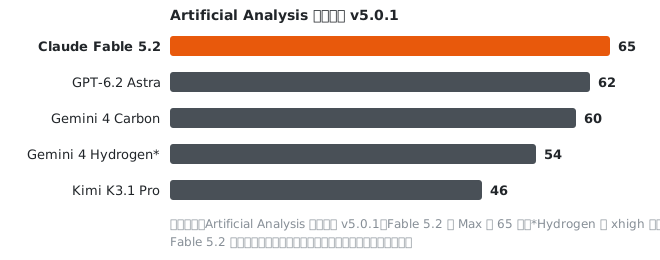
| Gemini 4 Hydrogen | 54 (xhigh) / 51 (default) | $1.50 / $7.50 | 1M tokens | No |
| Kimi K3.1 Pro | 46 | $2 / $10 | 1M tokens | Yes (custom license) |
AA Index is Artificial Analysis' Intelligence Index v5.0.1; prices checked November 2026 — the checkout page is authoritative. For the full point-by-point comparison, see the Comparisons section.
03Charts
AA Intelligence Index, head to head — this topic's model in orange.
04Top 3 reads
Short on time? Start with these three.
05Timeline
Within a week of launch came three waves — independent boards, hands-on tests and community debate; the Pro trial window closed on day seven, and the IPO listing was planned for the same week.
- Early Sep 2026
Fable 5.1's AA index stood at 50 (The Decoder, citing AA readings); two months later Fable 5.2 topped the board at 65, up 15 points.
- 2026-11-09
Fable 5.2 and Mythos 5.2 launch: two configurations of the same underlying model, Fable generally available, Mythos for vetted organizations only. GitHub Copilot integrates on launch day (Pro+ / Max / Business / Enterprise). Vals Index 71.31%, No. 1; ARC-AGI-2 93.8% (xhigh, ARC Prize verified). VentureBeat and The Decoder report the same day.
- 2026-11-09
Anthropic research post: Fable 5.2 designs three working electronic devices from short prompts alone (with Diode Computers); BenchCAD 2.1 at 83.5% (Max), nearly double 5.1 — all three are uncertified prototypes. See section 09.
- 2026-11-09
DTBench (decision-theory dilemmas) lists Fable 5.2 first at 99.2% (238 configurations; Opus 5.5 second at 98.9%); reference only, outside the BenchLeader Index. Recorded by this site on Nov 16. See section 12.
- 2026-11-09
Epoch AI's Capabilities Index (ECI, an independent composite of 50+ benchmarks) is published: Fable 5.2 scores a record 174, ahead of GPT-6 Astra's previous record of 169, with Opus 5.5 also at 169 and Fable 5.1 at 167; the exact value is 173.44 with an uncertainty interval of 169.9–177.5 (overlapping Astra). Recorded by this site on Nov 18. See section 12.
- 2026-11-09 – 10
CursorBench 4.0 results: Fable 5.2 is 60.0% at Max (#3, $32.79 per task), 56.9% at High, 56.3% at XHigh, 54.8% at Medium and 53.2% at Low; Carbon leads at High with 60.4% and $9.22 per task (see section 12).
- 2026-11-10
Artificial Analysis lists it: Max at 65, No. 1 of 74 models. Anthropic's IPO roadshow starts (planned Nasdaq listing Nov 19/20 under ANT, targeting a $1–1.5 trillion valuation, per the Wall Street Journal — not finally confirmed). OpenCode adds it as a built-in model; Simon Willison publishes the five-tier pelican SVG test; Sulat rounds up Devin early-access builds.
- 2026-11-10
Plotly publishes its data-analysis exam: Fable 5.2 scores 43/43 — the board's third perfect score — but the run costs $35.74, the second-dearest of 45 models, while GPT-6.1 Sol scores the same for $2.61; all five hidden patterns and all five statistical traps are passed. See section 09.
- 2026-11-10
CodeRouter publishes a coding-agent test: of 30 sampled tasks, 24 count in the main comparison, and Fable solves 15/24 — the same 15 as Sonnet 5.5 at 20.4× the cost, and one fewer than Opus 5.5 at 8.0× the per-task cost; the direction matches The New Stack's finding. See section 09.
- 2026-11-10
Artificial Analysis and Google DeepMind publish MKA (Multimodal Knowledge Agent, Climb WSR): 200 private tasks across 10 industries, with Fable 5.2 (max) at 57%, No. 1, at $31.97 per task; Carbon (high) 54% No. 2 and Opus 5.5 53% No. 3, with the top-three gaps not statistically significant. See section 12.
- 2026-11-11
ComputingForGeeks publishes its hands-on test: per-task cost 56% higher than 5.1 on the medium tier, challenging the "20% cheaper" story. EasyTicket rounds up the AA 65 score and AA's own words, "particularly expensive."
- 2026-11-11
LMArena publishes the Agent Arena overall board: Fable 5.2 (Max) leads with a net improvement of 30.48% ±3.07, ahead of Opus 5.5 at 19.51% (2,822,562 real agent sessions, 59 models); on the WebDev board, Fable 5.2 (xHigh) tops the board at 1838, ahead of Opus 5.5's 1815 — the Nov 8 opening value of 1832 was AutoEval, and 1,215 human votes only arrived after Nov 11.
- 2026-11-12
Anthropic's new Supported Regions Policy takes effect: the list grows to 175 countries and regions (adding Vietnam, Nigeria and others), with mainland China, Hong Kong and Macao still excluded. OrcaRouter re-checks Anthropic's price list: $8/$40 unchanged, and not a limited-time introductory price. Cognition updates the FrontierCode 2.0 cheating scanner and rescores the whole board: Fable 5.2 moves from 49.11% to 50.18% at Xhigh and from 45.65% to 48.23% at Max (a rescore, not a new run).
- 2026-11-13
Drift in the AA model-page readings is recorded: Max time per task appears as 44.1, 45.3 and 46.8 minutes across snapshots (AA re-runs); MultiAI publishes hands-on tests including a roughly 900K-token document test. MathArena lists Fable 5.2 (Max) at 82.8%, second behind Carbon (High) at 85.4%.
- 2026-11-13
OrcaRouter publishes its real-traffic comparison: the AA testbed shows a 267s first token and 46.8 minutes per task, but 35.6M tokens of real traffic over 7 days show a p50 first token of just 8.09s (p95 10.00s); testbed output speed is 97 tok/s, 35% faster than Carbon's 72; the gap is explained by the effort tier.
- 2026-11-14
Andon Labs' Vending-Bench 2 lists Fable 5.2: a mean final simulated balance of $9,628.48 across six runs, above Fable 5.1's $5,422 but below GPT-6 Astra's $15,515 and Carbon's $16,484; the simulated balance is not real profit, and effort tier and other run conditions are unconfirmed.
- 2026-11-14
Artificial Analysis releases Coding Agent Index v2.1 (Terminal-Bench upgraded from 4.0 to 4.1): Claude Code + Fable 5.2 scores 58, tied with Claude Code + Opus 5.5 at 58; by tier, Max scores only 55.7 — the worst tier on the board.
- 2026-11-14
Bug Hunt Bench: Fable 5.2 tops the board at 58.0% (No. 1 of 27 results) in a blind review of 105 planted bugs.
- 2026-11-14
DuelLab's GameBench 2 overall board updates: Fable 5.2 leads at 95.0, with XHigh 99.2 / Medium 93.9 / Low 91.7; Carbon is second at 90.1 (see section 12).
- 2026-11-15
This site's re-check: the AA model page reads Max at 45.3 minutes per task and output speed at about 97–103 tok/s (5-day average, drifting); this page's figures use the day's readings and note the date.
- 2026-11-15
The New Stack publishes a three-task engineering test: Fable 5.2 and Opus 5.5 both score a perfect 150/150, but Fable costs $8.98 and takes 1,579 seconds against Opus's $2.29 and 701 seconds; the conclusion is to start with Opus 5.5 for routine engineering work (see section 09). Limits: each task ran once, and the two models' effort tiers are not matched under default API settings.
- 2026-11-15
The Decoder's painting feature: Fable 5.2 paints by simulating brushes in Python — about 700,000 strokes for a parking-lot shopping cart, 1,000–2,000 lines of code per painting, no external image model; on a real robot arm recreating The Starry Night, Fable — ahead in simulation — is beaten by Astra, which paints faster with finer control. See section 09.
- 2026-11-16
Read by this site: on SemiAnalysis's GDPx board, Fable 5.2 leads at 16.4% ($88.15 per task, the dearest on the board), ahead of Opus 5.5 at 12.0%; Scale AI SEAL's HiL-Bench puts it first at 80.0% (result dated Nov 11, first of 35 configurations). See section 12.
- 2026-11-16
Read by this site: on five Vals AI and Epoch AI boards (all results dated Nov 9), Fable 5.2 leads on every one — ProgramBench 19.0%, EBR-bench 90.5%, SimpleBench 94.9%, LMCA 70.6%, BioMysteryBench 83.7%. See section 12.
- 2026-11-16
Pro trial window closes: 23:59 PT, 15:59 Beijing time on Nov 17. After that, Pro's Fable usage moves to paid usage credits.
- 2026-11-17
Read by this site: on AA-Omniscience (high effort), Fable 5.2 scores 77.2% accuracy with a 58.0% hallucination rate — the highest of the four compared models; at max effort the hallucination rate is 59.3% and accuracy 79.1%, so the numbers are strongly effort-dependent (see section 12).
- 2026-11-18
This site corrects its ARC-AGI-3 figures: against the Nov 17 ARC Prize board (Semi-Private set), Fable 5.2's ARC-AGI-3 is 81.2% (xhigh, best tier; high 79.3%, max 65.7%) and GPT-6.2 Astra's is 70.3% (max); this site had previously used the previous-generation GPT-6 Astra's score as the GPT-6.2 Astra comparison. Sections 09 and 12 and two older articles are corrected together. Also: DataCamp publishes a same-prompt Astra-vs-Fable test (a Collatz-conjecture video script) — a near-tie on quality, but all three Fable videos repeat an outdated fact; and on Epoch's Nov 18 ECI board Astra rises to 174, tying Fable. See sections 09 and 12.
- 2026-11-18
Coarena's computer-use leaderboard lists Fable 5.2 for the first time: #3 of 26, with a ~42.1% win rate, a self-reported agent completion rate of 84.3%, a median 3.2 minutes per task and about $3.41 per completion; first in Forms and shopping and in Data extraction, #2 in Web research, #3 in Coding and #4 in Site testing; on the phone board it is #5 of 24 (rating 1059±42) with a 72.7% completion rate (#23 of 24) (read by this site on Nov 19; the board refreshes every 5 minutes, so these are a read-date snapshot; run at medium effort). See section 12.
- 2026-11-18
Mercor publishes the first OpenWorldEngineer (OWE-Bench, 26 long-horizon engineering tasks) results: GPT-6.2 Astra debuts at 67.2% and takes No. 1, while Fable 5.2 drops to No. 2 at 54.6% (the benchmark itself launched Nov 12; Fable's score was already on this page). Artificial Analysis publishes AA-Robotics v0.1 (a real robot arm, research preview): Fable is 75, third (Astra 79, Sol 78), but is the first to complete the measure-a-box task (reading tape-measure markings on video to estimate box size). On AA-3D, Astra takes No. 1 at 1,318 Elo and Fable drops to second at 1,271. See section 12.
- 2026-11-19/20
KingBench 4 (Peter Gostev, YouTube video): six one-prompt app builds; Fable 5.2 leads 18 models with 42.0/60, 4.1 points ahead of Neon (37.9); one tester, a six-task mini-suite — see section 09.
- 2026-11-19/20
Planned IPO listing dates (not finally confirmed; this site will update after listing).
- 2027-03-08
Trial resets for Max, Ultra and Team advanced seats expire (23:59 PT).
- 2027-11-09
Retirement commitment: not before this date.
06Official specs
As published by Anthropic (launch page, models overview and the Artificial Analysis model page, re-checked Nov 15, 2026). This site could not open the system-card PDF directly; the table 8.1.A figures are corroborated by six independent secondary sources.
- Status
- Released (GA, 2026-11-09)
- Model ID
- claude-fable-5-2 (Claude API, Google Cloud, Microsoft Foundry); anthropic.claude-fable-5-2 (Bedrock)
- Architecture / parameters
- Not disclosed by Anthropic
- Context window
- 1M tokens (default is the maximum)
- Max output
- 128K tokens
- Input
- Text, image (VIALS-AA lab-image reading at 67.1% is measured evidence of image input)
- Output
- Text
- Effort tiers
- low / medium / high / xhigh / max; adaptive thinking always on, cannot be disabled; API defaults to high, the Claude app and Claude Code default to medium
- Knowledge cutoff
- June 2026
- Output speed
- Up to 30% faster than Fable 5.1 (vendor claim); AA 5-day average about 97–103 tok/s (Nov 15, 2026 reading, drifting)
- Safety filtering
- False blocks of legitimate requests down about 55% (Anthropic early-testing figure)
- API price
- $8 in / $40 out per 1M tokens; Fast $16/$80; Batch $4/$20; cache reads $0.20
- Data retention
- Mandatory 30 days (Covered Model); zero retention only with special Anthropic authorization
- Retirement
- Not before 2027-11-09
- Benchmarks
- AA index 65 (Max, v5.0.1); Vals Index 71.31%
07How to try it: five routes + a Claude Code section
Fable 5.2 has no free tier: the API bills by usage, and subscriptions draw on Pro/Max/Team/Ultra allowances. Fastest starts are Claude Code and the Claude app; cloud platforms suit teams already on a cloud bill.
1Claude API (official main route)
Model ID claude-fable-5-2, called directly through the Messages API, default effort tier high. Fast mode ($16/$80, up to 2.5× faster generation) is available only on the Messages API, Claude API, Google Cloud, Microsoft Foundry and Claude Code — not on Bedrock. Batch API bills at $4/$20; cache reads are $0.20.
2Claude app (Pro / Max / Team / Ultra)
Subscribers pick Fable inside the Claude app. The launch-week trial window ran Nov 9–16: Pro and Team standard seats could count all Fable models against subscription usage, capped at 50% of the weekly allowance, plus one free limit reset (expiring the same day); Max, Ultra and Team advanced seats received 1–3 resets by tenure, expiring March 8, 2027. After the window, Pro's Fable usage moves to paid usage credits (billed at API rates, opt-in required). The Free plan has no Fable. See our trial explainer.
3Cloud platforms: Bedrock, Google Cloud, Microsoft Foundry
All three are live. Bedrock's model ID is anthropic.claude-fable-5-2 and offers no Fast mode; Foundry's Fast-mode ID is claude-fable-5-2-fast; Google Cloud offers both standard and Fast modes. Teams already on a cloud bill can route through cloud billing and compliance.
4GitHub Copilot and OpenCode
GitHub Copilot integrated on launch day (Pro+ / Max / Business / Enterprise plans); OpenCode added it as a built-in model on Nov 10. Good for switching models side by side inside tools you already use.
5Agent platforms such as Devin (early access)
Devin opened early-access testing in launch week, with several testers trying it free; most results are unverified by independent checks and should be read as anecdotal. Sulat rounded up the early testers' builds — see section 09.
Claude Code: version, tiers and commands
Claude Code is the strongest follow-up search cluster, so it gets its own section: it requires Claude Code 2.1.321+; use /effort to switch effort tiers — Claude Code defaults to medium (the API defaults to high, don't confuse the two); the CLI takes claude --model claude-fable-5-2; in 2.1.321+ the fable alias resolves to 5.2, while older versions resolve it to 5.1, so check your version before upgrading. The community's consensus pattern is split routing: Fable plans, Opus 5.5 executes — "Fable 5.2 plans, Opus 5.5 executes" was the most-liked launch-week post (Matt Shumer, about 2,800 likes).
08Pricing
The rate card fell 20%, but the bill may not — Fable 5.2 is more verbose, writing twice the tokens of 5.1. Prices checked Nov 12–15, 2026; the checkout page price is authoritative.
| Item (per 1M tokens) | Fable 5.2 | Fable 5.1 | Opus 5.5 |
|---|---|---|---|
| Input | $8 | $10 | $4 |
| Output | $40 | $50 | $20 |
| Fast mode (input / output) | $16 / $80 | — | — |
| Batch (input / output) | $4 / $20 | — | — |
| Cache reads | $0.20 | — | $0.20 (same as Fable) |
| Cache writes (5 min / 1 hour) | $10 / $16 | — | — |
Per-task cost: Max $26.54, High $9.08
Artificial Analysis' independent measurement gives cost per index task (Nov 15, 2026 reading): Low $3.10, Medium $3.80, High $9.08, Xhigh $14.83, Max $26.54. Max is about 2.6× Opus 5.5's per-task cost and about 4.8× Carbon's — the most expensive on the board; High scores 62, just 3 points below Max, at under 35% of its cost. The FrontierCode 2.0 tier sweep (system card §8.4, reported by VentureBeat) tells the same story: High at $6.72/task nearly ties Opus Max at $12.82 (45.3% vs 45.5%), while Max at $44.70 scores below Xhigh's 49.1%.
The counter-evidence: a 20% cut, a 56% dearer bill
ComputingForGeeks ran three DevOps tasks via OpenRouter (locked to Anthropic): on the medium tier Fable 5.2 wrote twice the tokens of 5.1, and the three tasks cost $0.446 against 5.1's $0.285 — 56% more per task; on high, three tasks cost $0.838 against 5.1's $0.329; in the same run Opus 5.5 cost $0.208 and Sonnet 5.5 $0.047. The per-token price fell, but the model got chattier, and the actual bill went up — the strongest counter-evidence in the pricing story, on a three-task sample that needs more replication.
Official pages: Anthropic official launch page · Artificial Analysis model page · Vals model page
09First hands-on reviews
Mostly from the first wave, Nov 9–15, plus a small six-task KingBench 4 test from Nov 19–20: independent bodies confirm the No. 1 ranking, but three findings cut against the launch story — Max is not the best tier, cheaper rates don't mean cheaper bills, and the leader has weak spots. Every entry carries a verdict badge; "Read on this site" opens our rewritten deep-dive article, with the original source at the end.
Artificial Analysis independent measurement: 65 tops the board, at the highest cost and slowest pace
Verdict: The No. 1 ranking holds; "particularly expensive" is AA's own wordingSource: Artificial Analysis, listed Nov 10, 2026; model page read Nov 15, 2026
Intelligence Index v5.0.1: Max 65 (No. 1 of 74 models), High/Xhigh 62, Medium 56, Low 54; wins 5 of 9 evaluations (HLE-Diamond 80%, Terminal-Bench-Science 73% and others); AA-3D 1,271 Elo, No. 2 (Astra took No. 1 at 1,318 on Nov 18); VIALS-AA 67.1%, No. 1. But Max costs $26.54 per task and takes about 45.3 minutes (Nov 15 reading, drifting with AA re-runs), with time to first token around 268 seconds; AA-Briefcase Elo 1785 trails Opus 5.5's 1800 and Sonnet 5.5's 1813; Terminal-Bench 4.0 at 59.6% ranks only fourth.
Read on this site → (original ModelBrief rewrite)
Vals Index: 71.31%, No. 1 — with the lead inside the margin of error
Verdict: A double first; the weak sub-scores are just as clearSource: Vals AI, Nov 9, 2026 (run at High)
Vals Index v2.2 at 71.31% ±0.96, No. 1 of 36 models; Vibe Code Bench v1.1 at 93.77%, No. 1 of 127; Finance Agent v2.1 69.47% and EMB v1.1 77.38%, both No. 1; Terminal-Bench 4.0 65.15%, tied No. 1 with Opus 5.5; $17.94 per test, 0% refusal rate. But the lead is inside the margin of error (Sonnet 5.5 70.85%, Carbon 70.45%), and weak sub-scores stand out: Tax Agent Bench 27/84 (32.09%), Legal Research Bench 19/93 (46.15%).
Read on this site → (original ModelBrief rewrite)
Simon Willison's pelican test: Max thought until its tokens ran out and returned nothing
Verdict: Directly refutes "higher tier is better"Source: Simon Willison, Nov 10, 2026 (five-tier pelican-riding-a-bicycle SVG test)
Xhigh produced his favourite result; Max burned 128,000 thinking tokens and still returned no SVG — the same bug as Opus 5.5, and the first time it has appeared in the Fable line (Max on Fable 5 and 5.1 drew the picture fine). A Nov 11 follow-up: Fable 5.2 is sensitive to code attribution, tending to build on existing structure when no attribution is given. He also used Fable 5.2 to locate the source of a mysterious beeping sound.
Read on this site → (original ModelBrief rewrite)
ComputingForGeeks hands-on: a 20% cut, a 56% dearer bill
Verdict: The strongest evidence against the "cheaper" storySource: ComputingForGeeks, Nov 11–12, 2026 (OpenRouter locked to Anthropic, 3 DevOps tasks, scored on an Ubuntu 26.04 experimental VM)
On medium, Fable 5.2 wrote twice the tokens of 5.1: three tasks cost $0.446 against 5.1's $0.285; on high, three tasks cost $0.838 against 5.1's $0.329; in the same run Opus 5.5 cost $0.208 and Sonnet 5.5 $0.047. Fast mode and security-refusal reruns were also tested. A three-task sample — more replication is needed.
Read on this site → (original ModelBrief rewrite)
Casagbic SQL test: 320/320, but the premium is nearly pure waste
Verdict: On accuracy-ceiling tasks, Fable's premium doesn't paySource: Casagbic, Nov 10, 2026 (1,280 SQL queries, 4 models)
Fable 5.2 scored 320/320 on the low/medium tiers (not the default high) at $0.029 per query; Haiku 5.5 scored 319/320 at about 54× lower cost. The post also notes that the Oracle SQL case cited on Anthropic's launch page "ran but totalled 5–8× too high."
Read on this site → (original ModelBrief rewrite)
FinOps six-task coding test: Fable doesn't beat Opus on a small sample
Verdict: Six tasks is a sample, not a rankingSource: FinOps LLM, Nov 10, 2026 (6 coding tasks, same prompts)
Opus 5.5 and GPT-6.1 Sol passed 6/6, Fable 5.2 5/6, Carbon 3/6 (a Flex-routing 1,100-token cap — a routing artifact, not model capability); Fable's total spend was $0.2772.
VentureBeat on the system card: Max at $44.70 scores below Xhigh
Verdict: The core evidence that Max is not the best tierSource: VentureBeat, Nov 9, 2026 (citing the system card §8.4 FrontierCode tier sweep)
Low 34.2% / $2.10, Medium 37.6% / $2.48, High 45.3% / $6.72, Xhigh 49.1% / $14.19, Max 45.7% / $44.70. Max costs 3.15× Xhigh and scores 3.4 points lower; 22 of Max's 660 runs timed out and were still scored — counted as zero, Max would be 44.4% (below Opus 5.5's 45.5%). High nearly ties Opus Max (45.3% vs 45.5%) at about half the cost per task.
Read on this site → (original ModelBrief rewrite)
ARC Prize / Epoch AI: xhigh beats max again
Verdict: The tier inversion is not a one-offSource: ARC Prize / Epoch AI, Nov 9–10, 2026 (via waitwhichmodel.fyi and sugra.systems)
ARC-AGI-2 93.8% (xhigh, ARC Prize verified, the highest verified score; max 92.5%, high 90.4%); ARC-AGI-3 81.2% (xhigh, best tier; high 79.3%, max 65.7%), against GPT-6.2 Astra's 70.3% (max); GPQA Diamond 93.9% (Epoch AI, max tier). Xhigh beating max on ARC-AGI-2 matches the FrontierCode inversion. Correction: this site previously used the previous-generation GPT-6 Astra's score as the GPT-6.2 Astra comparison; corrected against the Nov 17 ARC Prize board.
The Decoder: it tops the board, but Opus stays the daily default
Verdict: Even Anthropic doesn't position Fable as the defaultSource: The Decoder, Nov 9, 2026
AA 65 tops the board, 15 points above Fable 5.1 in early September; wins 5 of 9 evaluations; Opus 5.5 remains Anthropic's recommended daily default. The piece also notes Fable trailing some rivals on agentic knowledge work and terminal coding.
Read on this site → (original ModelBrief rewrite)
The Decoder's painting feature: Fable doesn't generate images — it paints them
Verdict: first in simulation, beaten by Astra on the real robotSource: The Decoder, Nov 15, 2026, 23:42 Original →
Anthropic's Jake Eaton had Fable 5.2 paint by simulating real brushes in Python: a parking-lot shopping cart took about 700,000 strokes, each painting needing 1,000–2,000 lines of code, with no external image model involved; Graczyk's sunrise bird used just 111 strokes, and every stroke was irreversible — a mistake had to be painted over, not undone. Aris Zhu put the painting on a real robot arm to recreate The Starry Night: in simulation Fable's RoboDojo 64.9% dwarfs Astra's 29.8%, but on the real arm Astra painted faster and with finer control. Limits: a demonstration, not a standardized benchmark; the RoboDojo score itself is already in section 12.
Community consensus: Fable plans, Opus executes
Verdict: Split routing is the launch week's most-endorsed patternSource: X / Reddit, Nov 9–14, 2026 (community discussion, not measurement)
"Fable 5.2 plans, Opus 5.5 executes" (Matt Shumer, about 2,800 likes, the most-liked launch post); "Don't use Fable 5.2 Max" (@Yuchenj_UW, with the official FrontierCode chart); "Opus 5.5 is not suddenly obsolete… Fable 5.2 is just a better boss" (@rohit3a — Fable Medium orchestrates, Opus executes). An r/ClaudeCode thread asks whether Opus 5.5 is really better than Fable in daily use — most askers hadn't tested it yet.
Andon Labs Vending-Bench 2: six simulated runs average $9,628
Verdict: far above 5.1, still clearly behind Astra and CarbonSource: Andon Labs Vending-Bench 2 (checked by Kingy, Nov 14, 2026)
Each shop starts with $500 and a 365-day simulated horizon: Fable 5.2's six runs average a final simulated bank balance of $9,628.48 (standard error of the mean $726.25), above Fable 5.1's $5,422 on the same board but below GPT-6 Astra's $15,515 and Carbon's $16,484. Mind the measure: this is a simulated balance, not real profit and not a general autonomy metric; effort tier, endpoint, retries and trial dates are unconfirmed, individual run traces were not reviewed, and six runs are a small sample.
OrcaRouter real-traffic check: first token in 8.09s, not 267s
Verdict: 267s doesn't describe everyday use; long tasks still go by the testbedSource: OrcaRouter, Nov 13, 2026 (7 days of real traffic, 35.6M tokens)
On the AA testbed, Fable 5.2's first token takes 267s, each task 46.8 minutes, and each round costs $26.54 (at the Max effort tier); but across 35.6M tokens of real gateway traffic over 7 days, the p50 first token is just 8.09s and the p95 10.00s. Testbed output speed is 97 tok/s, 35% faster than Carbon's 72. The 7-day non-2xx error rate is 10.8% (Carbon 39.7%). The only explanation for the gap is the effort tier: the testbed measures long tasks at maximum effort, while the gateway measures median requests at caller-chosen effort. The takeaway: 267s doesn't describe everyday interactive use, but long tasks and batch workloads should still go by the testbed figures.
Read on this site → (original ModelBrief rewrite)
The New Stack's three-task engineering test: same score as Opus 5.5, about 4× the cost and 2.3× the time
Verdict: On everyday engineering work, the flagship premium buys no pointsSource: The New Stack (via GazeWire), Nov 15, 2026 (cron scheduler, invoicing-repo bug fix and incident investigation, three difficulty levels each, default API settings) Original →
Across three engineering tasks at three difficulty levels each, both models scored a perfect 150/150 — but Fable 5.2 totalled $8.98 and 1,579 seconds against Opus 5.5's $2.29 and 701 seconds: the same score at about 4× the cost and 2.3× the time. The test's conclusion is to start with Opus 5.5 for this kind of routine work. Limits: each task ran once; under default API settings the two models' effort tiers are not matched (Fable defaults to high, Opus to medium), so part of the cost gap is thinking volume, not capability.
Plotly data-analysis exam: 43/43, full marks — but the second-dearest run on the board
Verdict: the perfect score holds; it sits off the cost–accuracy frontierSource: Plotly, Nov 10, 2026 (43-question DataAnalyticsBench, standard mode) Original →
On the same 43-question data-analysis exam, Fable 5.2 answered all 43 correctly — the third model on the board to score full marks (after GPT-6.1 Sol and GPT-6 Astra), four questions ahead of 5.1's 39/43. It found all five hidden patterns — only 6 of 45 models managed that — and passed all five statistical traps, where 5.1 scored 3/5 on each. But the whole run cost $35.74, the second-dearest of 45 models: GPT-6.1 Sol scored the same full marks for just $2.61. List prices are 20% below 5.1, yet the run cost more ($35.74 vs $31.49): it used more tokens (10.1M vs 9.0M), and the bulk of the bill was cache writes — 2.1M tokens written at $10 per million, about $21, with output around $13 and cache reads about $1.50. Speed doesn't help either: a median 40 seconds per question (5.1 and Opus 5.5 at 27s, Sol at 18s); this run used standard mode, with the 2×-priced fast mode untested. Its method is not brute force: on open-ended questions it averaged 33 queries on hidden-pattern items (board median 25), under half of Ember's count, and still found them all; the median was 5 queries per question and answers of about 200 words. Limits: each model ran once.
CodeRouter coding-agent test: the same solves as Sonnet 5.5 at 20× the cost
Verdict: same score, 8× Opus's per-task cost; the direction matches The New Stack's findingSource: CodeRouter, Nov 10, 2026 (updated Nov 12; 30 tasks sampled from SWE-rebench 2026_03, mini-swe-agent 2.4.6, default API settings) Original →
Thirty tasks sampled at random from the 99-task SWE-rebench 2026_03 set, single-round, default API settings (Fable at its default high tier): six runs were cut off by the $10 session budget and excluded, leaving 24 tasks for the main comparison. Fable solved 15/24 — exactly the same 15 tasks Sonnet 5.5 solved — at 20.4× Sonnet's cost; against Opus 5.5 (16/24) it solved one fewer task at 8.0× the per-task cost ($1.571 vs $0.196), and 8.6× per solved task ($2.513 vs $0.293); counting the six cut-off runs as failures gives 15/30 against Opus's 18/30. The bill gap stacks two layers: a 1.8× price gap times 4.4× behaviour — 22,681 output tokens per run against Opus's 4,182 (5.4×), 37,850 cache-read tokens per request against 12,077 (3.1×), 18.0 requests per run against 11.2, thinking blocks in 78% of requests (Opus 45%), and 10 requests hitting the 8,192-token output cap (Opus none). This is a second, independent data point under a different agent harness, and it points the same way as The New Stack's three-task engineering test (same score, several times the cost). Limits: a small sample (24 tasks, 62.5% solve rate, 95% interval 43–79%); the other models ran on Nov 9 and Fable on Nov 10 (not interleaved); cache settings were not fully identical; session budgets differed ($10 for Fable, $2.50 for the rest); one agent harness, default API tier (Claude Code defaults to Medium, which thinks less and may cost less); the author builds CodeRouter (disclosed in the piece), whose router does not assign work to Fable 5.2 by default.
DataCamp same-prompt test: a near-tie on quality, but Fable loses on accuracy
Verdict: Quality is tied on a creative task — but all three videos state one fact wrong, at 5–10× the costSource: DataCamp, Nov 18, 2026 (one task, one tool — OpenCode — high tier, three runs each) Original →
The same task — write a 60-second Collatz-conjecture explainer video script in Manim — run three times per model on OpenCode at the high tier; all six videos rendered on the first try. Blind ratings on four dimensions (accuracy, teaching, entertainment, completion) differ by under 0.1 on average — a near-tie on quality; Fable is the steadier of the two, while Astra produces both the best and the worst runs. Accuracy splits them: all three Fable videos repeat the outdated claim that computers have checked the conjecture to 2^68 (the record as of 2020; since 2025 it is 2^71), while Astra states nothing false. Cost per video is $3.84–4.35 for Fable against $0.40–0.84 for Astra, with Fable emitting 4–10× the output tokens. DataCamp also cites an OpenAI chart: Harvey LAB-AA 15.0% for Astra vs 7.2% for Fable; FrontierCode 2.0 49.1% for Fable vs 44.2% for Astra; AA 62.1 vs 64.6. Limits: one task, one tester, a creative task — don't extrapolate.
Anthropic research post: three working electronic devices from short prompts alone
Verdict: The design files build as-is; all three are uncertified prototypesSource: Anthropic research post "Claude can design electronic prototypes from start to finish", Nov 9, 2026 (with Diode Computers) Original →
Working with Diode Computers, Fable 5.2 designed three working electronic devices from short prompts alone — a USB-C speaker phone, a voice-assistant hub and a handheld virtual pet; Diode manufactured them straight from Claude's design files, and all three prototype circuits worked with no modifications. On the public BenchCAD 2.1 benchmark it scored 83.5% (Max tier), nearly double Fable 5.1's 44.4%; on Diode's internal PCB Gym benchmark it scored 69%, against 25% for Fable 5. Limits: all three are uncertified prototypes — no electrical validation, antenna tuning, thermal testing or certification — so they cannot go straight into production; PCB Gym is Diode's internal benchmark; and Anthropic has a commercial relationship with Diode.
KingBench 4: six one-prompt app builds, Fable 5.2 42.0/60, #1 of 18
Verdict: wins the six-build race, 4 points clear of #2Source: Peter Gostev (YouTube video), Nov 19–20, 2026 (one tester, a six-task mini-suite; 18 models in the same run)
All six tasks are "one prompt, build a working app from scratch": a Rust simulator, a Go container runtime, a 3D room designer, a QMK keyboard configurator, a Pokémon Red remake, and a Rust Fitbit desktop app. Fable 5.2 scores 42.0/60, first of 18 models, 4.1 points ahead of second-place Neon (37.9), followed by Opus 5.5 (34.7), Astra (33.6), Carbon (32.0) and Hydrogen (24.9). The limits must be stated: a single tester and six tasks, a small sample, in video form with scoring details not fully disclosed — not a verdict.
Watch the original video → (youtube.com, video)
10Articles: our deep dives
The seven articles below are original ModelBrief rewrites and reorganization — restructured with added conclusions and buying advice, with facts and numbers checked against the original reviews. Read them on this site; each ends with its original source.
11Related topics
Topic pages for the other models on this site.
 MAI Code 2Released Nov 17, 2026 · Microsoft's first in-house coding flagship, live in GitHub Copilot on day one; Microsoft claims 98% of GPT-6.1 Sol's performance at 40% of the cost (50% promo price). The topic page covers official specs, pricing, benchmark analysis and 6 in-depth reviews.
LLM · Open weights · Released Nov 12, 2026
 Edge0-145BReleased Nov 12, 2026 · Edge0's first 145B on-device model, a latent MoE on a Qwen3.8-Flash-Next base, 256K context, weights public on HF under a custom community license (not open source). The topic page covers official specs, pricing, benchmark analysis and 6 in-depth reviews.
ModelBrief homeAll topicsBack to the home page: browse all 18 model topics by release date — LLMs, image models and video models.
12Benchmarks: official table + independent index
Anthropic published a 12-item main table plus a system-card appendix — comprehensive data, but all vendor-measured, with rival scores re-run by Anthropic rather than each vendor's published values. Check the conditions before the scores, then see what independent measurement says.
| Test (official launch page, vendor-reported) | Fable 5.2 | Fable 5.1 | Comparison |
|---|---|---|---|
| FrontierCode 2.0 (agentic coding) | 49.1% (Xhigh) | 32.4% (Xhigh) | Opus 5.5 45.5%; GPT-6 Astra 42.8%; Carbon 41.1% (Medium tier) |
| FrontierSWE v2 | 69.9% | 56.3% | Opus 5.5 62.3%; Astra 65.5%; Carbon 61.2% |
| AutomationBench (business processes) | 51.4% | 31.4% | Carbon 53.9% (Fable trails); Opus 5.5 42.5% |
| Terminal-Bench-Science 0.1 | 74.6% | 52.6% | Mythos 75.3%; Opus 5.5 58.7%; Astra 68.1% |
| Remote Labor Index (240 projects) | 41.3% (High, 99 completed) | 17.9% | Opus 5.5 21.3%; Astra 20.8% |
| Humanity's Last Exam (with tools) | 74.2% | 65.6% | Opus 5.5 67.7%; Astra 57.2% |
| AA-Briefcase v1.1 (rubric / Elo) | 66.1% / 1785 | 61.5% / 1669 | Opus 5.5 61.2% / 1800; Carbon 61.8% / 1611 |
| OSWorld 2.1 (offline partial) | 89.3% | 83.5% | Opus 5.5 87.2%; Astra 79.5%; Carbon 81.5% |
| WANDR (agentic search, relaxed) | 82.1% | 68.7% | Opus 5.5 72.3% |
| Chartography (no tools) | 73.4% | 44.8% | Opus 5.5 64.4%; Astra 71.0%; Carbon 72.5% |
| RoboDojo Sim (robotics, internal run) | 64.9% | 27.6% | Opus 5.5 39.4%; Astra 29.8% |
| SWE-bench Pro (system card table 8.1.A, Max) | 93.0% | 81.2% | Opus 5.5 89.9% (mean of 5 trials; not in the launch-page table) |
Independent index and third-party measurements
| Measurement | Source | Fable 5.2 result | Comparison |
|---|---|---|---|
| AA Intelligence Index v5.0.1 | Artificial Analysis, Nov 10 | 65 (Max), No. 1 of 74 | Carbon (High) 60; Opus 5.5 (Max) 59; GPT-6 Astra 57 |
| AA index by tier | Artificial Analysis | Low 54 / Medium 56 / High 62 / Xhigh 62 / Max 65 | High and Xhigh tie at 62, $5.75/task apart |
| AA cost per task | Artificial Analysis (Nov 15, 2026 reading) | Max $26.54; High $9.08; Medium $3.80; Low $3.10 | About 2.6× Opus 5.5; about 4.8× Carbon |
| AA time per task | Artificial Analysis (Nov 15, 2026 reading, drifting) | Max about 45.3 min; Xhigh 27.7; High 16.1 | Snapshots range 44.1–46.8 min as AA re-runs |
| AA Terminal-Bench 4.0 | Artificial Analysis (independent run) | 59.6% (Max/High; Xhigh 61.6%), 4th | Kimi K3.1 Pro 67.2%; Carbon 65.2%; Sonnet 5.5 63.6% |
| AA-3D (brief-to-3D, human blind rating) | Artificial Analysis | Elo 1,271, No. 2 | GPT-6.2 Astra 1,318, No. 1 (took the lead Nov 18); Opus 5.5 1,202 |
| VIALS-AA (lab-image reading) | Artificial Analysis, Nov 10 | 67.1% (all-three-correct), No. 1 of 21 | Carbon 64.0%; Astra 62.7%; 37.4 tool calls per task on average |
| Vals Index v2.2 | Vals AI, Nov 9 (High tier) | 71.31% ±0.96, No. 1 of 36 | Sonnet 5.5 70.85%; Carbon 70.45% (lead inside the margin of error) |
| Vals Terminal-Bench 4.0 | Vals AI | 65.15%, tied No. 1 with Opus 5.5 | A different runner from AA's 59.6% — don't mix them |
| ARC-AGI-2 / ARC-AGI-3 | ARC Prize verified (via secondary reports) | 93.8% (xhigh, highest verified score) / 81.2% (xhigh, best tier) | ARC-AGI-2: max 92.5%, high 90.4%; ARC-AGI-3: high 79.3%, max 65.7%; GPT-6.2 Astra 70.3% (max); the figure previously used as the Astra comparison was GPT-6 Astra's, the previous generation |
| GPQA Diamond | Epoch AI (max tier) | 93.9% | — |
| SimpleQA Verified | Epoch AI figures (via AIPings compilation) | 94% | Strongest rival about 76% |
| MathArena (math) | MathArena, Nov 13 | 82.8% (Max), 2nd | Carbon (High) 85.4%, 1st; Sol (Max) 80.6%, 3rd; the 2.6-point gap to first is inside the 95% confidence intervals (±5.3 / ±3.0); $40.20 per problem, about 38× Sol |
| Vending-Bench 2 (simulated business) | Andon Labs, Nov 14 | $9,628.48 (mean of 6 runs) | Fable 5.1 $5,422; GPT-6 Astra $15,515; Carbon $16,484; simulated balance, not real profit; effort tier and other run conditions unconfirmed |
| Coding Agent Index v2.1 (Terminal-Bench upgraded to 4.1) | Artificial Analysis, Nov 14 | 58, tied with Claude Code + Opus 5.5 | Fable 5.1 52.5; GPT-6 Astra 53.1; by tier High 58.2 ($7.51/task), Xhigh 58.5 ($15.47), Max only 55.7 ($44.22) — Max is the worst tier on this board; the first board that does not support the "Fable is worth twice the price" conclusion |
| LMArena Code Arena WebDev | LMArena, Nov 8–11, 2026 | 1838 (xHigh), No. 1 | Opus 5.5 1815; the Nov 8 opening value of 1832 was AutoEval (machine-predicted score, zero human votes) — 1,215 human votes only arrived after Nov 11 |
| LMArena Agent Arena overall board | LMArena, Nov 11, 2026 | Net improvement 30.48% ±3.07, No. 1 | Opus 5.5 19.51%; 2,822,562 real agent sessions, 59 models; 30.48% is a net improvement, not a success rate |
| BenchCAD 2.1 (electronics design) | Anthropic research post, Nov 9 | 83.5% (Max) | Fable 5.1 44.4%, nearly double; public benchmark |
| Bug Hunt Bench (blind review of planted bugs) | Bug Hunt Bench, Nov 14 (mirror: Inference360) | 58.0%, No. 1 of 27 results | Blind review of 105 planted bugs; 58.0% is a percentage, not a bug count |
| GDPx (professional-task agent benchmark) | SemiAnalysis, v1.0 Nov 2 (read Nov 16) | 16.4%, No. 1 | Opus 5.5 12.0%, 2nd; Carbon 10.9%, 3rd; $88.15 per task, the dearest on the board; 206 tasks across 11 domains; Fable was not on the Nov 2 launch board — added after launch |
| HiL-Bench (does the agent ask when a task is underspecified) | Scale AI SEAL (via BenchLeader snapshot, Nov 15), result dated Nov 11 | 80.0%, No. 1 of 35 configurations | Muse Wonder 79.7%, 2nd; GPT-6.1 Terra 68.0%, 3rd; Opus 5.5 59.0%, 13th |
| ProgramBench (reverse engineering: rebuilding source from binaries) | Vals AI (via BenchLeader snapshot, Nov 16), result dated Nov 9 | 19.0%, No. 1 of 65 configurations | Opus 5.5 18.5%, 2nd; reference only, outside the BenchLeader Index |
| EBR-bench (evidence-based reasoning) | Epoch AI Benchmarking Hub (via BenchLeader snapshot, Nov 16), result dated Nov 9 | 90.5%, No. 1 of 31 configurations | Carbon 87.6%, 2nd; reference only, outside the BenchLeader Index |
| SimpleBench (trick questions humans find easy) | SimpleBench (via BenchLeader snapshot, Nov 16), result dated Nov 9 | 94.9%, No. 1 of 111 configurations | Carbon 92.6%, 2nd; human baseline about 84%; small item count, feeds the BenchLeader reasoning score |
| LMCA (broad capability assessment) | Epoch AI Benchmarking Hub (via BenchLeader snapshot, Nov 16), result dated Nov 9 | 70.6% (xhigh), No. 1 of 201 configurations | Sonnet 5.5 68.3%, 2nd; this version caps at 85; reference only |
| BioMysteryBench (end-to-end bioinformatics analysis) | Vals AI (via BenchLeader snapshot, Nov 16), result dated Nov 9 | 83.7%, No. 1 of 31 configurations | Sonnet 5.5 81.1%, 2nd; reference only |
| LiveBench 2.0 (generalist long-horizon tasks) | LiveBench, read Nov 16, 2026 (current release dated Nov 6) | 84.9%, No. 1 overall | Agentic 82.9, Design 85.1, Coding 79.2, Browser 86.9, Data Analysis 81.5, Research 94.5, Reasoning 88.8; $9.850 per successful task |
| DTBench (decision-theory dilemmas) | Epoch AI Benchmarking Hub (via BenchLeader snapshot, Nov 16), result dated Nov 9 | 99.2%, No. 1 of 238 configurations | Opus 5.5 98.9%, 2nd; reference only, outside the BenchLeader Index |
| Epoch Capabilities Index (ECI, composite of 50+ benchmarks) | Epoch AI, Nov 9, 2026 (recorded by this site Nov 18) | 174, tied with GPT-6.2 Astra | Exact value 173.44, uncertainty interval 169.9–177.5; on the Nov 18 board GPT-6.2 Astra also scores 174 (11 benchmarks, interval 170–179); Opus 5.5 169, Fable 5.1 167; Epoch notes the absolute value is meaningless on its own — only comparisons between models matter |
| Plotly DataAnalyticsBench (data-analysis exam) | Plotly, Nov 10 | 43/43, the third perfect score of 45 models | 5.1 39/43; whole run $35.74, second-dearest; GPT-6.1 Sol also perfect for $2.61; median 40s per question; each model ran once |
| SWE-rebench 2026_03 (coding agent, 30-task sample) | CodeRouter, Nov 10 (updated Nov 12) | 15/24 (main comparison; 15/30 counting cut-offs) | Same 15 solves as Sonnet 5.5 at 20.4× the cost; Opus 5.5 16/24 at 8.0× lower per-task cost; small sample, 95% interval 43–79% |
| GameBench 2 overall (game development) | DuelLab, updated Nov 14, 2026 | 95.0, #1 | XHigh 99.2 / Medium 93.9 / Low 91.7; Carbon 90.1, 2nd |
| CursorBench 4.0 | Cursor (via BenchLeader), Nov 9–10, 2026 | Max 60.0% #3 ($32.79/task) / High 56.9% / XHigh 56.3% / Medium 54.8% / Low 53.2% | Carbon High 60.4% #1, $9.22 per task; Max is the most expensive tier on the board |
| CursorBench 4.1 | Cursor (Cursor changelog, Nov 18, 2026) | Max 61.3% #5, $48.11 per task | Version 4.0 had Max at 60.0% #3, $32.79 per task; in 4.1 the score is higher but the rank falls, and the per-task cost rises to $48.11; scores across versions are not directly comparable |
| AA-Omniscience (high effort) | Artificial Analysis (via BenchLeader model page, read Nov 17, 2026) | Accuracy 77.2%, hallucination rate 58.0% | Highest hallucination rate of the four compared models; max effort: accuracy 79.1%, hallucination 59.3% — strongly effort-dependent |
| Coarena computer-use leaderboard | Coarena, read by this site Nov 19 | #3 of 26, ~42.1% win rate | Self-reported agent completion 84.3%, median 3.2 minutes per task, ~$3.41 per completion; first in Forms and shopping and Data extraction, #2 in Web research, #3 in Coding, #4 in Site testing; phone board #5 of 24 (rating 1059±42), phone completion 72.7% (#23 of 24); run at medium effort; the board refreshes every 5 minutes, so these are a snapshot |
| Mercor OpenWorldEngineer (OWE-Bench, 26 long-horizon engineering tasks) | Mercor, Nov 18 (official LinkedIn post, via the Latent Space newsletter) | 54.6%, No. 2 | GPT-6.2 Astra debuts at 67.2% and takes No. 1; the benchmark itself launched Nov 12 and Fable's score was already on this page — the new item is Astra's first disclosure and the ranking change |
| AA-Robotics v0.1 (real robot arm, research preview) | Artificial Analysis, Nov 17 | 75, No. 3 | Astra 79 first, Sol 78 second, Hydrogen 58; Fable is the first to complete the measure-a-box task (reading tape-measure markings on video to estimate box size); a research preview, mostly basic tasks |
| MKA (Multimodal Knowledge Agent, Climb WSR) | Artificial Analysis × Google DeepMind, Nov 10, 2026 | 57%, No. 1 (max effort, $31.97 per task) | 200 private tasks across 10 industries; Carbon (high) 54% No. 2, Opus 5.5 53% No. 3; the top-three gaps are not statistically significant (Google's report: 56.56% vs 54.34%, 95% CI −0.94 to +5.49); Fable leads in 5 verticals |
Full tally: our benchmarks article →
13Comparisons
vs Fable 5.1 (predecessor)
| Dimension | Fable 5.2 | Fable 5.1 |
|---|---|---|
| AA Intelligence Index | 65 (Max) | 50 (early-September reading, The Decoder's figure) |
| Price (input / output) | $8 / $40 | $10 / $50 (5.2 is 20% cheaper) |
| Output speed | Up to 30% faster than 5.1 (vendor claim) | — |
| Safety-filter false blocks | Down about 55% (Anthropic early-testing figure) | — |
| FrontierCode 2.0 | 49.1% (Xhigh) | 32.4% (Xhigh) |
| FrontierSWE v2 | 69.9% | 56.3% |
| SWE-bench Pro | 93.0% (Max, system card) | 81.2% |
| Measured per-task cost | 3 DevOps tasks at Medium: $0.446 | Same tasks: $0.285 (5.2 was 56% dearer) |
The upgrade is real: 15 index points higher, 20% cheaper per token, faster output. But ComputingForGeeks' hands-on test warns that a cheaper rate card doesn't mean a cheaper bill — 5.2 wrote twice the tokens of 5.1, and three DevOps tasks cost 56% more.
vs Opus 5.5 (the in-house default — the core comparison)
| Dimension | Fable 5.2 | Opus 5.5 |
|---|---|---|
| AA Intelligence Index | 65 (Max) | 59 (Max) |
| Price (input / output) | $8 / $40 | $4 / $20 (Fable is 2×) |
| Cost per index task | Max $26.54; High $9.08 | About $10.2 (Fable Max about 2.6×) |
| FrontierCode 2.0 | 49.1% (Xhigh); High 45.3% / $6.72 | 45.5% (Max / $12.82) |
| Terminal-Bench 4.0 (AA run) | 59.6% (tied with Opus) | 59.6% |
| Terminal-Bench 4.0 (Vals run) | 65.15% (tied No. 1) | 65.15% (tied No. 1) |
| AA-Briefcase Elo / rubric | 1785 / 66.1% | 1800 / 61.2% |
| SWE-bench Pro (system card) | 93.0% | 89.9% |
| Remote Labor Index | 41.3% | 21.3% |
| FinOps six-task coding test | 5/6 | 6/6 |
| Anthropic's official advice | The hardest long-horizon tasks | The default start for most coding and knowledge work |
The in-house verdict is clean: Fable wins 14 of 16 headline results (system-card count), but the two losses sit in high-frequency daily work — AA-Briefcase Elo and GDPval-AA. High-tier Fable nearly ties Max-tier Opus on FrontierCode (45.3% vs 45.5%) at about half the cost per task; starting daily work on Opus and stepping up to Fable High for hard tasks is the route Anthropic and the community both endorse.
vs Gemini 4 Carbon / GPT-6 Astra / GLM 5.2
| Model | AA index | Price $/1M (in/out) | Cost per index task | One thing it beats Fable on |
|---|---|---|---|---|
| Claude Fable 5.2 | 65 (Max) | 8 / 40 | $26.54 (Max) | — |
| Gemini 4 Carbon | 60 (High) | 2 / 10 (intro price) | About $5.48 | AutomationBench 53.9% vs 51.4%; TB 4.0 AA run 65.2% |
| GPT-6 Astra | 57 | — | $6.24 | Under a quarter of Fable's per-task cost |
| GLM 5.2 | — | — | — | A real comparison query in EN and ZH autocomplete, but no dedicated comparison article exists as of Nov 15 |
Read the deep comparison: Fable 5.2 vs Opus 5.5 and Carbon →
14What's missing (as of Nov 15)
- A direct read of the system-card PDF (this site's fetch returned an empty response; the table 8.1.A figures are corroborated by six independent secondary sources, so the risk is low)
- Mythos 5.2 vetting criteria and the application-entry URL (only the two Verification Program names and organization-level admission are known)
- Final confirmation of the IPO listing date (Nov 19/20 is the plan, not finally confirmed)
- A same-day re-read of AA's time-per-task and output-speed figures (drifting values; this page uses the Nov 15, 2026 readings)
- Independent deep hands-on reproductions in English (current coverage is institutional boards plus small-sample hands-on tests)
- A dedicated Fable 5.2 vs GLM 5.2 comparison (real search demand exists; nothing public yet)
- Real usage-credits billing experience after the trial window closes (after Nov 16)
15Rumor check
Most confusion about Fable 5.2 comes from three places: unit price vs the bill, tier vs capability, and the three Terminal-Bench numbers — clarified one by one below.
Partly true "A 20% price cut means Fable is cheaper to use"
The unit price did fall: $8/$40 against 5.1's $10/$50. But ComputingForGeeks' hands-on test found medium-tier Fable 5.2 writing twice the tokens of 5.1, with three DevOps tasks costing $0.446 against 5.1's $0.285 — a 56% dearer bill. A cheaper rate card doesn't mean cheaper tasks; budget by per-task cost.
Not true "Max is the strongest tier"
On the FrontierCode 2.0 tier sweep, Xhigh scores 49.1% against Max's 45.7% while Max costs 3.15× more; on ARC-AGI-2, xhigh's 93.8% beats max's 92.5%; in Willison's pelican test, Max burned 128,000 thinking tokens and returned no SVG. Max leads only on the AA composite index (65 vs 62) and a few boards — not universally.
Clarified "Terminal-Bench 4.0 is 67.6%"
67.6% is Anthropic's system-card self-test; AA's independent run is 59.6% (Max/High; Xhigh 61.6%), and Vals' run is 65.15% (tied No. 1 with Opus 5.5). Three numbers from three runners, all correct, but not the same test — cite the runner, as in section 12.
Partly true "No. 1 of 104 models"
OrcaRouter's "No. 1 of 104" refers to AA's full board; the AA Intelligence Index board holds 74 models, where Fable Max's 65 ranks first. Use the 74-model basis when citing.
Not true "Fable 5.5 is already out"
"Fable 5.5" and "Claude Fable 5.5" once topped Google Trends' hot queries, but no such model exists — likely searches for the next generation. This site won't build a topic on it.
Not true "Fable and Mythos are two different models"
Anthropic's own words: "Claude Fable and Claude Mythos are the same underlying model." They are two configurations of one new model; the only difference is the safeguard layer — Fable's classifiers block high-risk cybersecurity and most research-biology requests (routing blocked requests to older models instead of refusing outright), while Mythos removes those blocks.
Not true "Mainland China can use the official API directly"
Mainland China, Hong Kong and Macao are not on Anthropic's official supported-regions list (the new policy effective Nov 12, 2026 covers 175 countries and regions), with no official API channel. The policy also bars use from unsupported regions and use by entities registered or headquartered there.
16FAQ
When was Claude Fable 5.2 released?
November 9, 2026 (Monday), generally available; Claude Mythos 5.2, the restricted same-base version, launched the same day. See section 05 for the timeline.
Is Claude Fable 5.2 free?
No. The Free plan has no Fable; the API bills at $8/$40 per 1M tokens. During the launch-week trial window (Nov 9–16), subscribers could count Fable against subscription usage, capped at 50% of the weekly allowance; after the window, Pro's Fable usage moves to paid usage credits (billed at API rates, opt-in required). See our trial explainer.
When does the Pro trial end?
The trial window ran Nov 9–16, 2026, ending at 23:59 PT on Nov 16 (15:59 Beijing time on Nov 17). The one free limit reset for Pro and Team standard seats expired the same day; the 1–3 resets for Max, Ultra and Team advanced seats (by tenure) expire March 8, 2027, 23:59 PT. Eligibility required paid billing before 10:00 PT on Nov 9.
Fable 5.2 or Opus 5.5 — which should I use?
Start daily coding and knowledge work on Opus 5.5 (Anthropic's official advice; Opus costs about 1/2.6 of Fable Max per task, and its AA-Briefcase Elo of 1800 beats Fable's 1785); step up to Fable 5.2 on High for the hardest long-horizon agent, science and research tasks — High nearly ties Opus Max on FrontierCode (45.3% vs 45.5%) at about half the cost per task. Reserve Max for tasks worth $26.54. See our comparison article.
Which effort tier should I use — medium or high?
Use high for most work: AA 62 at $9.08 per task, the score-per-dollar sweet spot; medium (56, $3.80) suits light tasks and is Claude Code's default starting point; xhigh ties high at 62 but costs $5.75 more per task — worth it only on tasks where xhigh beats max, such as FrontierCode and ARC-AGI-2; max (65, $26.54) is for the hardest tasks only, and note it can think until its tokens run out and return nothing on simple tasks (Willison's pelican test). The API defaults to high; the Claude app and Claude Code default to medium.
How much does it cost per task?
Artificial Analysis' cost per index task (Nov 15, 2026 reading): Low $3.10, Medium $3.80, High $9.08, Xhigh $14.83, Max $26.54. Max is about 2.6× Opus 5.5 and about 4.8× Carbon — the most expensive on the board. Also note ComputingForGeeks' finding: three DevOps tasks on medium cost $0.446, 56% more than 5.1 — a cheaper rate card doesn't mean a cheaper bill. See our pricing guide.
What is the model ID?
claude-fable-5-2 (Claude API, Google Cloud, Microsoft Foundry); anthropic.claude-fable-5-2 on Bedrock; claude-fable-5-2-fast for Fast mode on Foundry. In Claude Code, use claude --model claude-fable-5-2; the fable alias resolves to 5.2 in 2.1.321+.
What's the difference between Fable 5.2 and Mythos 5.2?
Two configurations of the same underlying model, with identical specs and pricing; the only difference is the safeguard layer. Fable's classifiers block high-risk cybersecurity tasks (penetration testing, exploit generation, binary vulnerability scanning) and most research-biology requests — blocked requests are routed to older models (cyber to Opus 4.8, biology to Opus 5) instead of being refused outright; Mythos removes those blocks. Mythos is available only to organizations vetted through the Cyber Verification Program or the Life Sciences Verification Program (organization-level admission, not personal); Claude Enterprise customers can also use it via Claude Security. Model ID claude-mythos-5-2.
Can it be used from mainland China?
Mainland China, Hong Kong and Macao are not on Anthropic's official supported-regions list, with no official API channel. The new policy effective Nov 12, 2026 expanded the list to 175 countries and regions (adding Vietnam, Nigeria and others), but mainland China, Hong Kong and Macao remain excluded; Taiwan, Singapore, Japan and India are on the list. This site states that fact only and does not describe or recommend any third-party gateway or workaround.
What does the AA 65 score mean?
Artificial Analysis' Intelligence Index v5.0.1 score is 65 (Max tier), No. 1 of 74 models — 5 points above Gemini 4 Carbon (High, 60), 6 above Opus 5.5 (Max, 59) and 8 above GPT-6 Astra (57); the gains come mainly from scientific reasoning, knowledge and FrontierCode 2.0. But the leader has weak spots: Terminal-Bench 4.0's AA run at 59.6% ranks only fourth, and AA-Briefcase Elo 1785 trails Opus and Sonnet. See our benchmarks article.
Is Terminal-Bench 4.0 59.6%, 65.15% or 67.6%?
Three numbers from three runners: AA's independent run 59.6% (Max/High; Xhigh 61.6%), Anthropic's system-card self-test 67.6%, and Vals' run 65.15% (tied No. 1 with Opus 5.5). On AA's board, Fable's 59.6% ranks fourth (Kimi K3.1 Pro 67.2%, Carbon 65.2%, Sonnet 5.5 63.6% ahead). Always cite the runner; don't mix them.
How many parameters does it have?
Anthropic has not disclosed the parameter count (the Artificial Analysis model-page FAQ states this explicitly). Any circulating parameter figure has no official source and is not used on this page.
17Sources
Every fact on this page comes from the public sources below (the official page and the AA model page read directly in the early hours of Nov 15, 2026; the rest checked Nov 13–16, 2026).
Official and independent boards
- Anthropic — Claude Fable and Mythos 5.2 (official launch page, with the 12-benchmark table; read Nov 14, 2026, 16:15 UTC) Nov 9
- Artificial Analysis — Claude Fable 5.2 model page (index 65; read Nov 14, 2026, 16:16 UTC) Listed Nov 10
- Vals AI — Claude Fable 5.2 model page (Vals Index 71.31%) Nov 9
- SemiAnalysis — GDPx leaderboard (Fable 5.2 16.4%, No. 1, $88.15/task; read Nov 16) v1.0 Nov 2
- BenchLeader — HiL-Bench leaderboard (Scale AI SEAL: Fable 5.2 80.0%, No. 1) Snapshot Nov 15
- LiveBench — LiveBench 2.0 overall board (Fable 5.2 84.9%, No. 1; read Nov 16) Current release Nov 6
- BenchLeader — DTBench leaderboard (Epoch AI Benchmarking Hub: Fable 5.2 99.2%, No. 1) Snapshot Nov 16
- DuelLab — GameBench 2 overall board (Fable 5.2 95.0 #1, Carbon 90.1 #2) Updated Nov 14
- BenchLeader — CursorBench leaderboard (Cursor: Fable 5.2 Max 60.0%, #3) Nov 9–10 scores
- Cursor — CursorBench leaderboard (CursorBench 4.1: Fable 5.2 Max 61.3%, #5, $48.11 per task) Nov 18 changelog
- BenchLeader — Claude Fable 5.2 model page (AA-Omniscience: 77.2% accuracy, 58.0% hallucination) Read Nov 17
- Coarena — computer-use leaderboard (Claude Fable 5.2 #3 of 26, ~42.1% win rate; phone board #5 of 24; read Nov 19, board refreshes every 5 minutes) Read Nov 19
- Artificial Analysis — Google DeepMind Multimodal Knowledge Agent MKA (Fable 5.2 max 57%, No. 1, $31.97 per task; Nov 10, 2026) Nov 10
English reporting and hands-on
- VentureBeat — Anthropic releases Claude Fable 5.2 and Mythos 5.2 (citing the system-card FrontierCode tier sweep) Nov 9
- The Decoder — Claude Fable 5.2 and Mythos 5.2 cement Anthropic's AI lead just before its IPO Nov 9
- Sulat — Claude Fable 5.2, Mythos, Devin early access builds Nov 10
- Epoch AI — Capabilities Index (ECI): Fable 5.2 scores a record 174 (as reported by Sulat, Nov 10) Nov 9 results
- Simon Willison — Claude Mythos / Fable tag page (Nov 10 five-tier pelican SVG test) Nov 10
- ComputingForGeeks — Claude Fable 5.2 released: features, benchmarks (3-task DevOps hands-on test) Nov 11–12
- Casagbic — Claude Fable 5.2 (1,280-query SQL test) Nov 10
- FinOps LLM — Four-model coding benchmark (6 coding tasks, same prompts) Nov 10
- EasyTicket — Claude Fable 5.2 performance benchmark roundup (AA 65 and AA's own wording) Nov 10
- AIPings — Claude Fable 5.2 (compilation of official docs and published reviews, not a hands-on test) Updated Nov 11
- Kingy — Claude Fable 5.2: Live launch updates and source history (Vending-Bench 2 result and FrontierCode rescore checks) Nov 14
- The Decoder — Gemini 4 Carbon takes the MathArena crown but costs 15 times more than GPT-6.1 Sol (MathArena: Fable 5.2 82.8%, 2nd) Nov 14
- The Decoder — Anthropic's Claude Fable 5.2 doesn't generate images, it paints them (about 700,000 brush strokes in simulation; Astra wins on the real robot arm) Nov 15
- OrcaRouter — Claude Fable 5.2 benchmark (AA testbed vs real traffic: p50 first token 8.09s vs 267s on the bench, 97 tok/s) Nov 13
- GazeWire — Claude Fable 5.2 vs Opus 5.5 Cost and Performance Analysis (reprint of The New Stack's three-task engineering test: same score, Fable $8.98 vs Opus $2.29) Nov 15
- Plotly — Claude Fable 5.2 Benchmark Results for Data Analysis (43-question data-analysis exam: 43/43, whole run $35.74, second-dearest) Nov 10
- CodeRouter — Claude Fable 5.2 agent benchmark: 8× the cost of Opus 5.5 (30-task SWE-rebench sample: 15/24, 8.0× Opus's per-task cost) Nov 10 (updated Nov 12)
- DataCamp — GPT-6.2 Astra vs Claude Fable 5.2 (same-prompt Manim video-script test: a near-tie on quality, all three Fable videos repeat an outdated fact, a 4–10× token gap in cost) Nov 18
- Pasquale Pillitteri — GPT-6.2 Astra hits 100% on ARC-AGI-3 only with adapter (ARC Prize Nov 17 board: standard harness Fable 81.2%, Astra 70.3%; ECI tied at 174) Nov 18
- Mercor — Introducing OWE-Bench (the Nov 12 benchmark post; Astra 67.2% No. 1 and Fable 54.6% No. 2 are from the Nov 18 official LinkedIn post, via the Latent Space newsletter) Nov 18
- Latent Space — GPT-6.2 Astra newsletter (source for OWE-Bench and AA-Robotics 79/78/75) Nov 18
- Peter Gostev — KingBench 4 (YouTube video: six one-prompt app builds, Fable 5.2 42.0/60, #1 of 18) Nov 19–20
More indexes: All Anthropic models · All Language Models · All models