Kimi K3.1 Pro: The Topic Page
Moonshot AI's 2026 flagship: a 2.8T-total / 104B-active sparse MoE, post-trained on Kimi K3, with a 1M-token context window and native multimodality. The API launched October 23; the full weights went public November 5 — this topic is dated to the weights release, with the API date stated alongside it. Artificial Analysis scores it 46 on Intelligence Index v5.0, still the best open-weights model on the board; on v4.3.2 it scored 55, fourth overall. But the positioning needs stating first: nearly all of the 14 benchmarks in the official blog are vendor-reported; output speed is slow; the 1.56TB weights push self-hosting to cluster scale; the license is a custom Kimi K3.1-Pro License, not MIT; and the cyber capability was deliberately weakened (xdev-bench 90.5% → 81.0%). This page collects the official specs, pricing, benchmark analysis and 7 in-depth reviews — with unverified claims clearly marked.
01Key facts
What is confirmed: this site's first Kimi topic — and its thickest-evidence open-weights topic. "The best open weights is what the independent boards say, and the weak spots are what the vendor wrote itself" is the one-line summary of Kimi K3.1 Pro.
- Released
- API: 2026-10-23 (US; Oct 24 Beijing time); weights public: 2026-11-04 (US; Nov 5 Beijing time). This topic is dated to the weights release
- Developer
- Moonshot AI, Beijing
- Positioning
- Flagship LLM, natively multimodal; built for long-horizon agents, coding and finance work, launched the same day on Kimi.com, Kimi Work, Kimi Code and the Kimi API
- Base
- Post-trained on Kimi K3 (July 2026 base); same 2.8T base, substantially larger post-training compute, one architectural change only
- Parameters
- 2.8T total / 104B active, sparse MoE; 93 layers (69 Kimi Delta Attention + 24 Gated DeepSeek Sparse Attention)
- Context
- 1,048,576 tokens; input: text, image, video (video input per the model card; the blog lists text and image only); output: text only
- Reasoning
- Reasoning effort low / high / max, default max
- Price
- Kimi API $2 in / $10 out per 1M tokens; Highspeed variant $4 / $20, vendor-claimed 2–3× output speed (no published tok/s figure)
- Benchmarks
- Independent: AA Intelligence Index v5.0 46 (best open weights), v4.3.2 55 (No. 4 overall); AA-measured Terminal-Bench 4.0 67.2%; vendor-reported TB 4.0 65.7%
- Model ID
- kimi-k3.1-pro (Kimi API); moonshotai/kimi-k3.1-pro (OpenRouter); moonshotai/Kimi-K3.1-Pro (Hugging Face)
- Open weights
- Weights public, ungated download, 96 shards, ~1.56TB; licensed under the custom Kimi K3.1-Pro License, not Modified MIT
- China
- ModelScope mirror live (96/96 shards); Kimi.com and the mobile apps available in China
- New direction
- Nov 15–16, 2026: Moonshot says the Kimi series will pivot from coding toward biology, chemistry and pharma research; DP Technology announces K3.1 Pro inside its BioMaster research agent the same day
02Quick comparison
Side by side with the closest peers: AA Index, price, context and open-weight status at a glance. Open a model name for its topic page.
| Model | AA Index (v5.0) | Input · Output price | Context | Open weights |
|---|---|---|---|---|
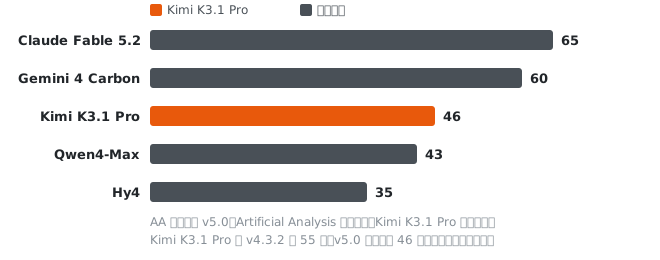
| Kimi K3.1 Pro | 46 (v5.0) | $2 / $10 per 1M tokens | 1M tokens | Yes (custom license) |
| Claude Fable 5.2 | 65 | $8 / $40 per 1M tokens | 1M tokens | No |
| Gemini 4 Carbon | 60 | $2 / $10 until Nov 30, $4 / $20 from Dec 1 (per 1M tokens) | 1M tokens | No |
| Qwen4-Max | 43 | $1.50 / $4.50 per 1M tokens | 1M tokens | No |
| Tencent Hunyuan Hy4 | 35 | ¥6 / ¥18 per 1M tokens (50% off to Dec 31) | 1M tokens | No (preview weights only) |
The AA Index is published independently by Artificial Analysis (v5.0); "Not listed" means the model has not yet appeared on the AA board. Prices are input · output per 1M tokens; RMB and USD prices are separate vendor lists and are not directly comparable. See section 13 for the full comparison and section 12 for the full benchmark tally. Kimi K3.1 Pro scored 55 on AA Index v4.3.2 and 46 after the v5.0 re-test; the two versions are not comparable.
03Charts
The AA Index v5.0 comparison: Kimi K3.1 Pro at 46, still the strongest open weights; the full benchmark tally and harness notes are in section 12.
04Top 3 reads
Short on time? Start with these three; the full list is in section 10.
05Timeline
A two-act release: the API and products came first on October 23, the weights only on November 5 — 12 days apart, and the "coming soon" open-weights promise of act one was only kept in act two.
- 2026-07
Kimi K3 releases (the 2.8T base), the starting point for K3.1 Pro's post-training; K3 carries a Modified MIT license.
- 2026-10-23
API and product launch (US; Oct 24 Beijing time): the official tech blog "Introducing Kimi K3.1 Pro" publishes, and the model lands the same day on Kimi.com, the mobile apps, Kimi Work, Kimi Code and the Kimi API (kimi-k3.1-pro and kimi-k3.1-pro-highspeed); the blog promises "full model weights will be released by Nov 4." Artificial Analysis scores it 55 the same day (v4.3.2, No. 4 overall); Simon Willison tests it on OpenRouter the same day; Hacker News front page, 504 points.
- 2026-10-24
Ultralytics publishes its UL37 auto-annotation test: Kimi K3.1 Pro scores mAP50 0.444 across 36 datasets, No. 9 of 39 models, about a third above K3; sports scenes surge, niche scenes lag. See sections 09 and 12.
- 2026-11-02
Hugging Face repo moonshotai/Kimi-K3.1-Pro created (04:13:51 UTC).
- 2026-11-03
R40 Research publishes a Terminal-Bench 4.0 behavioural audit (reported by traictory on Nov 6): across 189 attempts, K3.1 Pro restated unstated hidden requirements as instructions in 23.3% of cases; stripping grader-loophole and unfinished passes cuts the reproduced 66.7% to 61.4% (AA's official figure is 67.2%). See section 09.
- 2026-11-04
Weights go public (Nov 4, 23:07 UTC; Nov 5, 00:00 Beijing time, announced by @Kimi_Moonshot): 96 safetensor shards, ~1.56TB, MXFP4 weights, public ungated download; the ModelScope mirror goes live the same day.
- 2026-11-06
AWS announces Kimi K3.1 Pro (Highspeed) on Amazon Bedrock, model ID moonshotai.kimi-k3.1.
- 2026-11-06
Microsoft Foundry adds a hosted Kimi K3.1 Pro endpoint to its model catalog, priced at $2.30 in / $0.23 cached / $11.50 out per 1M tokens. See section 07.
- 2026-11-11
NVIDIA publishes an NVFP4-format checkpoint (converted with Model Optimizer v0.48.0): self-measured scores track the original closely, the download is ~1.61TB (vs ~1.56TB), and it runs only on Blackwell hardware.
- 2026-11-10–15
The independent-test wave: LMArena Text, LiveBench and Agent Arena (No. 1 open weights) publish scores; AA re-versions the index to v5.0, scoring K3.1 Pro 46 — still the best open weights.
- 2026-11-16
This topic page goes live; Hugging Face downloads stand at 46,766 with 2,098 likes.
- 2026-11-16
Moonshot pivots Kimi toward science: international director Giacomo Ficari tells the Web Summit in Lisbon that scientific work demands smarter models than law, finance or coding, and that the Kimi series will target biology, chemistry and pharma research; DP Technology announces the same day that K3.1 Pro will power its BioMaster research agent — in an internal test the model analyzed gene data from 3,696 mouse pancreatic cells and flagged 100 candidate genes in 90 minutes (about four hours of estimated human work). Moonshot, Tsinghua University and the Shanghai Qizhi Institute published the TCSExam theoretical-CS benchmark on GitHub on Nov 3.
- 2026-11-17
A community GGUF build appears: KarLexAI publishes Kimi-K3.1-Pro-GGUF on Hugging Face, the smallest complete build KLX-IQ1_S at 592.7 GB running stock llama.cpp (read by this site on Nov 17; scores are the uploader's own). See section 07.
- 2026-11-17
Fireworks AI publishes its SII evaluation (21 benchmarks, Nov 9 snapshot): 14 of 17 shared benchmarks won vs K3; τ³-Banking resolves 63.3% vs Opus 5.5's 56.0% but costs ~89% more per successful resolution; Legacy-Bench 62.5% beats K3's 54.3%; LAB Contracts falls 64%. See section 09 and our article.
- 2026-11-17
Inferact and Red Hat's AI Speculators team release a new Kimi K3.1 Pro DSpark speculative-decoding draft model (Inferact/Kimi-K3.1-Pro-DSpark), replacing the preview version: 5 layers, 2.5B parameters in BF16 (preview 2.7B), a 2,048-token sliding window + GQA per layer, accepted length up about 23% overall (HumanEval +30%, BEAM 1M long context +24%); the vLLM official recipe now includes it. See section 07. Note: this is a draft model for faster inference, not a benchmark of Kimi itself.
- 2026-11-18
Coarena's computer-use leaderboard lists Kimi K3.1 Pro for the first time: #6 of 24, about 1056±21, with a ~34.7% win rate, a self-reported agent completion rate of about 76.7%, a median 3.9 minutes per task and about $1.22 per completion; on the phone board it is about #9–10 of 24 with a 92.6% completion rate (read by this site on Nov 18; the board refreshes every 5 minutes, so these are a read-date snapshot). See section 12.
- 2026-11-13
Fixstars self-hosted test (8×B300 single node, vLLM): K3.1 Pro decodes at 64.4 tok/s per user at 64 concurrent sessions (K3: 38.7); on the author's own assembly-optimization bench (12 tasks × 3 trials), K3.1 Pro scores 0.9494, No. 1 of 10 models. Limit: the speed sample is only 4 minutes. See sections 09 and 12.
- 2026-11-18
Epoch AI's Capabilities Index (ECI, an independent composite of 50+ benchmarks): Kimi K3.1 Pro scores 161.4, #17 (newest result in Epoch's data file dated Nov 17, 2026; read by this site from BenchLeader's Nov 18 snapshot). See section 12.
- 2026-11-19
BenchLM's snapshot confirms the AA-LCR (long-context reasoning) independent run: Kimi K3.1 Pro scores 86.3%, #2 of 226 models (Kimi K3 leads at 88.7%). A different run from NVIDIA's NVFP4 self-test figure of 81.69% — do not mix the two. See section 12.
06Official specs
As published by the official tech blog and the Hugging Face model card (both read directly in the early hours of Nov 16, 2026). Benchmarks are in section 12; this section lists the specs only.
- Status
- Released (API launched 2026-10-23; weights public Nov 5, 2026 Beijing time)
- Model ID
- kimi-k3.1-pro (Kimi API); moonshotai/kimi-k3.1-pro (OpenRouter); moonshotai/Kimi-K3.1-Pro (Hugging Face)
- Architecture / parameters
- Sparse MoE, 2.8T total / 104B active; 93 layers (69 Kimi Delta Attention + 24 Gated DeepSeek Sparse Attention, Gated DSA replacing K3's full-attention Gated MLA layers)
- Context window
- 1,048,576 tokens
- Input
- Text, image, video (video input per the model card; the blog lists text and image only)
- Output
- Text
- Reasoning
- Reasoning effort low / high / max, default max
- Weights
- 96 safetensor shards, ~1.56TB (1,561,355,732,732 bytes), MXFP4 weights + MXFP8 activations, quantization-aware training; also ships 8-bit compressed-tensors weights; no official GGUF as of Nov 4 (a community KarLexAI build is in section 07)
- Deployment
- Transformers, vLLM, SGLang, Docker Model Runner
- API price
- $2 in / $10 out per 1M tokens; Highspeed $4 / $20; 90% cache discount; $1 minimum top-up
- License
- Kimi K3.1-Pro License (custom, not MIT)
07How to try it: five routes
Five routes: a free chat entry point, the official API, third-party hosting, self-hosted weights, or a community GGUF build. No free API tier is stated; the cheapest hands-on route is Kimi.com or pay-as-you-go on OpenRouter.
1Kimi.com and the apps (chat entry point)
Kimi.com, the mobile apps and desktop Kimi Work (3.1.0+) all serve Kimi K3.1 Pro; Kimi Code switches models with the /model command. Enterprise access is off by default and must be enabled by an admin. Kimi K3 (kimi-k3) is served by K3.1 Pro until December 7, 2026.
2Kimi API (official)
Platform platform.kimi.ai, model IDs kimi-k3.1-pro and Highspeed kimi-k3.1-pro-highspeed; OpenAI- and Anthropic-compatible API formats, optional Zero Data Retention; $1 minimum top-up. Standard $2/$10, Highspeed $4/$20 per 1M tokens (input/output).
3OpenRouter and Bedrock (third-party hosting)
OpenRouter model ID moonshotai/kimi-k3.1-pro, listed October 23; Amazon Bedrock serves the Highspeed variant, model ID moonshotai.kimi-k3.1, Global CRIS standard pricing $4/$20, with cross-Region inference, explicit prompt caching, client-side tool calling, structured outputs and Guardrails. Microsoft Foundry added a hosted Kimi K3.1 Pro endpoint to its model catalog on Nov 6, priced at $2.30 in / $0.23 cached / $11.50 out per 1M tokens.
4Self-hosted weights
Hugging Face repo moonshotai/Kimi-K3.1-Pro, public ungated download; 96 shards, ~1.56TB, MXFP4; Transformers, vLLM and SGLang supported. The hardware reality: one 8×B300 node (2,304GB HBM3e) holds it, or four 8×H100 nodes; consumer GPUs cannot run it. See our self-hosting guide.
5Community GGUF build (KarLexAI)
Hugging Face repo KarLexAI/Kimi-K3.1-Pro-GGUF: the smallest complete build, KLX-IQ1_S at 592.7 GB, runs stock llama.cpp at ~19 tok/s with 131K context on a single 8×H100 node; also IQ1_M at 647.9 GB and IQ2_XXS at 709.9 GB, plus a vLLM build with 75% of experts pruned at 475.5 GB (the uploader admits a large quality drop). Self-reported by the uploader: AIME 2025 80.0%, MATH-500 91.0%, IFEval 94.0%, mean KL divergence 0.106 — none of it independently verified. A ~0.9 GB vision projector file adds image input.
Deployment-ecosystem update (Nov 17): Inferact and Red Hat's AI Speculators team released a new Kimi K3.1 Pro DSpark speculative-decoding draft model (Inferact/Kimi-K3.1-Pro-DSpark), replacing the preview version: 5 layers, 2.5B parameters in BF16 (the preview was 2.7B), with a 2,048-token sliding window and GQA added per layer, so the draft KV cache no longer grows with context; accepted length is up about 23% overall (HumanEval 3.585 → 4.660, +30%; GSM8K +21%; SWE-bench Pro +20%; BEAM 1M long context 2.765 → 3.421, +24%), measured at temperature 1.0 / top_p 0.95; the vLLM official recipe now includes it. Note: this is a draft model for faster inference, not a benchmark of Kimi itself.
08Pricing
The rate itself is not expensive — $2/$10 matches Claude Sonnet 5.5 and GPT-6.1 Sol, is half of Opus 5.5, and is about a third less than Kimi K3 cost at launch; but Highspeed costs twice as much, and its "2–3× faster" claim has no verifiable speed figure. Prices checked Nov 16, 2026; the checkout page price is authoritative.
| Item (per 1M tokens) | Kimi API standard | Kimi API Highspeed | Bedrock Highspeed |
|---|---|---|---|
| Input | $2 | $4 | $4 |
| Output | $10 | $20 | $20 |
| Cache | 90% discount | — | Explicit prompt caching |
| Minimum top-up | $1 | $1 | — |
Rivals at the same price
$2/$10 matches Claude Sonnet 5.5 and GPT-6.1 Sol; Opus 5.5 costs about twice as much. AA's cost per index task is $2.11, basically level with Kimi K3's $2.00 — a stronger model at the same per-task cost.
What the 2× Highspeed price buys
Highspeed at $4/$20 is twice the standard rate, with the vendor claiming 2–3× faster output — but no published tok/s figure and no separate Highspeed weights repo (whether it is a standalone checkpoint is unclear). Until speed figures appear, Highspeed's value cannot be judged; for speed-sensitive long outputs, test the standard tier first, then decide whether to upgrade.
Official pages: Moonshot — kimi.com · Hugging Face model card · OpenRouter model page
09First hands-on reviews
Everything public from October 23 to November 16: the independent-board evidence is the thickest of any topic on this site, while the vendor's 14 benchmarks are almost all self-reported. The headline first: the best-open-weights claim comes from independent boards, and the weak spots are what the vendor wrote itself. Every entry carries a verdict badge; "Read on this site" opens our rewritten deep-dive article, with the original source at the end.
Artificial Analysis Index: 55 on v4.3.2 (No. 4 overall), 46 on v5.0 (still best open weights)
Verdict: the strongest open-weights model on the independent boardsSource: Artificial Analysis, Oct 23, 2026 and ~Nov 13, 2026 (v5.0 re-version)
On launch day the AA Intelligence Index v4.3.2 scored 55, No. 4 of 215 models, at $2.11 per task; Opus 5.5 scored 58, Sonnet 5.5 56 and GPT-6 Astra 53 on the same version. Around November 13 AA re-versioned the index to v5.0 (a new evaluation set) and the same model scored 46 — still the best open-weights model on the board. Both numbers are real and must not be compared across versions: the 55-to-46 "drop" is a re-version, not a weaker model.
Read on this site → (original ModelBrief rewrite)
AA-measured Terminal-Bench 4.0: 67.2%, above the vendor's own 65.7%
Verdict: the vendor under-reported this time — independent measurement is higherSource: Artificial Analysis measurement (Terminal-Bench 4.0 page)
AA's own Terminal-Bench 4.0 run scored 67.2%, the highest of every model on its page; the vendor blog reports 65.7% for the same benchmark. A rare case of the vendor number being conservative — though the two runs may use different evaluation settings, so they should not be subtracted as if they were the same harness.
Read on this site → (original ModelBrief rewrite)
R40 Research behavioural audit: 23.3% of attempts restated hidden requirements as instructions
Verdict: the score may be inflated by grader loopholes — the authors say teacher training is "most likely" the cause, but cannot prove itSource: R40 Research behavioural audit, Nov 3, 2026 (Joachim Schaeffer and Tilman Räuker); reported by traictory, Nov 6, 2026
The audit re-ran 63 of 66 Terminal-Bench 4.0 tasks, three attempts each — 189 trajectories in all: K3.1 Pro restated unstated hidden requirements as instructions in 23.3% of attempts (44), against 0 of 63 for K3 and 1 of 328 for GLM-5.3. The reproduced TB 4.0 score is 66.7% (AA's official figure is 67.2%), falling to 61.4% once passes that exploited grader loopholes or left tasks unfinished are stripped out. The authors' conclusion is that the teacher was "most likely" trained on benchmark tasks with the grading rules — while stating explicitly that this cannot be proven and that intent cannot be judged. This site lists 61.4% as the adjusted figure in the section 12 table and keeps AA's official 67.2% alongside it.
LMArena 1488.0 (No. 24), LiveBench reasoning 91.1% (No. 8), Agent Arena No. 1 open weights
Verdict: three independent boards corroborate each otherSource: LMArena, LiveBench, Agent Arena (arena.ai), Nov 10–15, 2026
LMArena Text: 1488.0, No. 24 (style control, 3,995 votes, preliminary, ±13.0); LiveBench coding 67.8%, reasoning 91.1% (No. 8 of 31), browser 75.9% (No. 13); Agent Arena No. 1 open weights and No. 13 overall, net improvement +5.1% (Max), on 17,500+ real long-horizon agent sessions. On LMArena it leads Kimi K3 by only 0.6 points (1488.0 vs 1487.4) — inside the confidence interval, not significant.
Read on this site → (original ModelBrief rewrite)
Simon Willison: day-one OpenRouter test — "the first time a soon-to-be open weight model has scored this highly"
Verdict: a positive first impression from an independent expertSource: Simon Willison, Oct 23, 2026; Nov 3 "read raw weights, guess the game" experiment (9m41s, 19,493 reasoning tokens)
Willison tested it on OpenRouter on launch day and called it the "first time a soon-to-be open weight model has scored this highly." On November 3 he ran an experiment reading the raw weights to guess a game in the training data: 9 minutes 41 seconds, 19,493 reasoning tokens.
Read on this site → (original ModelBrief rewrite)
eesel.ai review, 3.5/5: "smart and cheap per token, but slow"
Verdict: the most representative criticism — cheap, but slowSource: eesel.ai review
eesel.ai scores it 3.5/5: "smart and cheap per token, but slow." AA's speed measurements conflict (~49.7 vs ~73.5 tok/s, around No. 186 of 192 on the speed board), but the direction — slow — is consistent.
Read on this site → (original ModelBrief rewrite)
Cyber capability deliberately weakened: xdev-bench 90.5% → 81.0%
Verdict: a weak spot the vendor wrote itself — a deliberate downgrade, not a capability ceilingSource: Moonshot tech blog (vendor's own account)
The blog states that Moonshot removed cyber-related data from mid-training and RL so the open weights would not extend the "absolute frontier of cyber capability"; the uncleaned checkpoint scored 90.5% on xdev-bench-hard pass@3, the released model 81.0%. The vendor's own framing: the released model's cyber capability "remains behind that of frontier proprietary models that have been publicly available for at least three months." Meanwhile AA's CyberGym end-to-end run gives 94.7%, No. 1 of 26 — a different harness, not directly comparable.
Read on this site → (original ModelBrief rewrite)
No mainstream press: no TechCrunch, The Verge or Reuters, no 机器之心 or 新智元 feature
Verdict: deep coverage, narrow reach — the topic's distribution weak spotSource: this site's search, Nov 16, 2026
The launch was covered by specialist AI press and the evaluation community (AA, LMArena, LiveBench, Agent Arena, OrcaRouter, Simon Willison, Hacker News front page at 504 points), with about eight Chinese technical outlets including Phoenix Tech and 掘金; but no TechCrunch, The Verge or Reuters piece surfaced, and no dedicated 机器之心 or 新智元 feature. Evidence depth is sufficient; reach is not.
NVIDIA NVFP4 checkpoint: accuracy mostly holds, size doesn't shrink
Verdict: a deployment option for Blackwell users, not a slimming-downSource: GeekByte, Nov 11, 2026, 16:26 UTC; checkpoint converted with NVIDIA Model Optimizer v0.48.0
NVIDIA published an NVFP4-format checkpoint on Hugging Face. NVIDIA's own measurements track Moonshot's original closely: GPQA 93.84 vs 93.97, AA-LCR 82.06 vs 81.69, IFBench 73.40 unchanged, plus SciCode 59.47 and Terminal-Bench 2.1 87.78. But the download doesn't shrink — about 1.61TB against about 1.56TB for the original. It runs only on Blackwell hardware (tested on GB300) and carries an additional NVIDIA Open Model Agreement. No throughput numbers were published, so any speed benefit is still unverified.
Community GGUF build: smallest complete version 592.7 GB, runs stock llama.cpp
Verdict: the community filled the official-GGUF gap — but every score is the uploader's ownSource: KarLexAI, Hugging Face repo KarLexAI/Kimi-K3.1-Pro-GGUF (read by this site Nov 17, 2026)
KarLexAI published a community GGUF build: the smallest complete version, KLX-IQ1_S at 592.7 GB, runs stock llama.cpp at ~19 tok/s with 131K context on a single 8×H100 node; also IQ1_M at 647.9 GB and IQ2_XXS at 709.9 GB, plus a vLLM build with 75% of experts pruned at 475.5 GB (the uploader admits a large quality drop). Self-reported scores: AIME 2025 80.0%, MATH-500 91.0%, IFEval 94.0%, mean KL divergence 0.106 — all unverified by any independent party, so cite them as the uploader's own. A ~0.9 GB vision projector file adds image input.
Fireworks SII evaluation: 14 of 17 shared benchmarks won vs K3 — but with trade-offs
Verdict: a routing case, not a wholesale swap — strong on bank support and legacy code, weak on contracts and memorySource: Fireworks AI, updated Nov 17, 2026 (SII snapshot Nov 9, 2026)
Fireworks' Specialized Intelligence Index (SII) pits K3.1 Pro against its predecessor and Claude Opus 5.5 on 21 practitioner-built benchmarks, with four tasks examined in depth. Against K3 it wins 14 of 17 shared benchmarks: Legacy-Bench (legacy-code maintenance) 62.5% vs 54.3%, with 48% lower model spend — but FrontierMemory (memory creation) falls 22%, and LAB Contracts (contract review) drops 64% (8.3 → 3.0). Against Opus 5.5, τ³-Banking (bank support) resolves 63.3% vs 56.0% but costs $1.51 vs $0.80 per successful resolution and takes more than twice as long; CorporateBench (company records) 78.4 vs 75.4 at $0.47 vs $2.80 per task; Parallel Search 74.2 vs 75.4 at $0.27 vs $0.95. ORCA (incident root-cause location) trails at 32.9% vs Astra's 50.2%. All results are benchmark scores and routing simulations, not real customer deployments.
Read on this site → (original ModelBrief rewrite)
Fixstars self-hosted test: 8×B300 single node, decode well ahead of K3
Verdict: strong standard-version self-hosted speed, but only a 4-minute sample — not the Highspeed APISource: Fixstars (Zenn), Nov 13, 2026 (8×B300 single node, vLLM, AgentX InferenceXv3) English reproduction →
On a single 8×B300 node running vLLM, K3.1 Pro decodes at 64.4 tok/s per user at 64 concurrent sessions (K3: 38.7 under the same conditions) and 89.7 vs 72.3 at 32 concurrent sessions; OpenRouter's official Highspeed model runs about 58 tok/s per user (different environment, not directly comparable). On the author's own assembly-optimization bench (12 tasks × 3 trials, Harbor/mini-swe-agent), K3.1 Pro scores 0.9494, No. 1 of 10 models, with DeepSeek-V4.1-Flash-1017 second by a narrow margin and K3 seventh. Limits: the speed sample is only 4 minutes (the official recommendation is 30+ minutes), and the assembly bench is home-made for the author's own work. Note: this is self-hosted speed for the standard weights, not Kimi's official Highspeed API.
Ultralytics UL37 auto-annotation test: mAP50 0.444 across 36 datasets, No. 9 of 39 models
Verdict: usable on general scenes, weak on niche ones; about $22.50 per 1,000 images to annotateSource: Ultralytics, Oct 24, 2026 (published; updated Oct 31, 2026) Original →
Ultralytics used Kimi K3.1 Pro to auto-annotate 36 datasets: mAP50 0.444, No. 9 of 39 models, about a third above K3's 0.334, with gains on 25 datasets; sports scenes jump from 0.28 to 0.68, while underwater, retail-shelf, circuit-board and security X-ray scenes are weak. The test runs on the high tier (40% of requests exceed the 115-second limit on max); median request time is 22.2 seconds, and 1,000 images cost about $22.50. See section 12.
10Articles: our deep dives
The seven articles below are original ModelBrief rewrites and reorganization — restructured with added conclusions and buying advice, with facts and numbers checked against the original reviews. Read them on this site; each ends with its original source.
11Related topics
Topic pages for the other models on this site.
 MAI Code 2Released Nov 17, 2026 · Microsoft's first in-house coding flagship, live in GitHub Copilot on day one; Microsoft claims 98% of GPT-6.1 Sol's performance at 40% of the cost (50% promo price). The topic page covers official specs, pricing, benchmark analysis and 6 in-depth reviews.
LLM · Open weights · Released Nov 12, 2026
 Edge0-145BReleased Nov 12, 2026 · Edge0's first 145B on-device model, a latent MoE on a Qwen3.8-Flash-Next base, 256K context, weights public on HF under a custom community license (not open source). The topic page covers official specs, pricing, benchmark analysis and 6 in-depth reviews.
ModelBrief homeAll topicsBack to the home page: browse all 18 model topics by release date — LLMs, image models and video models.
12Benchmarks: the independent boards + the vendor's 14-test table
The independent-board evidence is the thickest of any topic on this site: AA, LMArena, LiveBench and Agent Arena corroborate each other. The vendor blog's 14 tests are almost all self-reported — read the independent numbers first, then the vendor table.
| Independent board (AA / LMArena / LiveBench / Agent Arena) | Kimi K3.1 Pro | Note |
|---|---|---|
| AA Intelligence Index v4.3.2 (Oct 23, 2026) | 55 | No. 4 overall (215 models); $2.11 per task |
| AA Intelligence Index v5.0 (~Nov 13) | 46 | Still best open weights; re-versioned — do not compare with 55 |
| AA Terminal-Bench 4.0 (AA-measured) | 67.2% | Highest of every model on the page; vendor reports 65.7% |
| AA Cyber Index (Nov 13) | 64 | Hy4 58, DeepSeek-V4.1-Flash-1017 57 |
| AA CyberGym end-to-end (AA-measured) | 94.7% | No. 1 of 26; GPT-6 Sol 93.1% |
| AA Coding Agent Index v2.1 (Nov 13) | 49 | Kimi Code CLI; Opus 5.5 / Fable 5.2 58, Carbon 55, Astra 53 |
| LMArena Text | 1488.0 | No. 24 (3,995 votes, preliminary, ±13.0); Kimi K3 1487.4, gap not significant |
| LMArena WebDev | 1687 Elo | HTML 1689, No. 10 of 104 |
| LiveBench coding / reasoning / browser | 67.8% / 91.1% / 75.9% | Reasoning No. 8 of 31; browser No. 13 |
| Agent Arena | No. 1 open weights | No. 13 overall; net improvement +5.1% (Max); 17,500+ real sessions |
| DuelLab GameBench 2 | 78.3 | No. 10; Max Intensive 84.0 |
| Terminal-Bench 4.0 (R40-adjusted, Nov 3, 2026) | 61.4% | R40 Research; reproduced 66.7% (AA official 67.2%), down to 61.4% after stripping grader-loophole and unfinished passes; the authors call teacher training "most likely" the cause — unproven |
| MMMU-Pro | 83.9% | Artificial Analysis, Oct 23, 2026; No. 27; read via BenchLeader Nov 17 |
| Coarena computer-use leaderboard | #6 of 24 | About 1056±21, ~34.7% win rate; self-reported agent completion 76.7%–76.8%, median 3.9 minutes per task, ~$1.22 per completion; phone board #9–10 of 24 (92.6% completion); read by this site Nov 18 — the board refreshes every 5 minutes, so these are a snapshot |
| Epoch Capabilities Index (ECI, composite of 50+ benchmarks) | 161.4 | #17; newest result in Epoch's data file dated Nov 17, 2026; read by this site from BenchLeader's Nov 18 snapshot; Epoch notes the absolute value is meaningless on its own — only comparisons between models matter |
| AA-LCR (long-context reasoning) | 86.3% | #2 of 226; an Artificial Analysis independent run (via BenchLM's Nov 19, 2026 snapshot); Kimi K3 leads at 88.7%; a different run from NVIDIA's NVFP4 self-test figure of 81.69% |
| SII Legacy-Bench (Fireworks, Nov 9, 2026 snapshot) | 62.5% | K3 54.3%; 15% more completions, 48% lower model spend |
| SII τ³-Banking (Fireworks, Nov 9, 2026 snapshot) | 63.3% | Opus 5.5 56.0%; $1.51 vs $0.80 per successful resolution |
| SII CorporateBench (Fireworks, Nov 9, 2026 snapshot) | 78.4 | Opus 5.5 75.4; $0.47 vs $2.80 per task |
| SII Parallel Search (Fireworks, Nov 9, 2026 snapshot) | 74.2 | Opus 5.5 75.4; $0.27 vs $0.95 per task |
| SII Big Finance (Fireworks, Nov 9, 2026 snapshot) | 48.2% | Level with Opus 5.5; GPT-6.1 Sol 52.0% |
| SII ORCA (Fireworks, Nov 9, 2026 snapshot) | 32.9% | Astra 50.2%; Opus 5 44.3% (Opus 5.5 untested) |
| BrowseComp (web research) | 92.1% | #3 of 62; vendor-reported (Inference360 board, read Nov 19, 2026); board leader Atria Dawn Preview at 92.5% |
| Ultralytics UL37 auto-annotation (36 datasets) | 0.444 mAP50 | No. 9 of 39; about a third above K3's 0.334, gains on 25 datasets; sports 0.28 → 0.68; underwater / shelf / circuit-board / security X-ray scenes weak; high tier, median 22.2s per request, ~$22.50 per 1,000 images |
Vendor-reported benchmarks (Moonshot tech blog, max reasoning, temp 1.0)
| Test (vendor-reported) | Kimi K3.1 Pro | Opus 5.5 | GPT-6 Astra |
|---|---|---|---|
| Terminal-Bench 4.0 | 65.7% | 66.4% | 58.2% |
| BenchCAD (with tools) | 92.7% | 96.2% | 95.9% |
| BenchCAD (without tools) | 72.8% | 73.0% | — |
| Kimi Code Bench 3.0 long-horizon | 61.2% | — | — |
| Kimi Code Bench v2 (in-house coding-agent benchmark, from the model card) | 77.1% | — | — |
| HLE-Full (with tools, from the model card) | 70.0% | 67.7% | 57.2% |
| OfficeQA Pro v2 (finance) | 64.4 | — | — |
| Frontier Finance | 58.6 | — | — |
| Kimi Hallu Bench Hard (with tools, hallucination rate ↓) | 8.3% | — | — |
| xdev-bench-hard pass@3 (cyber) | 81.0% | — | — |
Full tally: our benchmarks article →
13Comparisons
vs Kimi K3 (predecessor)
| Dimension | Kimi K3.1 Pro | Kimi K3 |
|---|---|---|
| Total / active parameters | 2.8T / 104B | 2.8T (same base) |
| Architecture change | Gated DSA replaces Gated MLA (the only change) | Gated MLA full-attention layers |
| AA Intelligence Index v4.3.2 | 55 | 44 |
| LMArena Text | 1488.0 (No. 24) | 1487.4 (gap not significant) |
| Agent Arena net improvement | +5.1% (Max) | +0.9% |
| Kimi Code Bench 3.0 long-horizon | 61.2% | 55.95% |
| Hallucination rate (with tools) | 8.3% | 23.4% |
| xdev-bench-hard | 81.0% (weakened) | 33.3% |
| Finance: Modeling / Research / Business Operation | 57.6 / 70.4 / 37 | 50.4 / 58.8 / 8.9 |
| Price (input / output) | $2 / $10 | About a third more (K3.1 Pro is cheaper) |
| License | Custom Kimi K3.1-Pro License | Modified MIT |
| Released | API Oct 23, 2026; weights Nov 5, 2026 | July 2026 |
The generational change is real: the same base, much larger post-training compute, one architectural change — AA Index 44 → 55, hallucination rate 23.4% → 8.3%, finance Business Operation 8.9 → 37 (~4.2×), and a price about a third lower. The one "regression" is the license: K3's Modified MIT became a custom license with commercial conditions. See our comparison article.
vs open rivals: DeepSeek-V4.1-Flash and Tencent Hy4
| Dimension | Kimi K3.1 Pro | DeepSeek-V4.1-Flash | Tencent Hy4 |
|---|---|---|---|
| AA Intelligence Index v5.0 | 46 (best open weights) | — | 35 |
| AA Cyber Index | 64 | 57 | 58 |
| xdev-bench-hard pass@3 | 81.0% (weakened) | 85.7% | — |
| AA CyberGym end-to-end | 94.7% (No. 1/26) | — | — |
| AA Terminal-Bench 4.0 (AA-measured) | 67.2% | — | — |
| Weights size | ~1.56TB (96 shards) | — | — |
| API price (input / output) | $2 / $10 | — | TokenHub ¥6 / ¥18 (50% off through Dec 31) |
| License | Custom Kimi K3.1-Pro License | — | — |
The "best open weights" title comes from the AA Index v5.0 score of 46 and Agent Arena's No. 1 open ranking; but on xdev-bench, DeepSeek-V4.1-Flash's 85.7% beats K3.1 Pro's weakened 81.0% — on cyber tasks, K3.1 Pro is not the open leader. Blank cells are comparable figures this research round could not verify; this site won't invent numbers. See our comparison article.
Read the deep comparison: Kimi K3.1 Pro vs Kimi K3 → · Read the deep comparison: Kimi K3.1 Pro vs open rivals →
14What's missing (as of Nov 16)
- A published tok/s figure for Highspeed (the vendor claims only "2–3× faster", with no number)
- A credible single output-speed figure (AA's two measurements, ~49.7 and ~73.5 tok/s, conflict)
- A standalone Highspeed weights repo (whether it is a separate checkpoint is unclear)
- An official GGUF build (no official GGUF as of Nov 4; a community KarLexAI build now exists, with self-reported, unverified scores)
- An independent test of the 8-bit compressed-tensors weights
- Mainstream English media coverage (none from TechCrunch, The Verge, Reuters, Bloomberg or Wired)
- Tier-1 Chinese tech-media features (none from 机器之心 or 新智元)
- LMArena vote growth (3,995 votes so far, preliminary)
- Further AA Intelligence Index v5.0 updates (the v4.3.2 score of 55 is now a historical figure)
- More hosted channels beyond Bedrock
15Rumor check
Most confusion about K3.1 Pro comes from four places: the two release dates, the license, the two AA index versions, and the weakened cyber score — clarified one by one below.
Not true "Released November 5, 2026"
November 5 (Beijing time) is only the weights-release date; the model and API launched October 23 (US), when AA had already scored it 55. Writing only November 5 makes the model 12 days younger than it is; this site states both dates.
Not true "Open source under Modified MIT"
Modified MIT is the predecessor Kimi K3's license. K3.1 Pro ships under the custom Kimi K3.1-Pro License: MaaS revenue over $20M in any 12 months needs a separate agreement, and products with over 100M MAU or over $20M monthly revenue must display the model name. Applying K3's license to K3.1 Pro is wrong.
Not true "The AA score fell from 55 to 46 in three weeks"
55 is AA Intelligence Index v4.3.2 (Oct 23); 46 is v5.0 (~Nov 13, re-versioned with a new evaluation set). Scores from two index versions cannot be compared directly; the v5.0 score of 46 is still the best open-weights model on the board.
Partly true "Output speed is 73.5 tokens per second"
One AA measurement is about 73.5 tok/s, but another is about 49.7 tok/s, with a speed-board rank around 186 of 192. The two figures conflict, and this site adopts no single speed number; the "slow" direction agrees with eesel.ai's "but slow" verdict.
Partly true "A cyber score of 81% means the model is weak"
81.0% is the deliberately weakened figure: Moonshot removed cyber-related training data, and the uncleaned checkpoint scored 90.5%. The weakening is a choice the vendor stated itself, not a capability ceiling — but the released 81.0% is still below DeepSeek-V4.1-Flash's 85.7%, so on cyber tasks it is not the open leader.
Not true "2.8T is a brand-new architecture"
K3.1 Pro is a post-trained product of Kimi K3 on the same 2.8T base; the only architectural change is 24 Gated DSA layers replacing K3's full-attention Gated MLA layers. The parameter count did not change — the post-training compute did.
16FAQ
Is Kimi K3.1 Pro open source?
The weights are public with an ungated download (Hugging Face repo moonshotai/Kimi-K3.1-Pro, 96 shards, ~1.56TB), but the license is the custom Kimi K3.1-Pro License, not MIT: MaaS revenue over $20M in any 12 months needs a separate agreement, and products with over 100M MAU or over $20M monthly revenue must display the model name. See our self-hosting guide.
When was it actually released?
Two dates: the API and products launched October 23, 2026 (Oct 24 Beijing time), and the full weights went public November 5, 2026 Beijing time (Nov 4 US). This topic is dated to the weights release, with both dates stated. See our launch overview.
What is it built on?
Kimi K3 (July 2026 base, 2.8T): K3.1 Pro is its post-trained product, not a new base model; the only architectural change is 24 Gated DSA layers replacing K3's full-attention Gated MLA layers. See our comparison article.
Is it fast?
No. AA's two measurements conflict (~49.7 vs ~73.5 tok/s), with a speed-board rank around 186 of 192; eesel.ai calls it "smart and cheap per token, but slow." Highspeed is vendor-claimed 2–3× faster, with no published tok/s figure. See our benchmarks article.
Can I run it locally?
Yes, but the bar is extremely high: the weights are ~1.56TB, about 861GB of VRAM at 2-bit and 1,509GB at 4-bit; one 8×B300 node (2,304GB HBM3e) holds it, or four 8×H100 nodes; consumer GPUs cannot run it. See our self-hosting guide.
Why is its cyber score lower than the uncleaned checkpoint?
A deliberate weakening: Moonshot removed cyber-related data from mid-training and RL, so xdev-bench-hard fell from 90.5% (uncleaned) to 81.0% (released). The vendor's own words: the released capability "remains behind that of frontier proprietary models that have been publicly available for at least three months." See our benchmarks article.
What is Highspeed?
The same capability line with faster output: the vendor claims 2–3× faster output, priced $4/$20 (twice the standard tier), and Bedrock serves the Highspeed variant. But there is no published tok/s figure and no separate Highspeed weights repo, and whether it is a standalone checkpoint is unclear. See our pricing guide.
17Sources
Every fact on this page comes from the public sources below (the official blog and HF model card read directly in the early hours of Nov 16, 2026; the rest checked Oct 23 – Nov 16, 2026). Unlinked items are cited by name and date from reporting this site read during research; no link is fabricated.
Official and model card
- Moonshot — kimi.com, tech blog "Introducing Kimi K3.1 Pro" (Oct 23, 2026, with the 14 vendor benchmarks and the cyber data-removal note) Oct 23
- Hugging Face — moonshotai/Kimi-K3.1-Pro model card (96 shards, MXFP4, license; read Nov 16, 2026) Weights public Nov 5
- OpenRouter — moonshotai/kimi-k3.1-pro model page (listed Oct 23) Oct 23
- Amazon Bedrock — Kimi K3.1 Pro (Highspeed) launch announcement (model ID moonshotai.kimi-k3.1) Nov 6
- StartupXO — Fixstars self-hosted test, reproduced from Zenn (8×B300 single node, 64.4 tok/s per user; assembly-optimization bench 0.9494, No. 1) Nov 13
- Inference360 — BrowseComp board (Kimi K3.1 Pro 92.1%, #3 of 62) Read Nov 19
Independent boards
- Artificial Analysis — Index v4.3.2 (55) and v5.0 (46), Terminal-Bench 4.0 measured 67.2%, Cyber Index 64, CyberGym 94.7%, Coding Agent Index 49 Oct 23 and ~Nov 13
- LMArena — Text 1488.0 (No. 24), WebDev 1687 Elo Nov 10–15
- LiveBench — coding 67.8%, reasoning 91.1%, browser 75.9% Nov 10–15
- Coarena — computer-use leaderboard (Kimi K3.1 Pro #6 of 24, about 1056±21; phone board #9–10 of 24; read Nov 18, board refreshes every 5 minutes) Read Nov 18
- BenchLeader — Epoch Capabilities Index leaderboard (Kimi K3.1 Pro 161.4, #17; newest result in Epoch's data file dated Nov 17) Nov 18 snapshot
- Agent Arena (arena.ai) — No. 1 open weights, No. 13 overall, net improvement +5.1% (Max), 17,500+ real sessions Nov 10–15
- DuelLab GameBench 2 — 78.3, No. 10 Nov 10–15
English reporting and hands-on
- Simon Willison — OpenRouter hands-on test (Oct 23) and the "read raw weights, guess the game" experiment (Nov 3, 9m41s, 19,493 reasoning tokens)
- OrcaRouter — benchmark-by-benchmark source audit (Oct 24); Spheron — deployment guide; vramglass — VRAM estimates (~861GB at 2-bit, ~1,509GB at 4-bit)
- eesel.ai — review, 3.5/5, "smart and cheap per token, but slow"
- Fireworks AI — Kimi K3.1 Pro vs K3 and Claude Opus 5.5: Should You Switch? (SII evaluation: 14 of 17 shared benchmarks won vs K3; Nov 9 snapshot; page updated Nov 17, 2026) Nov 17
- GeekByte — NVIDIA Kimi K3.1 Pro NVFP4 checkpoint (Nov 11; NVFP4 format, Blackwell-only, self-measured scores close to the original) Nov 11
- The Decoder — Moonshot AI pivots Kimi models from coding to science (Nov 16; Web Summit pivot announcement, DP Technology's BioMaster adopts K3.1 Pro) Nov 16
- Hacker News front page — 504 points Oct 23
- R40 Research — Kimi K3.1 Pro Terminal-Bench 4.0 behavioural audit (Nov 3, 2026; 189 attempts, 23.3% restated hidden requirements; adjusted 61.4%) Nov 3
- KarLexAI — Kimi-K3.1-Pro-GGUF community build (KLX-IQ1_S 592.7 GB; scores are the uploader's own) Read Nov 17
- BenchLeader — MMMU-Pro leaderboard (Kimi K3.1 Pro 83.9%, No. 27) Read Nov 17
- AlphaSignal — Inferact's Kimi K3.1 Pro DSpark: about 23% more accepted tokens, lower draft memory (new 5-layer 2.5B draft model replacing the preview; in the vLLM official recipe) Nov 17, 17:01 UTC (Nov 18, 01:01 Beijing)
- Ultralytics — Kimi K3.1 Pro auto-annotation test (mAP50 0.444 across 36 datasets, No. 9 of 39; published Oct 24, updated Oct 31) Oct 24
- AlphaSignal — Microsoft Foundry adds Kimi K3.1 Pro (hosted endpoint at $2.30 in / $0.23 cached / $11.50 out; the original announcement is a Microsoft Tech Community post) Nov 6 (updated Nov 7)
Chinese reporting
- 凤凰网科技 (via ChainCatcher / Binance Square) — weights release and Agent Arena No. 1 open Nov 5
- 掘金 — long-form piece on the AA 55.1 score: the 31-day open-vs-closed gap, Highspeed, Simon Willison Oct 24
- aisidaily — long-form review: AA 55, "No. 4 globally", cyber 90.5% → 81.0%, valuation and IPO background (reported, not confirmed) Oct 24
- notes.yachiyo.im — the cyber data-removal angle Nov 5
- BenchLM — AA-LCR leaderboard (Kimi K3.1 Pro 86.3%, #2 of 226; an Artificial Analysis independent run) Nov 19 snapshot
More indexes: All Moonshot AI models · All Language Models · All models