Edge0-145B: The Topic Page
The on-device agent / coding model released November 12, 2026 by the Edge0 team (AutoArk): 145B total parameters with only 10.12B active per token, built on Alibaba's Qwen3.8-Flash-Next, with weights open on Hugging Face. The official headline says "29GB peak memory — runs on one consumer computer" — but the model card's own measurements tell a different story: about 61.5 GiB for the whole machine on NVFP4, and no Mac support at launch. On benchmarks it wins big on two coding scores and trails its base on three knowledge scores, with a mean lead of just 1.1 points — and all six scores are vendor-reported, with no independent verification yet. This page collects the official specs, the install requirements, the licence, and the first coverage in English and Chinese — with unverified claims clearly marked.
01Key facts
What is confirmed: this site's first topic on "a 145B in one consumer computer" — "open weights, runs locally" is the real selling point, while the "29GB, open-source, MacBook Pro" claims all need discounting.
- Released
- 2026-11-12 (Thursday, official blog "Introducing Edge0-145B: Frontier AI Capabilities on Your Own Computer"); the 120B sibling Edge0-120B launched the same day; release notes for inference framework edge0-infer v0.2.0 went up a day earlier, on Nov 11
- Developer
- Edge0 (the AutoArk team; the official blog's contact address points to autoark.ai; company location not publicly disclosed)
- Positioning
- On-device agent / coding model: 145B parameters with only 10.12B active per token, built for local vibe coding and agent work
- Base model
- Alibaba's Qwen3.8-Flash-Next (Hugging Face model-card metadata, base_model; the official blog does not name Qwen); routed experts in all 48 layers rebuilt as latent MoE, then post-trained on Edge0's own data
- Architecture
- Latent sparse MoE: 48 layers, 512 experts per layer, 10 routed + 1 shared expert active per token, SwiGLU width 640; hybrid attention (full every 4 layers + sparse indexer); expert pool 84.6B, n-gram embedding table (PLE) 51.2B (fp8, memory-mapped from SSD), MTP speculative-decoding head 1.26B
- Training
- Per the vendor, trained natively at 4 bits in the on-device architecture from the outset, not post-hoc quantization; the technical report is still unpublished, so this cannot be verified
- Context
- 256K tokens; KV in int8, 32K resident
- Weight builds
- Open weights on Hugging Face: Q3_K 40.81 GiB and NVFP4 47.79 GiB (Edge0/Edge0-145B-q3k, Edge0/Edge0-145B-NVFP4)
- Speed (vendor-measured, RTX 5090 D 24GB)
- NVFP4: 98.3 tok/s agent decode, 3,165.7 tok/s 16K prefill; Q3_K: 121.2 tok/s agent decode, 3,554.9 tok/s 16K prefill; the blog's headline figures are 80+ tok/s decode, 1,100+ tok/s prefill, ~120W typical power
- The memory truth
- "29GB" is GPU-side peak only; the model card's measured residency: NVFP4 needs 23.25 GiB VRAM + 38.27 GiB host RAM (about 61.5 GiB total), Q3_K needs 23.14 GiB VRAM + 31.28 GiB host RAM (about 54.4 GiB total), plus an expert library of about 40GB in system memory and vocabulary data of about 48GB on SSD
- Benchmarks (vendor-reported)
- Six-benchmark mean 72.8, only +1.1 over the base Qwen3.8-Flash-Next (71.7); DeepSWE 1.1 at 64.6 (+5.9) and Terminal-Bench 2.1 at 86.52 (+3.22), but three scores sit below the base; no independent verification of any kind as of Nov 20 (no AA / LiveBench / LMArena listing)
- Licence
- Weights: Edge0 Community Model License 1.0 (Nov 12, 2026), with the Qwen Community License 1.0 applying as well; framework code under Apache 2.0. The weights are open weights, not open source; commercial services need a separate written licence
- Price
- No hosted API, no per-token billing; not listed on OpenRouter; cost is local hardware and electricity only
- Mac support
- The official blog claims day-one support for macOS / Apple M-series; but the GitHub README's platform table lists no macOS support for the 145B/120B models, and the Edge0 App is Windows-only; the 57.0 tok/s on M2 Ultra is a Metal speed measurement, not proof of availability
- Access
- Hugging Face weight download, GitHub edge0-infer local server (OpenAI / Anthropic Messages API compatible), Edge0 App (Windows); no cloud API
02Quick comparison
Where it stands among base derivatives: two coding wins, a mean lead of just 1.1 points; the biggest difference is not the score but the deployment shape — it is the only one that runs locally.
| Model | Mean (6, vendor-reported) | DeepSWE 1.1 | Terminal-Bench 2.1 | Weights | Cost |
|---|---|---|---|---|---|
| Edge0-145B | 72.8 | 64.6 | 86.52 | Open weights (custom licence) | Local hardware + power, no API price |
| Qwen3.8-Flash-Next (base) | 71.7 | 58.7 | 83.3 | Qwen community licence | Cloud model |
| DeepSeek-V4-Flash-0731 | 70.1 | 54.4 | 82.7 | — | Cloud model |
All benchmark scores are vendor-reported (Edge0 internal evaluations) with no independent verification as of Nov 20, 2026. Edge0-145B's mean lead over its base is only +1.1, and three scores (HLE, GPQA-Diamond, IFBench) sit below the base; the mean lead over DeepSeek-V4-Flash is +2.7. DeepSeek-V4-Flash-0731 is a July 31 build.
03Charts
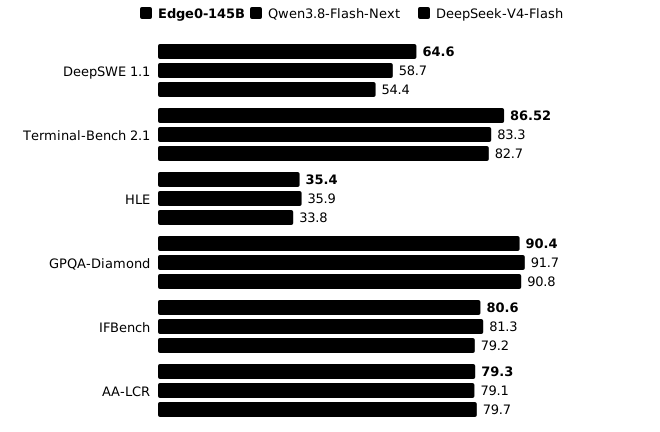
Six benchmarks, grouped: Edge0-145B's lead concentrates on the two coding tasks, DeepSWE and Terminal-Bench, while HLE, GPQA-Diamond and IFBench trail the base.
04Top 3 reads
Short on time? Start with these three: the benchmark tally, the licence analysis, and the install guide — the three places the headline misleads most.
05Timeline
Eight days after launch, the critical pieces arrived faster than any independent verification: three key critiques landed on Nov 13–15, flagging the 29GB, Mac and licence discrepancies, while independent scores remain at zero.
- 2026-09-10
Edge0-35B launches (a phone-scale model; per the official blog, the starting point of the 145B line).
- 2026-11-11
edge0-infer v0.2.0 release notes go up (GitHub): Windows x64/arm64 packages, the local server speaks the Anthropic Messages API; the notes say the 145B weights are not bundled with the installer and must be downloaded separately from Hugging Face.
- 2026-11-12
Edge0-145B and Edge0-120B launch: the official blog "Introducing Edge0-145B: Frontier AI Capabilities on Your Own Computer" goes up, weights land on Hugging Face (Q3_K and NVFP4 builds), framework and deployment tooling on GitHub, and the Edge0 App ships; the blog calls it "the world's first open-source on-device AI model with 145 billion parameters", with 29GB peak memory, runnable on a MacBook Pro.
- 2026-11-13
groundtruth.day publishes a critical piece flagging the 29GB and Mac-support discrepancies and taking apart the licence; Signal Sentry publishes its scorecard, stating "No independent results yet".
- 2026-11-14
freshsynapse and explainx.ai publish explainers; newtoken.link publishes the critical Chinese piece "Edge0's 145-billion-parameter model cannot run on Mac at launch"; the After Intelligence newsletter (edition 070) leads with Edge0-145B as a frontier item, alongside Nex-N2.6.
- 2026-11-15
oguzhan.co publishes a deep critical piece, "what the 29GB headline leaves out": the NVFP4 whole-machine figure of about 61.5 GiB, the Mac gap, and the licence detail; a YouTube deep-dive appears (commentary on the vendor numbers, not an independent run); Hacker News discussion follows (the "open-weight rather than open-source" debate).
- 2026-11-16
This site completes its research: the six benchmarks, the licence text and the install requirements are confirmed, and the verdict is that the material supports a hub + 6 articles — the topic is approved.
- 2026-11-20
This site's topic page goes live (this page). As of today: the technical report is still unpublished, AA, LiveBench and LMArena have no Edge0-145B listing, and OpenRouter has not listed it.
06Official specs
As published by the vendor (Hugging Face model cards, read directly by this site on Nov 16, 2026; official blog checked the same day).
- Status
- Released (Nov 12, 2026), open weights
- Total / active parameters
- 145B / 10.12B (per token)
- Architecture
- Latent sparse MoE: 48 layers, 512 experts per layer, 10 routed + 1 shared expert active per token, SwiGLU width 640; hybrid attention (full every 4 layers + sparse indexer)
- Expert pool
- 84.6B parameters, latent width ℓ=1792; each expert is a fixed 1.63 MB record
- N-gram embedding table (PLE)
- 51.2B parameters, fp8, memory-mapped from SSD
- MTP speculative-decoding head
- 1.26B draft model, 512 experts
- Context window
- 256K tokens; KV in int8, 32K resident
- Input / output
- Text + image input (vision encoder mmproj-BF16.gguf, needs the strata-vision helper); text output
- Training
- Per the vendor, natively trained at 4 bits (not post-hoc quantization); technical report unpublished
- Weight builds
- Q3_K 40.81 GiB (Edge0/Edge0-145B-q3k), NVFP4 47.79 GiB (Edge0/Edge0-145B-NVFP4)
- Base model
- Qwen3.8-Flash-Next (model-card metadata; routed experts in all 48 layers rebuilt as latent MoE, then post-trained on Edge0 data)
- Speed (vendor-measured, RTX 5090 D 24GB)
- NVFP4: 98.3 tok/s agent decode, 3,165.7 tok/s 16K prefill; Q3_K: 121.2 tok/s agent decode, 3,554.9 tok/s 16K prefill; blog headline figures are 80+ tok/s decode, 1,100+ tok/s prefill, ~120W typical power
- Memory (model-card measured residency)
- NVFP4: 23.25 GiB VRAM + 38.27 GiB host RAM (about 61.5 GiB total); Q3_K: 23.14 GiB VRAM + 31.28 GiB host RAM (about 54.4 GiB total); plus an expert library of about 40GB in system memory and vocabulary data of about 48GB on SSD
- Licence
- Weights: Edge0 Community Model License 1.0 (Nov 12, 2026) + Qwen Community License 1.0; framework code Apache 2.0
- Benchmarks (vendor-reported)
- Six-benchmark mean 72.8: DeepSWE 1.1 at 64.6, Terminal-Bench 2.1 at 86.52, HLE 35.4, GPQA-Diamond 90.4, IFBench 80.6, AA-LCR 79.3; no independent verification
07How to try it: four routes
There is no cloud API, so trying it means local routes only: the command line, the desktop app and a direct weight download all work; the Mac route does not work at launch.
1edge0-infer local server (official main route)
Get edge0-infer v0.2.0 (release notes Nov 11, 2026) from GitHub Edge0-AI/Edge0; the local server speaks the OpenAI- and Anthropic-compatible Messages APIs, and tool calling goes through it. Weights are not bundled with the installer — download them separately from Hugging Face. Requirements: NVIDIA GPU (compute capability 7.5+), 16 GiB+ VRAM, 20 GiB+ system RAM, CUDA Toolkit 13, Linux or Windows. See our install guide.
2Edge0 App desktop application (Windows)
Per the official blog, the core capabilities work offline with no account and no usage quota. But the v0.2.0 Edge0 Chat desktop packages are Windows-only — "download the app and open it" currently works for Windows users only.
3Hugging Face weight download
Q3_K (Edge0/Edge0-145B-q3k, 40.81 GiB) or NVFP4 (Edge0/Edge0-145B-NVFP4, 47.79 GiB). Default to Q3_K: smaller file, less host RAM, faster (121.2 vs 98.3 tok/s decode). The download is free; the licence is in section 08.
4Vision input and tool calling
Input supports text + image: the model folder carries a vision encoder, mmproj-BF16.gguf, but it needs the strata-vision helper (not built from the Edge0 tree) — check its status during setup; output is text. Tool calling goes through the local OpenAI- / Anthropic-compatible server.
Also: the 120B sibling Edge0-120B launched the same day, also in Q3_K and NVFP4 builds; its full specs and benchmark table are not yet published by the vendor — see section 13.
08Pricing
There is no per-token price, so there is no "$ per 1M tokens" table — Edge0-145B's ledger has two lines only: hardware and electricity. Prices checked Nov 16, 2026 (model cards and official blog, read directly).
| Cost item | Edge0-145B | Cloud API models (comparison) |
|---|---|---|
| API calls (per 1M tokens) | None (no hosted API, no OpenRouter listing) | Billed per use |
| Weight download | Free (open weights on Hugging Face) | — |
| Framework and tools | Free (Apache 2.0) | — |
| Hardware (one-off) | 16GB+ VRAM GPU, 20 GiB+ system RAM, CUDA 13; measured whole-machine demand about 61.5 GiB (NVFP4) | None |
| Electricity (marginal) | About 120W typical power (vendor figure) | None |
"Zero token cost" is not "zero cost"
The official pitch of "zero token cost" is true — but it tells half the story: the marginal cost is zero, the fixed cost is not. Before running Edge0-145B you need a machine that meets the bar — a 16GB+ VRAM GPU, 20 GiB+ system RAM, CUDA 13, and about 40–48 GiB of disk; measured whole-machine memory demand runs about double the headline 29GB (about 61.5 GiB for NVFP4). For someone who already owns that machine, the marginal cost is indeed only electricity (about 120W typical power); for someone who does not, the first bill is hardware, not tokens.
The counter-evidence: light usage is cheaper in the cloud
Compare it with cloud API models this way: cloud bills per use with zero fixed cost; Edge0-145B pays its fixed cost once and only electricity afterwards — the heavier your usage, the better the local route looks; light usage is cheaper in the cloud. Do not read "no token bill" as "free".
Official pages: Edge0 official blog · Hugging Face Q3_K model card · Hugging Face NVFP4 model card
09First hands-on reviews
All from Nov 13–16: nobody actually ran the model — every piece re-analyses the vendor's numbers. Every entry carries a verdict badge; "Read on this site" opens our rewritten deep-dive article, with the original source at the end.
Signal Sentry scorecard: no independent results yet
Verdict: zero independent verification is the most important fact so farSource: Signal Sentry, Nov 13–15, 2026
The original states it plainly: "No independent results yet. They appear here as Epoch AI and LMArena add this model." It also confirms OpenRouter does not list the model. The only "verification status" list from the first week: the benchmark, memory and speed figures all come from Edge0's own testing so far.
oguzhan.co deep critique: what the 29GB headline leaves out
Verdict: the three discrepancies in one piece — the best single critique of the roundSource: oguzhan.co, Nov 15, 2026
Works out the NVFP4 whole-machine figure of about 61.5 GiB (23.25 GiB VRAM + 38.27 GiB host RAM), flags the Mac-support gap, takes apart the licence, and reproduces the six-benchmark table with the vendor label. This page's memory and licence wordings agree with it; the piece has no independent run either.
Read on this site → (original ModelBrief rewrite)
groundtruth.day: two discrepancies flagged on the same day
Verdict: the earliest critique, with the fullest licence detailSource: groundtruth.day, Nov 13, 2026
Flagged the 29GB and Mac-support discrepancies the day after launch, with licence detail, and noted that the blog table's Claude-Opus-4.6 comparison column is outdated. One of the earliest and most carefully checked critical pieces.
Read on this site → (original ModelBrief rewrite)
freshsynapse and explainx.ai: explainers that checked HF and GitHub
Verdict: useful fact-checking, conclusions still vendor figuresSource: freshsynapse (Nov 14), explainx.ai
Both explainers actually checked the Hugging Face model cards and the GitHub repository, confirming the Q3_K / NVFP4 builds, the CUDA 13 requirement and the 16GB VRAM floor; explainx.ai states the "open weights, not open source" framing explicitly. Their value is in fact-checking, not new measurement.
Read on this site → (original ModelBrief rewrite)
newtoken.link: the only critical piece in Chinese
Verdict: the first piece for Chinese readers to readSource: newtoken.link, Nov 14, 2026
Headlined "Edge0's 145-billion-parameter model cannot run on Mac at launch": it makes three points — the Mac controversy, the mean lead of only +1.1 over the base, and the licence discount. The only Chinese piece with substantive criticism; no tier-1 Chinese tech media (Jiqizhixin, Xinzhiyuan, QbitAI, IT Home) has reported on it.
Read on this site → (original ModelBrief rewrite)
After Intelligence newsletter, edition 070: the lead frontier item
Verdict: an attention signal, not a measurementSource: After Intelligence newsletter, edition 070, Nov 14–15, 2026
Leads with Edge0-145B as a frontier item, alongside Nex-N2.6. It shows the model had entered English newsletters' view within three days of launch; the newsletter does no independent measurement, so do not cite it as verification.
YouTube deep-dive (Nov 15): commentary on the vendor numbers, not an independent run
Verdict: watchable commentary, not citable verificationSource: YouTube, Nov 15, 2026 (about 7 minutes, Edge0 + Gemini 4 leaks)
Video commentary on the vendor numbers, with no real hardware run and no independent measurement. Cite it only as "video commentary", never as "independent testing".
10Articles: our deep dives
The six articles below are original ModelBrief rewrites and reorganization — restructured with added conclusions and buying advice, with facts and numbers checked against the official sources. Read them on this site; each ends with its original source.
12Benchmarks: all vendor-reported, no independent verification
Edge0-145B has no score on any independent board yet: no AA, LiveBench or LMArena listing. The six scores below all come from the official blog's internal evaluations; the technical report is still unpublished and no reproduction instructions are out. Check the conditions and wording before the scores.
| Benchmark | Edge0-145B | Qwen3.8-Flash-Next (base) | DeepSeek-V4-Flash-0731 | Claude-Opus-4.6 (Max) |
|---|---|---|---|---|
| DeepSWE 1.1 | 64.6 | 58.7 | 54.4 | — |
| Terminal-Bench 2.1 | 86.52 | 83.3 | 82.7 | 78.2 |
| HLE | 35.4 | 35.9 | 33.8 | 40.0 |
| GPQA-Diamond | 90.4 | 91.7 | 90.8 | 91.3 |
| IFBench | 80.6 | 81.3 | 79.2 | 62.5 |
| AA-LCR | 79.3 | 79.1 | 79.7 | 78.0 |
| Mean (6) | 72.8 | 71.7 | 70.1 | — |
Full tally: our benchmarks article →
13Comparisons
vs Qwen3.8-Flash-Next (base)
| Dimension | Edge0-145B | Qwen3.8-Flash-Next |
|---|---|---|
| Mean (6, vendor-reported) | 72.8 | 71.7 (+1.1) |
| DeepSWE 1.1 | 64.6 | 58.7 (+5.9) |
| Terminal-Bench 2.1 | 86.52 | 83.3 (+3.22) |
| HLE / GPQA-Diamond / IFBench | 35.4 / 90.4 / 80.6 | 35.9 / 91.7 / 81.3 (higher on all three) |
| Deployment | On-device: one consumer GPU + large memory | Cloud model |
| Weights | Open weights (Edge0 community licence) | Qwen community licence |
| Context | 256K | — |
What the rebuild bought is direction, not breadth: +9.1 points combined on the two coding tasks, −2.5 combined on the three knowledge and instruction-following tasks, a net mean gain of 1.1. See our comparison article.
vs DeepSeek-V4-Flash-0731
| Dimension | Edge0-145B | DeepSeek-V4-Flash-0731 |
|---|---|---|
| Mean (6, vendor-reported) | 72.8 | 70.1 (+2.7) |
| DeepSWE 1.1 | 64.6 | 54.4 (+10.2) |
| Terminal-Bench 2.1 | 86.52 | 82.7 (+3.82) |
| GPQA-Diamond / AA-LCR | 90.4 / 79.3 | 90.8 / 79.7 (higher on both) |
| Deployment | On-device, runs locally | Cloud model |
The conclusion against DeepSeek matches the one against the base: the lead concentrates on the two coding scores, while GPQA-Diamond and AA-LCR still trail. DeepSeek-V4-Flash-0731 is a July 31 build. See our comparison article.
vs Edge0-120B (same-day sibling)
Edge0-120B launched the same day as the 145B — the smaller tier of the same line, also in Q3_K and NVFP4 builds. But as of Nov 20, 2026, neither the official blog nor the model cards publish the 120B's full specs or a six-benchmark comparison table — this site makes no quantified claim about "how much stronger the 145B is than the 120B". Some third-party pieces quote Terminal-Bench figures for the 120B, but the numbers contradict each other across sources (75.3 vs 81.3) — none of them is used until officially confirmed.
14What's missing (as of Nov 20)
- The full technical report (complete evaluation setup, hardware environment and reproduction instructions, promised with the report)
- The first independent benchmark scores: an Artificial Analysis, LiveBench or LMArena listing (none of the three has one yet)
- macOS support landing: the README adding macOS support for the 145B/120B, or a Mac Edge0 App release
- An OpenRouter listing (not listed yet)
- Full specs and a six-benchmark table for Edge0-120B (not yet published by the vendor)
- Hugging Face download and star counts as a traction signal (not obtained in this round — not invented)
- The benchmark score gap between the Q3_K and NVFP4 builds (not published by the vendor)
- Speed decay and accuracy at a full 256K context load (not published in the model card)
- Systematic tier-1 Chinese tech-media coverage (Jiqizhixin / Xinzhiyuan / QbitAI / IT Home)
- Verification of tier-1 English coverage (TechCrunch / The Verge / Reuters / Bloomberg)
15Rumor check
Most confusion about Edge0-145B comes from six places: the licence, the 29GB figure, the Mac, the "better across the board" claim, the API, and the Claude comparison — clarified one by one below.
Not true "Edge0-145B is an open-source model"
The weights are under the Edge0 Community Model License 1.0 (Nov 12, 2026) — a custom community licence under which commercial services need a separate written licence — and the Qwen Community License 1.0 applies as well. Only the framework code is Apache 2.0. The accurate term is "open weights", not "open source". The official blog's "open-sourcing" wording does not match the licence text.
Partly true "A 145B runs on 29GB of memory"
29GB is GPU-side peak memory, not whole-machine demand. The model card's measured residency: NVFP4 needs 23.25 GiB VRAM + 38.27 GiB host RAM (about 61.5 GiB total), Q3_K needs 23.14 GiB VRAM + 31.28 GiB host RAM (about 54.4 GiB total), plus an expert library of about 40GB in system memory and vocabulary data of about 48GB on SSD. "One consumer GPU" is true, but it is followed by a large helping of system RAM and SSD.
Not true "A MacBook Pro could run it from day one"
The official blog claims day-one support for macOS / Apple M-series and markets it with a MacBook Pro as the example; but the GitHub README's platform table lists no macOS support for the 145B/120B models, the build instructions target NVIDIA GPUs with CUDA 13 on Linux or Windows, and the Edge0 App is Windows-only. The 57.0 tok/s on M2 Ultra is a Metal speed measurement, not proof of availability.
Not true "It beats its base across the board"
The mean lead over the base is only 1.1 points (72.8 vs 71.7), and three scores sit below the base (HLE, GPQA-Diamond, IFBench). The lead concentrates on DeepSWE (+5.9) and Terminal-Bench (+3.22) — a directional lead on two coding tasks, not a general one.
Not true "There is an API to call"
Edge0-145B has no hosted API, no per-token price, and OpenRouter does not list it. Calls go only through the local edge0-infer server (OpenAI- / Anthropic-compatible Messages APIs), and the cost is hardware and electricity only.
Unverified "Its benchmarks beat Claude-Opus-4.6"
The blog table sets Edge0-145B's Terminal-Bench 2.1 (86.52) against Claude-Opus-4.6 (78.2), but commenters have already pointed out that this comparison is outdated — the Opus 4.6 figure is not a same-period, same-protocol measurement. State the timeliness problem before citing it.
16FAQ
When was Edge0-145B released?
November 12, 2026 (Thursday); the 120B sibling Edge0-120B launched the same day, and the edge0-infer v0.2.0 release notes went up a day earlier, on Nov 11. See section 05 for the timeline.
Which company is Edge0?
Edge0 is the on-device AI brand of the AutoArk team; the official blog's contact address points to autoark.ai. The company's location is not publicly disclosed, and this site found no credible source for it, so no country is stated on this page.
Is Edge0-145B open source?
No — it is open weights. The weights are under the Edge0 Community Model License 1.0 (Nov 12, 2026), with the Qwen Community License 1.0 applying as well; only the framework code is Apache 2.0. Personal use, research, modification, non-commercial sharing, internal business use and commercial use of generated outputs are free; selling the weights, operating a commercial model service for third parties, or offering an independent commercial coding or office product needs a separate written licence. See our licence article.
What is it built on?
Alibaba's Qwen3.8-Flash-Next (Hugging Face model-card metadata; the official blog does not name Qwen). The routed experts in all 48 layers were rebuilt as latent MoE and post-trained on Edge0's own data — a derivative, not a new base model.
Can it really run on a laptop? What does 29GB mean?
29GB is GPU-side peak memory only. The model card's measured residency: NVFP4 needs about 61.5 GiB for the whole machine (23.25 GiB VRAM + 38.27 GiB host RAM), Q3_K about 54.4 GiB, plus an expert library of about 40GB in system memory and vocabulary data of about 48GB on SSD. The bar is an NVIDIA GPU (compute capability 7.5+), 16 GiB+ VRAM, 20 GiB+ system RAM, CUDA 13. See our install guide.
Can a MacBook Pro run it?
Not at launch. The official blog claims day-one macOS support, but the GitHub README's platform table lists no macOS support for the 145B/120B models, and the Edge0 App is Windows-only. The 57.0 tok/s on M2 Ultra is a Metal speed measurement, not proof of availability. Wait until the README adds macOS support.
How much does Edge0-145B cost?
There is no per-token billing: no hosted API, no OpenRouter listing — the cost is local hardware and electricity only (about 120W typical power, per the vendor). Weight download and framework are free. See our licence and cost article.
Is it better than its base, Qwen3.8-Flash-Next?
Much better on coding and agents: DeepSWE 1.1 up 5.9 points, Terminal-Bench 2.1 up 3.22 points; but three scores sit below the base (HLE, GPQA-Diamond, IFBench), and the mean lead is only 1.1 points (72.8 vs 71.7). All six scores are vendor-reported, with no independent verification yet. See our benchmarks article.
Where are the weights?
On Hugging Face: the Q3_K build Edge0/Edge0-145B-q3k (40.81 GiB) and the NVFP4 build Edge0/Edge0-145B-NVFP4 (47.79 GiB). Default to Q3_K: smaller file, less host RAM, faster.
Where is the technical report?
Still unpublished. The official blog says the full evaluation setup, hardware environment and reproduction instructions will come with the technical report; as of Nov 20, 2026, the report is still unpublished, and AA, LiveBench and LMArena have no Edge0-145B listing.
17Sources
Every fact on this page comes from the public sources below (the Hugging Face model cards and the official blog read directly on Nov 16, 2026; the GitHub release notes checked the same day).
Official and model cards
- Edge0 — Official blog "Introducing Edge0-145B: Frontier AI Capabilities on Your Own Computer" (launch, 29GB peak memory, the six-benchmark table, licence wording; read directly by this site Nov 16, 2026) Published Nov 12
- Hugging Face — Edge0/Edge0-145B-q3k model card (145B/10.12B, 512 experts, 51.2B n-gram table, 256K context, Q3_K measured residency and speed; read directly Nov 16, 2026) Read Nov 16
- Hugging Face — Edge0/Edge0-145B-NVFP4 model card (NVFP4 measured residency and speed; read directly Nov 16, 2026) Read Nov 16
- GitHub — Edge0-AI/Edge0 (edge0-infer v0.2.0 release notes: Windows packages, Anthropic Messages API, 16GB VRAM floor, CUDA 13; platform table lists no macOS support) Release notes Nov 11
English critiques and explainers
- oguzhan.co — Deep critique (what the 29GB headline leaves out: the 61.5 GiB whole-machine figure, the Mac gap, licence detail; checked by this site Nov 16, 2026) Nov 15
- groundtruth.day — Critical piece (the 29GB and Mac discrepancies, licence detail, the outdated Claude comparison column) Nov 13
- freshsynapse — Explainer (checked the HF model cards and GitHub) Nov 14
- explainx.ai — Edge0-145B: 145B Open Weights on One GPU (checked HF/GitHub/benchmark table; the "open weights, not open source" framing) Nov 14
- signalsentry.ai — Scorecard ("No independent results yet"; OpenRouter does not list the model) Nov 13–15
- tokenstrom — Explainer (links to the Hacker News discussion) Nov 13–15
- After Intelligence newsletter, edition 070 — lead frontier item (alongside Nex-N2.6) Nov 14–15
Chinese
More indexes: All Edge0 topics · All LLMs · All models