Muse Ember: The Topic Page
The smallest, cheapest model in Meta Superintelligence Labs' Muse family, released November 9, 2026: built for high-volume agentic execution, with a 1M-token context window and native multimodal input. Its Artificial Analysis Intelligence Index of 36 (max effort) ties Claude Haiku 5.5, at $0.14 per task — a third of Haiku's $0.41. But the positioning needs stating first: there are no open weights — Meta's open-weight Muse model is Glimmer / Spark Open, not Ember; all six component benchmarks are vendor-reported reproductions of AA evaluations, and only the headline Index of 36 was independently published by AA; Ember loses FrontierCode 2.0 to Haiku 5.5, and its AA-Omniscience score of 21.1% is the lowest in its class; LMArena debuted it on Nov 15 (WebDev No. 37, Agent Arena No. 25); LiveBench has yet to list it; and prompts over 200K input tokens are billed at 3×, so the $0.10 headline holds only below 200K. This page collects the official specs, pricing, benchmark analysis and 6 in-depth reviews — with unverified claims clearly marked.
01Key facts
What is confirmed: this site's first topic about value rather than peak capability — Ember's story is cost per task and the price cliff, not maximum intelligence. In one line: the cheapness is real, and there is no free tier and no open weights.
- Released
- 2026-11-09 (Monday, Meta Superintelligence Labs; live the same day on the Meta Model API and Muse Code; Anthropic released Claude Fable 5.2 / Mythos 5.2 the same day)
- Developer
- Meta Superintelligence Labs
- Positioning
- The smallest, cheapest model in the Muse family, built for high-volume agentic execution: sub-agent tasks, tool calls, routing, extraction, long-document parsing
- Family position
- Fourth Muse model: Spark (April, mid-weight), Glimmer (August, open-weight twin of Spark), Wonder (October, frontier flagship), Ember (November, smallest)
- Parameters
- Not disclosed
- Context
- 1,048,576 tokens (1M); max output 524,288 tokens (512K)
- Input / output
- Input: text, image, audio, video, PDF (native multimodal); output: text only
- Reasoning
- Six effort levels (minimal, low, medium, high, xhigh, max), default max; Meta published benchmark results only at max effort
- Price
- Up to 200K input tokens: $0.10 in / $0.004 cached in / $0.50 out per 1M tokens; over 200K: the whole request bills at 3× ($0.30 / $0.012 / $1.50); Standard mode only, no Contributor mode
- Benchmarks
- Artificial Analysis Intelligence Index v5.0 36 (max effort, independently published); AA-Omniscience 21.1% (lowest in its class); the six component benchmarks are Meta-reported reproductions of AA evaluations, with AutomationBench-AA 37.8% vs Haiku 5.5's 13.9%; LMArena debuted Nov 15: WebDev 1,608 for No. 37, Agent Arena 1.7 for No. 25; LiveBench still has no listing; BenchLeader snapshot read Nov 17: Vals Index 60.5 (No. 15), Vals Legal 75.7% (No. 4), GameBench 2 51.7 (No. 36), AA-Omniscience non-hallucination rate 82.6% (No. 10)
- Model ID
- muse-ember-1.0 (Meta Model API)
- Open source
- No open weights, API-only; Meta's open-weight Muse model is Spark Open / Glimmer — don't confuse them
- Channels
- Meta Model API, Muse Code (all plans), Google Cloud, Oracle Cloud, Vercel AI Gateway (all live on launch day); no free tier mentioned
02Quick comparison
Side by side with the closest peers: AA Index, price, context and open-weight status at a glance. Open a model name for its topic page.
| Model | AA Index (v5.0) | Input · Output price | Context | Open weights |
|---|---|---|---|---|
| Muse Ember | 36 | $0.10 / $0.50 per 1M tokens (≤200K input; 3× above 200K) | 1M tokens | No |
| Qwen4-Max | 43 | $1.50 / $4.50 per 1M tokens | 1M tokens | No |
| Tencent Hunyuan Hy4 | 35 | ¥6 / ¥18 per 1M tokens (50% off to Dec 31) | 1M tokens | No (preview weights only) |
| Inkling 2 Small | 31 | $0.30 / $1.00 per 1M tokens | 1M (arch. cap; Tinker 64K/256K) | Yes (Apache 2.0) |
| Nex-N2.6 | Not listed | $0.12 / $0.40 per 1M tokens (20% off) | 262K (OpenRouter) / 1M (release config) | Yes (Apache 2.0) |
The AA Index is published independently by Artificial Analysis (v5.0); "Not listed" means the model has not yet appeared on the AA board. Prices are input · output per 1M tokens; RMB and USD prices are separate vendor lists and are not directly comparable. See section 13 for the full comparison and section 12 for the full benchmark tally.
03Charts
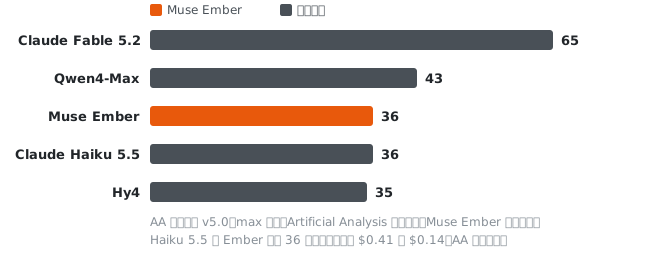
The AA Index v5.0 comparison: Ember at 36, tying Haiku 5.5; the full benchmark tally is in section 12.
04Top 3 reads
Short on time? Start with these three; the full list is in section 10.
05Timeline
Ember launched the same day as Fable 5.2 — Anthropic's "biggest" against Meta's "smallest" — and the coverage itself plays on the contrast. This site already has a Fable 5.2 topic; the two read as a pair.
- 2026-04
Muse Spark releases (the family's mid-weight model).
- 2026-08
Muse Glimmer releases — the open-weight twin of Spark, and still Meta's only open-weight Muse model.
- 2026-10
Muse Wonder releases (the family's frontier flagship); Wonder Full stays locked inside Muse Code.
- 2026-11-09
Muse Ember releases: Meta's research blog "Introducing Our Smallest, Most Efficient Model: Muse Ember" goes live; Alexandr Wang announces it on X the same day — the first model Meta says it trained using Muse Wonder Full; live the same day on the Meta Model API (muse-ember-1.0), Muse Code on all plans, Google Cloud, Oracle Cloud and the Vercel AI Gateway; Artificial Analysis publishes its launch evaluation the same day: Intelligence Index 36, $0.14 per task; TechCrunch covers it at 18:00 UTC; the Hacker News launch thread reaches 228 points; Anthropic releases Claude Fable 5.2 / Mythos 5.2 the same day.
- 2026-11-10
Simon Willison publishes his hands-on test (six reasoning levels, the pelican drawing test, 40× cheaper than Wonder); Chinese and TW/HK outlets follow (cocoloop, jiazhuangai, sunmedia, airesearch.hk).
- 2026-11-10
Plotly publishes its data-analysis test: Ember answers 38 of 43 DataAnalyticsBench questions, tying GPT-6 Luna — but the full run costs $1.04, 8× Luna's; hidden patterns come in at 1/5.
- 2026-11-10–11
Second-wave coverage and analysis: gptclub, datalearner, techbang, plus eesel.ai, i10x.ai, alphasignal, at-pulse, tech-insider (cost math on the 200K price cliff) and agentfred (the same-day comparison with Fable / Mythos 5.2).
- 2026-11-15
LMArena debut (Nov 15 results): WebDev 1,608 for No. 37 (max effort), Agent Arena 1.7 for No. 25; LiveBench still has no Ember run.
- 2026-11-16
This topic page goes live; Activepieces runs a small-sample test — 3/3 automation tasks correct in 8.4 seconds (3× gpt-5.4-mini, one run each); LiveBench still has no Ember listing.
- 2026-11-17
This site reads the BenchLeader snapshot and adds scores from 16 boards: Vals Index 60.5 (No. 15), Vals Legal 75.7% (No. 4), Vals Finance 60.9% (No. 13), GameBench 2 overall 51.7 (No. 36), AA-Omniscience non-hallucination rate 82.6% (No. 10), and more. See section 12.
- 2026-11-17
Mark Zuckerberg announces on X that Muse Ember is coming soon to Microsoft Foundry on Azure, in the same batch as Muse Wonder and Muse Spark 1.3; no date is given. See section 07.
06Official specs
As published by the Meta research blog and the Meta Model API docs (checked in the early hours of Nov 16, 2026, cross-checked across several secondary reports). Parameter count is undisclosed and the training method is not described; component benchmarks are vendor-reported.
- Status
- Released (2026-11-09; API and Muse Code live the same day)
- Model ID
- muse-ember-1.0 (Meta Model API)
- Architecture / parameters
- Parameter count not disclosed; training method not disclosed; Meta says it is the first model released trained using Muse Wonder Full
- Context window
- 1,048,576 tokens (1M)
- Max output
- 524,288 tokens (512K)
- Input
- Text, image, audio, video, PDF (native multimodal)
- Output
- Text
- Reasoning
- Six levels: minimal, low, medium, high, xhigh, max; default max; Meta published benchmarks only at max effort
- API
- Meta Model API (api.meta.ai/v1), Responses API supported, same request body as Muse Spark; also Muse Code, Google Cloud, Oracle Cloud, Vercel AI Gateway
- Weights
- No open weights; API-only
- API price
- Under 200K input $0.10 / $0.004 (cached) / $0.50; over 200K the whole request bills at 3×, $0.30 / $0.012 / $1.50 (per 1M tokens)
- Benchmarks
- AA Intelligence Index v5.0 36 (max, independently published); the six component benchmarks are Meta-reported reproductions of AA evaluations; AA-Omniscience 21.1%
- Safety evaluation
- Evaluated under the Meta Superintelligence Scaling Framework (chem/bio, cyber, loss-of-control); Meta says no category exceeded the high-risk threshold; also evaluated for resisting instructions hidden in web pages, documents and tool outputs, and for seeking human input before high-impact actions
07How to try it: six routes
Six routes: five were live on launch day, and Microsoft Foundry is announced as coming soon, not yet live. Meta's own API and Muse Code are the main doors, two clouds and a gateway handle distribution. There is no free tier and no downloadable weights — trying it means going through an API.
1Meta Model API (the main door)
Model ID muse-ember-1.0, endpoint api.meta.ai/v1, Responses API supported, same request body as Muse Spark. Pricing $0.10/$0.50 (under 200K input), whole-request 3× above 200K; Standard mode only, no Contributor mode.
2Muse Code (all plans)
Available on all Muse Code plans from launch day. The positioning is a two-model pattern — "Wonder plans, Ember executes": Wonder / Spark plan, Ember takes the high-volume execution work. Meta says Ember is the first model trained with Muse Wonder Full, which itself stays locked inside Muse Code.
3Google Cloud
Listed on launch day. Pricing and channel details per Google Cloud's official pages; not itemised in this research round.
4Oracle Cloud
Listed on launch day; Oracle is also one of the partners Meta quoted at launch. Pricing and channel details per Oracle Cloud's official pages; not itemised in this research round.
5Vercel AI Gateway (launch day)
Connected on launch day. The easy switch for projects already on the Vercel AI Gateway — change the model ID; pricing per the gateway's page.
6Microsoft Foundry (Azure) — coming soon
Meta CEO Mark Zuckerberg announced on X on November 17 that Muse Ember will come to Microsoft Foundry on Azure, alongside Muse Wonder and Muse Spark 1.3; he said "coming soon" and gave no date, so it cannot be used yet.
08Pricing
Ember's pricing story has two layers: its rates are identical to Haiku 5.5 and GPT-6 Luna ($0.10/$0.50) — the saving is per task ($0.14 vs $0.41), not per token; but whole requests over 200K input tokens bill at 3×, so the $0.10 headline holds only below 200K. Prices checked Nov 16, 2026; the checkout page price is authoritative.
| Item (per 1M tokens) | ≤ 200K input | > 200K input (whole request 3×) | Claude Haiku 5.5 | GPT-6 Luna |
|---|---|---|---|---|
| Input | $0.10 | $0.30 | $0.10 | $0.10 |
| Cached input | $0.004 | $0.012 | ~$0.01 (Ember cache ~60% cheaper) | — |
| Output | $0.50 | $1.50 | $0.50 | $0.50 |
| Cost per AA Index task | $0.14 | — | $0.41 | — |
The 200K cliff: the whole request, not just the excess
A request over 200,000 input tokens bills input, cached input and output all at 3× — and the whole request, not just the part above 200K. Example: a 250K-input-token request bills input at $0.30 and output at $1.50; for the same output volume, the bill is 3× a sub-200K request. Long-document parsing and over-long-context agent work hit this line most easily: count tokens first, then decide whether to split the request or switch effort levels.
Why identical rates still mean a third of the cost per task
Ember, Haiku 5.5 and GPT-6 Luna share the same list price ($0.10/$0.50); the saving is in usage, not rates. On the AA Index, Ember used ~115M output tokens against Haiku's ~298M — Ember does the same task set with fewer tokens, so cost per task is $0.14 vs $0.41. Cached input is also ~60% cheaper ($0.004 vs Haiku's ~$0.01). Read the other way: if your task makes Ember output as much as Haiku, the saving disappears. "A third of the cost" is a per-task claim, not a per-token claim.
Against the family flagship: a 17× gap
Alexandr Wang's claim: Ember delivers nearly Muse Spark 1.3 (max) intelligence (AA 37 vs 36) at a 17× cheaper price per AA — Spark $2.39 per task vs Ember $0.14. Simon Willison's hands-on test calls Ember 40× cheaper than Wonder. The two multiples use different bases (per-task cost vs an unstated basis), so don't mix them.
Official page: Meta research blog — Muse Ember launch post
09First hands-on reviews
Material from Nov 9–16: the independent evidence was a single evaluator, Artificial Analysis, until Plotly's data-analysis test and Simon Willison's hands-on test appeared on Nov 10, LMArena debuted on Nov 15 and an independent small-sample test landed on Nov 16. The headline first: the AA Index of 36 is real; the other six component benchmarks are Meta's retelling of AA evaluations, not an AA-published board. Every entry carries a verdict badge; "Read on this site" opens our rewritten deep-dive article, with the original source at the end.
Artificial Analysis: Index 36, $0.14 per task, "cheapest scoring 36+"
Verdict: the topic's only independent score — and the source of the headlineSource: Artificial Analysis launch evaluation, Nov 9, 2026 (independently run)
AA Intelligence Index v5.0: Ember (max effort) 36, level with Claude Haiku 5.5 (max), behind Spark 1.3 (max) at 37; cost per task $0.14 vs Haiku $0.41 and Spark $2.39; AA calls it the "cheapest model scoring 36 or higher"; 2nd of 33 comparable models at ~$0.14 per task. Note: this is the only item AA published independently — the six component benchmarks are in the next entry.
Read on this site → (original ModelBrief rewrite)
Meta's six reported benchmarks: a big AutomationBench win — and a FrontierCode loss
Verdict: five wins, one loss — and the loss is codingSource: Meta research blog launch post (Meta's retelling of AA evaluations — vendor-reported)
AutomationBench-AA 37.8% vs Haiku 13.9% and Luna 20.2% (the widest gap); Terminal-Bench 4.0 40.9% vs Haiku 39.2%; OSWorld 2.1 69.5% vs Haiku 68.9% and Luna 50.5%; Agents' Last Exam 61.6 vs 57.0 / 57.1; PerceptionBench 80.6 vs 78.6 / 62.8; but FrontierCode 2.0-AA 27.2% vs Haiku 34.9% — Ember loses. The AA Coding Agent Index of 46 is also Meta's figure; Ridge notes it as Meta's claim. Meta's chart notes Ember's costs were estimated at proposed pricing.
Read on this site → (original ModelBrief rewrite)
AA-Omniscience 21.1%: the lowest in its class
Verdict: the genuine weak spot underneath Index 36 — don't read the headline aloneSource: Artificial Analysis (via alphasignal)
AA-Omniscience 21.1%, the lowest among models with similar overall index scores. Index 36 summarises general intelligence; Omniscience measures a different dimension — Ember's 36 hides a bottom-of-class result that matters when choosing a model.
Read on this site → (original ModelBrief rewrite)
Simon Willison's hands-on test: six effort levels, quality doesn't rise steadily
Verdict: the only deep hands-on record — one person, one taskSource: Simon Willison, Nov 10, 2026 (personal hands-on test)
He tried all six reasoning levels: quality did not rise steadily with effort, and one request at high failed to return a complete drawing; he calls Ember 40× cheaper than Wonder. A single-person, single-task observation, not a benchmark — but it directly questions the "default max is safest" assumption, and it underlines that lower-effort quality is officially unverified.
Read on this site → (original ModelBrief rewrite)
TechCrunch and The Verge covered it the same day; HN 228 points
Verdict: the strongest mainstream coverage of this round's candidatesSource: TechCrunch, Nov 9, 2026, 18:00 UTC; Hacker News launch thread, 228 points on day one
TechCrunch reported at 18:00 UTC on launch day; The Verge also covered it the same day (this site did not obtain the original link in this round, so it is not linked here); the Hacker News launch thread reached 228 points. The second wave added eesel.ai (calling it "the cheapest way to get Claude Haiku 5.5-level results"), i10x.ai, alphasignal, at-pulse, tech-insider, agentfred and about ten analyst sites.
Read on this site → (original ModelBrief rewrite)
Chinese coverage: present, but no tier-1 mainstream outlet
Verdict: the Chinese-speaking world knows Ember — just not from the front pageSource: gptclub (Nov 11), cocoloop (Nov 10), jiazhuangai (Nov 10), datalearner (Nov 9); TW/HK: techbang (Nov 11), sunmedia (Nov 10), airesearch.hk (Nov 10)
Four mainland niche outlets and three TW/HK outlets followed up on Nov 9–11, covering specs, the two-tier pricing and the "no weights" question; but no piece appeared from 机器之心, 新智元, 量子位 or IT之家, and Chinese autocomplete is zero. Chinese readers currently learn about Ember mainly through the English launch and niche reposts.
Read on this site → (original ModelBrief rewrite)
LMArena debuts: WebDev No. 37, Agent Arena No. 25; LiveBench still absent
Verdict: independent evidence is no longer AA alone — but neither debut score flatters EmberSource: LMArena (via BenchLeader mirror), Nov 15, 2026 results
LMArena's Nov 15 results: WebDev (max effort) 1,608 for No. 37, Agent Arena 1.7 for No. 25 — listed on both boards, but ranked low on each, and the Agent Arena score in particular sits awkwardly against the AA Index 36 "ties Haiku" story. LiveBench still has no Ember run and stays on the tracking loop's watchlist.
Activepieces small-sample test: 3/3 automation tasks right, but 3× slower than gpt-5.4-mini
Verdict: accurate but slow — one run each, indicative onlySource: Activepieces, Nov 16, 2026, 13:31 Beijing time (independent small-sample test)
The author ran 3 automation tasks (ticket triage, invoice field extraction, email-thread summarisation); Ember got 3/3 right, but took 8.4 seconds in total — 3× gpt-5.4-mini's 2.8 seconds. The author ran each task once and flags the result as indicative only: the accuracy claim is thinly supported, but the direction of the speed gap is worth noting — Ember sells cheapness, not speed.
Plotly data-analysis test: 38/43 ties Luna — but the bill is 8× Luna's
Verdict: a high score with an expensive bill; hidden patterns are the weak spotSource: Plotly, Nov 10, 2026 (independent test, DataAnalyticsBench, 43 questions)
Plotly put 45 models through the same 43-question data-analysis exam, built on a real data warehouse, where the model writes its own queries, checks the data and answers. Ember got 38 right, tying GPT-6 Luna, one ahead of Haiku 5.5 (37) and three ahead of Meta's own open-weight Glimmer 30B (35). By category: all 33 questions with a definite answer came back correct — a clean sweep across analysis, ambiguous questions, impossible requests and data quality; statistical traps 4/5, ahead of Luna's 3/5 and Haiku's 2/5; the losses cluster in "hidden patterns", where it found just 1 of 5. The bill is the other side of the story: the full run cost $1.04, 8× Luna's $0.13. The cause is usage: Ember read about 26.6M input tokens across the exam, roughly 5× Luna's, 70% of it cached ($0.004 per million); hidden-pattern questions averaged 78 queries each, the second-highest of the 45 models (median 25, two questions over 100). On speed, the median question took 28 seconds, against a board median of 27; one question ran 75 minutes in total, but almost all of that was the database executing heavy queries — the model's own generation took about 24 minutes. The caveat: each model ran once, and Plotly says repeat runs can swing by up to 3 points, so gaps of 1–2 points count as a tie — the tie with Luna and the 1-point lead over Haiku both sit inside that margin.
10Articles: our deep dives
The six articles below are original ModelBrief rewrites and reorganization — restructured with added conclusions and buying advice, with facts and numbers checked against the original reviews. Read them on this site; each ends with its original source.
11Related topics
Topic pages for the other models on this site.
 MAI Code 2Released Nov 17, 2026 · Microsoft's first in-house coding flagship, live in GitHub Copilot on day one; Microsoft claims 98% of GPT-6.1 Sol's performance at 40% of the cost (50% promo price). The topic page covers official specs, pricing, benchmark analysis and 6 in-depth reviews.
LLM · Open weights · Released Nov 12, 2026
 Edge0-145BReleased Nov 12, 2026 · Edge0's first 145B on-device model, a latent MoE on a Qwen3.8-Flash-Next base, 256K context, weights public on HF under a custom community license (not open source). The topic page covers official specs, pricing, benchmark analysis and 6 in-depth reviews.
ModelBrief homeAll topicsBack to the home page: browse all 18 model topics by release date — LLMs, image models and video models.
12Benchmarks: AA Index 36 + the six component benchmarks
Read the table in two layers: the top layer is the independently published AA Index of 36 (max effort); the lower layer is Meta's retelling of AA evaluations across six component tests — the two layers carry different weight, so check who is speaking before reading the scores.
| Test (Meta-reported, AA evaluations reproduced) | Muse Ember (max) | Claude Haiku 5.5 (max) | GPT-6 Luna (max) |
|---|---|---|---|
| AutomationBench-AA (end-to-end business workflows) | 37.8% | 13.9% | 20.2% |
| Terminal-Bench 4.0 (terminal tasks) | 40.9% | 39.2% | — |
| FrontierCode 2.0-AA (coding) | 27.2% | 34.9% | — |
| OSWorld 2.1 (computer use) | 69.5% | 68.9% | 50.5% |
| Agents' Last Exam (end-to-end agent tasks) | 61.6 | 57.0 | 57.1 |
| PerceptionBench (fine visual perception) | 80.6 | 78.6 | 62.8 |
The independently published layer: AA Index 36 and Omniscience 21.1%
| Measurement (AA, independently published) | Muse Ember | Claude Haiku 5.5 | Muse Spark 1.3 |
|---|---|---|---|
| AA Intelligence Index v5.0 (max effort) | 36 | 36 | 37 |
| Cost per task (AA Index) | $0.14 | $0.41 | $2.39 |
| AA-Omniscience | 21.1% (lowest in its class) | — | — |
| AA Coding Agent Index | 46 (Meta's figure) | — | — |
Independent evidence (as of Nov 17)
| Measurement | Source | Ember result | Note |
|---|---|---|---|
| AA Intelligence Index v5.0 | Artificial Analysis, Nov 9 | 36 (max), $0.14/task | The only independent score; "cheapest scoring 36+" |
| AA-Omniscience | Artificial Analysis (via alphasignal) | 21.1% | The lowest-in-class weak spot |
| Simon Willison hands-on test | Simon Willison, Nov 10 | Six effort levels, quality not monotonic | One person, one task — not a benchmark |
| Plotly DataAnalyticsBench (43-question data-analysis exam) | Plotly, Nov 10 | 38/43 (88%), $1.04 | Tied with Luna, at 8× Luna's cost; hidden patterns 1/5 is the weak spot |
| LMArena WebDev | LMArena (via BenchLeader mirror), Nov 15 results | 1,608, No. 37 (max effort) | Debut; ranked low |
| LMArena Agent Arena | LMArena (via BenchLeader mirror), Nov 15 results | 1.7, No. 25 | Debut; a low score |
| LiveBench | — | Still not listed | No independent score |
| Vals Index | BenchLeader, read Nov 17, 2026 | 60.5, No. 15 | Originally published by Vals AI |
| Vals Legal | BenchLeader, read Nov 17, 2026 | 75.7%, No. 4 | Originally published by Vals AI |
| Vals Finance | BenchLeader, read Nov 17, 2026 | 60.9%, No. 13 | Originally published by Vals AI |
| Vibe Code Bench v1.1 | BenchLeader, read Nov 17, 2026 | 83.7%, No. 25 | — |
| Design Arena (Website) | BenchLeader, read Nov 17, 2026 | 1329, No. 10 | — |
| SimpleBench | BenchLeader, read Nov 17, 2026 | 72.7%, No. 23 | — |
| APEX-Agents | BenchLeader, read Nov 17, 2026 | 64.3%, No. 15 | — |
| SWE Atlas v1.1 | BenchLeader, read Nov 17, 2026 | 56.0%, No. 20 | Sub-scores: Codebase QnA 61.3% (No. 19), Test Writing 56.7% (No. 19), Refactoring 50.0% (No. 18) |
| HLE-Diamond (Scale) | BenchLeader, read Nov 17, 2026 | 22.0%, No. 17 | — |
| FORTRESS | BenchLeader, read Nov 17, 2026 | 11.9%, No. 8 | — |
| Excel Modeling | BenchLeader, read Nov 17, 2026 | 72.2%, No. 13 | — |
| Terminal-Bench 4.0 (AA), max effort | BenchLeader, read Nov 17, 2026 | 40.9%, No. 46 | Originally published by Artificial Analysis; same score as Meta's reported 40.9% — this is the AA board ranking |
| FrontierCode 2.0 (AA), max effort | BenchLeader, read Nov 17, 2026 | 27.2%, No. 45 | Originally published by Artificial Analysis; same score as Meta's reported 27.2% — this is the AA board ranking |
| AA Intelligence Index, xhigh effort | BenchLeader, read Nov 17, 2026 | 34.1 | Originally published by Artificial Analysis; max effort is 36, xhigh is 1.9 points lower |
| GameBench 2 overall | BenchLeader, read Nov 17, 2026 | 51.7, No. 36 | Originally published by DuelLab; XHigh effort 58.6 |
| AA-Omniscience (non-hallucination rate) | BenchLeader, read Nov 17, 2026 | 82.6%, No. 10 | Originally published by Artificial Analysis; the non-hallucination component — the 21.1% elsewhere on this page is the overall Omniscience figure, a different measure |
Full tally: our benchmarks article →
13Comparisons
vs Claude Haiku 5.5 (the defining rival)
| Dimension | Muse Ember | Claude Haiku 5.5 |
|---|---|---|
| AA Intelligence Index v5.0 (max) | 36 | 36 |
| Cost per task (AA Index) | $0.14 | $0.41 |
| List price (input / output, per 1M tokens) | $0.10 / $0.50 (under 200K) | $0.10 / $0.50 |
| Cached input | $0.004 (~60% cheaper) | ~$0.01 |
| AutomationBench-AA | 37.8% | 13.9% |
| Terminal-Bench 4.0 | 40.9% | 39.2% |
| FrontierCode 2.0-AA | 27.2% | 34.9% |
| OSWorld 2.1 | 69.5% | 68.9% |
| Agents' Last Exam | 61.6 | 57.0 |
| PerceptionBench | 80.6 | 78.6 |
| AA-Omniscience | 21.1% (lowest in its class) | — |
| Context | 1M | — |
| Open weights | No | No |
| Released | 2026-11-09 | — (not confirmed in this round) |
Same price, same index, a third of the cost per task — that is the whole Ember-vs-Haiku story. Ember wins on using fewer tokens (~115M output tokens vs ~298M) and on business workflows, terminal work and computer use; it loses on coding (FrontierCode 27.2% vs 34.9%) and sits bottom of its class on Omniscience at 21.1%. Pick Ember for repeatable tasks, tool calls, routing and extraction; check FrontierCode before choosing it for code-heavy work.
vs GPT-6 Luna (the other named rival) and the family
| Dimension | Muse Ember | GPT-6 Luna | Muse Spark 1.3 |
|---|---|---|---|
| AA Intelligence Index v5.0 (max) | 36 | — | 37 |
| Cost per task (AA Index) | $0.14 | — | $2.39 |
| List price (input / output) | $0.10 / $0.50 | $0.10 / $0.50 | — |
| AutomationBench-AA | 37.8% | 20.2% | — |
| OSWorld 2.1 | 69.5% | 50.5% | — |
| Agents' Last Exam | 61.6 | 57.1 | — |
| PerceptionBench | 80.6 | 62.8 | — |
| Positioning | High-volume execution | Lightweight flagship rival | Mid-weight mainstay (the 17× reference) |
Against Luna it is four wins out of four measured boards (AutomationBench, OSWorld, Agents' Last Exam, PerceptionBench) — but Luna's AA Index and cost per task were not confirmed in this research round and are left blank; this site won't invent numbers. Inside the family: Ember trails Spark 1.3 by one index point (36 vs 37) at roughly a seventeenth of the cost per task — the price gap the "planner and executor" split is built on. Note: Spark's list price and Luna's index were not confirmed in this round and are left blank.
Read the deep comparison: Muse Ember vs Claude Haiku 5.5 → · Read the deep comparison: Muse Ember vs GPT-6 Luna and the family →
14What's missing (as of Nov 16)
- Any independent score from LiveBench (still no listing; LMArena debuted Nov 15)
- Parameter count (undisclosed) and training-method detail (not described)
- Official benchmark results at any effort level below max (Meta published max only)
- Open weights (none; Meta's open-weight Muse model is Glimmer / Spark Open)
- A free tier (no source mentions one)
- GPT-6 Luna's AA Index and cost per task (not confirmed in this round)
- Google Cloud and Oracle Cloud pricing detail for Ember (not itemised in this round)
- Tier-1 Chinese tech-media coverage (none from 机器之心, 新智元, 量子位 or IT之家)
- The original link to The Verge's launch report (not obtained in this round; not linked)
- Mainstream English media coverage from Reuters / Bloomberg / Wired (none found in this round)
15Rumor check
Most confusion about Ember comes from three places: the open-weights question, the pricing, and who published which benchmark — clarified one by one below.
Not true "Muse Ember is open source / has open weights"
Ember shipped no weights at all; it is API-only. Google autocomplete shows "muse ember open weights" because people are asking — not because weights exist to download. Meta's open-weight Muse model is Glimmer (the open-weight twin of Spark, released in August); don't confuse the two models.
Not true "Muse Ember is cheaper than Haiku 5.5 because its rates are lower"
The rates are identical — $0.10/$0.50 for both. Ember saves on cost per task ($0.14 vs $0.41) because it uses fewer output tokens on the same test set (~115M vs ~298M). Calling "a third of the cost" a rate saving is wrong.
Not true "$0.10 is Ember's price"
Only when input stays at or below 200K tokens. Requests above 200K bill the whole request at 3× ($0.30/$1.50) — the whole request, not just the excess. The real rate for long-context work is $0.30, not $0.10.
Partly true "Ember beats Haiku 5.5 across the board"
The AA Index is tied (36 vs 36); across the component boards Ember wins five of six measured against Haiku (AutomationBench, Terminal-Bench 4.0 by just 1.7 points, OSWorld, Agents' Last Exam, PerceptionBench) but loses FrontierCode 2.0-AA 27.2% vs 34.9%, and its AA-Omniscience 21.1% is the lowest in its class. Business workflows and agent execution are the strengths; coding is the weak spot.
Not true "All six component benchmarks were independently published by AA"
Only the Intelligence Index of 36 was independently published by AA on Nov 9. The six component scores come from charts in Meta's launch post — Meta's retelling of AA evaluations; the AA Coding Agent Index of 46 is likewise Meta's figure. Cite who is speaking.
Unconfirmed "Ember has a free tier"
No source in this round — the Meta blog, the API docs, TechCrunch, or a dozen analyst pieces — mentions a free tier. There is no free tier to write about, and none is ruled out for the future; check Meta's official pages.
16FAQ
Is Muse Ember open source? Does it have open weights?
No. Ember is API-only and shipped no weights. Meta's open-weight Muse model is Glimmer / Spark Open (released August) — a different model. The Google autocomplete suggestion "muse ember open weights" shows people asking, not weights existing. See our launch overview.
How much does Muse Ember cost?
With input at or below 200K tokens: $0.10 in / $0.004 cached in / $0.50 out per 1M tokens. Above 200K: the whole request bills at 3× ($0.30 / $0.012 / $1.50). Cost per AA Index task is $0.14, against Haiku 5.5's $0.41. No source mentions a free tier. See our pricing guide.
Is it as smart as Claude Haiku 5.5?
On the AA Intelligence Index v5.0 (max effort) both score 36 — a tie — but Ember costs a third as much per task ($0.14 vs $0.41). By component: Ember leads on AutomationBench, OSWorld and two more boards, trails on FrontierCode 27.2% vs 34.9%, and its AA-Omniscience 21.1% is the lowest in its class. See our comparison article.
What is the 200K price cliff?
Requests over 200,000 input tokens bill input, cached input and output all at 3× — and the whole request, not just the excess. Below 200K it is $0.10/$0.50; above it, $0.30/$1.50. Count tokens before sending long-document work. See our pricing guide.
What is Muse Ember for?
High-volume, repeatable agent execution: sub-agent tasks, tool calls, routing, extraction, long-document parsing — Meta's framing is "Wonder plans, Ember executes". Code-heavy work needs care: it loses to Haiku 5.5 on FrontierCode. See our usage guide.
Can I use it in Muse Code?
Yes — available on all plans from launch day. Also via the Meta Model API (muse-ember-1.0), Google Cloud, Oracle Cloud and the Vercel AI Gateway. See our usage guide.
17Sources
Every fact on this page comes from the public sources below (checked in the early hours of Nov 16, 2026, cross-checked across several secondary reports; the Microsoft Foundry item was checked Nov 18). Unlinked items are cited by name and date from reporting this site read during research; no link is fabricated.
Official
- Meta research blog — Introducing Our Smallest, Most Efficient Model: Muse Ember (launch post, six component benchmarks, pricing, safety evaluation) Nov 9
- Meta Model API docs and pricing page (muse-ember-1.0, api.meta.ai/v1, Responses API, two-tier pricing) Nov 9
- Alexandr Wang's X post (launch announcement; "the first model we've released trained using Muse Wonder Full") Nov 9
Independent evaluation and hands-on
- Artificial Analysis — launch evaluation: Intelligence Index v5.0 36 (max), $0.14 per task, "cheapest model scoring 36 or higher" Nov 9
- Simon Willison — hands-on test: six reasoning levels, the pelican drawing test, 40× cheaper than Wonder Nov 10
- Activepieces — small-sample test: 3/3 automation tasks correct, 8.4 seconds total (3× gpt-5.4-mini; one run each) Nov 16
- Plotly — data-analysis test: 38/43 correct (88%), $1.04 — tied with GPT-6 Luna at 8× its cost; hidden patterns 1/5 Nov 10
- alphasignal — AA-Omniscience 21.1% (lowest in its class), as reported
- at-pulse — "2nd of 33 comparable models at ~$0.14 per task"
- BenchLeader — Muse Ember model page (Vals Index 60.5, Vals Legal 75.7%, Vals Finance 60.9%, GameBench 2 51.7, AA-Omniscience non-hallucination rate 82.6% and more — multi-board snapshot) Read Nov 17
English reporting and analysis
- TechCrunch — Meta releases Muse Ember, a new lightweight model for agent execution Nov 9, 18:00 UTC
- The Verge — same-day coverage (original link not obtained in this round; not linked) Nov 9
- The Decoder — the "more intelligence per dollar than Haiku 5.5 or GPT-6 Luna" claim, as cited via sunmedia
- Hacker News — launch thread, 228 points on day one Nov 9
- TipRanks (via TheFly) — Zuckerberg says Muse Wonder, Muse Spark 1.3 and Muse Ember are coming to Microsoft Foundry on Azure Nov 17
- eesel.ai — explainer and review ("the cheapest way to get Claude Haiku 5.5-level results"); i10x.ai; tech-insider.org (cost math on the 200K cliff); agentfred.ai (same-day comparison with Fable / Mythos 5.2); mer.vin; dineroit.com; besoft.vn; codema.ai
Chinese reporting
- gptclub.ai — detailed report ("same price as Haiku, a third of the cost per task") Nov 11
- datalearner.com — specs, two-tier pricing and the "no weights" Q&A Nov 9
- news.cocoloop.cn Nov 10; jiazhuangai.com (citing TechCrunch) Nov 10
- techbang.com — benchmark table (incl. Agents' Last Exam 61.6, OSWorld 69.5, PerceptionBench 80.6) Nov 11; sunmedia.tw Nov 10; airesearch.hk (citing TechCrunch and The New Stack) Nov 10
More indexes: All Meta models · All Language Models · All models