Kling 4.0 Flash: The Topic Page
The cheap, fast tier of Kuaishou's Kling 4.0: announced September 28, 2026, open that day only to annual subscribers in early access, and generally available to everyone on November 4 — that date gap is the first thing to understand about this topic. Flash is capped at 720p, 20-second clips, and no keyframes, but costs $0.094 per second, about 40% below the full Kling 4.0 — a draft tier for the flagship. The honest side first: Kling has published no benchmark numbers, and neither Kling 4.0 nor Flash is listed on Artificial Analysis or LMArena; there are no weights and no open source; and Flash's native-audio status is disputed across sources and still unverified. This page collects the official specs, pricing, timeline and same-prompt tests — with unverified claims clearly marked.
01Key facts
What is confirmed: Flash is the cheap, fast tier of Kling 4.0, not a new generation — "cheap, fast, capped" is the one-line summary.
- Released
- Announced 2026-09-28 (with the Kling 4.0 generation; Flash open the same day only to Ultra Yearly / Black Gold annual subscribers in early access, with no public API and no published price); generally available 2026-11-04 (open to everyone on the website and API, with the price card published — the GA date this topic counts as the public release)
- Developer
- Kuaishou Kling AI, China
- Positioning
- The cheap, fast tier of Kling 4.0: 720p, 20s cap, no keyframes, for batch drafts and fast validation; finals still need the full Kling 4.0 (up to 4K, with 10-bit HDR coming soon)
- Resolution
- 720p ceiling, 8-bit SDR; no 1080p, no 4K, no HDR
- Clip length
- 3–20 s per clip; the full model does 3–30 s (extension to 2 min coming soon)
- Keyframes
- None — no keyframes, no last frame; the full model allows up to 10 keyframes
- References (Omni)
- Up to 15 inputs (≤10 images + ≤5 videos); single-image image-to-video uses the first frame; the full model additionally supports up to 7 subjects and audio/voice references
- Audio
- Unverified: one source says the Flash API has two-channel stereo audio, another says the official pricing table and API docs carry no native-audio row for Flash — the two claims are presented side by side, and this page endorses neither
- Price
- Official API: 0.6 Units/s ≈ $0.094/s with no input video; 0.4 Units/s with input video, nominally ~$0.063/s, but billed on 2× output duration — effectively ~$0.126/s, so the cheaper-looking row costs more; the full model is 1.0 Units/s at 720p ($0.157/s), making Flash ~40% cheaper
- Benchmarks
- No independent score of any kind: neither Kling 4.0 nor Flash is on the Artificial Analysis video boards or LMArena; Kling itself has published no benchmark numbers
- Weights & license
- Closed: no public weights, no model card, no tech report, no parameter count; available only via the website, API, resellers and plugins
- Access
- Kling website and app, official API, resellers (UnificAlly, Runway and others), MCP server, CLI and AI plugins (Adobe Photoshop / Premiere Pro / After Effects, per Kling's X post as reported by secondary sources — not verified against an Adobe listing)
- Free tier
- No free tier verified for Flash specifically: the website bills by credits and Flash is open to all plans, but no Flash-specific free allowance has been verified — this page does not claim one exists
02Quick comparison
Kling 4.0 Flash at a glance against the video models it is most often compared with. Neither Kling 4.0 nor Flash has an independent score; prices are per second at 720p. Flash sells on price (under half of Seedance 2.5) and control, not on leaderboard rank.
| Model | Key benchmark score or rank | Price | Scale or specs | Open weights |
|---|---|---|---|---|
| Kling 4.0 Flash | Not listed (no independent score) | $0.094 / s (720p) | 3–20 s, 720p | No |
| Seedance 2.5 Flash | Not listed (no independent score) | ~$0.15 / s (720p, converted) | Up to 30 s, 720p | No |
| Gemini Omni 1.2 Flash | AA text-to-video 1154 (#6), image-to-video 1086 (#14), editing 1164 (#2) | ~$0.07 / s (720p) | 3–15 s (extendable to 30 s) | No |
| Seedance 2.5 (flagship) | AA image-to-video #1, text-to-video #5 | $0.231 / s (720p) | Up to 30 s, up to 1080p | No |
Seedance 2.5 Flash's dollar rate is a conversion (~$0.15/s, from ~$0.76 for 5 s at 720p) and is not directly comparable with Kling's list price; treat the dollar comparison as a rough guide. Scores will be added here when Kling 4.0 or Flash is listed. See section 12.
03Charts
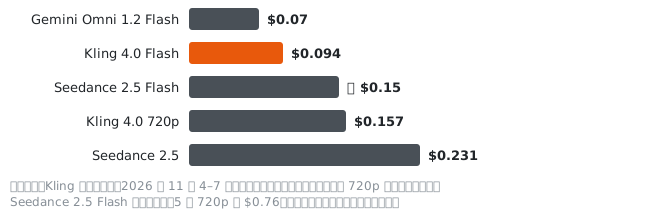
Per-second price at 720p (US dollars): Flash is the second cheapest of the five, behind only Gemini Omni 1.2 Flash; with an input video it bills at 2× output length, about $0.126/s in practice.
04Top 3 reads
Short on time? Start with these three: the split-by-task test against Seedance 2.5, the upgrades and board gap versus Kling 3.0, and the billing trap behind $0.094/s.
05Timeline
Two waves: Sep 28 – Oct 23 covers the announcement, the full-model launch and hands-on tests; Nov 4–7 is the Flash GA and pricing — the second wave is when Flash actually became publicly usable.
- 2026-09-28
The Kling 4.0 generation is announced; Kling 4.0 Flash opens the same day to a limited group: Ultra Yearly / Black Gold annual subscribers only, with no public API and no published price. The model name enters circulation on this day — 49 days old at the time of this site's Nov 16 research, not a brand-new name.
- 2026-10-02
PhotoGPT publishes an 8-test same-prompt comparison (Kling 4.0 vs Seedance 2.5), updated Nov 5.
- 2026-10-15
The full Kling 4.0 launches to all users on the Kling website (30s clips, 10 keyframes, 15 references). Kuaishou's launch comms claim 100M+ global Kling AI users and 50k+ enterprise customers (vendor claim). Covered in this site's AI briefing the same week.
- 2026-10-17
Techub News covers Kling 4.0; XiaoHu.AI collects 74 demo videos.
- 2026-10-21
Moe Lueker publishes a same-prompt test (Artlist-sponsored): with text alone, Seedance 2.0 beat Kling 4.0 on his hardest prompts, and he calls Kling 4.0 "not the most realistic AI video model you can use today." OpenClips publishes a Kling 4.0 review (updated Oct 31).
- 2026-10-23
新智元 (AI Era) runs a 4-model hands-on test: Kling 4.0 praised for character psychology and fight scenes, Seedance 2.5 best for long takes and emotion.
- 2026-10-25
什么值得买 (SMZDM) publishes Kling 4.0 coverage.
- 2026-10-27
Atlas Cloud's product-shot test runs Kling 4.0 Flash (not the full 4.0) and prefers Seedance 2.5 on a two-person dialogue scene. 毒眸/虚眸 run a multi-dimension test (via Sina News) with Seedance 2.5 as the baseline.
- 2026-10-28
The full Kling 4.0 becomes fully available on the official API (720p/1080p).
- 2026-11-04
Flash GA: Kling announces Flash is "now available to everyone on the Kling AI website and via API", publishes the rate card and the three API paths, and opens MCP, CLI and AI plugins (Adobe Photoshop / Premiere Pro / After Effects, per Kling's X post as reported by secondary sources). Genfire publishes a release-date/specs/price guide the same day; adgraam reports "Kling 4 Flash Is Out".
- 2026-11-05
UnificAlly lists Kling 4.0 Flash (from $0.0756/s); Genfire's guide goes out.
- 2026-11-06
laozhang.ai synthesizes the same-prompt tests: no independent benchmark ranks the two against each other, and the published tests "split by task". jiazhuangai publishes a Chinese pricing analysis (citing 界面新闻/Jiemian on the Nov 4 opening); 传乘AI (ccaiclass) publishes coverage.
- 2026-11-07
OrcaRouter updates its Flash GA analysis — the best single English source on price and the billing rule.
- 2026-11-10
Kling 4.0 lands in Adobe Firefly (per ReviewRamble, checked Nov 14).
- 2026-11-13 – 14
A second, smaller wave: aistacknav publishes a guide (Nov 14); ReviewRamble re-checks the AA non-listing (Nov 14).
- 2026-11-16
This site's research confirms AA and LMArena both omit Kling 4.0/Flash, and that the Flash audio conflict is unresolved.
06Official specs
Per the official docs (Kling's release note, feature page and API docs, as quoted by OrcaRouter, Atlas Cloud, Genfire and others in Nov 2026). Kling publishes no parameter count, architecture detail or model card — what is not in the table is what the vendor never gave.
| Capability | Kling 4.0 (full) | Kling 4.0 Flash |
|---|---|---|
| Clip length | 3–30 s (extension to 2 min coming soon) | 3–20 s |
| Resolution | 720p, 1080p, 4K (4K and 10-bit HDR marked "coming soon" on the release page; API currently 720p/1080p) | 720p only (the API settings.resolution enum has no second value) |
| Dynamic range | 10-bit HDR (1080p/4K, coming soon) | 8-bit SDR only |
| Keyframes | Up to 10 | None — no keyframes, no last frame |
| References (Omni) | Up to 15 inputs (≤10 images, ≤5 videos, ≤7 subjects, audio/voice refs) | Up to 15 inputs (≤10 images, ≤5 videos); single first-frame image-to-video |
| Prompt budget | Text up to 8,000 tokens | English prompt up to 26,000 characters (per OrcaRouter, from official docs) |
| Aspect ratios | Incl. 21:9 ultra-wide | Not separately published |
| Languages / dialogue | 9 languages incl. dialects | Not separately published |
| Audio | Stereo sound on every clip (per Genfire, citing official wording) | Unverified — conflicting sources, see below |
| Generation speed | Not published | No number published — "faster" is positioning only, with no seconds-per-clip figure from Kling |
| Parameters / architecture | Not disclosed | Not disclosed |
| Weights / license | Closed, no public weights | Closed, no public weights |
settings show none. The two claims directly conflict, so this topic endorses neither — do not make purchasing or workflow decisions on "Flash has audio" or "Flash has no audio" until Kling clarifies.Official pages: Kling official pricing page · Kling API docs: 4.0 Flash text-to-video · Kling usage guide: Kling 4.0 (§5.1)
07How to try it: 4 routes
Flash is open to everyone now — no annual plan, no waitlist. The website is fastest; the official API is the main route for workflows, and MCP and CLI are new channels that opened Nov 4.
1Kling website and app (fastest)
Flash is open to all plans, billed in credits on the website. Text-to-video, image-to-video and Omni multi-reference all work in the browser; per-request caps are 20s and 720p. Note: no Flash-specific free allowance has been verified, so do not budget on a free tier.
2Official API (main route)
Three official API paths (text-to-video, image-to-video, Omni multi-reference), published with the Nov 4 GA. No input video: 0.6 Units/s (~$0.094/s), billed on output duration; with input video: 0.4 Units/s, billed on 2× output duration (see section 08 for the arithmetic). Docs: official API docs.
3MCP server and CLI (new Nov 4)
Opened alongside the Flash GA: an MCP server and a command-line tool, for wiring Flash into agents and batch scripts. Details per Kling's docs; this site has not yet verified the command parameters one by one.
4Resellers and plugins (mind the sourcing)
Resellers: UnificAlly lists it (from $0.0756/s, Nov 5); Runway also carries Flash (per ReviewRamble). AI plugins: Adobe Photoshop / Premiere Pro / After Effects — per Kling's X post as reported by secondary sources, not verified against an Adobe listing, so this site marks it second-hand. Kling 4.0 separately entered Adobe Firefly on Nov 10 (per ReviewRamble).
08Pricing
Flash's price card has only two rows, but the second is a trap: the 0.4 Units/s row bills on 2× duration, so it actually costs ~34% more than the 0.6 Units/s row. Prices as checked Nov 4–7, 2026 (OrcaRouter, jiazhuangai, citing the official pricing page); the checkout page is authoritative.
| Item (720p) | Units / s | ≈ $ / s | Billing |
|---|---|---|---|
| Flash, no input video | 0.6 | $0.094 | Billed on output duration |
| Flash, with input video | 0.4 | Nominal $0.063; effective ≈ $0.126 | When input ≤ output, billed on 2× output duration |
| Full Kling 4.0, 720p | 1.0 | $0.157 | Billed on output duration |
| Full Kling 4.0, 1080p | 1.5 | $0.235 | Billed on output duration |
| Full Kling 4.0, 4K | — | Price column blank | — |
1 Unit ≈ $0.157 at list (bundle-discounted $0.149–$0.154 depending on pack size). Flash is ~40% cheaper than the full model at the same 720p (0.6 vs 1.0 Units/s).
The billing-trap arithmetic: why the 0.4 row costs more
Take a 10s output. No input video: 0.6 Units/s × 10 s = 6 Units, ≈ $0.94. With input video: 0.4 Units/s × (10 s × 2) = 8 Units, ≈ $1.26 — about 34% more. The rule triggers when the input video is no longer than the output (per OrcaRouter and jiazhuangai, citing the official docs). In other words, image-to-video and video-continuation uses — the ones that take an input — cost more on Flash than plain text-to-video; work out the 2× rule before choosing Flash or the full model for input-based work.
Cost per clip: $0.94 for 10s, $1.88 for 20s
No input video, 720p: 10s ≈ $0.94, 20s (Flash's per-request cap) ≈ $1.88. With input video: 10s of output ≈ $1.26, 20s ≈ $2.51. For comparison, the full model at 720p: 10s $1.57, 20s $3.14, 30s $4.71; 1080p 30s $7.06. When batching drafts, Flash saves about $0.63 (10s) to $1.26 (20s) per clip against the full model at 720p.
Reseller prices
UnificAlly's kuaishou/kling-4-0-flash-video starts at $0.0756/s (listed Nov 5), below the official ~$0.094/s — but this site has not verified one by one whether resellers apply the same 2× rule, so check the reseller's own page before ordering. fal and Runway list the full 4.0 at $0.157/s (720p) / $0.235/s (1080p), matching the official card; Runway also carries Flash (per ReviewRamble).
Official page: Kling official pricing page
09Same-prompt tests: four test sets, split by task
Neither Flash nor Kling 4.0 has an independent score — everything below is same-prompt testing and synthesis published Oct 2 – Nov 6. Mind the scope: except for Atlas Cloud, the tests compare the flagship Kling 4.0, not the Flash tier; no Flash-vs-Flash test exists yet.
PhotoGPT 8-test same-prompt comparison: flagship vs flagship
Verdict: 8 tests, back and forthSource: PhotoGPT, Oct 2, 2026 (updated Nov 5)
Eight same-prompt tests, Kling 4.0 vs Seedance 2.5. The wins go back and forth across the eight items, with no runaway winner; this site does not roll the eight into a single total — the tester did not give one either.
Read the full article → (本站原创整理)
Fuser same-prompt test: the control-first side
Verdict: Kling 4.0 leads on controlSource: Fuser, same-prompt test (Oct–Nov 2026)
On the same prompts, Kling 4.0 leads on shots that need precise control; look-and-performance shots lean to Seedance 2.5. The direction matches laozhang.ai's synthesis.
Read the full article → (本站原创整理)
Atlas Cloud product-shot test: the only test that ran the Flash tier
Verdict: on a two-person dialogue scene, Seedance leadsSource: Atlas Cloud, Oct 27, 2026 (Kling 4.0 Flash vs Seedance 2.5)
The only same-prompt test so far that ran the Flash tier: a product-shot scene, Kling 4.0 Flash vs Seedance 2.5, with the two-person dialogue scene preferring Seedance. One scene is a single data point — do not extrapolate it into an overall verdict.
Read the full article → (本站原创整理)
新智元 4-model test: character psychology and fight scenes
Verdict: Kling 4.0 praised for psychology and fightsSource: 新智元 (AI Era), Oct 23, 2026 (via 人人都是产品经理)
A four-model test: Kling 4.0 praised for character psychology and fight scenes; Seedance 2.5 best for long takes and emotion. 毒眸/虚眸 ran a multi-dimension test on Oct 27 (via Sina News) with Seedance 2.5 as the baseline.
Read the full article → (本站原创整理)
Moe Lueker: on the hardest prompts, Seedance 2.0 wins
Verdict: a cold splash on the "most realistic" narrativeSource: Moe Lueker, Oct 21, 2026 (Artlist-sponsored)
With text alone, Seedance 2.0 beat Kling 4.0 on his hardest prompts; his words call Kling 4.0 "not the most realistic AI video model you can use today". Note the comparison is against Seedance 2.0 (the previous generation), not Seedance 2.5.
Read the full article → (本站原创整理)
laozhang.ai synthesis: no overall ranking, only a task split
Verdict: "split by task" is the most honest summary availableSource: laozhang.ai, Nov 6, 2026 (same-prompt test synthesis)
The gist: no independent benchmark ranks the two against each other, and the published same-prompt tests split by task — Kling 4.0 leads where control matters, Seedance 2.5 where look and performance matter. This topic adopts that framing for its comparison.
Read the full article → (本站原创整理)
10Articles: our in-depth reads
The 6 articles below are our own rewritten, reorganized deep dives — restructured with conclusions and selection advice, with facts and figures checked against the original sources. Click any one to read it on this site; original sources are cited at the end of each article.
11Related topics
Topic pages for the other models on this site.
 MAI Code 2Released Nov 17, 2026 · Microsoft's first in-house coding flagship, live in GitHub Copilot on day one; Microsoft claims 98% of GPT-6.1 Sol's performance at 40% of the cost (50% promo price). The topic page covers official specs, pricing, benchmark analysis and 6 in-depth reviews.
LLM · Open weights · Released Nov 12, 2026
 Edge0-145BReleased Nov 12, 2026 · Edge0's first 145B on-device model, a latent MoE on a Qwen3.8-Flash-Next base, 256K context, weights public on HF under a custom community license (not open source). The topic page covers official specs, pricing, benchmark analysis and 6 in-depth reviews.
ModelBrief homeAll topicsBack to the home page: browse all model topics by release date — LLMs, image models and video models.
12Benchmarks and boards: no score is itself the finding
Kling has published no benchmark numbers, and no independent board has listed Kling 4.0 or Flash. This section is not a score table — it records the absence itself, plus where the predecessor sits, so readers can judge what 4.0 has to catch up to.
| Board / measurement | Source & check date | Kling 4.0 / Flash score | Comparison |
|---|---|---|---|
| Artificial Analysis video board (text-to-video) | AA; checked by ToolColumn Oct 29, laozhang.ai Nov 6, ReviewRamble Nov 14 | Not listed (neither Kling 4.0 nor Flash) | The best Kling model on the board is Kling 3.0 1080p (Pro), the fixed anchor at 1000 Elo, ~22nd |
| Artificial Analysis video board (image-to-video / Omni) | AA; same checks | Not listed | Kling 3.0 Omni at 1020 Elo |
| LMArena video board | LMArena; checked Nov 16, 2026 | Not listed (neither Kling 4.0 nor Flash) | The best Kling model on the board is the older 2.6 Pro, ~31st |
| Kling's own benchmarks | Kling official launch and feature pages | None — no VBench-style score table or board claim published | Quality claims are words only: "smoother motion", "more realistic footage", "realism, controllability, professionalism" |
| Same-prompt tests (vs Seedance 2.5) | PhotoGPT, Fuser, Atlas Cloud, dxbuilder; laozhang.ai synthesis Nov 6 | No total score; split by task | Kling 4.0 leads on control, Seedance 2.5 on look and performance; Atlas's dialogue scene prefers Seedance |
Full analysis: our comparison article →
13Comparisons
vs the full Kling 4.0 (in-family, the core comparison)
| Dimension | Kling 4.0 Flash | Kling 4.0 (full) |
|---|---|---|
| Resolution ceiling | 720p | 720p / 1080p / 4K (4K coming soon) |
| Dynamic range | 8-bit SDR | 10-bit HDR (1080p/4K, coming soon) |
| Clip length | 3–20 s | 3–30 s (extension to 2 min coming soon) |
| Keyframes | None | Up to 10 |
| References (Omni) | Up to 15 (≤10 images + ≤5 videos) | Up to 15 (≤10 images + ≤5 videos, ≤7 subjects, audio/voice refs) |
| 720p price | $0.094/s (0.6 Units/s) | $0.157/s (1.0 Units/s) |
| With input video | 0.4 Units/s, 2× billing, ≈ $0.126/s effective | The official docs did not separately list a with-input-video billing row for the full model in this round's checks |
| Audio | Unverified (conflicting sources) | Stereo on every clip (per Genfire, citing official wording) |
| Role | Draft tier: batch samples, fast validation | Finals tier: keyframe workflows, high-res delivery |
The in-family trade-off is clean: Flash is ~40% cheaper, and the price is a 720p ceiling, a 20s cap, no keyframes and unverified audio. Drafts on Flash, finals on the full model — the only sensible division of labour between the two tiers.
vs Seedance 2.5 (the main rival)
| Dimension | Kling 4.0 Flash | Seedance 2.5 (flagship) |
|---|---|---|
| Price per second | $0.094 | $0.231 (Flash is under half) |
| Resolution ceiling | 720p | 1080p (flagship; its Flash tier is 720p) |
| Clip length | 3–20 s | Up to 30 s (its Flash tier is also 30 s) |
| Same-prompt tests | Leads on control | Leads on look and performance; Atlas's dialogue scene prefers Seedance |
| Independent scores | None (AA/LMArena: not listed) | None (AA/LMArena: not listed) |
| Audio | Unverified | Built-in synchronised audio (flagship figure) |
Mind the scope: this table compares Flash against the Seedance 2.5 flagship — Flash costs under half per second, but the flagship has 1080p, 30s clips and verified synced audio. For the Flash-vs-Flash comparison, see the twin-cheap-tier comparison on the Seedance topic →.
vs Kling 3.0 (the predecessor)
| Dimension | Kling 4.0 / Flash | Kling 3.0 |
|---|---|---|
| Clip length | Full 3–30 s; Flash 3–20 s | The official 4.0 launch page does not list 3.0's length item by item; this site does not fill in unverified numbers |
| Keyframes | Full: up to 10; Flash: none | 3.0 also has a keyframe workflow (the generational gap is in count and precision, not itemised in this round's checks) |
| References (Omni) | Up to 15 inputs, ≤7 subjects (full-model figure) | Omni arrived with the 3.0 generation; 4.0 expands input and subject counts |
| AA video board | Not listed | 3.0 1080p (Pro) fixed anchor 1000 Elo, ~22nd; 3.0 Omni 1020 Elo |
| LMArena | Not listed | The best Kling model on the board is the older 2.6 Pro, ~31st |
| Price | Flash $0.094/s; full 720p $0.157/s | 3.0's current price was not re-confirmed in this round, so no side-by-side price comparison |
The 4.0 upgrade over 3.0 is real (longer clips, more keyframes and references, 21:9, the HDR/4K roadmap) — but no independent score backs the size of the jump yet: 3.0 is at least the fixed anchor on the AA board, and 4.0 is not listed at all. That listing is the single most awaited item for the 4.0 generation — only then will the upgrade have a comparable number.
Read the deep comparison: Kling 4.0 Flash vs Seedance 2.5 → · Read the deep comparison: Kling 4.0 Flash vs Kling 3.0 →
14What's missing (as of Nov 16)
- An AA video-board listing for Kling 4.0/Flash (a watch item for this site's 8-hour tracking loop — recorded as soon as it appears)
- An LMArena entry for Kling 4.0/Flash
- A clarification from Kuaishou on Flash's native audio (two sources conflict, still unresolved)
- A 1080p/4K tier for Flash (720p only today; the full model's 4K and 10-bit HDR are still marked coming soon)
- A Flash-vs-Flash same-prompt test (the only test that ran the Flash tier is Atlas Cloud's single product-shot scene, Oct 27)
- Verification of the Adobe plugins against an official Adobe listing (currently only Kling's X post via secondary sources)
- A generation-speed figure for Flash ("faster" has no seconds-per-clip number) and a one-by-one check of the MCP/CLI commands
- The full Kling 4.0's with-input-video billing row (not separately listed in this round's checks) and a re-confirmation of Kling 3.0's current price
15Rumor check
Confusion about Kling 4.0 Flash comes from three places: the two release dates, the with-input-video price row, and scores that do not exist — each clarified below.
Partly true "Kling 4.0 Flash was released on Nov 4"
Nov 4 is the general-availability date (website and API open to everyone, price published), but the name was announced Sep 28 and opened to annual subscribers in early access that day. Writing only "released Nov 4" makes it sound like a brand-new name; writing "released Sep 28" as if it were publicly usable is equally wrong — there was no API and no price between Sep 28 and Nov 4. The correct wording: announced and in early access Sep 28, generally available Nov 4.
False "With input video it's 0.4 Units/s, so it's cheaper"
0.4 Units/s is indeed below 0.6 Units/s on unit price alone, but when input ≤ output it bills on 2× output duration: a 10s output is 8 Units (≈ $1.26), more than the 6 Units (≈ $0.94) with no input video. The cheaper-looking row costs ~34% more. Quote the 0.4 row only together with the 2× rule.
False "Kling 4.0 Flash has 4K/HDR"
It does not. Flash is 720p and 8-bit SDR only; 4K and 10-bit HDR are capabilities marked "coming soon" for the full Kling 4.0 on its launch page, and the API currently offers only 720p/1080p. Reading the full model's roadmap as Flash's current capability is the most common misreading.
False "Kling 4.0 has an AA score"
It does not. As of the Nov 14 checks, neither Artificial Analysis video board lists Kling 4.0 or Flash, and LMArena does not either. The best Kling model on the boards is still 3.0 (the 1000-Elo fixed anchor). Any circulating "Kling 4.0 AA score" has no source.
Unverified "Flash has native audio"
Two sources conflict: UnificAlly's Flash API page says two-channel stereo audio; OrcaRouter says the official pricing table and API docs carry no native-audio row for Flash. Until Kuaishou clarifies, neither claim is endorsed.
False "Flash has a free tier"
No Flash-specific free allowance has been verified. The website bills by credits and Flash is open to all plans, but "a free tier" as a claim has no source — this topic does not claim one exists.
False "Flash is Kling 5.0 / a new generation"
Flash is the cheap, fast tier of the same Kling 4.0 generation, not a new one. The full model and Flash are two tiers of one generation: the differences in specs, price and positioning are all within the tier, and there is no "5.0".
16FAQ
When was Kling 4.0 Flash released?
Announced Sep 28, 2026, open that day only to Ultra Yearly / Black Gold annual subscribers in early access; generally available to everyone on Nov 4, 2026 (website and API usable, price published). This topic counts Nov 4 as the public-release date, while the first paragraph and timeline both state the Sep 28 early access. See section 05 for the timeline.
How much does Kling 4.0 Flash cost?
Official API: 0.6 Units/s with no input video, ≈ $0.094/s (1 Unit ≈ $0.157), billed on output duration; 0.4 Units/s with input video, nominally ≈ $0.063/s, but billed on 2× output duration when input ≤ output — effectively ≈ $0.126/s, so the cheaper-looking row costs more. A 10s clip is ≈ $0.94, a 20s clip ≈ $1.88. See our pricing guide.
What is the resolution limit?
720p only, 8-bit SDR; no 1080p, no 4K, no HDR. The full Kling 4.0 offers 720p/1080p, with 4K and 10-bit HDR marked coming soon. See our specs article.
Does Kling 4.0 Flash have keyframes?
No: no keyframes, no last frame. For a keyframe workflow, use the full Kling 4.0 (up to 10 keyframes). See our specs article.
Is there a free tier?
Not verified. The website bills by credits and Flash is open to all plans, but this site has found no Flash-specific free allowance to verify, so it does not claim a free tier exists. Prices per the official pricing page.
Is it on any leaderboard? Does it have an independent score?
No. As of the Nov 14, 2026 checks, neither Artificial Analysis video board nor LMArena lists Kling 4.0 or Flash, and Kuaishou has published no benchmark numbers. Quality judgments today rest only on small-sample same-prompt tests (section 09): split by task, with Kling leading on control and Seedance on look.
Can I run it locally? Is it open source?
No. Kling 4.0 Flash is a closed model with no public weights, no model card and no tech report; it can only be used via the Kling website and app, the official API, resellers and plugins — not deployed locally.
17Sources
The facts on this page come from the public sources below (official pages cross-checked via multiple quotations; research completed in the early hours of Nov 16, 2026).
Official
- Kling — official pricing page (Unit pricing, both Flash billing rows; as cited by OrcaRouter and jiazhuangai, Nov 4–7, 2026) Published Nov 4
- Kling — official API docs: Kling 4.0 Flash text-to-video (720p ceiling, 3–20 s; as cited by OrcaRouter and Atlas Cloud) Nov 4
- Kling — official usage guide: Kling 4.0 (§5.1; as cited by OrcaRouter) Nov 4
- Kling official launch page and feature page (Kling 4.0 generation announcement, full-model specs; as cited by Genfire, Atlas Cloud and OpenClips, Sep 28 – Oct 31, 2026) Announced Sep 28
- Kling's official X post (Flash GA and MCP/CLI/AI plugins; via secondary sources — the Adobe plugin part is not verified against an Adobe listing) Nov 4
English coverage and tests
- OrcaRouter — Flash GA analysis (the best single English source on price and the billing rule; Nov 4, updated Nov 7; a Chinese edition also exists) Nov 4–7
- Atlas Cloud — "Kling 4.0 vs Flash: Every Official Spec Before October" and the ByteDance provider page (Flash entry Nov 12); product-shot test (Oct 27, the only test that ran the Flash tier) Oct 27 – Nov 12
- Genfire — release-date/specs/price guide (incl. Flash live Nov 4) Nov 5
- OpenClips — Kling 4.0 review Oct 21 (updated Oct 31)
- aiartimind — Kling 4.0 guide Oct 18 (updated ~Nov 12)
- adgraam — "Kling 4 Flash Is Out" Nov 4–5
- PhotoGPT — 8-test same-prompt comparison (Kling 4.0 vs Seedance 2.5) Oct 2 (updated Nov 5)
- Fuser — same-prompt test; dxbuilder — review Oct–Nov
- laozhang.ai — same-prompt test synthesis ("split by task") Nov 6
- Moe Lueker — same-prompt test (Artlist-sponsored) Oct 21
- ToolColumn, ReviewRamble, aztech3d — comparison/review pieces (all noting the AA absence) Oct 21 – Nov 14
- UnificAlly —
kuaishou/kling-4-0-flash-videolisting (from $0.0756/s) Nov 5
Chinese coverage and tests
- 新智元 (AI Era) — 4-model hands-on test (via 人人都是产品经理) Oct 23
- 毒眸/虚眸 — multi-dimension test (via Sina News, Seedance 2.5 as baseline) Oct 27
- 界面新闻 (Jiemian) — Nov 4 Flash opening report (as cited by jiazhuangai, syndicated by Sina Finance) Nov 4
- jiazhuangai — Chinese pricing analysis (the best Chinese pricing source) Nov 6
- Techub News Oct 17 · XiaoHu.AI (74 demo videos) · 什么值得买 (SMZDM) Oct 25 · 传乘AI (ccaiclass) Nov 6 · aistacknav guide Nov 14
- This site's AI briefing — Oct 15 full-model launch coverage Oct 16 briefing
Mainstream English coverage not found: no TechCrunch, The Verge, Reuters, Bloomberg or Wired piece on either the Nov 4 GA or the Oct 15 launch; in Chinese, no standalone 机器之心 piece surfaced, and no 量子位/IT之家-tier piece on the Nov 4 GA was found.
More indexes: All Kuaishou models · All Video Models · All models