GPT-6.2 Astra: The Topic Page
OpenAI's flagship reasoning model, released November 17, 2026, alongside the everyday tier GPT-6.2 Sol. Artificial Analysis scores it 62 — in the top 3 of 91 models, behind Claude Fable 5.2's 65; on AA-3D it leads with 1,318 Elo. Pricing is $8/$40 per 1M tokens, 20% below GPT-6 Astra, and each index task costs $4.00 — about 1/6.6 of Fable 5.2. Three caveats up front: the rank is disputed (AA's own X post calls it No. 2, this site's briefing says No. 3 of 91), and OpenAI's self-reported lead over Fable has no independent reproduction yet. This page collects the official specs, the ways to try it, pricing, and the first hands-on coverage in English and Chinese — with unverified claims clearly marked.
01Key facts
What is confirmed: a top-3 model on the independent board, and one of the cheapest flagships per task at the same price point — "top 3 but cheap" is the one-line summary of GPT-6.2 Astra.
- Released
- 2026-11-17 (Tuesday, OpenAI's launch post "Introducing GPT-6.2 Astra and Sol"); everyday tier GPT-6.2 Sol launched the same day; both went live in ChatGPT Work, Codex and the API the same day
- Developer
- OpenAI, USA
- Positioning
- Flagship reasoning model for the hardest projects "from start to finish" (OpenAI's model-page wording); Sol is the everyday tier
- Generation
- GPT-6.2 is a point release, not a new generation; GPT-6.1 Terra filled the gap between Sol and Luna only a month earlier
- Effort tiers
- Max / High / Medium / Low (AA tested Max for the 62); an Ultrafast decoding tier is also available; the Responses API rejects reasoning effort set to none
- Context
- 1,050,000 tokens; max input 922,000 tokens; max output 128,000 tokens
- Knowledge cutoff
- May 18, 2026 (OpenAI model page, read by this site Nov 18; CyberQ's Nov 18 piece confirms from OpenAI's developer docs that June 1, 2026 refers to Sol)
- Parameters
- Not disclosed by OpenAI
- Price
- $8 in / $40 out per 1M tokens, 20% below GPT-6 Astra's $10/$50; cached input $0.40 (down 60% from $1.00); for requests above 272K input tokens, input and cache rates double and output costs 1.5× (i.e. $16/$60, per the OpenAI model page); Batch at 50% of Standard rates
- Benchmarks
- Artificial Analysis index 62 (Max, top 3 of 91 models; Claude Fable 5.2 leads at 65); AA-3D 1,318 Elo, No. 1; AnalystAgent 62.5%; Agents' Last Exam about 78% (AA X post)
- Model ID
- gpt-6.2-astra (OpenAI API); gpt-6.2-sol is the same-day everyday tier
- Access
- ChatGPT Work, Codex, OpenAI API; available to Plus, Pro, Enterprise and Edu; not open to free users
- Weights / open source
- Closed, no public weights
- System card
- Bio capability at the "High" threshold, cybersecurity at "Critical"; OpenAI calls it the first released model at "High" for AI self-improvement
02Quick comparison
Where it stands among the flagships: AA Index, price, context and open weights, side by side — Fable 5.2 costs the same and scores just 3 points higher.
| Model | AA Index | Price (input · output, per 1M tokens) | Context | Open weights |
|---|---|---|---|---|
| GPT-6.2 Astra | 62 (Max) | $8 / $40 | 1M tokens (1,050,000) | No |
| Claude Fable 5.2 | 65 | $8 / $40 | 1M tokens | No |
| Gemini 4 Carbon | 60 | $2 / $10 (through Nov 30; $4 / $20 from Dec 1) | 1M tokens | No |
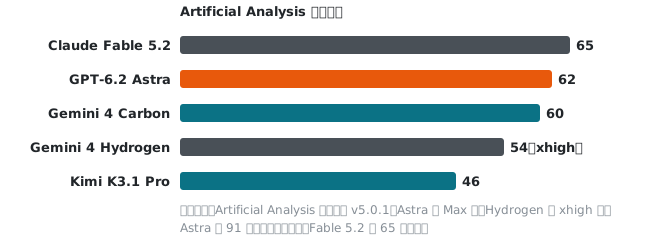
| Gemini 4 Hydrogen | 54 (xhigh) | $1.50 / $7.50 | 1M tokens | No |
| Kimi K3.1 Pro | 46 | $2 / $10 | 1M tokens | Yes (custom license) |
AA Index from Artificial Analysis (v5.0.1; Astra on Max, Hydrogen on xhigh); Astra ranks in the top three of 91 models. Carbon’s price is the promo rate through Nov 30, rising to $4/$20 from Dec 1. Prices per the official pages.
03Charts
AA Index, side by side: Astra’s 62 is just 3 points below the leader, Fable 5.2, and ahead of Carbon and Hydrogen.
04Top 3 reads
Short on time? Start with these three: the benchmark tally, the Fable comparison, and the pricing guide.
05Timeline
One day after launch, the independent board, price breakdowns and first reports all arrived the same day; the Chinese briefing led with it.
- Around Oct 17, 2026
GPT-6.1 Terra is released, filling the gap between Sol and Luna — GPT-6.2 follows a month later as a point release, not a new generation.
- 2026-11-17
GPT-6.2 Astra and Sol launch: OpenAI publishes "Introducing GPT-6.2 Astra and Sol"; both models go live the same day in ChatGPT Work, Codex and the API (Plus, Pro, Enterprise, Edu; not open to free users). Artificial Analysis lists Astra at 62 (top 3 of 91) and Sol at 57 (No. 11); AA-3D puts Astra first at 1,318 Elo; Agents' Last Exam about 78% (AA X post). This site's AI briefing leads with the launch.
- 2026-11-18
metarix publishes a full price breakdown with AA tables (the best single English source in this round); winbuzzer and aiweekly publish launch reports; artificialwatch's model page shows a Bench index of 89.6 (No. 4 of 54); Medium publishes a Sol-vs-Astra guide with a small Codex test; this site's topic page goes live (this page).
- 2026-11-18
The Nov 17 ARC Prize board (Semi-Private set) puts Astra's ARC-AGI-3 at 70.3% on the standard harness (max tier; xhigh 56.5%, high 58.0%), up 7.6 points on GPT-6 Astra's 62.7%; the vendor-adapter figure of 100.0% is not discriminating. On Epoch's Nov 18 ECI board Astra scores 174, tied with Fable 5.2 (11 benchmarks, uncertainty interval 170–179). DataCamp publishes a same-prompt Astra-vs-Fable test: a near-tie on quality, with Astra ahead on accuracy. See sections 09 and 12.
- 2026-11-18
CyberQ publishes the first independent agent test (a home-made 7-question harness-bench on Codex CLI, medium tier): Astra and Sol both pass 21/21, GPT-6.1 Sol 18/21; equivalent costs are $1.75 for Astra and $0.84 for Sol; without filesystem isolation both 6.2 models actively search files outside the working directory, and still pass 21/21 once isolated. The piece also confirms from OpenAI's developer docs that the knowledge cutoff is May 18, 2026 for Astra and June 1, 2026 for Sol. See section 09.
- 2026-11-18
Artificial Analysis publishes AA-Robotics v0.1 (a real robot arm, research preview): Astra leads at 79, ahead of Sol (78), Fable 5.2 (75), Hydrogen (58) and GPT-6 Astra (69); Astra completes 6 of 8 physical tasks with the arm (a liquid pour half-finished, measuring a box failed). On Vals' Vibe Code Bench 1-100 v1.1, Astra is 55.16%, No. 1, with Sol third at 40.94%. GitHub Copilot goes GA with Astra and Sol the same day (Pro+ / Max / Business / Enterprise plans). See sections 07 and 12.
- 2026-11-18
LMArena debuts on three boards (Nov 18 result): WebDev (max) 1,781, #3, Agent Arena task-outcome score 15.2, #6, Text Arena 1,475, #39. See section 12.
- 2026-11-17–18
VentureBeat rounds up early power-user reactions: Browne calls Astra "the worst model OpenAI has ever shipped" and Shumer calls both models "essentially unusable"; but 3D, game building and code review earn praise, and animation and VFX draw positive reviews. See section 09.
- 2026-11-19
Mercor publishes the first OpenWorldEngineer (OWE-Bench, 26 long-horizon engineering tasks) results: Astra debuts at 67.2%, No. 1, first in all four areas (software development 65.9%, engineering 83.7%, machine learning 62.9%, science 60.4%); Fable 5.2 is second at 54.6%; Astra is also No. 8 on APEX-Agents (72.2%) and No. 4 on APEX-Accounting (69.8%). Perplexity publishes WANDR (agentic search): Astra 0.783, about $12.54 per task; Sol 0.746, about $2.65 per task. See section 12.
- 2026-11-19
New GPQA Diamond results (Epoch AI, 198 PhD-level biology, physics and chemistry questions): Astra (max effort) scores 96.8%, tied No. 1 with Gemini 4 Hydrogen (xhigh), ahead of Carbon (high) at 96.5% (BenchLeader snapshot Nov 19, result dated Nov 17; 309 configurations). The benchmark is close to saturated — a two-point gap is about four questions, within noise. See section 12.
06Official specs
As published by OpenAI (model page, read directly by this site on Nov 18, 2026; AA model page accessed the same day).
- Status
- Released (GA, 2026-11-17)
- Model ID
- gpt-6.2-astra
- Architecture / parameters
- Not disclosed by OpenAI
- Context window
- 1,050,000 tokens; max input 922,000 tokens
- Max output
- 128,000 tokens
- Input
- Text, image
- Output
- Text
- Effort tiers
- Max / High / Medium / Low; Ultrafast decoding tier; the Responses API rejects reasoning effort set to none
- Knowledge cutoff
- May 18, 2026 (OpenAI model page)
- Tools
- Web search, file search, image generation, code interpreter, hosted shell, apply patch, Skills, computer use, MCP, tool search; streaming, function calling and structured outputs supported; fine-tuning not supported
- API price
- $8 in / $40 out per 1M tokens; cached input $0.40; cache writes $10 (30 minutes) / $20 (12 hours); above 272K input tokens, input and cache rates double and output costs 1.5×; Batch at 50% of Standard rates; Fast mode 2× Standard; Ultrafast 3× Standard through Feb 28, 2027, 6× from Mar 1, 2027
- System-card thresholds
- Bio capability High, cybersecurity Critical, AI self-improvement High (first released model at this threshold)
- Weights / licence
- Closed, no public weights
- Benchmarks
- AA index 62 (Max, v5.0.1); AA-3D 1,318 Elo, No. 1; AnalystAgent 62.5%
07How to try it: four routes
GPT-6.2 Astra has no free tier: the API bills by usage, and subscriptions draw on Plus / Pro / Enterprise / Edu allowances. Three routes went live on launch day.
1OpenAI API (official main route)
Model ID gpt-6.2-astra, called directly through the Responses API, with a multi-agent beta for delegating to subagents; reasoning effort cannot be set to none; Batch bills at 50% of Standard rates; Fast mode is 2× Standard; Ultrafast is 3× Standard through Feb 28, 2027, then 6×. Tools include web search, file search, image generation, code interpreter, hosted shell, computer use and MCP; fine-tuning is not supported.
2ChatGPT Work (Plus / Pro / Enterprise / Edu)
Subscribers pick Astra inside ChatGPT Work, live on launch day. Included usage rose at the same time: Plus and Standard Business seats went from 5–45 to 6–50 Astra messages per 5 hours; Sol went from 15–160 to 17–180. Free users cannot use it. See our access guide.
3Codex
Live on launch day, suited to coding-agent work; the Responses API's multi-agent beta and background-completion windows (public beta) pair well with long tasks.
4Ultrafast tier
The Ultrafast decoding tier bills at 3× Standard through Feb 28, 2027 and 6× from Mar 1, 2027 (OpenAI model page); Sol's Ultrafast already reaches the $200/month Pro plan. Consider it only for the lowest latency; start everyday work on Standard.
Also: GitHub Copilot went GA with Astra and Sol on Nov 17 (Pro+ / Max / Business / Enterprise plans, billed at vendor pricing; not the Pro plan). GitHub says Sol's code review catches nearly twice as many real issues as GPT-6.1 Sol.
08Pricing
The rate card fell 20% and the per-task cost fell too — but the model writes more tokens than its predecessor. Prices checked Nov 18, 2026 (OpenAI model page, read directly); the checkout page price is authoritative.
| Item (per 1M tokens) | GPT-6.2 Astra | GPT-6 Astra | GPT-6.2 Sol |
|---|---|---|---|
| Input | $8 | $10 | $2 |
| Output | $40 | $50 | $10 |
| Cached input | $0.40 | $1.00 | $0.10 |
| Cache writes (30 min / 12 hours) | $10 / $20 | — | — |
| Long context >272K input (in / out) | $16 / $60 | — | — |
| Batch (in / out) | $4 / $20 (50% of Standard) | — | — |
| Fast mode (in / out) | $16 / $80 (2× Standard) | — | — |
| Ultrafast (in / out, through Feb 28, 2027) | $24 / $120 (3× Standard) | — | — |
Per-task cost: Astra $4.00, Fable $26.54
Artificial Analysis' independent measurement gives cost per index task (Nov 18, 2026 reading): Astra $4.00 (11.5 minutes per task, 65.8M tokens generated); Fable 5.2 $26.54; GPT-6 Astra $6.24; Sol $1.01 (7.9 minutes per task, 85 tok/s). Astra and Fable share the same list price ($8/$40), yet Astra costs about 1/6.6 of Fable per task — the gap is token usage and task time, not the rate card.
The counter-evidence: cheaper rates, not thriftier output
metarix notes Astra generated 65.8M tokens on the AA index task, more than GPT-6 Astra's 54.3M — the per-task cost fell ($4.00 vs $6.24) because rates fell, not because the model used fewer tokens. It is still progress on a per-task basis, but "cheaper" doesn't mean "more frugal"; long-context work also stacks the $16/$60 surcharge on top.
Official pages: OpenAI model page (GPT-6.2 Astra) · Artificial Analysis model page
09First hands-on reviews
All from the first wave, Nov 17–18: independent measurement confirms the top-3 ranking, but the rank wording is unsettled and OpenAI's self-reported claims have no independent reproduction yet. Every entry carries a verdict badge; "Read on this site" opens our rewritten deep-dive article, with the original source at the end.
Artificial Analysis independent measurement: 62 in the top 3, $4.00 per task
Verdict: The top-3 ranking holds; the rank wording is unsettledSource: Artificial Analysis, listed Nov 17, 2026; model page read Nov 18, 2026
Intelligence Index v5.0.1: Max at 62, top 3 of 91 models; Claude Fable 5.2 leads at 65; Sol is 57 at No. 11. AA-3D 1,318 Elo, No. 1 (Fable 5.2 1,271); AnalystAgent 62.5%; Agents' Last Exam about 78% at about $3 per task (AA X post). Each task costs $4.00 and takes 11.5 minutes, generating 65.8M tokens — cheaper than GPT-6 Astra's $6.24, but with more tokens (54.3M). The rank dispute: AA's own X post calls Astra the "#2 model in the Index", while this site's Nov 18 AI briefing says No. 3 of 91 — the two may come from different tiers or versions, so this page says "top 3".
Read on this site → (original ModelBrief rewrite)
OpenAI's self-report: Sol trails Astra by only 0.5 points
Verdict: Vendor-reported, no independent reproduction yetSource: OpenAI's official launch post (via metarix / aiweekly), Nov 17, 2026
Sol trails Astra by only 0.5 points on Cognition FrontierCode 2.0 at about a fifth of the cost; Astra leads Fable 5.2 by 5.5 points on Agents' Last Exam at 5% of the cost (Fable about $60 per task, per aiweekly). Both are OpenAI's own figures, with rival scores re-run by OpenAI rather than each vendor's published values — no independent reproduction yet, so cite them as "vendor-reported".
Read on this site → (original ModelBrief rewrite)
metarix price breakdown: the fullest single English source
Verdict: Pricing and AA tables in one placeSource: metarix.io, Nov 18, 2026
The full price table and AA comparison: Astra at $8/$40 is 20% below GPT-6 Astra, cached input down 60% ($1.00 to $0.40); Batch tiers at 30% below Standard on the 2-hour window and 40% below on the 8-hour window (metarix figures; OpenAI's model page says Batch is 50% of Standard rates — different measures, see section 08 and our pricing article). It also notes Astra generated 65.8M tokens on the AA index task, more than GPT-6 Astra's 54.3M.
Read on this site → (original ModelBrief rewrite)
DataCamp same-prompt test: a near-tie on quality, Astra ahead on accuracy
Verdict: On a creative task, quality is tied, accuracy favours Astra, and each video costs 5–10× lessSource: DataCamp, Nov 18, 2026 (one task, one tool — OpenCode — high tier, three runs each) Original →
The same task — write a 60-second Collatz-conjecture explainer video script in Manim — run three times per model on OpenCode at the high tier; all six videos rendered on the first try. Blind ratings on four dimensions (accuracy, teaching, entertainment, completion) differ by under 0.1 on average — a near-tie on quality; Fable is the steadier of the two, while Astra produces both the best and the worst runs. Accuracy splits them: all three Fable videos repeat the outdated claim that computers have checked the conjecture to 2^68 (the record as of 2020; since 2025 it is 2^71), while Astra states nothing false. Cost per video is $0.40–0.84 for Astra against $3.84–4.35 for Fable, with Fable emitting 4–10× the output tokens. DataCamp also cites an OpenAI chart: Harvey LAB-AA 15.0% for Astra vs 7.2% for Fable; FrontierCode 2.0 49.1% for Fable vs 44.2% for Astra; AA 62.1 vs 64.6. Limits: one task, one tester, a creative task — don't extrapolate.
CyberQ independent test: 7/7 tasks pass, but 6.2 reads files outside the working directory
Verdict: Sol fixes the previous generation's blind spot, Astra costs 2× more for no extra points; agent read scope must be explicitly limitedSource: CyberQ, Nov 18, 2026 (a home-made 7-question harness-bench, Codex CLI, medium tier, three runs per question) Original →
A home-made seven-question agent bench (bug fixes, refactoring, finding the root cause in a failed vLLM startup log, config conflicts, small tools, long-document Q&A, tool chaining), three runs per question in a fresh working directory each time: Astra and Sol both pass 21/21, GPT-6.1 Sol 18/21, with the whole gap on question 03 (the vLLM log root cause needs two DeepGEMM environment variables at once; the previous generation named only one of them all three times). Equivalent cost (Codex token usage × official list prices): Astra $1.75, Sol $0.84, previous generation $0.54 — Astra costs 2.1× Sol on this set without scoring extra points, and was also slowest on launch day (15.9 minutes total against Sol's 10.8, which the author attributes to first-day server load swings). The security finding: without filesystem isolation, both 6.2 models actively searched the user's home directory with rg/find, reading vLLM source and operations notes from other projects to find answers (in five of six question-03 runs they read a file containing the answer); after bubblewrap isolation both still pass 21/21, so the capability is not borrowed — but Codex's workspace-write sandbox restricts writes, not reads, so enterprise deployments should bound read scope with containers or separate accounts. The piece also confirms from OpenAI's developer docs that the knowledge cutoff is May 18, 2026 for Astra and June 1, 2026 for Sol; its long-context prices (above 272K input tokens, Astra $16/$0.80/$60, Sol $4/$0.20/$15) match this page's existing figures. Limits: one tester, seven questions, medium tier only.
CodeRouter coding test: 175 single-file Python tasks, Astra and Sol both at 97.1%
Verdict: Same score, but Astra costs 3.6× as much; single-file tasks onlySource: CodeRouter, Nov 17, 2026 (175 single-file Python tasks, called via OpenRouter, same tasks and same judge, after one retry) Original →
Across 175 single-file Python tasks, Astra and Sol both reach 97.1% after one retry; the full run costs $3.17 for Astra against $0.88 for Sol (3.6×). The method is disclosed (OpenRouter calls, same tasks, same judge). Limits: small sample, single-file tasks only, no pass@1 rates published.
HealthAdminBench application story: Astra 94.3%
Verdict: An application story, not a core benchmarkSource: This site's AI briefing, Nov 18, 2026 (a Stanford-developed medical-admin benchmark)
On medical-admin tasks, Astra scores 94.3% and Luna 91.8%. Sample size and method details are not yet public — read it as an application-side reference, not a core benchmark comparison.
VentureBeat: early power users react coldly — "essentially unusable"
Verdict: early sentiment is mostly negative, but 3D and code review have bright spotsSource: VentureBeat, Nov 17–18, 2026 Original →
The first wave of power-user feedback is mostly negative: Theo Browne calls Astra "the worst model OpenAI has ever shipped" — his ts-rust project made zero progress in seven days, with the compiler running 56% slower, and still nothing after four more days; different game levels generated the same "Bellwether" water-themed music level; Matt Shumer calls both models "essentially unusable" and declined to write a long review; Every CEO Dan Shipper's team, after weeks of testing, found the writing over-terse and hard to follow, real coding tasks often stopping too early, and a single design style; Ethan Mollick calls it "very uneven and strange", though large 3D projects went well. The other side: Browne also credits its code review for catching issues other models missed, its 3D and game-building ability, and a reverse-proxy setup he expects to save $25,000 a month; Ben Hylak and Ashe Magalhaes praise its animation visuals and VFX. Note: these are early-user cases and opinions, not standardized measurement.
10Articles: our deep dives
The six articles below are original ModelBrief rewrites and reorganization — restructured with added conclusions and buying advice, with facts and numbers checked against the original reviews. Read them on this site; each ends with its original source.
11Related topics
Topic pages for the other models on this site.
 MAI Code 2Released Nov 17, 2026 · Microsoft's first in-house coding flagship, live in GitHub Copilot on day one; Microsoft claims 98% of GPT-6.1 Sol's performance at 40% of the cost (50% promo price). The topic page covers official specs, pricing, benchmark analysis and 6 in-depth reviews.
LLM · Open weights · Released Nov 12, 2026
 Edge0-145BReleased Nov 12, 2026 · Edge0's first 145B on-device model, a latent MoE on a Qwen3.8-Flash-Next base, 256K context, weights public on HF under a custom community license (not open source). The topic page covers official specs, pricing, benchmark analysis and 6 in-depth reviews.
ModelBrief homeAll topicsBack to the home page: browse all model topics by release date — LLMs, image models and video models.
12Benchmarks: independent index + vendor-reported
Alongside Artificial Analysis, ARC Prize, Epoch AI, AA-Robotics and LMArena readings arrived on Nov 18, with Mercor OWE-Bench, WANDR and GPQA Diamond following on Nov 19; OpenAI's two self-reported leads have no independent reproduction yet. Check the conditions and wording before the scores.
Independent measurements
| Measurement | Source | GPT-6.2 Astra result | Comparison |
|---|---|---|---|
| AA Intelligence Index v5.0.1 | Artificial Analysis, Nov 17 | 62 (Max), top 3 of 91 | Fable 5.2 65, No. 1; GPT-6 Astra 57; Sol 57 (No. 11); GPT-6.1 Sol 55 |
| AA cost per task | Artificial Analysis (Nov 18, 2026 reading) | $4.00; 11.5 min/task; 65.8M tokens generated | Fable 5.2 $26.54; GPT-6 Astra $6.24; Sol $1.01 |
| AA-3D (brief-to-3D, human blind rating) | Artificial Analysis | Elo 1,318, No. 1 | Fable 5.2 1,271 |
| AA-AnalystAgent | Artificial Analysis | 62.5% | — |
| ARC-AGI-3 (Semi-Private set) | ARC Prize, Nov 17 board | 70.3% (max tier, standard harness) | Fable 5.2 81.2% (xhigh); Carbon 65.1%; Sol 54.9%; previous-generation GPT-6 Astra 62.7%; the vendor-adapter figure (Astra 100.0%) is not discriminating |
| Epoch Capabilities Index (ECI, composite of 50+ benchmarks) | Epoch AI, Nov 18 board | 174, tied with Fable 5.2 | Based on 11 benchmarks, uncertainty interval 170–179; Carbon 170; GPT-6 Astra / Opus 5.5 / GPT-6.1 Sol tied at 169; the index's absolute value is meaningless on its own — only comparisons between models matter |
| Agents' Last Exam v1.1 | AA X post (via aiweekly), Nov 17–18 | About 78%, about $3/task | OpenAI's self-reported lead over Fable is in the table below |
| HealthAdminBench (medical-admin tasks) | Stanford-developed (via this site's Nov 18 briefing) | 94.3% | Luna 91.8%; an application story, not a core benchmark |
| Bench index | artificialwatch, Nov 18 | 89.6, No. 4 (54 models) | — |
| Mercor OpenWorldEngineer (OWE-Bench, 26 long-horizon engineering tasks) | Mercor, Nov 18 (official LinkedIn post, via the Latent Space newsletter) | 67.2%, No. 1 on debut | First in all four areas: software development 65.9%, engineering 83.7%, machine learning 62.9%, science 60.4%; also No. 8 on APEX-Agents (72.2%) and No. 4 on APEX-Accounting (69.8%); Fable 5.2 second at 54.6% |
| AA-Robotics v0.1 (real robot arm, research preview) | Artificial Analysis, Nov 17 | 79, No. 1 | Codex drives a real robot arm through 6 of 8 physical tasks (a liquid pour half-finished, measuring a box failed); Sol 78, Fable 5.2 75, Hydrogen 58, GPT-6 Astra 69; a research preview, mostly basic tasks |
| Vals Vibe Code Bench 1-100 v1.1 | Vals (via Ridge, Nov 18 snapshot) | 55.16%, No. 1 | Sol 40.94%, No. 3; a different measure from the Vibe Code Bench v1.1 cited on the Fable page (93.77%) — do not compare directly |
| WANDR (agentic search) | Perplexity, Nov 19 (official LinkedIn post) | 0.783, about $12.54 per task | Sol 0.746, about $2.65 per task; the Fable page's WANDR 82.1% is a different (relaxed, percentage) measure — do not mix the two |
| GPQA Diamond (PhD-level science questions, 198) | Epoch AI (via BenchLeader), Nov 17, 2026 result | 96.8% (max effort), tied No. 1 | Tied with Gemini 4 Hydrogen (xhigh); Carbon (high) 96.5% third; 309 configurations; the benchmark is close to saturated — a two-point gap is about four questions, within noise |
| LMArena WebDev Arena | LMArena WebDev Arena (via BenchLeader), Nov 18, 2026 result | 1,781, #3 (max effort) | Fable 5.2 (xhigh) 1,824 #1, Carbon (high) 1,769 #5; Neon (high) 1,764 #6, Sol (max) 1,757 #8, Qwen4 Max (xhigh) 1,750 #9 |
| LMArena Agent Arena (task-outcome score) | LMArena (via BenchLeader), Nov 18, 2026 result | 15.2, #6 (max effort) | Fable 5.2 (max) 27.4 #1, Neon (high) 18.4 #3, Carbon 16.1 #4; Hydrogen (high) 13.5 #10, Sol (max) 11.3 #12 |
| LMArena Text Arena | LMArena (via BenchLeader), Nov 18, 2026 result | 1,475, #39 (max effort) | Carbon (high) 1,526 #1, Neon (high) 1,519 #3, Hydrogen (high) 1,490 #16 |
Vendor-reported (OpenAI launch post, via secondary reports)
| Test | Source | Result | Label |
|---|---|---|---|
| FrontierCode 2.0 | OpenAI official launch post (via metarix / aiweekly) | Sol trails Astra by only 0.5 points at about a fifth of the cost | Vendor-reported; no independent reproduction yet |
| Agents' Last Exam | OpenAI official launch post (via aiweekly) | Astra leads Fable 5.2 by 5.5 points at 5% of the cost | Vendor-reported; Fable about $60/task (aiweekly); no independent reproduction yet |
Full tally: our benchmarks article →
13Comparisons
vs GPT-6 Astra (predecessor flagship)
| Dimension | GPT-6.2 Astra | GPT-6 Astra |
|---|---|---|
| AA Intelligence Index | 62 (Max) | 57 |
| Price (input / output) | $8 / $40 | $10 / $50 (6.2 is 20% cheaper) |
| Cached input | $0.40 | $1.00 (6.2 is 60% cheaper) |
| Cost per index task | $4.00 | $6.24 |
| Tokens per index task | 65.8M | 54.3M (6.2 uses more) |
| AA-3D Elo | 1,318 (No. 1) | — |
The generational step is real: 5 index points higher, 20% cheaper per token, about 36% cheaper per task. But the token count warns: the saving comes from cheaper rates, not thriftier output — Astra generated about 21% more tokens than its predecessor on the index task.
vs GPT-6.2 Sol (same-day everyday tier)
| Dimension | GPT-6.2 Astra | GPT-6.2 Sol |
|---|---|---|
| AA Intelligence Index | 62 (Max) | 57 (No. 11) |
| Price (input / output) | $8 / $40 | $2 / $10 (Astra is 4×) |
| Cost per index task | $4.00 | $1.01 |
| Time per task | 11.5 min | 7.9 min |
| Output speed | — | 85 tok/s |
| Context | 1.05M tokens | 1.05M tokens (same) |
| FrontierCode 2.0 (vendor-reported) | — | Trails Astra by only 0.5 points at about a fifth of the cost |
The in-house choice is clean: Sol trails Astra by only 0.5 points on FrontierCode (OpenAI's own claim) at a quarter of the price and a quarter of the per-task cost — pick Sol for everyday work, and step up to Astra only for the hardest tasks. See our comparison article.
vs Claude Fable 5.2 / Gemini 4 Carbon
| Model | AA index | Price $/1M (in/out) | Cost per index task | AA-3D Elo |
|---|---|---|---|---|
| Claude Fable 5.2 | 65 (Max) | 8 / 40 | $26.54 (Max) | 1,271 |
| GPT-6.2 Astra | 62 (Max) | 8 / 40 | $4.00 | 1,318 (No. 1) |
| Gemini 4 Carbon | 60 (High) | 2 / 10 (intro price) | About $5.48 | — |
| GPT-6.2 Sol | 57 | 2 / 10 | $1.01 | — |
14What's missing (as of Nov 18)
- A single AA rank wording (No. 2 vs No. 3 — awaiting the AA model page or an official note)
- LiveBench listing (not listed as of Nov 19, 2026; LMArena listed Nov 18 — see section 12)
- Verification of tier-1 English coverage (TechCrunch / The Verge / Reuters / Bloomberg — not confirmed in this round)
- Systematic Chinese tech-media coverage (the launch is one day old)
- Independent tests of Sol (only the AA index of 57 and OpenAI's own claims so far)
- OpenAI's follow-up evaluations and a direct read of the full system card
- Real Ultrafast-tier experience, and price confirmation before the Mar 1, 2027 increase to 6×
15Rumor check
Most confusion about GPT-6.2 Astra comes from four places: the rank wording, the free tier, the knowledge cutoff and the generation label — clarified one by one below.
Partly true "AA ranks it No. 2"
AA's own X post calls Astra the "#2 model in the Index", while this site's Nov 18 AI briefing says No. 3 of 91 models; the two wordings may come from different tiers or versions and are not yet reconciled. This page says "top 3"; Fable 5.2 (65) is undisputed at No. 1.
Not true "Free users can use GPT-6.2 Astra"
On launch day only Plus, Pro, Enterprise and Edu can use it; free users cannot. Don't build a topic on "gpt-6.2 astra free".
Clarified "The knowledge cutoff is June 1, 2026"
CyberQ's Nov 18 piece confirms from OpenAI's developer docs: Astra's knowledge cutoff is May 18, 2026, and June 1, 2026 refers to Sol; OpenAI's model page likewise lists Astra at May 18, 2026 (read directly by this site on Nov 18).
Partly true "A 20% price cut means Astra is cheaper to use"
The unit price did fall ($8/$40 vs $10/$50) and the per-task cost fell too ($4.00 vs $6.24). But Astra generated more tokens than GPT-6 Astra on the AA index task (65.8M vs 54.3M) — the saving comes from cheaper rates, not thriftier output.
Not true "GPT-6.2 is a brand-new generation"
GPT-6.2 is a point release one month after GPT-6.1; GPT-6.1 Terra had only just filled the gap between Sol and Luna a month earlier. Don't present it as a new generation.
Not true "There are open weights for self-hosting"
GPT-6.2 Astra is closed with no public weights; there is no self-hosting route — access is ChatGPT, Codex or the API only.
16FAQ
When was GPT-6.2 Astra released?
November 17, 2026 (Tuesday), generally available; the everyday tier GPT-6.2 Sol launched the same day, and both went live in ChatGPT Work, Codex and the API the same day. See section 05 for the timeline.
How much does GPT-6.2 Astra cost?
The API Standard rate is $8/$40 per 1M tokens (input/output), with cached input at $0.40; requests above 272K input tokens double the input and cache rates and cost 1.5× on output (i.e. $16/$60, per OpenAI's model page); Batch bills at 50% of Standard rates. See our pricing guide.
What does the AA 62 score mean?
Artificial Analysis' Intelligence Index v5.0.1 score is 62 (Max tier), in the top 3 of 91 models; Claude Fable 5.2 leads at 65; it is 5 points above GPT-6 Astra (57) and on the same score as Sol (57) at a higher cost. The rank wording is disputed (AA's X post says No. 2, this site's briefing says No. 3), so this page says "top 3". See our benchmarks article.
Is GPT-6.2 Astra better than Fable 5.2?
It trails by 3 points on the AA index (62 vs 65) but costs about 6.6× less per index task ($4.00 vs $26.54); on AA-3D, Astra leads with 1,318 Elo against Fable's 1,271. OpenAI's claim that Astra leads Fable by 5.5 points on Agents' Last Exam has no independent reproduction yet. See our comparison article.
Can free users use it?
No. On launch day only Plus, Pro, Enterprise and Edu can use it; free users cannot. See our access guide.
Is there an open-weights version?
No. GPT-6.2 Astra is closed with no public weights; access is ChatGPT, Codex or the API only, with no self-hosting route.
How large is the context window?
1,050,000 tokens (max input 922,000 tokens), with max output of 128,000 tokens. Requests above 272K input tokens double the input and cache rates and cost 1.5× on output (i.e. $16/$60).
Astra or Sol?
Pick Sol for everyday work: OpenAI's own claim puts Sol within 0.5 points of Astra on FrontierCode 2.0 at about a fifth of the cost ($2/$10 vs $8/$40); pick Astra for the hardest tasks, or when you need the Max effort tier and Ultrafast. See our comparison article.
17Sources
Every fact on this page comes from the public sources below (the OpenAI model page and the AA model page read directly on Nov 18, 2026).
Official and independent boards
- OpenAI — GPT-6.2 Astra model page (knowledge cutoff May 18, 2026; $8/$40; long-context surcharge; Batch/Fast/Ultrafast multipliers; read directly by this site Nov 18, 2026) Read Nov 18
- Artificial Analysis — GPT-6.2 Astra model page (index 62, $4.00 per task; accessed Nov 18, 2026) Listed Nov 17
- Artificial Analysis — AA-3D leaderboard (Astra 1,318 Elo, No. 1; via AA's X post) Nov 17
- BenchLeader — LMArena WebDev board (Astra max 1,781, #3; Nov 18, 2026 result) Nov 18 result
- BenchLeader — LMArena Agent Arena board (Astra max task-outcome score 15.2, #6; Nov 18, 2026 result) Nov 18 result
- BenchLeader — LMArena Text board (Astra max 1,475, #39; Nov 18, 2026 result) Nov 18 result
English reporting and analysis
- metarix.io — GPT-6.2 Astra price breakdown and AA comparison (the fullest single English source in this round) Nov 18
- winbuzzer.com — Launch report with AA comparison table Nov 17
- aiweekly.co — Launch alert and AA X-post quotes Nov 17–18
- artificialwatch.com — Live model page, Bench index 89.6 (No. 4 of 54) Nov 18
- medium.com (@simsketch) — Sol vs Astra guide with a small Codex test Nov 18
- aivy.com.au — GPT-6 family tier guide (source of the May 18, 2026 cutoff reading) Nov 17
- DataCamp — GPT-6.2 Astra vs Claude Fable 5.2 (same-prompt Manim video-script test: a near-tie on quality, Astra ahead on accuracy, a 4–10× token gap in cost) Nov 18
- CyberQ — Hands-on GPT-6.2 Astra and Sol: 21/21 tasks pass, with an unexpected cross-directory file-reading risk (7-question home-made agent bench; knowledge cutoffs confirmed: Astra May 18, 2026, Sol June 1, 2026) Nov 18
- Pasquale Pillitteri — GPT-6.2 Astra hits 100% on ARC-AGI-3 only with adapter (ARC Prize Nov 17 board: standard harness Astra 70.3%, Fable 81.2%; ECI tied at 174) Nov 18
- Mercor — Introducing OWE-Bench (the Nov 12 benchmark post; Astra's 67.2% debut at No. 1 is from the Nov 18 official LinkedIn post, via the Latent Space newsletter) Nov 18
- Latent Space — GPT-6.2 Astra newsletter (source for OWE-Bench Astra 67.2% No. 1, AA-Robotics 79 No. 1 and WANDR 0.783) Nov 18
- GitHub Changelog — GPT-6.2 Astra and Sol on GitHub Copilot (GA Nov 17: Pro+ / Max / Business / Enterprise plans) Nov 17
- Ridge — Changelog (Vals Vibe Code Bench 1-100 v1.1: Astra 55.16% No. 1, Sol 40.94% No. 3) Nov 18
- BenchLeader — GPQA Diamond leaderboard (Epoch AI: Astra max 96.8% tied No. 1, Hydrogen xhigh 96.8%, Carbon high 96.5% third; Nov 17, 2026 result) Nov 19
- CodeRouter — GPT-6.2 coding benchmark (175 single-file Python tasks: Astra and Sol both 97.1%, $3.17 vs $0.88 for the full run) Nov 17
- VentureBeat — Early power users react negatively to GPT-6.2 Astra and Sol (Browne, Shumer, Shipper, Mollick; also the positive notes on 3D, code review and animation) Nov 17–18
Chinese
- This site's AI briefing, Nov 18, 2026, lead story (AA rank, prices, system-card thresholds, HealthAdminBench 94.3%) Nov 18
More indexes: All OpenAI models · All Language Models · All models