Gemini 4 Hydrogen — Topic Page
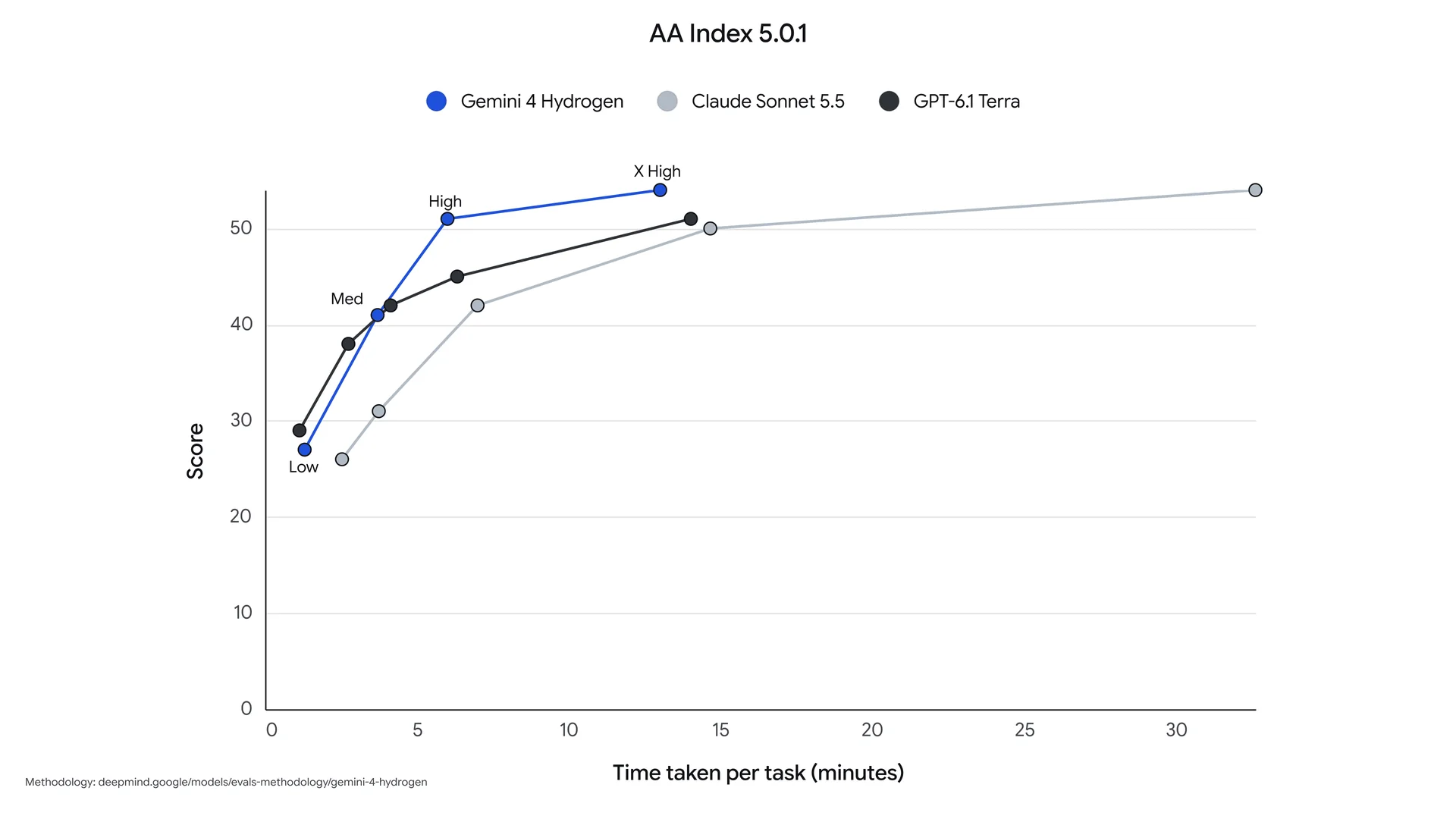
The fast execution tier of Google's Gemini 4 family — and the family's new Flash tier, succeeding 3.8 Flash (rumored pre-launch as "Gemini 4 Flash"; the official name is Hydrogen). Generally available on November 12, 2026, adapted from Carbon, built for everyday coding and agentic workflows. Artificial Analysis index 51 (default high) / 54 (xhigh), just above Argon; API $1.50/$7.50 with the family's only free tier — but "2.5× faster" refers to throughput: Artificial Analysis measured ~41 seconds to first token at xhigh. Within 24 hours of launch, "Gemini 4 Hydrogen" hit 100 on Google Trends (Breakout), with China the top searching region. This page collects official specs, how to try it, pricing, and the first hands-on reviews in Chinese and English — and clearly marks what is still unverified.
01Key facts
The confirmed essentials first: this is a GA release, not a time-limited preview; it is the family's execution tier, not the flagship — its case is speed, price, and low hallucination, not topping the charts.
- Announced / GA
- November 12, 2026, by Koray Kavukcuoglu (SVP, Google DeepMind / Google Chief AI Architect) on blog.google, generally available the same day; 02:00 Beijing time, November 13
- Model ID
gemini-4-hydrogen(single stable identifier, free and paid tiers)- Alias
- Rumored pre-launch as "Gemini 4 Flash"; Google's three official blog posts never use that name — the official name is Hydrogen
- Search interest
- Google Trends, November 13, 2026: "Gemini 4 Hydrogen" hit 100 (Breakout), up from 28 on November 12; China is the top searching region
- Official positioning
- The Gemini 4 family's new Flash tier (succeeding 3.8 Flash), a fast execution tier for everyday coding and agentic workflows; Carbon and Argon handle deep, long-horizon reasoning. Kavukcuoglu called it "our daily driver for agentic workflows"
- Derived from
- Gemini 4 Carbon (adapted from Carbon); architecture, training data, and hardware all defer to the Carbon model card
- Context
- 1,048,576 tokens, shared across input + thinking + output
- Max output
- 65,536 tokens (synchronous); up to 1M via background long decode
- Thinking
- On by default; levels low / medium / high (default) / xhigh (new); no minimal level (returns an error); sampling parameters fixed (temperature 1.0, top_p 0.95, top_k 64) — custom values are ignored
- Input / output
- Input: text, image, audio, video (plus PDF); output: text
- Knowledge cutoff
- March 2026 (model card)
- Availability
- Gemini API (free + paid tiers), AI Studio (all tiers), Gemini app (free users get it only via automatic model selection), Google Search (all users), Antigravity (Pro / Ultra), Gemini for business, Sheets. The only Gemini 4 model with a free tier
- Pricing
- API: $1.50 input / $7.50 output per million tokens (standard price, no expiry); cached input $0.075; Batch / Flex half price; free tier $0 (rate-limited)
- Benchmarks
- Artificial Analysis index 51 (high, default) / 54 (xhigh); Terminal-Bench 4.1 57% (3.8 Flash: 18.2%); AA-Omniscience hallucination rate just 8%
- Weights / license
- Not released; proprietary hosted model, not open source
- Parameter count
- Undisclosed
- Lifecycle
- Short-term GA: the Cloud model page states a minimum 45-day retirement notice period
02Timeline
About two weeks from rumored codename to GA launch; before release it was blind-tested in the Arena for over a week under a 3.8 Flash label.
- 2026-09-30
Gemini 4 Argon ships, the family's first model.
- 2026-10-27
Pankaj Kumar posts that "Gemini 4 Flash is in internal testing under the codename Hydrogen" — the rumor's starting point.
- 2026-10-29 – 11-07
The community encounters a suspected Hydrogen in Arena blind tests under the
gemini-3.8-flashlabel; the latest checkpoint is seen November 5 at 18:05 PT. - 2026-11-04
Two accounts claim 5 new checkpoints at 300–500 tokens/s, A/B-tested on AI Studio and LMArena (the speed claim was never confirmed).
- 2026-11-06
A tester times Hydrogen vs 3.8 Flash on a motion-graphics prompt in the Arena (single prompt, single run; TLDRArena: ~2 min vs ~11 min).
- 2026-11-08
The codename
hyperion(5 variants) appears in Devin desktop and CLI builds, plus a second unattributed codename,wyvern; Cognition's public model page lists no Hyperion and no release note for that build. - 2026-11-10
Gemini 4 Carbon goes GA.
- 2026-11-12
General availability: a changelog entry appears at 17:41 UTC; at 18:00 UTC (02:00 Beijing, November 13) three official blog posts publish simultaneously; the model card is released; Antigravity launches Orchestrator (dynamic Carbon ↔ Hydrogen switching); at 18:30 UTC the DerpMeter Daily Run adds Hydrogen.
- 2026-11-12 – 13
First review wave: the-decoder, winbuzzer, cellcog, davidayo, All Agent Encyclopedia, and others publish hands-on reviews in English and Chinese (see section 06).
- 2026-11-30
Carbon / Argon intro pricing ($2/$10) ends.
- 2026-12-01
Carbon / Argon prices double to $4 input / $20 output per million tokens.
- 2026-12-31
Gemini 3.8 Flash promo pricing ($0.75/$3.75) ends.
- 2027-01-01
Gemini 3.8 Flash rises to $1.50 / $7.50 — the same as Hydrogen.
- 2027-01-12
TTL cache control becomes available for Hydrogen and later models.
03Official specs
Officially published figures (model page, model card, and announcements, checked November 12–13, 2026); unpublished items are stated as such rather than filled in by guesswork.
- Status
- GA (from 2026-11-12); short-term GA, minimum 45-day retirement notice
- Model ID
- gemini-4-hydrogen
- Context window
- 1,048,576 tokens (input + thinking + output shared)
- Max output
- 65,536 tokens (synchronous); background long decode up to 1M
- Thinking
- On by default: low / medium / high (default) / xhigh (new); no minimal level
- Input
- Text, image, audio, video (plus PDF)
- Output
- Text
- Knowledge cutoff
- March 2026
- API
- Gemini API free + paid tiers; the family's only model with a free tier
- Tools
- Function calling, structured outputs, code execution, computer use, file search, URL context, Google Search / Maps grounding
- Benchmarks
- AA index 51 (high) / 54 (xhigh); Terminal-Bench 4.1 57%
- Model card
- Published (2026-11-12); full Safety & Security Report "in the coming days"
- Parameters
- Undisclosed
- Weights
- Not released
- API pricing
- $1.50 / $7.50 per million tokens (standard price); cached input $0.075
04How to try it: 6 routes
For developers the fastest route is the free-tier API; for everyone else, no action is needed — Search already runs on it. Picking it explicitly in the app requires a subscription.
1Gemini API / AI Studio (free + paid tiers)
The main developer route. Model ID gemini-4-hydrogen; the free tier needs no billing account (rate-limited; scriptbyai's reading of Google's rate-limits page puts it at 5 RPM / 250K TPM / 20 RPD); the paid tier requires a billing account. Free-tier data may be used by Google to improve its products — keep sensitive content on the paid tier.
2Gemini app
Pro / Ultra subscribers can pick Hydrogen from the model dropdown; free users cannot see or select it — the system decides automatically based on the input.
3Google Search (all users)
No action needed: Hydrogen is already live in Search globally for all users. Robby Stein (VP Product for Search) called it "the biggest model upgrade to Search yet", alongside upgraded query fan-out.
4Antigravity + Orchestrator
Hydrogen is available in Antigravity for Pro / Ultra subscribers; Orchestrator is Ultra-only: within one session, Carbon and Hydrogen switch dynamically — Carbon explores dependencies and plans in a read-only phase, Hydrogen writes the edits, updates packages, and runs tests, handing back to Carbon when stuck; in parallel, Carbon coordinates while Hydrogen powers worker and verifier agents in isolated workspaces. Google claims near-Carbon task success with 24% less quota and 19% faster — but the two official sources contradict each other on the benchmark version (see section 09).
5Gemini for business / Sheets
The enterprise route: call via API or the dropdown, available in Antigravity and Sheets (Sheets for qualifying business subscriptions, with Pro / Ultra users first). The Antigravity agent in Gemini Managed Agents now uses Hydrogen by default.
6Android Studio and third parties
Available in Android Studio on the paid tier. Cursor is listed as available by All Agent Encyclopedia (single source only); OrcaRouter's catalog has no Hydrogen yet and OpenRouter availability is unconfirmed — Google's own API and AI Studio remain the most reliable routes for now.
05Pricing
The headline price is a standard price with no expiry — but "cheap" depends on the comparison: it's twice Flash's current price this year and equal to Flash's January price; against Carbon/Argon it's only 25% cheaper today but 62.5% cheaper after December 1. Prices checked November 12–13, 2026; the checkout page is authoritative.
| API tier (per million tokens) | Input | Output |
|---|---|---|
| Standard | $1.50 | $7.50 |
| Cached input (implicit caching, 95% discount) | $0.075 | — |
| Batch API (paid tier only) | $0.75 | $3.75 |
| Flex (paid tier only) | $0.75 | $3.75 |
| Priority | $2.70 | $13.50 |
| Free tier | $0 | $0 |
Caching is implicit: prompts of at least 4,096 tokens trigger it automatically. Free-tier limits per scriptbyai's reading of Google's rate-limits page (5 RPM / 250K TPM / 20 RPD, RPD resetting at midnight Pacific); tbngrow says Google published no numbers on the pages it reviewed — check the rate-limits page.
Free tier: the family's only one, with two costs
Hydrogen is the only Gemini 4 model with a free tier — Carbon and Argon are paid-only. The free tier needs no billing account and is good for prototypes; the costs are rate limits (20 requests/day, per scriptbyai) and that free-tier data may be used by Google to improve its products, while paid-tier data is not. Production traffic and sensitive content belong on the paid tier.
vs 3.8 Flash: twice the price this year, equal next year
Gemini 3.8 Flash currently costs $0.75/$3.75 (promo price through 2026-12-31), so Hydrogen's $1.50/$7.50 is exactly double — VentureBeat's headline called it "a faster, smarter, pricier Flash successor". But from 2027-01-01 Flash rises to $1.50/$7.50, the same as Hydrogen. So: migrating this year doubles the per-token price; migrating next year costs the same per token for a better model. Per-task math flips the conclusion again: Hydrogen costs less per task overall (partner tests: 2–2.8× faster, 12–23% fewer tokens).
vs Carbon / Argon: don't compare a standard price with a promo price
Today, Hydrogen is only 25% cheaper than Carbon/Argon's $2/$10 — but that price is a promo expiring November 30. After December 1, Carbon/Argon double to $4/$20, and Hydrogen's price is just 37.5% of theirs. In other words: it isn't discounted — the others are. Per-task cost (Artificial Analysis): Hydrogen high $1.87, Argon ~$1.99 at promo price and ~$3.98 at standard price — nearly equal during the promo, diverging after December 1.
Cost per task: what the four levels cost
| Thinking level | AA index | Cost per task | Notes |
|---|---|---|---|
| low | 27 | $0.29 | Cheapest, but only 27 points of intelligence |
| medium | 41 | $0.80 | The value sweet spot: 41 points for $0.80 |
| high (default) | 51 | $1.87 | The out-of-the-box level; medium → high buys 10 points at more than double the cost |
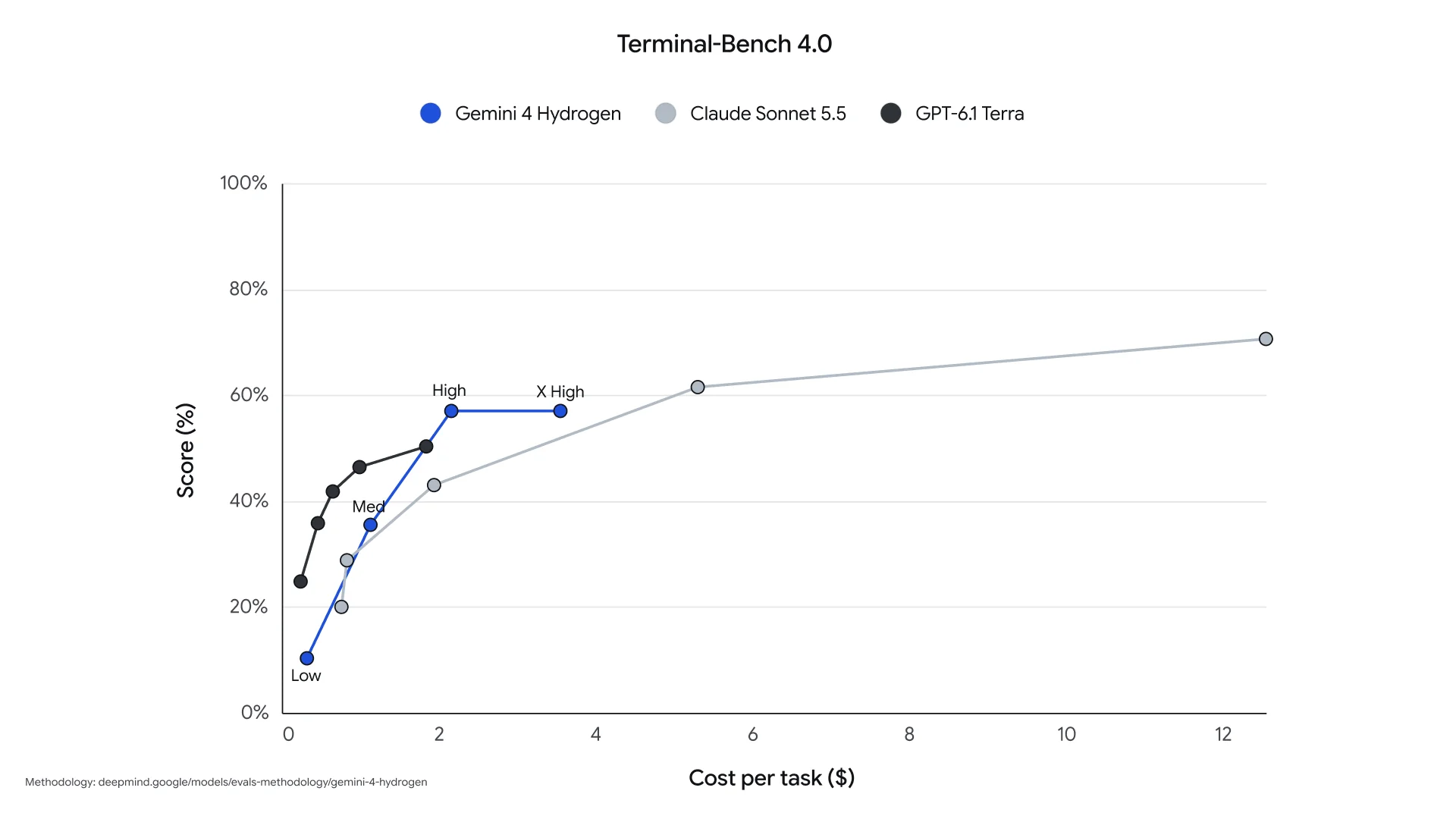
| xhigh | 54 | $3.16 | 69% more money for 3 more points; Terminal-Bench 4.0 is 54% at both levels |
Official pages: Gemini API pricing · Google's November 12 announcement
06First hands-on reviews
All of the following are first-day hands-on reviews and data analyses from November 12–13: the model is one day old, samples are small, and methods differ — read them as individual cases. Each carries a verdict badge; "Read the full article on this site" opens our in-depth rewritten article page, with the original source linked at the end.
English sources
DerpMeter Daily Run: 10 coding chores, same day
Verdict: strongest in the family, 9/10 passedSource: DerpMeter, November 12, 2026, 18:30 UTC (7 models, 10 coding chores, single sample)
Hydrogen scored 25 (5 Smart, 0 Dumb), finished in 20 minutes, passed 9/10 chores, re-reading only 1.0M context tokens; in-family Argon scored 60 (73 min, 7/10, 9.6M re-read) and Carbon 75 (82 min, 6/10, 7.5M, 5 chores judged Dumb). Of 7 models Hydrogen ranked 5th — Sonnet 5.5 best (5), Sol and Terra 15, Opus 5.5 20. Conclusion: Hydrogen is the steadiest Gemini for everyday coding chores, but mid-pack across the field.
Read the full article on this site → (ModelBrief original)
Benchmark roundup: the official table + independent AA measurement
Verdict: strong scores, but check who measured them and against whomSources: Google's official table (deepmind.google); Artificial Analysis; the-decoder; winbuzzer, Nov 12–13, 2026
Google's official table: SWE-sweep 13.5% (Sonnet 5.5 just 3.1%), Agents' Last Exam 71.6%, AutomationBench-AA 76.1% — three class-leading results; but Terminal-Bench 4.1 57.0% trails Sonnet 5.5's 63.9%, and OSWorld 77.6% trails Sonnet's 83.9%. Independent measurement: AA index high 51 / xhigh 54, hallucination rate just 8% (Sonnet 43%, Sol 52%); but Terminal-Bench 4.0 is only 54%, below Sonnet's 64% and Sol's 56%.
Read the full article on this site → (ModelBrief original)
The 3.8 Flash migration math: 2.5× faster, twice the price
Verdict: switching this year doubles the price; next year it costs the sameSources: cellcog.ai; tbngrow.com; VentureBeat, Nov 12–13, 2026
Google's official line: tasks complete 2.5× faster, Terminal-Bench 4.1 rises from 18.2% to 57%, fabricated claims drop more than 5×, partner tests show 2–2.8× faster with 12–23% fewer tokens. But the per-token price is twice Flash's current price ($1.50/$7.50 vs $0.75/$3.75); from 2027-01-01 Flash rises to the same price. Max output also grows from 8,192 to 65,536 tokens.
Read the full article on this site → (ModelBrief original)
Three-tier comparison: Hydrogen vs Carbon vs Argon
Verdict: 51 vs 50 is basically a tie — the win is price and speedSources: orcarouter.ai; the-decoder; Google's official announcements, Nov 12, 2026
AA index: Carbon 60, Hydrogen 51 (high) / 54 (xhigh), Argon 50 — Hydrogen's 51 vs Argon's 50 is a 1-point gap, essentially a tie; but Hydrogen has a free tier and, after December 1, costs 37.5% of Carbon/Argon's price. Division of labor: Carbon handles architecture and hard problems, Hydrogen handles execution and verification, and Antigravity's Orchestrator (Ultra only) pairs them automatically, with near-Carbon success rates at 24% less quota.
Read the full article on this site → (ModelBrief original)
Pricing and free tier: standard price vs promo price math
Verdict: it isn't discounted — the others areSources: cellcog.ai; scriptbyai.com; justinmckelvey.com, Nov 12–13, 2026
$1.50/$7.50 is a standard price with no expiry; Carbon/Argon's $2/$10 is a promo expiring November 30, doubling after. Free tier: 5 RPM / 250K TPM / 20 RPD (per scriptbyai's reading), but free-tier data may be used to improve Google's products. One rarely noted limit: the Cloud model page lists Hydrogen as short-term GA with a minimum 45-day retirement notice.
Read the full article on this site → (ModelBrief original)
davidayo: a day early, rapid prototypes and small SaaS tools
Verdict: excellent single-shot code generation; impressionistic, no hard dataSource: davidayo.com, November 12, 2026 (about one day of early access)
The author used early access to build several rapid prototypes and small SaaS tools: single-shot code generation stood out, boilerplate setup time was near zero — good for fast iteration without burning expensive tokens. The article gives no concrete test tasks or scores, so it reads as an early impression rather than performance evidence.
Read the original → (davidayo.com, English)
Chinese sources
All Agent Encyclopedia: what's fast is throughput, not response
Verdict: good for batch work; don't use it interactivelySource: All Agent Encyclopedia (所有 Agent 百科), November 13, 2026 (AA model page data vs official claims)
The sharpest first Chinese analysis: the official "2.5× faster" is generation throughput (~198 tokens/s); Artificial Analysis measured 41.11 seconds to first token at xhigh (peer median 13.45s), and the full index run took 13.0 minutes vs a 12.9-minute median — end to end, no faster. High → xhigh costs 69% more ($1.87 → $3.16) for 3 more points, with Terminal-Bench 4.0 identical at 54%. But the 8% hallucination rate (Sonnet 43%, Sol 52%) is its most buyable advantage. Conclusion: batch runs, background jobs, and parallel workers fit; interactive chat and IDE inline completion don't.
Read the full article on this site → (ModelBrief original)
06BArticles: in-depth reads on this site
All 7 articles below are ModelBrief original rewrites and syntheses — restructured, with added conclusions and selection advice, and facts and figures checked against the original reviews. Click any card to read on this site; the original source is linked at the end of each article.
06CBenchmarks: official table + independent leaderboards
Hydrogen has no shortage of scores, but half come from Google itself and half from independent Artificial Analysis measurements — and the two don't always agree. Google's official table first, then independent measurement, then the caveats.
| Test (Google official table) | Hydrogen | Sonnet 5.5 | GPT-6.1 Terra |
|---|---|---|---|
| AA Intelligence Index v5.0 | 54 (xhigh) / 51 (high) | — | — |
| SWE-sweep | 13.5% | 3.1% | 5.8% |
| Terminal-Bench 4.1 (cheating-adjusted) | 57.0% | 63.9% | — |
| Agents' Last Exam v1.1 | 71.6% | 60.4% | 69.8% |
| AutomationBench-AA | 76.1% | 71.8% | 60.2% |
| OSWorld-2.1 | 77.6% | 83.9% | — |
| HLE-Diamond | 58.8% | — | — |
| Terminal-Bench-Science 0.1 | 51.4% | — | — |
| Vals Tax Agent Bench | 52.3% (#1 of 85) | — | — |
| Vals Legal Research Bench | 55.8% (tied #1) | — | — |
| Multimodal Knowledge Agent (MKA) | 53.4% (class-leading) | — | — |
| Agent Arena | #5 | — | — |
The official table is published by Google (deepmind.google model page and the November 12 announcement); "class-leading" doesn't name which models make up the class. Sonnet 5.5's HLE-Diamond score of 53.3% appears only in one video summary and is not included here. Checked Nov 13: the Vals Legal "55.8% tied #1" disagrees with the board — Hydrogen is 53.85%, 6th of 95, and 55.77% is Carbon's top score; MKA 53.4% is Google's own run, with Fable 5.2 (56.56) and Carbon (54.34) both higher. See our line-by-line check →.
Independent measurement (Artificial Analysis and third parties, Nov 12–13, 2026)
| Measurement | Source | Hydrogen | Comparison |
|---|---|---|---|
| AA Intelligence Index v5.0.1 (four levels) | Artificial Analysis | low 27 / medium 41 / high 51 / xhigh 54 | Argon 50 (high); Sonnet 5.5 and Sol 55 each (max); Carbon 60 (high) |
| Cost per task | Artificial Analysis | low $0.29 / medium $0.80 / high $1.87 / xhigh $3.16 | xhigh ≈ 1/3 of Sonnet 5.5 (max), ≈ 2.5× GPT-6.1 Sol (max) |
| Time per task | Artificial Analysis | high ~6.0 min; xhigh ~13–14 min | AA re-runs every 6 hours, so numbers drift; sources differ slightly |
| Time to first token (xhigh) | Artificial Analysis | ~41 seconds | Peer median ~13.6s; high-level data not published separately |
| Output speed (xhigh) | Artificial Analysis | ~198 tokens/s | — |
| Total output tokens over the index run | Artificial Analysis | 304M | Peer median 72.8M — it thinks long, then writes a lot |
| AA-Omniscience hallucination rate | Artificial Analysis | 8% | Sonnet 5.5 43%; GPT-6.1 Sol 52% |
| Terminal-Bench 4.0 (AA) | Artificial Analysis | 54% (same at high and xhigh), 11th of 64 | Sol 56%; Sonnet 5.5 64% |
| Terminal-Bench-Science 0.1 (AA) | Artificial Analysis | high 41% → xhigh 50% | Sonnet 5.5 53% (the-decoder) |
| AA-Briefcase / GDP.pdf | Artificial Analysis | Presentation quality rated above other Gemini models (incl. Carbon); GDP.pdf tied highest at medium | — |
| DerpMeter Daily Coding Chores | DerpMeter, Nov 12 | 25 points (5 Smart, 0 Dumb), 20 min, 9/10 passed | 5th of 7; Argon 60, Carbon 75; single sample |
| LLM Leaderboard independent reruns (xhigh) | aireiter, Nov 13 | MKA 49.52% (Google 53.4%), Terminal-Bench-Science 49.52% (Google 51.4%) | Reruns below Google self-runs; output speed 198.2 tok/s (Sonnet 5.5 144.0, 3.8 Flash 136.6) |
Full roundup: our benchmarks article →
07Comparisons
vs Gemini 3.8 Flash (the model it succeeds)
| Dimension | Gemini 4 Hydrogen | Gemini 3.8 Flash |
|---|---|---|
| Released | 2026-11-12 GA | September 2026 |
| API price (this year) | $1.50 / $7.50 | $0.75 / $3.75 (promo, through Dec 31) |
| API price (from 2027-01-01) | $1.50 / $7.50 (unchanged) | $1.50 / $7.50 (equal to Hydrogen) |
| AA index | 51 (high) / 54 (xhigh) | 31 (high) |
| Terminal-Bench 4.1 | 57% | 18.2% |
| Task speed | Baseline (2.5× faster, official) | 2.5× slower; partner tests: Hydrogen 2–2.8× faster, 12–23% fewer tokens |
| Fabricated claims | Down 5×+ (official) | Baseline |
| Max output | 65,536 tokens (sync) | 8,192 tokens |
| Thinking levels | low / medium / high / xhigh | Default medium, no xhigh |
| Free tier | Yes (rate-limited) | Yes (20 requests/day) |
Read the in-depth comparison: Hydrogen vs 3.8 Flash →
vs Gemini 4 Carbon / Argon (the three in-family tiers)
| Dimension | Gemini 4 Hydrogen | Gemini 4 Carbon | Gemini 4 Argon |
|---|---|---|---|
| Released | 2026-11-12 GA | 2026-11-10 GA | 2026-09-30 |
| Positioning | Fast execution tier | Strongest reasoning flagship | Hard, long-horizon tasks |
| API price | $1.50 / $7.50 (standard) | $2 / $10 through Nov 30, then $4 / $20 | Same as Carbon |
| AA index | 51 (high) / 54 (xhigh) | 60 (high) | 50 (high) |
| Default thinking level | high | medium | medium |
| Cost per task (AA) | high $1.87 / xhigh $3.16 | high $7.76 | ~$1.99 promo / ~$3.98 standard |
| Free tier | Yes | No | No |
| Subscription | Selectable on Pro / Ultra; auto for free users | Ultra only | Pro and above |
| Best for | Everyday coding, batch agents, high-concurrency workers | The hardest tasks: long-horizon agents, tricky debugging, scientific reasoning | Most programming and knowledge work, interactive coding |
Hydrogen is adapted from Carbon; all three have a 1M context window and a 65,536-token sync output cap.
Read the in-depth comparison: Hydrogen vs Carbon vs Argon →
vs the field (Artificial Analysis index, Nov 12–13, 2026)
| Model | API price $/M (in/out) | AA index | Context |
|---|---|---|---|
| Claude Fable 5.2 | 8 / 40 | 65 (max) | 1M |
| Gemini 4 Carbon | 2 / 10 (through Nov 30) | 60 (high) | 1M |
| Claude Opus 5.5 | — | 59 (max) | — |
| GPT-6 Astra | 10 / 50 | 57 (max) | 1.05M |
| Claude Sonnet 5.5 | — | 55 (max) | — |
| GPT-6.1 Sol | 2 / 10 | 55 (max) | 1.05M |
| Gemini 4 Hydrogen | 1.50 / 7.50 | 54 (xhigh) / 51 (high) | 1M |
| Gemini 4 Argon | 2 / 10 (through Nov 30) | 50 (high) | 1M |
| Qwen3.8 Max | 2 / 6 | 45 (09-27) | 1M |
| Gemini 3.8 Flash | 0.75 / 3.75 (through Dec 31) | 31 (high) | 1M |
08What's still missing (as of November 13)
- Parameter count and architecture details (Google has not disclosed them; the model card defers to the Carbon model card)
- The full Safety & Security Report ("in the coming days")
- Exact free-tier limit numbers (only scriptbyai's reading exists; tbngrow says Google published no numbers on the pages it reviewed)
- Vertex AI availability (not addressed in the announcement materials)
- Third-party gateway availability (whether OpenRouter and others carry it is unconfirmed)
- Orchestrator's actual success-rate numbers (both official sources say only "near Carbon", with no figure — and they contradict each other on the benchmark version)
- High-level time-to-first-token data (Artificial Analysis published only xhigh's ~41 seconds)
- Gemini 3.8 Flash retirement plans (none announced; only the January 1, 2027 price rise is known)
- Hydrogen's long-term pricing plans (the current price is standard with no expiry date)
- The identity of the Hyperion codename (an unexplained codename in Devin builds)
- Whether Carbon's empty-answer thinking-burn bug affects Hydrogen (no evidence either way — do not extrapolate)
- Long-term stability data (the model is one day old)
09Rumor check
Hydrogen accumulated plenty of pre-launch rumors, and a few post-launch claims are easy to misread. Each one, checked.
Clarified "Hydrogen is Gemini 4 Flash"
Pre-launch rumors said Hydrogen was the codename for "Gemini 4 Flash"; but Google's three official blog posts never use the name "Gemini 4 Flash" — Hydrogen is the official product name. The old name's only trace: a video file in the Search post named Gemini4Flash_TucsonOuting_V04.mp4. Two companion rumors also missed: X estimates of a "November 18 release" were 6 days late, and a tester's price guess of $0.75/$3.75 (same as Flash) was disproved by the actual $1.50/$7.50.
Needs qualification "2.5× faster than 3.8 Flash"
The official claim refers to generation throughput and task completion speed — not first-token latency, and not end-to-end response. Artificial Analysis measured ~41 seconds to first token at xhigh (peer median ~13.6s) and an index run of 13.0–13.7 minutes, roughly at the median. The speed shows only in the final output phase (~198 tokens/s). Good for batch work; it feels slow interactively.
Overblown "AA index 51 beats Argon's 50, so it's better across the board"
A 1-point gap is essentially a tie under this index's methodology. And the levels aren't symmetric: Hydrogen's 51 is its default high level, while Argon's default is medium — Hydrogen ships at a high level out of the box. On terminal work Hydrogen doesn't lead either: Artificial Analysis measured Terminal-Bench 4.0 at 54%, below Sol's 56% and Sonnet 5.5's 64%. Hydrogen wins on price, the free tier, and hallucination rate — not on intelligence score.
Unverified "Hyperion in Devin is Hydrogen"
On November 8, the codename hyperion (5 variants) appeared in Devin desktop and CLI builds, positioned among Gemini models, sparking speculation. But Cognition's public model page has no Hyperion, and no release note exists for that build; after Hydrogen's launch, Hyperion remains unexplained. The same build also carried a second unattributed codename, wyvern. Neither's relationship to Hydrogen is known.
Unverified "300–500 tokens/s"
A November 4 rumor claimed new checkpoints ran at 300–500 tokens/s. It was never confirmed. Artificial Analysis's independent measurement puts output speed at ~198 tokens/s (xhigh). Don't cite the rumor number.
False "The model card doesn't publish a knowledge cutoff"
OrcaRouter claimed Google published no knowledge cutoff in the model card or migration guide. That is wrong. The model card states explicitly: "The knowledge cutoff for Gemini 4 Hydrogen is March 2026" (verified by fetching the model card PDF directly).
False "Hydrogen-1.0 is the same model"
A name collision only. Hydrogen-1.0 is Deep Principle's science model (a GLM-5.3 post-train for chemistry, materials, and life sciences), with no connection to Google's Gemini 4 Hydrogen.
10FAQ
When was Gemini 4 Hydrogen released?
Announced by Google on November 12, 2026, at 18:00 UTC (02:00 Beijing time, November 13) and generally available the same day — not a time-limited preview. Within 24 hours, "Gemini 4 Hydrogen" hit 100 on Google Trends (Breakout), with China the top searching region.
What is the Gemini 4 Hydrogen price?
API standard price: $1.50 input / $7.50 output per million tokens, with no expiry date; cached input $0.075; Batch and Flex at half price (paid tier only); Priority $2.70/$13.50. There is also a free tier ($0, rate-limited). Prices checked November 12–13, 2026; the checkout page is authoritative. Full analysis in section 05 and our pricing article →
Does Gemini 4 Hydrogen have a free tier? What are the free-tier limits?
Yes — and it is the only Gemini 4 model with one; Carbon and Argon are paid-only. The free tier needs no billing account; per scriptbyai's reading of Google's rate-limits page, the limits are 5 RPM / 250K TPM / 20 RPD (tbngrow says Google published no numbers on the pages it reviewed — check the rate-limits page). Note: free-tier data may be used by Google to improve its products; keep sensitive content on the paid tier.
Gemini 4 Hydrogen benchmark: what scores exist?
Official table: SWE-sweep 13.5%, Agents' Last Exam 71.6%, AutomationBench-AA 76.1% (three class-leading results), Terminal-Bench 4.1 57% (below Sonnet 5.5's 63.9%). Independent measurement (Artificial Analysis): AA index high 51 / xhigh 54, hallucination rate just 8%, but Terminal-Bench 4.0 only 54%. Full roundup in section 06C and our benchmarks article →
Gemini 4 Hydrogen vs 3.8 Flash: what's the difference?
Hydrogen is the new Flash tier, succeeding 3.8 Flash: tasks 2.5× faster (official claim, referring to throughput), Terminal-Bench 4.1 up from 18.2% to 57%, fabricated claims down more than 5×, max output up from 8,192 to 65,536 tokens, AA index up from 31 to 51. But the per-token price is twice Flash's current price ($1.50/$7.50 vs $0.75/$3.75); from 2027-01-01 Flash rises to the same price. Full comparison in our comparison article →
Gemini 4 Hydrogen vs Carbon: how to choose?
Carbon is the flagship (AA 60) for the hardest tasks; Hydrogen is the execution tier (AA 51/54) for everyday coding and batch agents. On price, Hydrogen is only 25% cheaper today, but after Carbon rises to $4/$20 on December 1 it costs just 37.5% as much; Hydrogen also has a free tier, Carbon doesn't. Antigravity's Orchestrator (Ultra only) pairs them automatically: Carbon plans, Hydrogen executes. Full comparison in our three-tier comparison →
Gemini 4 Hydrogen vs Argon: which is stronger?
On the AA index, Hydrogen 51 (high) vs Argon 50 — a 1-point gap, essentially a tie; at xhigh Hydrogen's 54 is slightly ahead. But they serve different purposes: Argon targets hard, long-horizon tasks, while Hydrogen targets speed and price — it has a free tier, and after December 1 its per-token price is 37.5% of Argon's. Choose by task: Argon for hard long-horizon work, Hydrogen for everyday coding and batch tasks.
Are Gemini 4 Flash and Gemini 4 Hydrogen the same model?
Same product, two names. "Gemini 4 Flash" was the pre-launch rumored name (on October 27, 2026, a post said "Gemini 4 Flash is in internal testing under the codename Hydrogen"); Google's official name at launch is Gemini 4 Hydrogen, and its three official blog posts never use "Gemini 4 Flash". When searching, both terms refer to the same model.
Why does Gemini 4 Hydrogen take so long to produce the first token?
Because it thinks for a long time, then writes a lot. Artificial Analysis measured ~41 seconds to first token at xhigh (peer median ~13.6s) and 304M total output tokens over the index run (peer median 72.8M). The official "2.5× faster" refers to generation throughput (~198 tokens/s) and task completion speed, not first-token latency. Use the default high or medium level for interactive work; xhigh fits batch and background jobs. Details in our speed article →
How do I choose a Gemini 4 Hydrogen thinking level?
Four levels: low (AA 27, $0.29/task), medium (41, $0.80), high (default, 51, $1.87), xhigh (54, $3.16). The default high is already a fairly expensive setting; medium is the value sweet spot; xhigh costs 69% more for 3 more points, and Terminal-Bench 4.0 is 54% at both levels — open it only on tasks where your own tests show a gain. Note: there is no minimal level (it returns an error), and custom temperature, topP, and topK values are ignored.
What is Antigravity's Orchestrator, and who can use it?
Orchestrator is an Antigravity feature launched November 12, 2026 alongside Hydrogen: within one session, Carbon and Hydrogen switch dynamically — Carbon explores dependencies and plans in a read-only phase, Hydrogen writes the edits, updates packages, and runs tests, handing back to Carbon when stuck; in parallel, Carbon coordinates while Hydrogen powers worker and verifier agents in isolated workspaces. Google claims near-Carbon success rates with 24% less quota and 19% faster. Currently Ultra subscribers only ("additional models and plans supported in the future"); enterprises get it via Gemini for business. Note: the two official sources disagree on the benchmark version (the main blog says Terminal-Bench 4.0, the Antigravity post says 4.1), and neither gives an actual success-rate number.
Is Gemini 4 Hydrogen open source? Is it on Hugging Face?
No. The weights are not released; it is only callable through Google's hosted channels (Gemini API, AI Studio, Gemini app, Search, Antigravity, and others). There are no official Gemini 4 Hydrogen weights on Hugging Face; similarly named third-party models (such as Deep Principle's Hydrogen-1.0 science model) are unrelated.
Is there a gemini-4 model ID?
No. Gemini 4 is a family name with only three model IDs — Carbon, Argon, and Hydrogen. There is no gemini-4 endpoint. Call it with the full ID gemini-4-hydrogen.
Where can I follow the latest Gemini 4 Hydrogen news?
Official channels: Google's November 12 announcement, the Gemini API pricing page, and the Artificial Analysis model page (re-runs every 6 hours). This page will also be updated; the full Safety & Security Report is expected "in the coming days".
11Sources (checked Nov 12–13, 2026)
Official materials first; independent measurements and hands-on reviews each noted with source and date. Unverified items are flagged in section 08 and throughout.
Official
- Introducing Gemini 4 Hydrogen for Agentic Workflows — blog.google (Nov 12, 2026)
- Build with Gemini 4 Hydrogen — blog.google developer post (Nov 12, 2026)
- Gemini 4 Hydrogen Model Card (PDF, November 2026)
- Gemini API pricing — ai.google.dev
- Gemini 4 Hydrogen model page — Artificial Analysis
- Gemini model page (with official comparison table) — deepmind.google
English coverage and hands-on reviews
- the-decoder: AA data analysis (Nov 12, 2026)
- winbuzzer: launch and AA data analysis (Nov 12, 2026)
- cellcog.ai: launch verification and rumor cross-check (Nov 12, 2026)
- davidayo.com: early hands-on review (Nov 12, 2026)
- stackfutures: AA cost analysis (Nov 13, 2026)
- SiliconANGLE: launch coverage and early-tester quotes (Nov 12, 2026)
- VentureBeat: launch coverage (Nov 12, 2026)
- Unite.AI: launch coverage (Nov 12, 2026)
- myindustrynews.net: Cloud model page summary (Nov 12, 2026)
- orcarouter.ai: three-tier comparison (Nov 12, 2026)
- Medium — Gemini 4 Hydrogen review: line-by-line check of Google's 11 claims (exact AA values, Vals Legal, 2.5× re-check) Nov 13, 2026
- aireiter — Hydrogen vs Argon: LLM Leaderboard independent reruns (MKA and TB-Science below Google self-runs) Nov 13, 2026
- softreviewed.com: specs and score transcription (Nov 12, 2026)
- tbngrow.com: pricing and migration analysis (Nov 13, 2026)
- scriptbyai.com: Gemini API rate limits (Nov 12, 2026)
- scriptbyai.com: free-tier limits (Nov 12, 2026)
- mer.vin: pricing, benchmarks, and migration guide (Nov 12, 2026)
- DerpMeter Daily Run (Instagram video, Nov 12, 2026)
- kie.ai: Arena checkpoint timeline (Nov 12, 2026)
- YouTube: Gemini 4 Hydrogen: Everyday Model for Everyone (video, Nov 12, 2026)
Chinese coverage and hands-on reviews
- All Agent Encyclopedia (所有 Agent 百科): what's fast is throughput, not response (Nov 13, 2026)
- TechNews Taiwan (科技新报): launch coverage (Nov 13, 2026)
- Cnyes (钜亨网): launch coverage (Nov 13, 2026)
- Pedaily (投资界): Search-first rollout and query fan-out (Nov 13, 2026)
- AGIHunt: launch update (Nov 12, 2026)
- aihot.news: leaderboard entry (Nov 12, 2026)