MiniMax H3-Image: The Topic Page
MiniMax's first image model, released November 10, 2026 — and this site's first image-model topic: one 33.1B checkpoint for text-to-image and image editing, native output of about 16.8 megapixels (4096×4096) with no upscaler, distilled to six sampling steps, with up to 16 reference images. MiniMax claims a 4K image in under 10 seconds, but its own official comparison chart shows a 16.0-second median for Standard and 10.3 seconds for Highspeed; the weights are public, but the custom community license excludes the United States, the European Union, the United Kingdom and South Korea. The API costs about $0.022 per 1K image and $0.069 per 4K image, with 4K at half price until November 17. This page collects the official specs, pricing, licensing and the first hands-on reviews — with unverified claims clearly marked.
01Key facts
What is confirmed: an image model derived from MiniMax's H3 video model, one checkpoint for generation and multi-reference editing, with native 4K as its real strength — but the "under 10 seconds" claim doesn't match the vendor's own chart, the license is far stricter than the word "open" suggests, and image quality has no independent score at all.
- Released
- 2026-11-10 (announced on X at 14:15 UTC, weights on Hugging Face at 14:50 UTC, API release notes the same day; official blog 16:23 UTC, Nov 11 00:23 Beijing). This site uses Nov 10 as the release date.
- Developer
- MiniMax (China); the weights are licensed by Nanonoble Pte. Ltd. of Singapore
- Model type
- An image model, not an LLM: text-to-image + image editing in one checkpoint; this site's first non-language-model topic
- Architecture
- 33.1B dense diffusion transformer (DiT only): 50 layers, hidden 5,376, 56 attention heads, FFN 14,336, 3D multimodal RoPE; H3-Base without the audio branch; text encoder is H3's full Qwen3-VL encoder, unchanged
- Output
- Native about 16MP at all aspect ratios (4096×4096 at 1:1, 5472×3072 at 16:9, 6272×2688 at 21:9), no upscaler; API caps output area at 20MP; 1–10 images per request
- Reference editing
- Up to 16 reference images, addressed positionally as "Picture 1" through "Picture 16" in upload order; no masked edits, transparent backgrounds or preview images
- Sampling
- Distilled to 6 sampling steps (6 NFEs), no classifier-free guidance; step count and guidance are locked (other values return HTTP 400); no negative prompts
- Speed claim
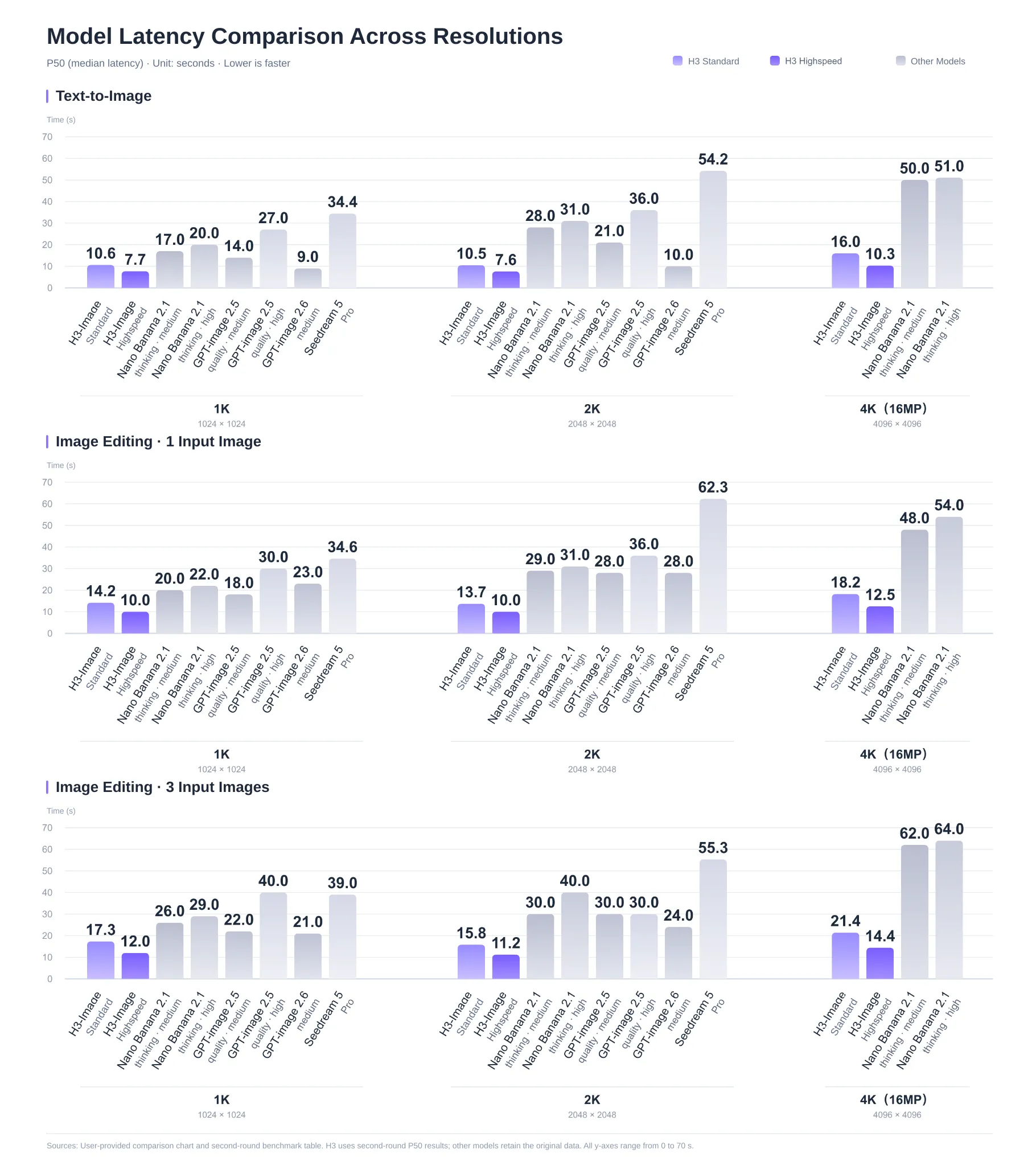
- Blog says 4K in "under 10 seconds"; the X post says "10–20 seconds"; the official chart's P50 for 4K text-to-image is 16.0s Standard, 10.3s Highspeed (see section 06C)
- Price
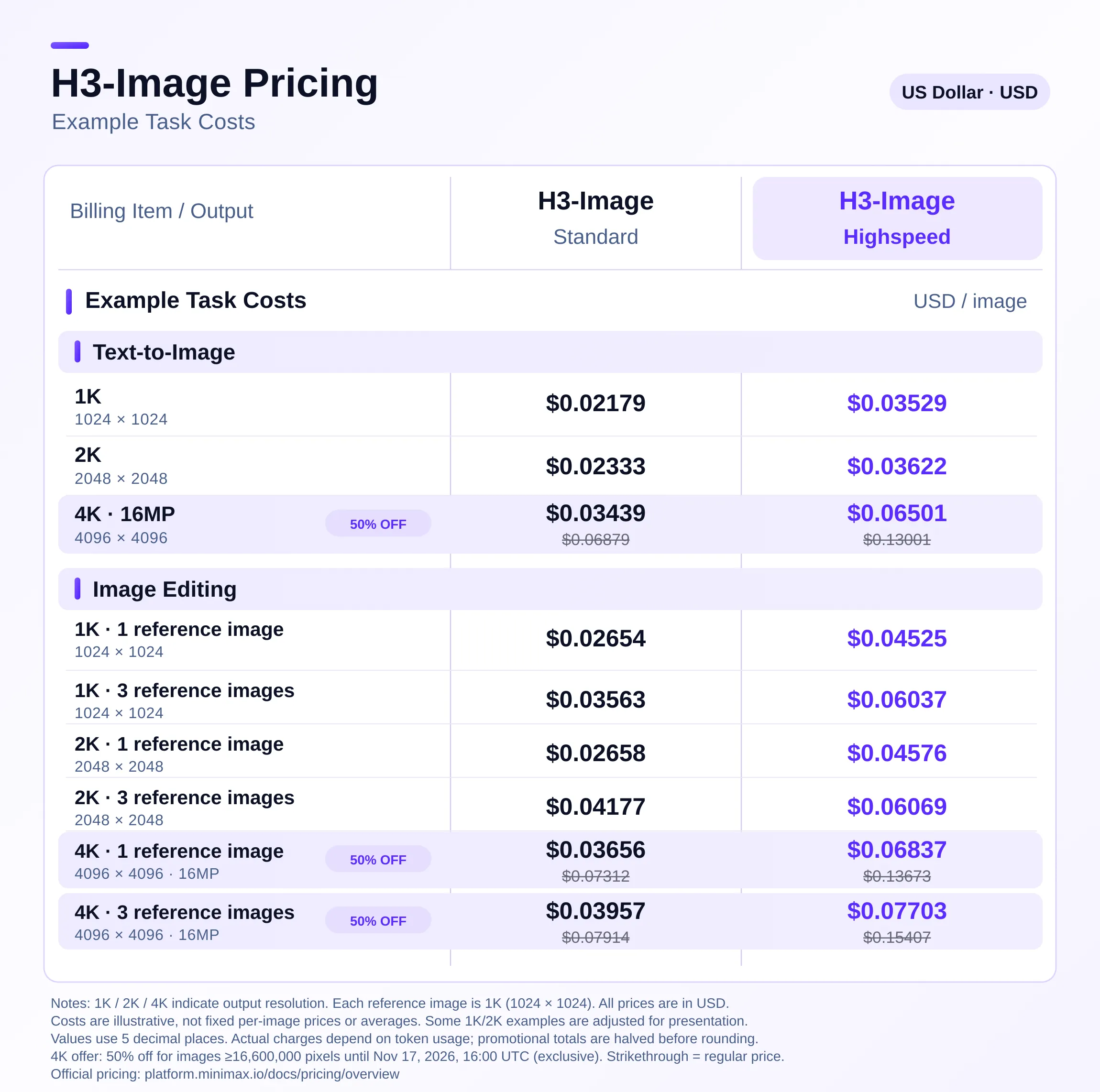
- Token-based: Standard $2.30/$1.50/$3.80 (text in / image in / image out, per 1M tokens); a 4K text-to-image example costs $0.06879, half price $0.03439 until Nov 17, 16:00 UTC
- Weights
- Public (2026-11-10, Hugging Face; 68.65 GB plus a 66.7 GB text encoder, about 135 GB total; 437,039 downloads as of the evening of Nov 13)
- License
- MiniMax-H3-Image Community License (custom, not an OSI open-source license): excludes the US, EU, UK and South Korea; written authorization required above $1M annualized revenue or for hosted services
- Independent benchmarks
- None: no entry on Artificial Analysis image boards, no GenEval, DPG-Bench or human-preference scores (as of Nov 11); MiniMax publishes no evaluation table either
- Access
- MiniMax API Platform, MiniMax Code, Hailuo AI; self-hosting via SGLang, vLLM-Omni, diffusers, LightX2V, ComfyUI (native support on day one)
02Timeline
Three and a half months from the H3 video model to the image model; on launch day the announcement, weights, API and ComfyUI support all landed at once — but the repository had been created a week earlier and sat empty until then.
- 2026-07-28
MiniMax-H3 video model weights land on Hugging Face (API release notes say Jul 31); H3-Image is built on H3 and reuses its text encoder.
- 2026-10-17
MiniMax-M3.1-Flash weights land on HF (API release notes say Oct 19); MiniMax's latest LLM.
- 2026-11-03
H3-Image repo created (06:34 UTC), then empty for a week; Pruna releases the third-party P-H3-Image the same day (an 8-step distillation at 8MP, unrelated to the official release).
- 2026-11-08
MiniMax-H3-Image-PE repo created (15:35 UTC): an optional prompt-expansion model (17.9 GB), not a variant of H3-Image.
- 2026-11-10 14:15 UTC
Announced on X: "16 million pixel. 10-20 seconds. Open weights."
- 2026-11-10 14:50 UTC
Weights go public on Hugging Face: 68.65 GB, under the community license agreement dated the same day.
- 2026-11-10 16:05 UTC
ComfyUI blog announces native support; v0.45.0 ships the same day with text-to-image and editing workflow templates.
- 2026-11-10 16:23 UTC
Official blog publishes (Nov 11, 00:23 Beijing): "Bringing 4K Image Generation into the 10-Second Era," with the latency comparison chart and pricing examples.
- 2026-11-11
First coverage from Times of AI, Qiniu, agidaily and XenoSpectrum; OrcaRouter notes no third-party timing and no AA image-board entry as of that day.
- 2026-11-13
437,039 downloads on the main HF repo; this topic page goes live.
- 2026-11-17 16:00 UTC
The 4K half-price offer expires (Nov 18, 00:00 Beijing); list prices resume.
03Official specs
As published by MiniMax (Hugging Face model card, API guide and official blog, checked Nov 13, 2026). Note: 33.1B counts the DiT only, not the text encoder; the gap between the speed claim and the chart is covered in section 06C.
- Status
- Released (2026-11-10); weights public (same day)
- Model IDs
- MiniMax-H3-Image (Standard) / MiniMax-H3-Image-Highspeed
- Architecture
- 33.1B dense diffusion transformer: 50 layers, hidden 5,376, 56 attention heads, FFN 14,336, 3D multimodal RoPE; H3-Base without the audio branch; BF16 weights, embedding/timestep/output layers in FP32
- Text encoder
- H3's full Qwen3-VL text encoder, unchanged (the DiT reads its 50th layer's hidden states); not in the H3-Image repo, 66.7 GB
- Image VAE
- CNN encoder + 2D ViT decoder (24 layers), 16× spatial downsampling, 24 latent channels; the DiT patchifies the latent with a 2×2 patch, so each token covers 32×32 pixels
- Sampling
- Distilled to 6 steps (6 NFEs), no classifier-free guidance; num_inference_steps must be omitted or 6, guidance_scale omitted or 1 (other values return HTTP 400); no negative prompts
- Output sizes
- Working range about 4–20MP, best around 16MP; 4096×4096 at 1:1, 4736×3552 at 4:3, 5024×3360 at 3:2, 5472×3072 at 16:9, 6272×2688 at 21:9; custom sizes 655,360–20,000,000 pixels, never scaled or rounded
- Reference editing
- 1–16 reference images (JPG/PNG/WebP/HEIC/HEIF, 128–8,192 pixels per side), addressed as "Picture 1" … "Picture 16" in upload order; no masked edits, transparent backgrounds or preview images
- Prompts
- The model expects a detailed English description of the whole image; the API expands short prompts in any language via H3-Image-Context-IR; the optional local PE model (17.9 GB NVFP4, fine-tuned from Qwen3.8-27B) does the same locally
- API endpoints
- Text-to-image
/v1/images/generations(JSON), editing/v1/images/edits(multipart form); PNG returned indata[0].b64_json; prompts capped at 32,000 characters, only about the first 4,096 tokens take effect - API behavior
- Neither endpoint is idempotent: the server finishes generation and charges even if the client times out or disconnects; the server waits up to 600 seconds; prompt rewriting is on by default (can be off for text-to-image, always on for edits)
- Weights
- 68.65 GB (transformer 66.28 GB + VAE 2.34 GB + per-step output heads 12 MB + tokenizer 23 MB) plus a 66.7 GB text encoder, about 135 GB total; PE optional at 17.9 GB
- License
- MiniMax-H3-Image Community License (2026-11-10; licensor Nanonoble Pte. Ltd.): excludes the US, EU, UK and South Korea; written authorization required above $1M annualized revenue or for hosted services
- API price
- Standard $2.30/$1.50/$3.80 (text in / image in / image out, per 1M tokens); Highspeed $2.30/$3.00/$7.60; RMB ¥15/¥10/¥25 and ¥15/¥20/¥50
04How to try it: five routes
Fastest are the API and Hailuo; to run it yourself, the weights are public and ComfyUI supported them on day one — but budget about 135 GB of downloads and read the license first.
1MiniMax API Platform (official main route)
platform.minimax.io (global) / platform.minimax.cn (China), models MiniMax-H3-Image and MiniMax-H3-Image-Highspeed. Text-to-image and editing endpoints, token-based billing; 4K at half price until Nov 17. Note that neither endpoint is idempotent: the server finishes and charges even after a client timeout, and the guide advises turning off automatic retries.
2Hailuo AI (official app)
Web app at hailuoai.video (global) / hailuoai.com (China), plus a desktop app at agent.minimax.io. No code needed; whether its pricing matches the API is unverified.
3MiniMax Code
H3-Image is available inside MiniMax Code, listed by the official blog as one of the three entry points alongside the API and Hailuo.
4ComfyUI (local weights or Partner Nodes)
Native support from day one (v0.45.0, Nov 10): download the weights and run on your own GPU, or use Partner Nodes to call the MiniMax API without downloading weights. Official text-to-image and editing workflow templates are provided; the Qwen3-VL text encoder is shared with H3, so existing H3 users don't re-download it.
5Self-hosting (weights are public)
Downloadable from Hugging Face: 68.65 GB for the model plus a 66.7 GB text encoder loaded from the MiniMax-H3 repo, about 135 GB total; the PE prompt expander is an optional 17.9 GB. The model card recommends SGLang (the reference path, with a cookbook and a single-GPU command), vLLM-Omni (recipes for H200 / RTX PRO 6000 Blackwell / MI350X), diffusers and LightX2V. MiniMax publishes no VRAM guidance — don't estimate GPUs from the file size.
05Pricing
Billing is per token, not per image — but MiniMax publishes a full set of per-image examples. A 4K image holds 16× the pixels of a 1K image and costs only about 3.2× as much: the shape of the price ladder that matters most. The half-price offer has days left: it ends Nov 17 at 16:00 UTC. Prices checked Nov 13, 2026 (both the USD and RMB price pages read); the checkout page is authoritative.
| Rate (per 1M tokens) | Standard | Highspeed | RMB Standard | RMB Highspeed |
|---|---|---|---|---|
| Text input | $2.30 | $2.30 | ¥15 | ¥15 |
| Image input | $1.50 | $3.00 | ¥10 | ¥20 |
| Image output | $3.80 | $7.60 | ¥25 | ¥50 |
| H3-Image-Context-IR (prompt enhancement, input) | $2.30 | ¥15 | ||
Example cost per image (official, USD)
| Task | Standard | Highspeed |
|---|---|---|
| Text-to-image 1K | $0.02179 | $0.03529 |
| Text-to-image 2K | $0.02333 | $0.03622 |
| Text-to-image 4K | ||
| Edit, 1 reference · 1K / 2K / 4K | $0.02654 / $0.02658 / | $0.04525 / $0.04576 / |
| Edit, 3 references · 1K / 2K / 4K | $0.03563 / $0.04177 / | $0.06037 / $0.06069 / |
Struck-through prices are list prices; bold prices are the discounted 4K rates. RMB examples: text-to-image 1K ¥0.1430, 2K ¥0.1531, 4K ¥0.4522 → ¥0.2261; the full RMB table is in our pricing guide.
The discount rules and the small print
Orders are half price when the delivered image has at least 16,600,000 pixels, until November 17, 2026, at 16:00 UTC (Nov 18, 00:00 Beijing, exclusive); a 4K image (16,777,216 pixels) qualifies, 2K does not. The small print: the examples are "illustrative, not fixed per-image prices or averages," "some 1K/2K example amounts have been adjusted for presentation," actual charges depend on token usage, and promotional totals are halved before rounding.
Official pages: MiniMax official blog · Official pricing (USD) · Official pricing (RMB) · Hugging Face weights repo
06Hands-on reviews
Everything below is a first read from Nov 10–13 — and they share one trait: nobody has actually run a benchmark or timed anything; every speed and quality conclusion traces back to MiniMax's own materials. "Read the local article" opens this site's rewritten deep dive, with the original source at the end.
Chinese sources
Qiniu: 16MP generation, multi-image editing, API hands-on
Verdict: the fullest Chinese launch-day write-up, with RMB pricesSource: Qiniu, 2026-11-11 (model-card verification, RMB prices, API endpoints)
Checks the official model card item by item: about 16MP native output, 6-step sampling, local inference paths; gives the RMB Standard rates (¥15 text in / ¥10 image in / ¥25 image out per 1M tokens) and both API endpoints; warns that commercial use and hosted services each need their own authorization check under the custom community license.
Read the local article → (our own write-up)
agidaily: native 4K in six steps, license excludes the US, EU, UK and Korea
Verdict: the most detailed Chinese coverage of the licenseSource: agidaily, 2026-11-11 (licensor Nanonoble, comparison with the H3 video license)
Notes the licensor is Nanonoble Pte. Ltd. of Singapore, the excluded territory matches the Aug 2 H3 video license, but the revenue threshold dropped from $20M to $1M — and hosted services need written authorization regardless of revenue; also records ComfyUI's Nov 10 blog with native workflows and Partner Nodes.
Read the local article → (our own write-up)
English sources
CellCog: 16M pixels, prices and open weights, fully unpacked
Verdict: the most complete fact-check of launch daySource: CellCog, 2026-11-10 (9 sections: announcement, API docs, prices, license, what's missing)
Works through the X post, API guide, price list and model card item by item: size presets, aspect ratios, images per request, output formats; flags three API behaviors — non-idempotent endpoints (timeouts still charged), a 600-second server wait, prompt enhancement always on for edits; unpacks the license clause by clause and warns that P-H3-Image is not this release. CellCog states it has not tested H3-Image and is based in the US, an excluded territory.
Read the local article → (our own write-up)
OrcaRouter: 16 MP in 10 seconds is a claim, not yet a measurement
Verdict: the sharpest check of the 10-second claimSource: OrcaRouter, 2026-11-10 (claim-vs-evidence table, price ladder, deployment costs)
Core judgment: ten seconds is architecturally plausible — six unguided steps are genuinely a different cost class from a thirty-step guided sampler — but "plausibility is not evidence": the model card states no generation time anywhere, no third-party timing existed as of Nov 11, there is no AA image-board entry, no GenEval, no DPG-Bench and no human-preference numbers; also notes the vLLM-Omni recipe exercises only 9 reference images, a first local generation needs about 135 GB of downloads, and proposes three tests worth running (API timing, identity consistency, blind A/B). OrcaRouter states it does not serve H3-Image.
Read the local article → (our own write-up)
XenoSpectrum: the official chart says 16 seconds for 4K
Verdict: the first check to extract every number from the chartSource: XenoSpectrum, 2026-11-11 (Japanese; numbers extracted from the official latency chart)
Extracts all H3-Image figures from the official chart: text-to-image 16.0s Standard / 10.3s Highspeed, 1-reference edits 18.2/12.5s, 3-reference edits 21.4/14.4s — while cautioning that whether the blog's "under 10 seconds" and the chart medians were measured under the same conditions is unknown, so the difference alone doesn't prove either wrong; P50 is a median, not a guarantee; and the footnote says H3-Image uses second-round P50 while other models use original data, so the chart is not a same-environment ranking.
Read the local article → (our own write-up)
ComfyUI blog: native support on day one
Verdict: the fastest path to running it locallySource: ComfyUI blog, 2026-11-10 16:05 UTC (native support, Partner Nodes, shared text encoder with H3)
Two ways to run it: download the weights and run natively on your own GPU, or use Partner Nodes to call the MiniMax API without downloading weights; text-to-image and editing share one graph, switching modes when reference images are connected; the Qwen3-VL text encoder is shared with H3, so existing H3 users don't re-download it. Official text-to-image and editing workflow templates are provided.
Read the local article → (our own write-up)
Times of AI: open-weight 4K model, license excludes four territories
Verdict: a short English brief, license-firstSource: Times of AI, 2026-11-12 (release facts + license terms)
Summarizes the release: a 33.1B DiT, six sampling steps, 4K in under 10 seconds (the vendor's claim), up to 16 reference images; the focus is the license: the EU, UK, South Korea and US are excluded, and written authorization is required above $1M in annual revenue or for hosted services.
06BArticles: our in-depth coverage
The six articles below are our own rewritten and reorganized deep dives — restructured, with added conclusions and selection advice, and facts and figures checked against the original reviews. Open any one to read it on this site; the original source is linked at the end.
06CSpeed check: the 10-second claim vs the official chart
H3-Image has no benchmark scores — no GenEval, no DPG-Bench, no AA image-board entry. The only numbers that can be checked are speed: the blog says 4K in "under 10 seconds," the official chart says 16.0 seconds. Below are all the H3-Image figures from the chart (P50 median latency, seconds) and the state of independent measurement.
| 4K task (official chart P50) | Standard | Highspeed | Blog claim |
|---|---|---|---|
| Text-to-image | 16.0 | 10.3 | Under 10 seconds |
| Edit · 1 reference image | 18.2 | 12.5 | — |
| Edit · 3 reference images | 21.4 | 14.4 | — |
| 1K / 2K text-to-image (official chart P50) | Standard | Highspeed |
|---|---|---|
| 1K text-to-image | 10.6 | 7.7 |
| 2K text-to-image | 10.5 | 7.6 |
| 1K edit · 1 reference image | 14.2 | 10.0 |
| 2K edit · 1 reference image | 13.7 | 10.0 |
| 1K edit · 3 reference images | 17.3 | 12.0 |
| 2K edit · 3 reference images | 15.8 | 11.2 |
Independent measurement and third-party data
| Measurement | Source | H3-Image result | Notes |
|---|---|---|---|
| AA image boards | Artificial Analysis | No entry (as of Nov 11) | Neither image board has it — not a low rank |
| GenEval / DPG-Bench | — | None | Not published by MiniMax, not run by third parties |
| Human-preference scores | — | None | — |
| Third-party 4K timing | — | None (as of Nov 11) | Checked by OrcaRouter |
| HF downloads | Hugging Face API | 437,039 downloads / 965 likes | Evening of Nov 13; a popularity metric, not a quality metric |
Full coverage in our 10-second claim fact-check →
07Comparisons
vs MiniMax H3 (video model, same family)
| Dimension | H3-Image (image) | H3 (video) |
|---|---|---|
| Released | 2026-11-10 | 2026-07-28 (weights) |
| Task | Text-to-image + image editing | Text/image/video/audio generation (video-first) |
| Architecture | H3-Base without the audio branch; 33.1B DiT | H3-Base, with the audio branch |
| Text encoder | Reuses H3's full Qwen3-VL encoder | Own Qwen3-VL encoder |
| Sampling | 6 steps, no CFG | Video diffusion sampling (step count not checked here) |
| License revenue threshold | $1M/year | $20M/year |
| Excluded territories | US, EU, UK, South Korea | US, EU, UK, South Korea (identical) |
H3-Image isn't a renamed H3: it drops the audio branch and specializes in still images, but the text encoder is fully shared — existing H3 users don't need to re-download 66.7 GB for local deployment. The image license is stricter: the revenue threshold fell from $20M to $1M, and a hosted-service trigger was added.
vs P-H3-Image (Pruna third-party distillation — don't confuse them)
| Dimension | H3-Image (official MiniMax) | P-H3-Image (Pruna, third party) |
|---|---|---|
| Released | 2026-11-10 | 2026-11-03 |
| Origin | Official MiniMax checkpoint | Pruna distills the H3 video model into an image model |
| Sampling steps | 6 | 8 |
| Native resolution | About 16MP (4096×4096) | About 8MP (2912×2912) |
| Local size | About 135 GB (incl. text encoder) | About 21 GB in 4-bit |
| License | MiniMax-H3-Image community license ($1M threshold) | Older MiniMax H3 community license |
| ComfyUI | v0.45.0 native support (Nov 10) | v0.44.0 native support (Nov 4) |
The names differ by one letter P and the releases are a week apart, but they are entirely different things: P-H3-Image is a third-party distilled build that shipped a week before the official image model, and there is no sourced side-by-side quality test between them.
vs closed image models (official chart data, vendor figures)
| 4K text-to-image P50 (official chart) | H3-Image Standard | H3-Image Highspeed | Nano Banana 2.1 medium | Nano Banana 2.1 high |
|---|---|---|---|---|
| Text-to-image 4K | 16.0s | 10.3s | 50.0s | 51.0s |
| Edit · 1 reference · 4K | 18.2s | 12.5s | 48.0s | 54.0s |
| Edit · 3 references · 4K | 21.4s | 14.4s | 62.0s | 64.0s |
08What's missing (as of Nov 13)
- Any independent benchmark: GenEval, DPG-Bench, human-preference scores, an AA image-board entry (all absent)
- Third-party 4K timing: the hardware and measurement conditions behind the speed claim are unpublished
- VRAM requirements for local deployment (only file sizes are published, no GPU guidance)
- Whether Context-IR is billed separately (the price page lists a rate but doesn't say if it's charged automatically)
- Generation time at a full 16 reference images (the chart stops at 3)
- Prices for Hailuo AI and MiniMax Code (whether they match the API is unverified)
- Licensing progress in the excluded territories (US/EU/UK/Korea): whether anyone has obtained a license, on what terms
- Availability on third-party inference providers (OrcaRouter explicitly does not serve it; others not checked)
- API rate limits (not published by MiniMax)
- A quality comparison between H3-Image and P-H3-Image (no sourced test exists)
09Rumor check
The confusion around H3-Image comes from three places: two versions of "10 seconds," a similarly named third-party model, and the word "open source" used too loosely. Each claim, addressed in turn.
Partly true "A 4K image in under 10 seconds"
The blog's headline and text say so, but the official comparison chart puts 4K text-to-image at a 16.0-second median for Standard and 10.3 seconds for Highspeed — even the fast tier exceeds 10 seconds. The X announcement's "10–20 seconds" matches the chart better. 1K/2K text-to-image on Highspeed genuinely runs under 10 seconds (7.7/7.6s) — "under 10 seconds" only fails at 4K. Also note: MiniMax hasn't said whether the blog claim and the chart medians were measured under the same conditions.
Partly true "H3-Image is open source"
The weights are genuinely public and downloadable, but the license is not a standard open-source license like MIT or Apache: a custom community license that excludes the US, EU, UK and South Korea, requires written authorization above $1M annualized revenue or for hosted services, requires commercial interfaces to display the model name, and forbids using outputs to train other models. Hugging Face lists it as license: other. "Open weights" is accurate; "open source" misleads.
False "P-H3-Image is H3-Image"
P-H3-Image is Pruna's Nov 3 third-party distillation: the H3 video model converted into an 8-step image model, 8MP, about 21 GB in 4-bit, under the older H3 community license. The official H3-Image is a Nov 10 release: 6 steps, 16MP, about 135 GB. The names differ by one letter and the releases are a week apart, but the origin, specs and license are all different.
False "PE is a small variant of H3-Image"
MiniMax-H3-Image-PE (repo created Nov 8) is not a model variant but an optional prompt-expansion model: 17.9 GB, NVFP4, fine-tuned from Qwen3.8-27B, for reproducing the API's prompt expansion locally (expanding short prompts into detailed English descriptions). H3-Image runs without it.
False "Local deployment only needs a 68.65 GB download"
68.65 GB is only the H3-Image repo itself; the 66.7 GB text encoder lives in the MiniMax-H3 repo and must be downloaded separately on first deployment, about 135 GB in total. Also note: file size is not VRAM — MiniMax publishes no GPU guidance, so don't estimate graphics cards from 135 GB.
False "Half-price 4K is the normal price"
Half price is a launch-week promotion: 50% off when the delivered image has at least 16,600,000 pixels, until November 17, 2026 at 16:00 UTC. After that, 4K text-to-image returns to the $0.06879 (Standard) and $0.13001 (Highspeed) list prices. Budget at list price.
Clarified "Was it released Nov 10 or Nov 11?"
The announcement (X post 14:15 UTC), the weights (14:50 UTC) and the API release notes are all Nov 10; the official blog published at 16:23 UTC on Nov 10, which is 00:23 Beijing time on Nov 11 — "released Nov 11" is the Beijing-time phrasing. This site uses Nov 10 as the release date.
10FAQ
When was MiniMax H3-Image released?
November 10, 2026: the X announcement at 14:15 UTC, weights on Hugging Face at 14:50 UTC, API release notes and native ComfyUI support the same day; the official blog at 16:23 UTC (00:23 Beijing on Nov 11). See section 02 for the full timeline.
Does a 4K image really come out in under 10 seconds?
By MiniMax's own official chart: no. The 4K text-to-image P50 median is 16.0 seconds for Standard and 10.3 seconds for Highspeed; 1-reference edits are 18.2/12.5s, 3-reference edits 21.4/14.4s. Whether the blog's "under 10 seconds" and the chart medians were measured under the same conditions is unstated; the X post's "10–20 seconds" matches the chart better. 1K/2K text-to-image on Highspeed genuinely runs under 10 seconds (7.7/7.6s). See our 10-second claim fact-check.
Is H3-Image open source?
The weights are public, but not under a standard open-source license. The MiniMax-H3-Image Community License excludes the US, EU, UK and South Korea; written authorization is required above $1M annualized revenue or for hosted services; commercial interfaces must display the model name; outputs may not train other models. Hugging Face lists it as license: other. See our license deep dive.
How much does H3-Image cost? When does the half price end?
Token-based billing: Standard $2.30/$1.50/$3.80 (text in / image in / image out, per 1M tokens), RMB ¥15/¥10/¥25. Examples: text-to-image 1K $0.02179, 2K $0.02333, 4K $0.06879; orders are half price when the delivered image has at least 16,600,000 pixels, until November 17, 2026 at 16:00 UTC (Nov 18, 00:00 Beijing). See our pricing guide.
Where do I download the weights? How much disk space does local deployment need?
Hugging Face MiniMaxAI/MiniMax-H3-Image: 68.65 GB for the model, plus a 66.7 GB text encoder from the MiniMax-H3 repo, about 135 GB total; PE prompt expansion is an optional 17.9 GB. Framework support: SGLang, vLLM-Omni, diffusers, LightX2V, ComfyUI. MiniMax publishes no VRAM guidance. See our local deployment article.
Can ComfyUI run H3-Image?
Yes, with native support from day one: the ComfyUI blog announced it on Nov 10, and v0.45.0 includes H3-Image nodes with text-to-image and editing workflow templates. Two ways to run it: download the weights and run on your own GPU, or use Partner Nodes to call the MiniMax API without downloading weights. The Qwen3-VL text encoder is shared with H3, so existing H3 users don't re-download it.
How many reference images can I use?
Up to 16, addressed in the prompt as "Picture 1" through "Picture 16" in upload order. Note that vLLM-Omni's day-one recipe only exercises 9 images per request — 16 is the model limit, 9 is what that framework's recipe measured. Reference images support JPG/PNG/WebP/HEIC/HEIF, 128–8,192 pixels per side.
What can't H3-Image do?
The API guide explicitly lists as unsupported: masked edits, transparent backgrounds and preview images. Sampling parameters are locked: steps can only be 6 and guidance only 1 (other values return HTTP 400), with no negative prompts. Prompt rewriting is always on for edits and can't be disabled. Both endpoints are also non-idempotent: if the client times out, the server still finishes and charges.
What's the difference between H3-Image and P-H3-Image?
P-H3-Image is Pruna's Nov 3 third-party distillation (8 steps, 8MP, about 21 GB in 4-bit, under the older H3 license), not a MiniMax release; H3-Image is MiniMax's Nov 10 official model (6 steps, 16MP, about 135 GB). There is no sourced quality comparison between them.
What should prompts look like?
The model is designed for detailed English prompts describing the whole image. The API expands short prompts in any language via H3-Image-Context-IR into detailed English before generating; local deployments can use the optional PE model (17.9 GB) for the same expansion, though MiniMax doesn't guarantee it matches the API exactly. Prompts are capped at 32,000 characters, with only about the first 4,096 tokens taking effect.
Does H3-Image have independent benchmarks?
As of Nov 11, there are no independent benchmarks: no Artificial Analysis image-board entry, no GenEval, DPG-Bench or human-preference scores, and MiniMax itself publishes no evaluation table. The model card's claim of "the strongest instruction-following among open-source models" has no numbers behind it. This site will keep tracking it.
Can I use H3-Image in the US or Europe?
The weights license excludes the US, EU, UK and South Korea — anyone there needs a separate license from MiniMax before using the weights. API use is governed by the service terms instead, which may differ from the weights license — check the service terms separately before using the API.
11Sources
All facts on this page come from the public sources below (checked Nov 13, 2026).
Official
- MiniMax — MiniMax H3-Image: Bringing 4K Image Generation into the 10-Second Era (official blog, with the latency comparison chart and pricing examples) Nov 10
- Hugging Face — MiniMaxAI/MiniMax-H3-Image (official model card: architecture, size table, deployment guidance) Nov 10
- Hugging Face — MiniMax-H3-Image Community License Agreement (full license text, 2026-11-10) Nov 10
- MiniMax Open Platform — Pricing Overview (USD price page: rates and per-image examples) checked Nov 13
- MiniMax Open Platform — Pricing Overview (RMB price page: rates and per-image examples) checked Nov 13
- MiniMax Open Platform — Image Generation Guide (API guide: sizes, reference images, unsupported items)
- ComfyUI — MiniMax H3-Image tutorial (official workflow templates)
Coverage and analysis
- CellCog — MiniMax H3-Image: 16M-Pixel Images, Prices, Open Weights (9-section deep dive) Nov 10
- OrcaRouter — MiniMax-H3-Image: 16 MP in 10 Seconds, Still Unmeasured (claims vs evidence) Nov 10
- XenoSpectrum — 「4K画像を10秒未満で生成」MiniMaxが新AIモデルを公開、ただし公式ベンチマークには気になる差も (chart figures extracted, Japanese) Nov 11
- ComfyUI blog — MiniMax H3 Image is now available in ComfyUI (native support on day one) Nov 10
- Times of AI — MiniMax H3-Image: Open-Weight 4K Model (release facts + license terms) Nov 12
- Qiniu — MiniMax H3-Image 开放权重:16MP 生图、多图编辑与 API 上手 (Chinese; includes RMB prices) Nov 11
- agidaily — MiniMax 开放 H3-Image 权重:原生 4K 六步出图,许可排除美欧英韩 (Chinese; licensor and H3 license comparison) Nov 11
- TechToHeart — MiniMax H3-Image Lands in ComfyUI With Native 4K Image Gen on Day One
- forkalt — MiniMax-H3-Image vs P-H3-Image (official release vs Pruna third-party build)