MiniMax H3-Image Pricing: 4K at Half Price to Nov 17
H3-Image bills per token, not per image — but MiniMax publishes full per-image examples on both the USD and RMB price pages, all 18 combinations listed. This article collects both pages' rates and examples, then explains the half-price rules, the expiry, and one question MiniMax hasn't answered: whether Context-IR is billed at all.
Rate table (per 1M tokens, checked Nov 13, 2026)
| Rate | Standard USD | Highspeed USD | Standard CNY | Highspeed CNY |
|---|---|---|---|---|
| Text input | $2.30 | $2.30 | ¥15 | ¥15 |
| Image input | $1.50 | $3.00 | ¥10 | ¥20 |
| Image output | $3.80 | $7.60 | ¥25 | ¥50 |
| Context-IR prompt enhancement (input) | $2.30 | ¥15 | ||
Highspeed only costs more on the image side: image input and output rates are double Standard, text input is the same price. Context-IR (prompt expansion) is listed as a separate line on the price page, but whether it's charged automatically when called — and whether it's charged on every call — is unstated. See the open question at the end.
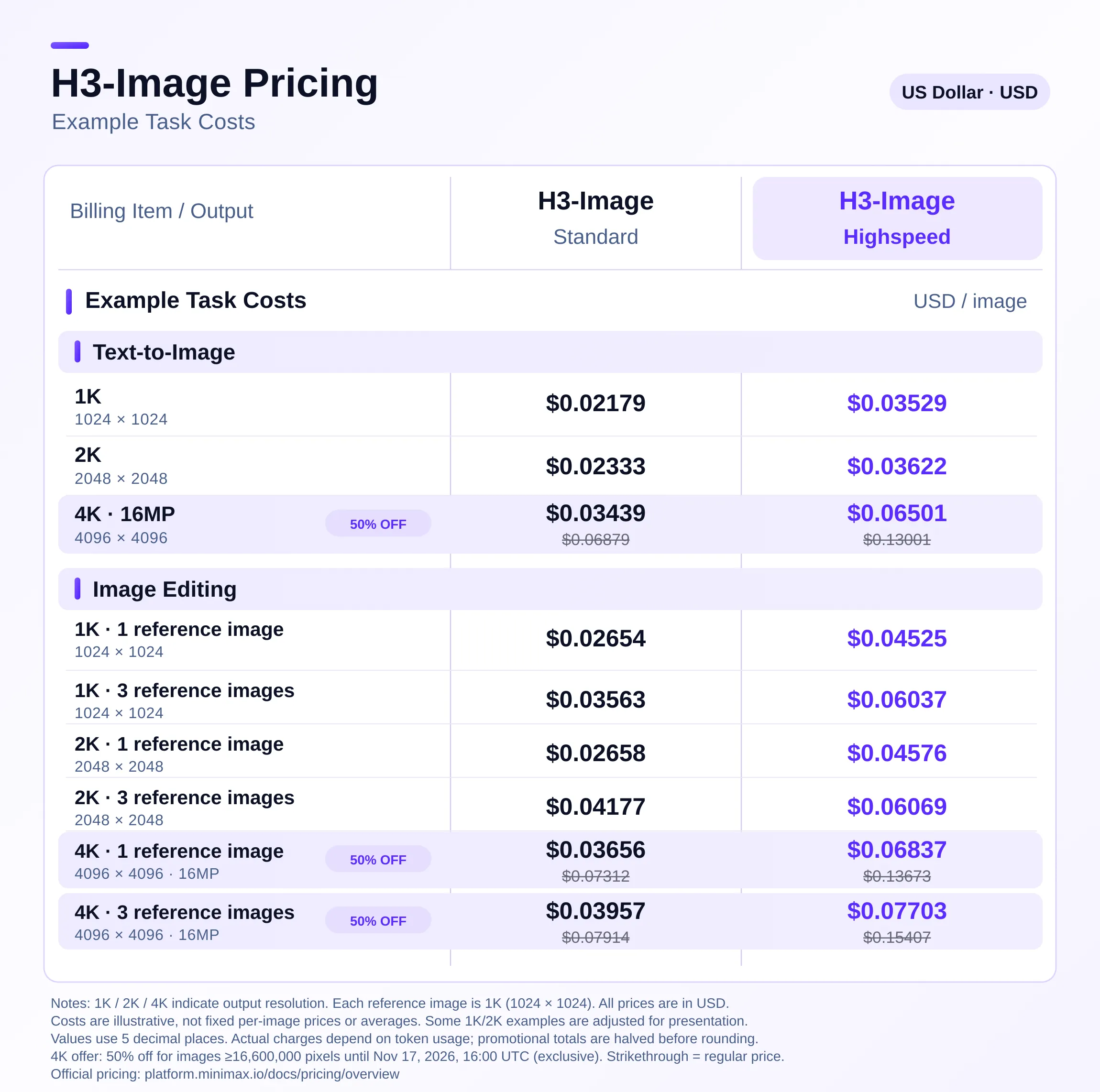
Per-image examples (official, USD)
| Task | Standard | Highspeed |
|---|---|---|
| Text-to-image 1K | $0.02179 | $0.03529 |
| Text-to-image 2K | $0.02333 | $0.03622 |
| Text-to-image 4K | ||
| Edit · 1 reference · 1K | $0.02654 | $0.04525 |
| Edit · 1 reference · 2K | $0.02658 | $0.04576 |
| Edit · 1 reference · 4K | ||
| Edit · 3 references · 1K | $0.03563 | $0.06037 |
| Edit · 3 references · 2K | $0.04177 | $0.06069 |
| Edit · 3 references · 4K |
Struck-through prices are list prices; bold prices are the discounted 4K rates. RMB examples: text-to-image 1K ¥0.1430, 2K ¥0.1531, 4K ¥0.4522 → ¥0.2261; edit with 1 reference 1K ¥0.1741, 2K ¥0.1744, 4K ¥0.4800 → ¥0.2400; edit with 3 references 1K ¥0.2339, 2K ¥0.2742, 4K ¥0.5194 → ¥0.2597 (Highspeed: text-to-image 1K ¥0.2316, 2K ¥0.2377, 4K ¥0.8531 → ¥0.4266; edit with 1 reference ¥0.2970/¥0.3003/¥0.8972 → ¥0.4486; edit with 3 references ¥0.3962/¥0.3983/¥1.0110 → ¥0.5055).
Why 4K costs only 3.2× a 1K image
A 4K image holds 16× the pixels of a 1K image, but the example price is only about 3.2× higher ($0.06879 vs $0.02179). The reason is token metering: each DiT token covers 32×32 pixels, so image token counts don't grow linearly with area; with text input and fixed overhead included, the price curve is much flatter than the pixel curve. That's H3-Image's real price advantage at 4K — and why the half-price offer targets 4K only: 4K is already its best-value size.
For comparison (OrcaRouter's estimate, not official data): the 4K list price is roughly an eighth of a FLUX 3 Image 4K frame and a fifth of a Nano Banana 2.1 frame. But price comparisons are not quality comparisons — H3-Image has no independent quality benchmark.
Half-price rules and expiry
The rule: orders are half price when the delivered image has at least 16,600,000 pixels. 4K (16,777,216 pixels) qualifies; 2K does not. The offer ends November 17, 2026 at 16:00 UTC (Nov 18, 00:00 Beijing, exclusive). After that, 4K text-to-image returns to the $0.06879 (Standard) and $0.13001 (Highspeed) list prices. Budget at list price and treat the discount as margin.
The small print: the examples are "illustrative, not fixed per-image prices or averages"; "some 1K/2K example amounts have been adjusted for presentation"; actual charges depend on token usage; promotional totals are halved before rounding. In other words, the examples are guidance, not a billing promise — the checkout page is authoritative.
Open question: is Context-IR billed?
The price page lists H3-Image-Context-IR (prompt enhancement) as its own line, at $2.30/¥15 per 1M input tokens — the same rate as text input. But the API guide says prompt enhancement is on by default (can be off for text-to-image, always on for edits) without saying whether that generates a charge, or whether billing uses the pre- or post-expansion token count. Local deployments can substitute the PE model, but MiniMax doesn't guarantee it matches the API exactly. Check the checkout page for actual billing; this site will update when there's a clear answer.
Which tier to pick
Standard and Highspeed differ only in speed and image-side rates: Highspeed doubles image input/output rates in exchange for cutting 4K text-to-image P50 from 16.0 seconds to 10.3 seconds. Use Highspeed for batch generation or tight deadlines; Standard when cost matters and time doesn't — there is no official quality difference between them. Also note both endpoints are non-idempotent: if the client times out, the server still finishes and charges, and the guide advises turning off automatic retries.
Reference: MiniMax Open Platform — Pricing Overview (USD price page) (rewritten and organized by ModelBrief; facts per the official source; RMB rates from the RMB price page)