MAI Code 2: The Topic Page
Microsoft's in-house coding flagship, released at Ignite 2026 on November 17, 2026, and live in GitHub Copilot the same day alongside its lightweight sibling MAI Code 2 Flash. Microsoft's own claim: a four-benchmark average reaching 98% of GPT-6.1 Sol at about 40% of the cost (Microsoft-chosen benchmarks, 50% promotional-price basis), and 96% of Claude Opus 5.5 at just 5% of the cost (same basis). But the positioning needs stating first: every benchmark figure is Microsoft's own, with no independent score anywhere; the price is GitHub's published promotional rate ($0.50/$2.50 per 1M tokens, ending May 17, 2027, doubling after), and the 40% and 5% figures are relative costs computed at that promo price; the model card is published (about 80B active, ~2.8T total, 1.05M context, knowledge cutoff before August 2026 data). This page collects the official specs, the ways to try it, a pricing breakdown and 6 in-depth reviews — with unverified claims clearly marked.
01Key facts
What is confirmed: Microsoft's first in-house coding model positioned as a Copilot workhorse — "near-flagship scores at a fraction of the price" is its pitch, and also the claim most in need of checking.
- Released
- 2026-11-17 (Tuesday, Ignite 2026, San Francisco, Nov 17–20); Microsoft AI launched seven MAI models the same day, with MAI Code 2 and MAI Code 2 Flash live in GitHub Copilot the same day
- Developer
- Microsoft AI (Microsoft), USA
- Positioning
- Everyday enterprise coding flagship: production code, deep debugging, multi-file changes, repo-wide reasoning, UI work; Microsoft says both models are "explicitly not yet tuned" for fundamental science research or very-long-horizon agentic work
- Sibling
- MAI Code 2 Flash: the lightweight tier for code explanations, targeted edits, routine fixes and rapid iteration; comparable to GPT-6 Luna and Claude Haiku 5.5 (Microsoft's own runs), at 65% and 20% of the cost (50% promo-price basis); covered inside this topic, not as its own topic
- Parameters / architecture
- Decoder-only transformer with sparse MoE layers and an integrated vision encoder; MAI Code 2 about 80B active (77B active + 3B embedded, ~2.8T total), Flash about 12B active (~398B total); base MAI-Base-2 (model card, Nov 17, 2026)
- Context window
- 1,050,000 tokens (model card); max input 922,000, max output 128,000; the 1M window works only in VS Code and Copilot CLI (GitHub docs)
- Knowledge cutoff
- Data before August 2026 (model card); it may not know newer libraries, APIs or vulnerabilities
- Benchmarks
- Microsoft-reported four-benchmark average: 98% of GPT-6.1 Sol at about 40% of the cost (Microsoft-chosen benchmarks, 50% promo-price basis); 96% of Claude Opus 5.5 at about 5% of the cost (same basis). No independent score exists: not listed by Artificial Analysis, LiveBench or LMArena
- Blind test
- A 258-person front-end blind test: developers preferred MAI Code 2's output over GPT-6 Sol, now stated as 64% in both Microsoft posts (better on both aesthetics and functionality); 67% and 68% were the pre-correction values on the pages as saved around 04:00 JST on Nov 18, now kept only as a historical note (see sections 12 and 15)
- Price
- $0.50 / $2.50 per 1M tokens (GitHub Copilot pricing page): $0.50 input, $0.025 cached input, $2.50 output, promotional to May 17, 2027, then $1.00/$0.05/$5.00; Flash $0.05/$0.005/$0.25, then $0.10/$0.01/$0.50; usage-based inside GitHub Copilot (1 AI credit = $0.01)
- Access
- GitHub Copilot (VS Code, Visual Studio, Copilot CLI, cloud agent, GitHub.com, mobile, JetBrains, Xcode, Eclipse); MAI Code 2 Flash also in limited-access preview in Microsoft Foundry; MAI Code 2 has joined Copilot Fusion Standard
- Plans
- MAI Code 2: Copilot Pro, Pro+, Max, Business, Enterprise; MAI Code 2 Flash: those plans plus Free and Student
- Weights / open source
- Closed, no public weights
- Chip
- All seven MAI models run on Microsoft's second-generation Maia 200 chip, now in production
02Quick comparison
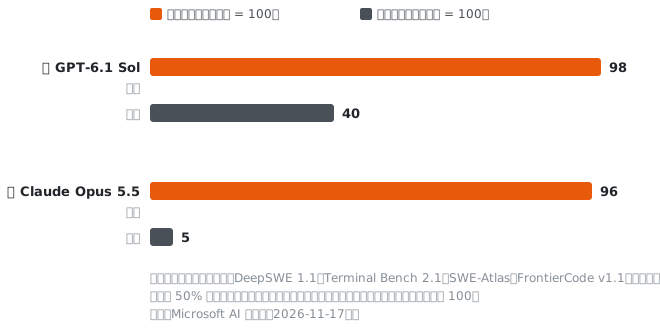
Microsoft's pricing story in one table: 2–4% less performance at a fraction of the cost — but both the performance and the cost come from Microsoft's own arithmetic; see the note below the table.
| Model | Four-benchmark average (relative performance) | Relative cost | Context | Open weights |
|---|---|---|---|---|
| MAI Code 2 | 98 (GPT-6.1 Sol = 100) | ~40% (50% promo-price basis) | 1.05M tokens | No |
| GPT-6.1 Sol | 100 (reference) | 100 (reference) | 1M tokens | No |
| Claude Opus 5.5 | 100 (reference) | 100 (reference) | 1M tokens | No |
| MAI Code 2 Flash | Comparable to GPT-6 Luna and Claude Haiku 5.5 (Microsoft's own runs, three benchmarks) | 65% of Luna / 20% of Haiku 5.5 (50% promo-price basis) | 1.05M tokens | No |
Relative performance is the average of four Microsoft-chosen benchmarks (DeepSWE 1.1, Terminal Bench 2.1, SWE-Atlas, FrontierCode v1.1), all models at max reasoning effort; three of the four ran on Microsoft's internal MSBench platform (via the Copilot CLI), and the FrontierCode v1.1 scores and costs come from Artificial Analysis. Costs are computed at the 50% promotional price, which ends May 17, 2027. All figures are Microsoft-reported, with no independent verification.
03Charts
Relative performance vs relative cost, grouped: MAI Code 2 trails the reference models by only 2–4% on performance while costing 40% and 5% — but both sets of numbers are computed at the 50% promotional price and all are Microsoft-reported.
04Top 3 reads
Short on time? Start with these three: the benchmark tally, the pricing breakdown and the Opus 5.5 comparison — all three take apart Microsoft's line "98% of the performance at 40% of the cost".
05Timeline
Three days after launch, the official posts, GitHub changelog and tier-1 coverage all arrived the same day; Chinese coverage is still thin and no independent score has appeared.
- June 2026
MAI Code 1 Flash launches, the starting point of the MAI coding line (per industry reporting); the line stayed lightweight until MAI Code 2 added a general-purpose flagship tier.
- 2026-11-17
Seven MAI models launch at Ignite 2026: MAI Code 2, MAI Code 2 Flash (coding), MAI Cyber 2 Flash (security), MAI Image 2.7 (image editing), MAI Realtime 1 (speech-to-speech), MAI Transcribe 2 (transcription, powering Dragon Copilot Transcribe), Decision 1.1 (task routing); all run on the second-generation Maia 200 chip, now in production. The Microsoft AI product post gives all the benchmark claims: MAI Code 2 reaches 98% of GPT-6.1 Sol at about 40% of the cost (Microsoft-chosen benchmarks, 50% promo-price basis), and 96% of Claude Opus 5.5 at about 5% of the cost (same basis).
- 2026-11-17
MAI Code 2 and Code 2 Flash go live in GitHub Copilot the same day: GitHub's changelog confirms both models in the model picker across VS Code, Visual Studio, Copilot CLI, cloud agent, GitHub.com, mobile, JetBrains, Xcode and Eclipse; MAI Code 2 covers Pro, Pro+, Max, Business and Enterprise, Flash adds Free and Student; both are usage-billed. GitHub also confirms MAI-Code-2 joins Copilot Fusion Standard the same day, and announces MAI-Code-1.1-Flash will retire on Dec 18.
- 2026-11-17–18
Axios covers the launch (via superpowerdaily), noting the pricing advantages reflect promotional discounts; edgeconsultancykw, rrtechpulse, pasqualepillitteri and scanradar publish launch-day analyses, all labelling the comparisons as Microsoft's own and the prices as promotional. English autocomplete forms the same day with comparison-shaped long tails: "mai code 2 benchmarks", "mai code 2 vs opus 5.5", "mai code 2 artificial analysis".
- 2026-11-18
Blind-test figure unified at 64%: ai-oriens' Nov 18 report confirms both Microsoft's product post and its Ignite post now read 64% (258-person blind test, better on aesthetics and functionality); pages saved around 04:00 JST on Nov 18 showed 67% in the product post and 68% in the keynote post, both since corrected to 64%. The 67%/68% figures now stand only as a historical note.
- 2026-11-20
This site's topic page goes live (this page). As of publication: Artificial Analysis, LiveBench and LMArena have not listed MAI Code 2; Microsoft's model card and GitHub's pricing page are published (about 80B active, 1.05M context, $0.50/$2.50 promo to May 17, 2027); no systematic tier-1 Chinese tech-media coverage yet.
06Official specs
As published by Microsoft (Microsoft AI product post, model card and GitHub changelog, Nov 17, 2026). Undisclosed items are written as "not disclosed", not guessed.
- Status
- Released (GA, 2026-11-17, live in GitHub Copilot)
- Model ID
- MAI-Code-2 / MAI-Code-2-Flash (GitHub Copilot identifiers)
- Positioning
- Everyday enterprise coding: production code, deep debugging, multi-file changes, repo-wide reasoning, UI work; also tuned for dashboards and visualizations, per Microsoft
- Architecture / parameters
- Decoder-only transformer with sparse MoE layers and an integrated vision encoder; MAI Code 2 about 80B active (~2.8T total), Flash about 12B active (~398B total); base MAI-Base-2; trained from scratch by Microsoft (model card)
- Context window
- 1,050,000 tokens (max input 922,000, max output 128,000); the 1M window works only in VS Code and Copilot CLI
- Knowledge cutoff
- Data before August 2026 (model card)
- Input / output
- Inputs: text and images (screenshots, UI mockups, charts and diagrams); outputs: text (model card). Optimized for English code production only at release
- Out of scope
- Microsoft states plainly: both models are explicitly not yet tuned for fundamental science research or very-long-horizon agentic work
- Access
- GitHub Copilot (VS Code, Visual Studio, Copilot CLI, cloud agent, GitHub.com, mobile, JetBrains, Xcode, Eclipse); MAI Code 2 Flash also in limited-access preview in Microsoft Foundry; MAI Code 2 has joined Copilot Fusion Standard
- Plans
- MAI Code 2: Pro, Pro+, Max, Business, Enterprise; MAI Code 2 Flash: those plans plus Free and Student; both models only for eligible Copilot subscribers on annual plans (GitHub changelog wording)
- Billing
- Usage-based inside GitHub Copilot; MAI Code 2 $0.50/$0.025/$2.50 per 1M tokens (promo to May 17, 2027, then $1.00/$0.05/$5.00), Flash $0.05/$0.005/$0.25 (then $0.10/$0.01/$0.50); 1 AI credit = $0.01
- Weights / licence
- Closed, no public weights
- Benchmarks
- Microsoft-reported: a four-benchmark average of 98% of GPT-6.1 Sol at about 40% of the cost (Microsoft-chosen benchmarks, 50% promo-price basis), and 96% of Claude Opus 5.5 at about 5% of the cost (same basis); no independent score
- Chip
- All seven MAI models run on Microsoft's second-generation Maia 200 chip, now in production
07How to try it: four routes
MAI Code 2 has exactly one official route: GitHub Copilot. No standalone API, no weights, no free tier — free users get Flash only, not MAI Code 2 itself.
1VS Code / Visual Studio (main route)
Pick MAI Code 2 in the Copilot Chat model picker (Pro, Pro+, Max, Business, Enterprise) or MAI Code 2 Flash (which also covers Free and Student). Suited to the full everyday coding flow: production code, deep debugging, multi-file changes, repo-wide reasoning, UI work; Flash suits code explanations, targeted edits, routine fixes and rapid iteration. See our Copilot guide.
2Copilot CLI and cloud agent
Call it from the terminal with the Copilot CLI, or use the cloud agent on GitHub.com and mobile: suited to agent-style coding, with multi-file changes and repo-wide reasoning as its headline use; note Microsoft says it is not tuned for very-long-horizon agentic work, so break long tasks into stages and check each one.
3Copilot Fusion Standard
GitHub's Nov 17 changelog confirms MAI-Code-2 has joined Copilot Fusion Standard. Fusion routes tasks across several models, so picking Standard may land you on MAI Code 2; to pin it down, pick the model explicitly in the model picker.
4Microsoft Foundry (Flash only, limited preview)
MAI Code 2 Flash is also in limited-access preview in Microsoft Foundry; MAI Code 2 itself is not in Foundry. Sources disagree on Foundry access (the Microsoft keynote post says both coding models are there; other reporting calls Flash a private preview), so go by what the Foundry console actually shows.
Also: MAI-Code-1.1-Flash retires across all Copilot experiences on Dec 18, 2026; GitHub recommends switching to the latest MAI Code Flash model. Business and Enterprise admins must allow MAI models in the Copilot model policy (enabled by default for Business and Enterprise).
08Pricing
GitHub's pricing page publishes the rate card — $0.50/$2.50 per 1M tokens, promotional until May 17, 2027, then $1.00/$5.00. What follows is the rate card plus an analysis of the "relative cost" figures themselves: how they were computed, what they hide, and what may change when the promotion ends. Prices checked Nov 20, 2026; the checkout page price is authoritative.
| Comparison | Relative performance (Microsoft-reported) | Relative cost (Microsoft-reported) | Basis |
|---|---|---|---|
| MAI Code 2 vs GPT-6.1 Sol | 98% | ~40% | Four-benchmark average; cost at 50% promo price |
| MAI Code 2 vs Claude Opus 5.5 | 96% | ~5% | Four-benchmark average; cost at 50% promo price |
| MAI Code 2 Flash vs GPT-6 Luna | Comparable | 65% | Three benchmarks; cost at 50% promo price |
| MAI Code 2 Flash vs Claude Haiku 5.5 | Comparable | 20% | Three benchmarks; cost at 50% promo price |
A rate card exists — but it is a promo price
GitHub's Copilot pricing page already publishes per-1M-token prices, and it is the actual checkout reference: MAI Code 2 at $0.50 input, $0.025 cached input and $2.50 output, promotional until May 17, 2027, then $1.00/$0.05/$5.00; Flash at $0.05/$0.005/$0.25, then $0.10/$0.01/$0.50. Three things are confirmed: both models bill usage-based inside Copilot; the cost figures in the benchmark comparison are computed at a 50% promotional price; and the promotion ends on May 17, 2027 (GitHub pricing page).
What happens when the promotion ends
Working backwards from Microsoft's own footnote: if the promo price is half the list price, MAI Code 2's relative cost vs GPT-6.1 Sol rises from about 40% to about 80% after the promotion, and vs Claude Opus 5.5 from about 5% to about 10% — still cheaper, but the "40%" figure most often quoted doubles overnight. That is the premise that must travel with every citation of the relative costs, and Axios' launch-day reporting makes the same point: the pricing advantages reflect promotional discounts.
AT&T's "50x" is one customer, not a rate card
Microsoft says a custom AT&T version of MAI Code 2 Flash outperformed GPT-6.1 Sol on standard 5G network analysis while costing 50x less. That is a single-customer anecdote, not a public rate card, and it cannot be converted into general pricing.
Official pages: Microsoft AI — MAI Code 2 product post · Microsoft AI — MAI Code 2 model card · GitHub Changelog — MAI Code 2 in GitHub Copilot
09First hands-on reviews
All from the first wave, Nov 17–20: there is no independent measurement yet — every score comes from Microsoft, and third parties can only check the wording, not reproduce the scores. Every entry carries a verdict badge; "Read on this site" opens our rewritten deep-dive article, with the original source at the end.
Microsoft AI product post: the source of every benchmark claim
Verdict: Vendor-reported, no independent verification yetSource: Microsoft AI, Nov 17, 2026 Original →
The post "MAI Code 2 and Code 2 Flash: Everyday coding at scalable prices" is the source of all the numbers: a four-benchmark average of 98% of GPT-6.1 Sol at about 40% of the cost (Microsoft-chosen benchmarks, 50% promo-price basis), and 96% of Claude Opus 5.5 at about 5% of the cost (same basis); Flash comparable to GPT-6 Luna and Claude Haiku 5.5 at 65% and 20% of the cost. The footnotes also disclose the methodology: all models at max reasoning effort, three tests on Microsoft's internal MSBench platform (via the Copilot CLI, no subagents), with the FrontierCode v1.1 scores and costs from Artificial Analysis; MAI Code 2's cost is shown at its 50% promotional price. The same post states plainly that both models are not tuned for fundamental science research or very-long-horizon agentic work.
Read on this site → (original ModelBrief rewrite)
Microsoft AI Ignite post: the seven-model family and Maia 200
Verdict: Vendor-reported; its blind-test figure once disagreed with the product post, now unified at 64%Source: Microsoft AI, Nov 17, 2026 Original →
The Ignite post "Seven new world-class models at scalable price-performance" presents the full seven-model family and the Maia 200 chip in production, and repeats the 98% / 40% and 96% / 5% claims. Notably, its blind-test preference figure once differed from the product post's — pages saved around 04:00 JST on Nov 18 showed 67% in the product post and 68% in the keynote post; both have since been corrected to 64%, matching the product post's main text (see sections 12 and 15).
Read on this site → (original ModelBrief rewrite)
GitHub Changelog: the only authority on plans and access
Verdict: Availability confirmed; pricing details still missingSource: GitHub Changelog, Nov 17, 2026 Original →
The changelog confirms: MAI Code 2 covers Copilot Pro, Pro+, Max, Business and Enterprise, Flash adds Free and Student; both enter the model picker in VS Code, Visual Studio, Copilot CLI, cloud agent, GitHub.com, mobile, JetBrains, Xcode and Eclipse; both are usage-billed and limited to eligible subscribers on annual plans. A second changelog entry the same day confirms MAI-Code-2 joins Copilot Fusion Standard, and announces MAI-Code-1.1-Flash retires on Dec 18. The changelog gives no price figures at all.
Read on this site → (original ModelBrief rewrite)
Axios: the pricing advantage reflects promotional discounts
Verdict: Tier-1 launch-day coverage, with the right caveatSource: Axios (via superpowerdaily), Nov 17, 2026 Summary →
Axios' launch-day report repeats Microsoft's pricing claims while stating plainly that the pricing advantages reflect promotional discounts. It is the only confirmed tier-1 English media report so far; no systematic tier-1 Chinese tech-media coverage exists yet.
Read on this site → (original ModelBrief rewrite)
Third-party launch-day analyses: all checking the wording, none reproducing the scores
Verdict: Wording checks agree; independent reproduction is zeroSource: edgeconsultancykw, rrtechpulse, pasqualepillitteri, scanradar, Nov 17–18, 2026
Four third-party launch-day analyses share one pattern: they repeat Microsoft's numbers while labelling the comparisons as Microsoft's own and the prices as promotional; none attempts an independent benchmark reproduction. scanradar additionally notes Microsoft says OpenRouter, Vercel and other channels are "coming soon" (wording incomplete, unconfirmed whether live), and that sources disagree on Flash's Foundry access status.
Chinese coverage: still thin three days in
Verdict: Chinese search demand has not formedSource: This site's research, Nov 18, 2026 (Google Autocomplete, Chinese queries)
The Chinese query "mai code 2" produced no usable autocomplete (only French promo-code noise), and no systematic tier-1 Chinese media coverage has been verified. English demand is the opposite: within 24 hours of launch, comparison-shaped long tails formed — "mai code 2 benchmarks", "mai code 2 vs opus 5.5", "mai code 2 artificial analysis". This topic's Chinese traffic path is the GitHub Copilot user base, not Chinese search.
10Articles: our deep dives
The six articles below are original ModelBrief rewrites and reorganization — restructured with added conclusions and buying advice, with facts and numbers checked against the original sources. Read them on this site; each ends with its original source.
12Benchmarks: all Microsoft-reported, no independent yardstick yet
MAI Code 2 has no independent board reading anywhere: Artificial Analysis appears only in Microsoft's footnotes (the source of the FrontierCode v1.1 scores and costs), not as an independent listing. Everything below is Microsoft-reported — check the methodology before the scores.
Vendor-reported (Microsoft AI product post, Nov 17, 2026)
| Test | Source | Result | Label |
|---|---|---|---|
| Four-benchmark average vs GPT-6.1 Sol | Microsoft AI product post | 98% of the performance at about 40% of the cost (Microsoft-chosen benchmarks, 50% promo-price basis) | Vendor-reported; no independent verification |
| Four-benchmark average vs Claude Opus 5.5 | Microsoft AI product post | 96% of the performance at about 5% of the cost (same basis) | Vendor-reported; no independent verification |
| Front-end blind test vs GPT-6 Sol (258 people) | Microsoft AI posts | Preference for MAI Code 2: 64% (67%/68% were pre-correction values from Nov 18) | Vendor-reported; corrected to 64%, see below |
| Flash, three benchmarks vs GPT-6 Luna | Microsoft AI product post | Comparable performance at 65% of the cost (50% promo-price basis) | Vendor-reported; the three benchmarks are unnamed |
| Flash, three benchmarks vs Claude Haiku 5.5 | Microsoft AI product post | Comparable performance at 20% of the cost (50% promo-price basis) | Vendor-reported; the three benchmarks are unnamed |
| AT&T custom Flash vs GPT-6.1 Sol | Microsoft AI product post | Wins on standard 5G network analysis at 50x lower cost | Vendor-reported; single-customer anecdote |
Methodology: what the four benchmarks are and how they ran
The four benchmarks are DeepSWE 1.1, Terminal Bench 2.1, SWE-Atlas and FrontierCode v1.1, which Microsoft says target the everyday enterprise coding tasks it sees in GitHub Copilot. All models ran at max reasoning effort; DeepSWE 1.1, Terminal Bench 2.1 and SWE-Atlas ran on Microsoft's internal MSBench platform via the Copilot CLI with no subagents, while the FrontierCode v1.1 scores and costs come from Artificial Analysis. Average pass rates (from the chart on Microsoft's official blog): MAI Code 2 at 63.2%, GPT-6.1 Sol at 64.1%, Claude Opus 5.5 at 65.3% — MAI Code 2's average is actually the lowest of the three, so "98%" is a relative figure, not an absolute lead. Average cost per task (same chart): MAI Code 2 at $0.309, GPT-6.1 Sol at $0.761, Claude Opus 5.5 at $6.306, with MAI Code 2's cost computed at the 50% promotional price.
Full tally: our benchmarks article →
13Comparisons
vs GPT-6.1 Sol (the headline comparison)
| Dimension | MAI Code 2 | GPT-6.1 Sol |
|---|---|---|
| Four-benchmark average (Microsoft-reported) | 98% of GPT-6.1 Sol (Microsoft-chosen benchmarks, 50% promo-price basis) | 100 (reference) |
| Average pass rate (Microsoft blog chart) | 63.2% | 64.1% |
| Average cost per task (Microsoft blog chart) | $0.309 (50% promo-price basis) | $0.761 |
| Relative cost | ~40% (50% promo-price basis) | 100 |
| Context window | 1.05M tokens | 1M tokens |
| Access | GitHub Copilot | ChatGPT Work, Codex, API, Bedrock, Copilot |
| Weights | Closed | Closed |
The full meaning of "98% of the performance at about 40% of the cost": the average of four Microsoft-chosen benchmarks trails by only 2%, and the cost at the 50% promotional price is about 40%. But on average pass rate MAI Code 2 actually trails GPT-6.1 Sol (63.2% vs 64.1%), and after the promotion the relative cost rises to about 80%. See our comparison article.
vs Claude Opus 5.5 (the boldest claim)
| Dimension | MAI Code 2 | Claude Opus 5.5 |
|---|---|---|
| Four-benchmark average (Microsoft-reported) | 96% of Opus 5.5 (Microsoft-chosen benchmarks, 50% promo-price basis) | 100 (reference) |
| Average pass rate (Microsoft blog chart) | 63.2% | 65.3% |
| Average cost per task (Microsoft blog chart) | $0.309 (50% promo-price basis) | $6.306 |
| Relative cost | ~5% (50% promo-price basis) | 100 |
| Context window | 1.05M tokens | 1M tokens |
| Independent score | None | AA Index (see this site's Claude Fable 5.2 topic for the same-generation figures) |
"96% of the performance at 5% of the cost" is likewise a Microsoft-chosen benchmark average at a 50% promotional price; on average pass rate MAI Code 2 trails by 2.1 points, and the cost advantage comes from Opus 5.5's own high pricing stacked with the 50% promotion. See our comparison article.
MAI Code 2 vs MAI Code 2 Flash (choosing inside the family)
| Dimension | MAI Code 2 | MAI Code 2 Flash |
|---|---|---|
| Positioning | General-purpose flagship: production code, deep debugging, multi-file changes, repo-wide reasoning, UI | Lightweight tier: code explanations, targeted edits, routine fixes, rapid iteration |
| Reference models (Microsoft-reported) | GPT-6.1 Sol (98%), Claude Opus 5.5 (96%) | GPT-6 Luna, Claude Haiku 5.5 (both comparable) |
| Relative cost (Microsoft-reported, 50% promo-price basis) | ~40% of Sol / ~5% of Opus 5.5 | 65% of Luna / 20% of Haiku 5.5 |
| Copilot plans | Pro, Pro+, Max, Business, Enterprise | Those plans plus Free and Student |
| Foundry | Not available | Limited preview |
14What's missing (as of Nov 20)
- Any independent score: Artificial Analysis, LiveBench and LMArena have not listed MAI Code 2 ("mai code 2 artificial analysis" in autocomplete is search interest, not a listing)
- Post-promo relative costs: Microsoft has published no figures; this site works them backwards from the footnote at about 80% (vs Sol) and about 10% (vs Opus 5.5), with the about-$0.62 per-task figure matching Microsoft's own numbers (see the pricing guide)
- The default context size on Copilot clients other than VS Code and Copilot CLI: GitHub does not state it; the 1M window works only in VS Code and Copilot CLI
- Speed and accuracy at a full 1M context: Microsoft has not published them; the model card gives only the upper limits
- Per-benchmark scores for GPT-6.1 Sol and Opus 5.5: Microsoft has not published the rivals' individual scores, so the 98%/96% averages cannot be checked item by item (MAI Code 2's own scores are in the model card's main table and our benchmarks article)
- The names of Flash's three benchmarks: Microsoft did not name them, so the "comparable to Luna and Haiku 5.5" wording cannot be checked
- Whether the 64% blind-test figure changes again: Microsoft corrected both posts to 64% on Nov 18 (67%/68% were the earlier values — see section 12); any further change is still to be watched
- Systematic mainland Chinese tech-media coverage (three days after launch; Chinese coverage is still thin)
- A consistent Foundry access statement (sources disagree) and confirmation of whether OpenRouter, Vercel and other channels are live yet
15Rumor check
Most confusion about MAI Code 2 comes from seven places: the list price, the blind-test figures, the free tier, open weights, the AA listing, Flash's status and what "98%" means — clarified one by one below.
True, with caveats "MAI Code 2 has a list price of so many dollars per 1M tokens"
GitHub's Copilot pricing page has published the prices: MAI Code 2 at $0.50 input, $0.025 cached input and $2.50 output per 1M tokens, promotional until May 17, 2027, then $1.00/$0.05/$5.00; Flash at $0.05/$0.005/$0.25, then $0.10/$0.01/$0.50. Two caveats: the prices come from GitHub's docs, not Microsoft's product post; and they are 50% promotional prices, not long-term list prices — Microsoft's relative-cost claims (about 40% of GPT-6.1 Sol, about 5% of Opus 5.5) are computed at the promo price.
Resolved "64% of developers preferred MAI Code 2 in the blind test"
Microsoft's posts now both give 64% (a 258-person blind test, vs GPT-6 Sol, better on both aesthetics and functionality). The 67% and 68% figures were the values on the pages as saved around 04:00 JST on November 18 — 67% in the product post, 68% in the keynote post — and both have since been corrected to 64%. Cite 64%; treat 67%/68% as a historical footnote.
Not true "Free users can use MAI Code 2"
MAI Code 2 covers Copilot Pro, Pro+, Max, Business and Enterprise only; Free and Student get MAI Code 2 Flash. Don't build a topic on "mai code 2 free".
Not true "There are open weights for self-hosting"
MAI Code 2 is closed with no public weights; access is GitHub Copilot only, with no self-hosting route.
Not true "MAI Code 2 is listed on Artificial Analysis"
"mai code 2 artificial analysis" is only search interest in autocomplete; AA has not listed the model, and the FrontierCode v1.1 scores and costs come from AA data cited in Microsoft's footnotes, not from an independent AA listing.
Not true "MAI Code 2 Flash is a separate topic"
Flash is MAI Code 2's lightweight sibling, covered inside this topic, not as its own topic. Its three benchmarks are unnamed, and it targets high-volume everyday tasks, not a flagship substitute.
Partly true "MAI Code 2 has 98% of GPT-6.1 Sol's performance at 40% of the cost"
The figures come from Microsoft's official post, but two premises are inseparable from them: the performance is an average of four Microsoft-chosen benchmarks (and on average pass rate MAI Code 2 actually trails GPT-6.1 Sol, 63.2% vs 64.1%), and the cost is computed at a 50% promotional price (after the promotion the relative cost is about 80%). Without the premises, the sentence misleads.
16FAQ
When was MAI Code 2 released?
November 17, 2026 (Tuesday), at Ignite 2026, live in GitHub Copilot the same day; six other MAI models launched the same day, including MAI Code 2 Flash. See section 05 for the timeline.
How much does MAI Code 2 cost?
There is a rate card, from GitHub's Copilot pricing page: MAI Code 2 at $0.50 input, $0.025 cached input and $2.50 output per 1M tokens, promotional until May 17, 2027, then $1.00/$0.05/$5.00; Flash at $0.05/$0.005/$0.25, then $0.10/$0.01/$0.50. Microsoft's own relative-cost claims are 98% of GPT-6.1 Sol's performance at about 40% of the cost (Microsoft-chosen benchmarks, 50% promo-price basis), and 96% of Claude Opus 5.5 at about 5% of the cost (same basis); both models bill usage-based inside Copilot. See our pricing guide.
Where can I use MAI Code 2?
Only in GitHub Copilot: VS Code, Visual Studio, Copilot CLI, cloud agent, GitHub.com, mobile, JetBrains, Xcode, Eclipse. MAI Code 2 covers Copilot Pro, Pro+, Max, Business and Enterprise; Flash adds Free and Student. See our Copilot guide.
Is MAI Code 2 better than GPT-6.1 Sol?
On Microsoft's own four-benchmark average it reaches 98% of GPT-6.1 Sol (Microsoft-chosen benchmarks, 50% promo-price basis) at about 40% of the cost; but on average pass rate it actually trails slightly (63.2% vs 64.1%), and all figures are Microsoft-reported with no independent verification. See our comparison article.
Is MAI Code 2 open source?
No. MAI Code 2 is closed with no public weights; access is GitHub Copilot only, with no self-hosting route.
How large is MAI Code 2's context window?
1,050,000 tokens per the model card (max input 922,000, max output 128,000); the 1M window works only in VS Code and Copilot CLI. Parameters are about 80B active (~2.8T total) and the knowledge cutoff is data before August 2026 — both from the model card.
Can MAI Code 2 do fundamental science research?
Microsoft says not to count on it: both models are "explicitly not yet tuned" for fundamental science research or very-long-horizon agentic work; they target everyday enterprise coding.
MAI Code 2 or MAI Code 2 Flash?
Pick MAI Code 2 for complex work: production code, deep debugging, multi-file changes, repo-wide reasoning, UI work; pick Flash for high-volume everyday work — code explanations, targeted edits, routine fixes, rapid iteration — and Flash is the only one on the Free and Student plans. See our Copilot guide.
17Sources
Every fact on this page comes from the public sources below (the Microsoft AI product post and GitHub changelog published Nov 17, 2026; this site's research on Nov 18, 2026, fact-checked Nov 20, 2026).
Official
- Microsoft AI — Product post "MAI Code 2 and Code 2 Flash: Everyday coding at scalable prices" (four-benchmark averages 98% / 40% and 96% / 5%, blind test, Flash comparisons, 50% promo-price footnote, MSBench wording, out-of-scope limits) Published Nov 17
- Microsoft AI — Ignite post "Seven new world-class models at scalable price-performance" (all seven MAI models, Maia 200 chip in production) Published Nov 17
- GitHub Changelog — MAI Code 2 and MAI Code 2 Flash in GitHub Copilot (plan coverage, model-picker entry points, usage-based billing, annual-plan limit) Published Nov 17
- GitHub Changelog — Copilot Fusion updates (MAI-Code-2 joins Fusion Standard) Published Nov 17
- GitHub Changelog — MAI-Code-1.1-Flash retires Dec 18, 2026 Published Nov 17
English reporting and analysis
- superpowerdaily — Axios report summary "Microsoft launches specialized AI models, claiming steep savings over rivals" (pricing advantages reflect promotional discounts) Nov 17
- scanradar — MAI Code 2 launch-day analysis (plans, entry points, Foundry limited preview, Microsoft-reported wording) Nov 17–18
- edgeconsultancykw — MAI Code 2 launch-day analysis (Microsoft-reported wording, promo-price labels) Nov 17–18
- rrtechpulse — MAI Code 2 launch-day analysis (Microsoft-reported wording, promo-price labels) Nov 17–18
- pasqualepillitteri.it — MAI Code 2 launch-day analysis (Microsoft-reported wording, promo-price labels) Nov 17–18
- ai-oriens — MAI Code 2 launch report (reporting Microsoft's official blog chart: average pass rates 63.2% / 64.1% / 65.3%, per-task costs $0.309 / $0.761 / $6.306; also confirming the blind-test figure is now unified at 64%, with 67%/68% as pre-correction values) Nov 17–18
Chinese
- This site's research, Nov 18, 2026: Google Autocomplete produced no usable Chinese suggestions, and no systematic tier-1 Chinese tech-media coverage was found Nov 18
More indexes: All Microsoft models · All Language Models · All models