Nex-N2.6: The Topic Page
A computer-use agent from Nex-AGI (open-sourced by the Shanghai Innovation Institute), listed silently on OpenRouter on November 10, 2026: about 321B parameters, post-trained on Z.ai's GLM-5.3-Flash, with a vendor-reported OSWorld score of 83.0 and FP8 weights under Apache 2.0. But the positioning needs stating first: all three benchmarks are vendor-reported, with no independent score from Artificial Analysis, LiveBench or LMArena; it is not a new base model but a post-trained derivative of an August base; Terminal-Bench 2.1 trails its own base, and AutomationBench trails DeepSeek. This page collects the official specs, pricing, benchmark analysis and 6 in-depth reviews — with unverified claims clearly marked.
01Key facts
What is confirmed: this site's first computer-use agent topic — and its thinnest-evidence topic. "The open weights are real; independent verification hasn't arrived" is the one-line summary of Nex-N2.6.
- Released
- 2026-11-10 (Tuesday, silent OpenRouter listing — no launch post, no model card); FP8 weights and model card only publicly readable from ~Nov 12
- Developer
- Nex-AGI, Shanghai; open-sourced by the Shanghai Innovation Institute (GitHub org sii-nex)
- Positioning
- Computer-use agent, built for desktop operation, terminal tasks and business-process automation
- Base
- Post-trained on Z.ai's GLM-5.3-Flash (released Aug 26, 2026, 320B/18B); not a new base model
- Parameters
- ~321B total (321.3B / ~18B active, sparse MoE; 45-layer, 4,096-dim backbone: 3 dense FFN layers + 42 sparse MoE layers)
- Context
- 262,144 tokens on the OpenRouter endpoint; released configuration specifies 1,048,576 tokens (two different figures — see section 06)
- Max output
- 235,929 tokens (OpenRouter; reasoning tokens consume this budget, so usable output is less)
- Reasoning
- Mandatory; OpenRouter offers medium/high (default high), the HF chat template offers reasoning_effort low/high/max (default max)
- Input / output
- Input: text, image, video; output: text only; tool calling, forced tool choice, structured outputs and logprobs supported
- Price
- OpenRouter $0.12 in / $0.40 out per 1M tokens (20% off the $0.15/$0.50 list price, no stated expiry); cache reads $0.024; MOSS API free for a limited time
- Benchmarks
- Vendor-reported: OSWorld 83.0, Terminal-Bench 2.1 84.1, AutomationBench 45.7; no independent score of any kind
- Model ID
- nex-agi/nex-n2.6 (OpenRouter); nex-agi/Nex-N2.6 (Hugging Face)
- Open source
- Apache 2.0; FP8 weights in 129 safetensor shards, ~328.34GB
- China
- Published by a Shanghai team; ModelScope listing live since Nov 12 (nex-agi/Nex-N2.6, 129 safetensor shards, listed total size 224.8GB, Apache 2.0)
02Quick comparison
Side by side with the closest peers: AA Index, price, context and open-weight status at a glance. Open a model name for its topic page.
| Model | AA Index (v5.0) | Input · Output price | Context | Open weights |
|---|---|---|---|---|
| Nex-N2.6 | Not listed | $0.12 / $0.40 per 1M tokens (20% off) | 262K (OpenRouter) / 1M (release config) | Yes (Apache 2.0) |
| Kimi K3.1 Pro | 46 (v5.0) | $2 / $10 per 1M tokens | 1M tokens | Yes (custom license) |
| Tencent Hunyuan Hy4 | 35 | ¥6 / ¥18 per 1M tokens (50% off to Dec 31) | 1M tokens | No (preview weights only) |
| Inkling 2 Small | 31 | $0.30 / $1.00 per 1M tokens | 1M (arch. cap; Tinker 64K/256K) | Yes (Apache 2.0) |
| LongCat 2.5 | Not listed | $0.30 / $1.20 per 1M tokens (promo) | 1M tokens | Yes (MIT) |
The AA Index is published independently by Artificial Analysis (v5.0); "Not listed" means the model has not yet appeared on the AA board. Prices are input · output per 1M tokens; RMB and USD prices are separate vendor lists and are not directly comparable. See section 13 for the full comparison and section 12 for the full benchmark tally.
03Charts
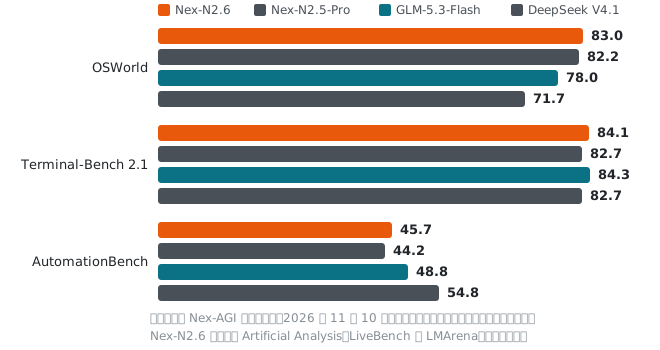
The model card's three benchmarks — all vendor-reported by Nex-AGI; Nex-N2.6 has no independent score yet. The full benchmark tally is in section 12.
04Top 3 reads
Short on time? Start with these three; the full list is in section 10.
05Timeline
A two-stage release: Nov 10 brought only the API listing; the weights and model card appeared around Nov 12. In the two-day information vacuum, early reviews wrote "no benchmarks, no weights" — outdated the next day.
- 2026-08-26
Base model GLM-5.3-Flash releases (320B/18B) — the starting point for N2.6's post-training.
- 2026-09-08
Predecessor Nex-N2.5-Pro releases (Qwen3.5 base, ~397B/~17B active), priced $0.075/$0.25 on OpenRouter.
- 2026-11-10
N2.6 lists silently on OpenRouter (nex-agi/nex-n2.6): no launch post, no readable model card, no benchmark table; the GitHub repo sii-nex/Nex-N2.6 is created the same day. The vendor website still advertised only the N2.5 family.
- 2026-11-11
The Hugging Face repo nex-agi/Nex-N2.6 is still not publicly readable (OrcaRouter hits a login prompt, Hokai a missing page); ai345 (Chinese) finds ModelScope 404 and HF unreachable. The "no benchmarks, no weights" claims OrcaRouter and Hokai publish that day are outdated by the next.
- 2026-11-11–12
MOSS API starts its limited-time free promotion (0 credits per request, no end date, no SLA).
- ~2026-11-12
Weights and model card become publicly readable. Open Model Weights publishes its weights report on Nov 12; lininn.cn (Chinese) publishes a critical long-form piece the same day, with the Plotly 38/43 result and the 1,670-call failure case; SMF Clearinghouse publishes its Cold Iron test the same day: 76.4% on 157 tests, up 24.8 points on N2.5-Pro (see section 09).
- 2026-11-12
ModelScope listing: the nex-agi/Nex-N2.6 page goes live (updated Nov 12), with 129 safetensor shards, a listed total size of 224.8GB and Apache 2.0; its README carries the same three benchmark figures as the HF model card (OSWorld 83.0, Terminal-Bench 2.1 84.1, AutomationBench 45.7); 13 downloads.
- 2026-11-14
AI Weekly publishes its release summary (410 HF downloads in the past month); the After Intelligence newsletter (edition 070) lists N2.6 as one of four lead frontier items; two Instagram reels (small creators, promotional tone).
- 2026-11-14
GameBench 2 (DuelLab overall board) lists N2.6: 62.0 overall, No. 19 of 95 models (Max 50.1 / High 63.2 / Low 72.7).
- 2026-11-16
This topic page goes live; as of today, Artificial Analysis, LiveBench and LMArena have all yet to list N2.6.
06Official specs
As published by the model card and the OpenRouter endpoint (HF model card read directly in the early hours of Nov 16, 2026; page crawled Nov 15, 2026, 18:16 UTC). All benchmarks are vendor-reported; the card states the scores are model-level results, not a separate evaluation of the FP8 export.
- Status
- Released (API listed 2026-11-10; weights readable ~Nov 12)
- Model ID
- nex-agi/nex-n2.6 (OpenRouter); nex-agi/Nex-N2.6 (Hugging Face)
- Architecture / parameters
- Sparse MoE, 321.3B total / ~18B active; 45-layer, 4,096-dim backbone (3 dense FFN + 42 sparse MoE layers); post-trained on GLM-5.3-Flash
- Context window
- 262,144 tokens (OpenRouter endpoint); released configuration 1,048,576 tokens
- Max output
- 235,929 tokens (OpenRouter; reasoning tokens consume the budget)
- Input
- Text, image, video
- Output
- Text
- Reasoning
- Mandatory; OpenRouter medium/high (default high), HF template reasoning_effort low/high/max (default max)
- Tooling
- Tool calling, forced tool choice, structured outputs, logprobs
- Weights
- FP8, 129 safetensor shards, ~328.34GB (314.4B FP8 + 6.92B BF16 + 3.6M FP32); Apache 2.0
- API price
- $0.12 in / $0.40 out per 1M tokens; cache reads $0.024
- Benchmarks
- OSWorld 83.0 / Terminal-Bench 2.1 84.1 / AutomationBench 45.7 (vendor-reported)
- License
- Apache 2.0
07How to try it: three routes
Three routes: pay-as-you-go on OpenRouter, the limited-time free MOSS API, or self-hosted FP8 weights. There is no chat-app entry point and no other hosted provider.
1OpenRouter (the only paid hosted channel)
Model ID nex-agi/nex-n2.6, $0.12/$0.40 per 1M tokens (input/output), cache reads $0.024; Nex-AGI itself is the sole provider, with no fallback endpoint. Reasoning is mandatory, medium/high tiers, default high; context 262,144 tokens, max output 235,929 tokens (reasoning tokens consume the budget, so usable output is less).
2MOSS API (free for a limited time)
Endpoint api.mosi.cn/v1, model alias nex-n2.6 (pinned nex-n2.6-2026-11-05), 0 credits per request, no end date; compatible with OpenAI Chat Completions / Responses and Anthropic Messages; no SLA promised. The free window can end at any time — don't build production on it.
3Self-hosted FP8 weights
Hugging Face repo nex-agi/Nex-N2.6, Apache 2.0; 129 shards, ~328GB, SGLang recommended (FP8 config, GLM-5.3-Flash-compatible runtime); ~202.6GB at 4-bit. The hardware reality: a 24GB consumer GPU is nowhere near enough — the realistic floor is a 512GB-unified-memory Mac Studio or a multi-GPU server. See our self-hosting guide.
08Pricing
The rate itself is cheap — $0.12/$0.40 is among the lowest API prices of any topic on this site; but it is 60% dearer than the predecessor, and the 20% discount has no stated end date. Prices checked Nov 16, 2026; the checkout page price is authoritative.
| Item (per 1M tokens) | Nex-N2.6 | Nex-N2.5-Pro | N2.6 list price |
|---|---|---|---|
| Input | $0.12 | $0.075 | $0.15 |
| Output | $0.40 | $0.25 | $0.50 |
| Cache reads | $0.024 | — | — |
| vs predecessor | 60% more (input and output alike) | — | — |
The 20% discount has no end date
OpenRouter shows $0.12/$0.40 as 20% off the $0.15/$0.50 list price, with no end date stated; treat it as introductory — if the price returns to list, rates rise 25%. The MOSS free window likewise has no end date. Neither the "free" nor the "discounted" price carries a time commitment, so budget against the list price.
What the 60% buys
Against N2.5-Pro's $0.075/$0.25, N2.6 costs 60% more on input and output alike. What it buys: OSWorld 82.2 → 83.0, reasoning repetition 16.0% → 1.6%, tool adherence 100% — the reliability fixes are real, but the benchmark gains are small. Whether the 60% is worth it depends on whether N2.5-Pro's repetition and tool errors ever blocked your tasks.
Official pages: OpenRouter model page · Hugging Face model card
09First hands-on reviews
Everything public from Nov 10–16: the vendor model card is the only systematic data, and the independent evidence is five small-sample records. The headline first: there is no independent score at all, the Plotly independent benchmark run ties the base, and the strongest criticism comes from one Chinese long-form piece. Every entry carries a verdict badge; "Read on this site" opens our rewritten deep-dive article, with the original source at the end.
Model-card benchmarks (vendor-reported): OSWorld is the only clear win
Verdict: computer use is the strength; the other two don't separateSource: Hugging Face model card (Nex-AGI), read directly Nov 16, 2026
OSWorld 83.0 (first in the table, 5.0 above the base, 0.8 above the predecessor); Terminal-Bench 2.1 84.1, below its own base GLM-5.3-Flash at 84.3; AutomationBench 45.7, below the base's 48.8 and DeepSeek-V4.1-Flash's 54.8. Internal reliability evaluation: reasoning repetition down from N2.5-Pro's 16.0% to 1.6%, tool adherence 100%. The card states the scores are model-level results, not a separate evaluation of the FP8 export.
Read on this site → (original ModelBrief rewrite)
Plotly DataAnalyticsBench 38/43, tied with the base
Verdict: post-training opened no gap on this boardSource: lininn.cn, Nov 12, 2026 (third-party run)
An independent benchmark run: Plotly DataAnalyticsBench 38/43, tied with the base GLM-5.3-Flash. On the same board as this site tracks it: Carbon 42/43, Hydrogen 43/43 (full marks) — N2.6's 38/43 sits behind both. Two runaway loops pushed the whole run's cost to $10.19.
Read on this site → (original ModelBrief rewrite)
SMF Cold Iron: 76.4% on 157 tests, up 24.8 points on the predecessor
Verdict: The generational jump is real; coding has a new syntax flawSource: SMF Clearinghouse (SMF Works), Nov 12, 2026 (157-test in-house suite, single run) Original →
120/157 (76.4%), No. 24 on its board — up 24.8 points on Nex-N2.5-Pro's 51.6%: math repaired from 1/30 to 22/30, reasoning up from 9/30 to 27/30, tool calling from 0/2 to 2/2. But coding is only 11/30, and 14 of the 17 failures are SyntaxErrors — four rows put em-dashes or arrows into program text, five shipped unterminated strings. Limits: a single run on a 157-test suite; the model cannot turn thinking off (effort=none returns HTTP 400), so this ran at medium effort with reasoning tokens at 88% of all output; the whole run cost $0.13 and took 49.8 minutes.
lininn.cn failure case: 1,670 calls in 2h20m, no answer found
Verdict: the strongest critical data point availableSource: lininn.cn, Nov 12, 2026 (third-party test)
In a third-party test, the model ran 1,670 calls over 2 hours 20 minutes on one data-analysis question without finding the answer; the bill was $10.19. Read next to the model card's 100% tool-adherence self-assessment: internal replays and real long tasks are not the same thing.
Read on this site → (original ModelBrief rewrite)
GameBench 2: 62.0 overall, No. 19 of 95
Verdict: the first independent record on a public board, of limited valueSource: DuelLab, updated Nov 14, 2026 (overall board; by effort: Max 50.1 / High 63.2 / Low 72.7)
GameBench 2 scores 62.0 overall, No. 19 of 95 models; by effort tier, Max 50.1, High 63.2 and Low 72.7 — the low-effort run scores highest, so the high-effort result is notably weaker. Still one board, so no overall judgement can rest on it.
hypeorcode: 6 runs, 28m48s, $0.077
Verdict: too small a sample to conclude anythingSource: hypeorcode (small-sample run)
Six runs, 28m48s total, $0.077 at list price. Listed here because almost no other public hands-on run exists.
No independent score anywhere: AA, LiveBench and LMArena all silent
Verdict: the topic's most fundamental evidence gapSource: OrcaRouter, vakati-tech, DuelLab; Epoch AI: no standardized scores yet
As of Nov 16, Artificial Analysis has no N2.6 model page, LiveBench has no run, LMArena has no listing; Epoch AI says there are no standardized scores yet. The big boards' standardized scores are still blank — only scattered independent runs exist (see above) — and a listing on AA, LiveBench or LMArena remains the first item on the 8-hour tracking loop's watchlist.
OrcaRouter and Hokai's early analyses: price and base-swap analysis still valid, "no benchmarks, no weights" outdated
Verdict: cite only the price and base-swap analysisSource: OrcaRouter, Hokai, Nov 11, 2026 (written before the model card was readable)
Both Nov 11 analyses were written before the model card was readable; their "no benchmarks, no weights" claims went stale when the weights became readable on Nov 12 — don't cite them. Their analysis of the price and the Qwen-to-GLM base swap still stands. Their throughput figures conflict (Hokai 80 tok/s, OrcaRouter ~35 tok/s); this site adopts no single number.
Read on this site → (original ModelBrief rewrite)
10Articles: our deep dives
The six articles below are original ModelBrief rewrites and reorganization — restructured with added conclusions and buying advice, with facts and numbers checked against the original reviews. Read them on this site; each ends with its original source.
11Related topics
Topic pages for the other models on this site.
 MAI Code 2Released Nov 17, 2026 · Microsoft's first in-house coding flagship, live in GitHub Copilot on day one; Microsoft claims 98% of GPT-6.1 Sol's performance at 40% of the cost (50% promo price). The topic page covers official specs, pricing, benchmark analysis and 6 in-depth reviews.
LLM · Open weights · Released Nov 12, 2026
 Edge0-145BReleased Nov 12, 2026 · Edge0's first 145B on-device model, a latent MoE on a Qwen3.8-Flash-Next base, 256K context, weights public on HF under a custom community license (not open source). The topic page covers official specs, pricing, benchmark analysis and 6 in-depth reviews.
ModelBrief homeAll topicsBack to the home page: browse all 18 model topics by release date — LLMs, image models and video models.
12Benchmarks: the model card's three tests + the reliability table
The model card gives just three benchmarks and one internal reliability table — not much data, and all of it vendor-reported, with rival scores as Nex-AGI lists them rather than each vendor's published values. Check the conditions before the scores, then see what independent evidence says.
| Test (model card, vendor-reported) | Nex-N2.6 | Nex-N2.5-Pro | GLM-5.3-Flash (base) | DeepSeek-V4.1-Flash |
|---|---|---|---|---|
| OSWorld (computer use) | 83.0 | 82.2 | 78.0 | 71.7 |
| Terminal-Bench 2.1 (terminal tasks) | 84.1 | 82.7 | 84.3 | 82.7 |
| AutomationBench (business processes) | 45.7 | 44.2 | 48.8 | 54.8 |
Internal reliability evaluation (vendor's known-issue replay)
| Metric | Nex-N2.5-Pro | GLM-5.3-Flash | Nex-N2.6 |
|---|---|---|---|
| Reasoning repetition rate ↓ | 16.0% | 6.0% | 1.6% |
| Overall non-repetition rate ↑ | 91.0% | 96.2% | 97.8% |
| Valid tool selection rate (overall) ↑ | 82.2% | 85.3% | 100.0% |
| Valid tool selection rate (when with tools) ↑ | 80.5% | 84.1% | 100.0% |
Independent evidence (as of Nov 16)
| Measurement | Source | N2.6 result | Note |
|---|---|---|---|
| Plotly DataAnalyticsBench | lininn.cn, Nov 12 | 38/43 | Tied with the base; Carbon 42/43, Hydrogen 43/43; whole run $10.19, two runaway loops |
| Cold Iron (157-test in-house suite) | SMF Clearinghouse, Nov 12 | 76.4% (120/157), No. 24 | Up 24.8 points on N2.5-Pro; single run; thinking cannot be disabled, run at medium effort |
| GameBench 2 (overall) | DuelLab, updated Nov 14 | 62.0, No. 19/95 | One board; by effort: Max 50.1 / High 63.2 / Low 72.7 |
| hypeorcode run | hypeorcode | 6 runs, 28m48s, $0.077 | Small sample, no conclusion |
| lininn.cn failure case | lininn.cn, Nov 12 | 1,670 calls, no answer, $10.19 | The strongest critical data point |
| Artificial Analysis / LiveBench / LMArena | — | Not listed | No independent score |
Full tally: our benchmarks article →
13Comparisons
vs Nex-N2.5-Pro (predecessor)
| Dimension | Nex-N2.6 | Nex-N2.5-Pro |
|---|---|---|
| Base | GLM-5.3-Flash | Qwen3.5 |
| Total parameters | ~321B | ~397B |
| Active parameters | ~18B | ~17B |
| OSWorld | 83.0 | 82.2 |
| Terminal-Bench 2.1 | 84.1 | 82.7 |
| AutomationBench | 45.7 | 44.2 |
| Reasoning repetition rate | 1.6% | 16.0% |
| Valid tool selection rate (overall) | 100.0% | 82.2% |
| Price (input / output) | $0.12 / $0.40 | $0.075 / $0.25 (N2.6 is 60% dearer) |
| Context (OpenRouter) | 262K | 262K |
| Released | 2026-11-10 | 2026-09-08 |
The generational change is real: a new base, reliability fixes, a 60% higher price. The benchmark gains are small (OSWorld +0.8, TB 2.1 +1.4, AutomationBench +1.5); the real change is reliability — repetition down from 16.0% to 1.6%. Whether to upgrade depends on whether the predecessor's repetition and tool errors ever blocked your tasks.
vs GLM-5.3-Flash (base) and DeepSeek-V4.1-Flash
| Dimension | Nex-N2.6 | GLM-5.3-Flash | DeepSeek-V4.1-Flash |
|---|---|---|---|
| OSWorld | 83.0 | 78.0 | 71.7 |
| Terminal-Bench 2.1 | 84.1 | 84.3 | 82.7 |
| AutomationBench | 45.7 | 48.8 | 54.8 |
| Reasoning repetition rate | 1.6% | 6.0% | — |
| Valid tool selection rate (overall) | 100.0% | 85.3% | — |
The post-training account is clean: OSWorld +5.0, repetition 6.0% → 1.6%, tool adherence 85.3% → 100% — computer use and reliability are the gains; TB 2.1 −0.2, AutomationBench −3.1 — terminal and business-process work went backwards. DeepSeek-V4.1-Flash's AutomationBench 54.8 leads the whole table, so N2.6 is not the first pick for business-process tasks. Note also the context figures: N2.6 is 262K on OpenRouter against a 1M released config — the API gives you 262K; see the comparison article.
Read the deep comparison: Nex-N2.6 vs N2.5-Pro → · Read the deep comparison: Nex-N2.6 vs GLM and DeepSeek →
14What's missing (as of Nov 16)
- Any independent score from Artificial Analysis / LiveBench / LMArena (none list it)
- The MOSS API free window's end date (not announced)
- Tier-1 Chinese tech-media coverage (none from 机器之心, 新智元, 量子位 or IT之家)
- Mainstream English media coverage (none from TechCrunch, The Verge, Reuters, Bloomberg or Wired)
- An independent test of the FP8 export (the model-card scores are model-level, not FP8-export results)
- A credible throughput/latency figure (Hokai and OrcaRouter conflict)
- Any further hosted channel (only OpenRouter and MOSS so far)
15Rumor check
Most confusion about N2.6 comes from three places: the release date vs the open-weights date, model-level scores vs the FP8 export, and the conflicting speed figures — clarified one by one below.
Not true "Released Nov 10 with open weights"
Nov 10 was only the silent OpenRouter listing: no launch post, no model card, and the HF repo was still unreadable the next day; the weights and model card became publicly readable only around Nov 12. The release date and the open-weights date are two different things, and this site writes them separately.
Outdated "This model has no benchmarks and no weights"
OrcaRouter's and Hokai's Nov 11 claims, written before the model card was readable; from Nov 12 the model card (three benchmarks plus the reliability table) and the FP8 weights have been public. When citing those two pieces, take only their price and base-swap analysis — not the "no benchmarks / no weights" conclusion.
Not true "The FP8 weights scored OSWorld 83.0"
The card's own words: the scores are model-level results, not a separate evaluation of the FP8 export. The downloadable FP8 weights have never been independently tested; 83.0 cannot be read as the export's score.
Partly true "Stronger than its base across the board"
OSWorld 78.0 → 83.0, repetition 6.0% → 1.6%, tool adherence 85.3% → 100% — the gains are real; but TB 2.1 84.3 → 84.1 and AutomationBench 48.8 → 45.7 go the other way. Post-training lifted computer use and reliability, not every capability.
Unconfirmed "80 tokens per second"
Hokai (Nov 11, OpenRouter) claims 80 tok/s with 0.89s latency; OrcaRouter claims ~35 tok/s with p50 2.81s. The two figures differ by more than 2×, and this site adopts no single throughput or latency number.
Not true "321B is a brand-new architecture"
N2.6 is a post-trained derivative of GLM-5.3-Flash (320B); the 1B parameter difference is a rounding/adapter artefact, not a new architecture. The 45-layer, 4,096-dim backbone matches the base.
16FAQ
Is Nex-N2.6 open source?
Yes. Apache 2.0 license, FP8 weights public on Hugging Face (repo nex-agi/Nex-N2.6, 129 shards, ~328GB). Note, though: the weights became readable only around Nov 12, not on the Nov 10 release day; and the model-card scores are model-level results, not a separate evaluation of the FP8 export.
What is Nex-N2.6 built on?
Z.ai's GLM-5.3-Flash (released Aug 26, 2026, 320B/18B). N2.6 is its post-trained derivative, not a new base model; the predecessor N2.5-Pro used a Qwen3.5 base, so the base changed between generations. See our launch overview.
How is it different from N2.5-Pro?
Three things: the base swaps from Qwen to GLM; reliability is much improved (reasoning repetition 16.0% → 1.6%, tool adherence 100%); and the price is 60% higher ($0.12/$0.40 vs $0.075/$0.25). Benchmark gains are small, and context stays 262K. See our comparison article.
Can I run it locally?
Yes, but the bar is high: FP8 weights are ~328GB, ~202.6GB at 4-bit; a 24GB consumer GPU is nowhere near enough, and the realistic floor is a 512GB-unified-memory Mac Studio or a multi-GPU server, with SGLang recommended. See our self-hosting guide.
Is it free?
The MOSS API is free for a limited time (0 credits per request, no end date, no SLA); OpenRouter bills $0.12/$0.40 per 1M tokens (20% off list, no expiry stated). The free window can end at any time — don't build production on it. See our pricing guide.
Is it better than its base?
It depends on the test: OSWorld 83.0 vs 78.0, and reliability wins across the board; but Terminal-Bench 2.1 84.1 vs 84.3 and AutomationBench 45.7 vs 48.8 trail the base. Pick N2.6 for computer-use tasks; for terminal and business-process work the base may be no worse. See our benchmarks article.
17Sources
Every fact on this page comes from the public sources below (the HF model card read directly in the early hours of Nov 16, 2026, page crawled Nov 15, 2026, 18:16 UTC; the rest checked Nov 11–16, 2026). Unlinked items are cited by name and date from reporting this site read during research; no link is fabricated.
Official and model card
- Hugging Face — nex-agi/Nex-N2.6 model card (benchmark table, reliability table, FP8 weights; read Nov 16, 2026) Readable ~Nov 12
- ModelScope — nex-agi/Nex-N2.6 (129 safetensor shards, listed total size 224.8GB, Apache 2.0; the same three benchmark figures as the HF model card) Listed Nov 12
- OpenRouter — nex-agi/nex-n2.6 model page (pricing, context, max output, reasoning tiers) Listed Nov 10
- GitHub — sii-nex/Nex-N2.6 (repo created Nov 10, 14 stars as of ~Nov 12) Nov 10
English reporting and hands-on
- Open Model Weights — weights release report (note the FP8 vs model-level distinction) Nov 12
- AI Weekly — release summary and 410 HF downloads in the past month Nov 14
- After Intelligence newsletter, edition 070 — N2.6 as one of four lead frontier items, with the three benchmarks and repetition figures Nov 14–15
- OrcaRouter — release analysis and vs Grok 4.7; the "no benchmarks / no weights" claims are outdated — cite only the price and base-swap analysis Nov 11
- Hokai — specs and pricing roundup; same staleness caveat as OrcaRouter on the early "no benchmarks / no weights" claims Nov 11
- nlp.com.ai — architecture and shard detail (45 layers, 4,096-dim, 314.4B FP8 + 6.92B BF16 + 3.6M FP32)
- DuelLab — GameBench 2 overall board (62.0 overall, No. 19/95; Max 50.1 / High 63.2 / Low 72.7) Updated Nov 14
- SMF Clearinghouse — Nex-N2.6 on Cold Iron (76.4% on 157 tests, up 24.8 points on the predecessor; coding syntax flaw) Nov 12
- Plotly — Introducing DataAnalyticsBench (DataAnalyticsBench main post: N2.6 at 38/43, two runaway loops pushing the whole run to $10.19) Updated Nov 16
- hypeorcode — 6-run record (28m48s, $0.077); madebyagents — hardware-fit analysis; vakati-tech — specs and Haiku 5.5 price comparison; thegtmdirectory, themodelbeat, Puter — specs and pricing listings
Chinese reporting
- lininn.cn — critical long-form piece: MOSS free API, Plotly 38/43, the 1,670-call failure case, hardware reality check Nov 12
- ai345 — N2.6 vs N2.5 comparison, the base swap and 60% price hike, the 1B parameter gap and the context discrepancy Nov 11
More indexes: All Nex-AGI models · All Language Models · All models