Runway Praxis-1: The Topic Page
Runway's world action model Praxis-1: announced on September 30, 2026 at the Runway AI Summit and open to partners only at the time, then released with weights and inference and fine-tuning code on November 11, 2026 under Apache 2.0, including commercial use. It scores 46.2% on NVIDIA's public RoboLab-120 board — first among world action models, fifth overall. But the positioning needs stating first: every benchmark figure is vendor-reported, with no independent replication anywhere; 46.2% still means failing more than half of simulated attempts; the standard build needs a single 80GB GPU, and the consumer-card quantized build had not been validated closed-loop at release. This page collects the official specs, the ways to try it, a pricing breakdown and 6 in-depth reviews — with unverified claims clearly marked.
01Key facts
What is confirmed: Praxis-1 is this site's first robotics / world-model topic, and the first model in the category to hand over its weights, code and licence together — "open" is its selling point, and the wording of its board ranking is the part most in need of checking.
- Announced
- 2026-09-30 (Runway AI Summit): Runway publishes "Introducing Praxis-1", calling it "our first open-weight world action model", but open to partners only at the time, with public weights promised "in the coming months" and no firm date
- Weights opened
- 2026-11-11, 15:00 UTC: Runway publishes "Praxis-1 Is Now Available" — weights plus inference and fine-tuning code open to everyone under Apache 2.0, including commercial use; the technical report is published the same day
- Developer
- Runway, USA
- Positioning
- World action model (WAM): predicts the next video frames and the robot's actions together, from camera images, a text instruction and the robot's current pose; built on large-scale video pretraining, for robot control
- Architecture / parameters
- 27B-parameter (27.2B per the technical report) mixture-of-experts diffusion transformer; video backbone 26.9B + 314M action expert; about 2.8B active parameters per token (10.3%); 17 of 20 backbone FFN layers are MoE, with 1 shared + 128 routed experts per layer and top-8 routed experts per token (9 including the shared expert)
- Encoders
- Frozen Wan2.2 VAE (latent space) and a frozen Qwen3.5-2B text encoder (for instructions); both carry separate licences — see sections 08 and 15
- Action output
- 1.6 s of motion per call — 24 action steps at 15 Hz (first chunk 1.4 s, then 1.6 s); about 0.55 s per call on one H100 (545 ms bimanual YAM / 522 ms single-arm Franka, p50)
- Checkpoints (4)
- Base mid-trained model; DROID fine-tuned single-arm; YAM fine-tuned bimanual; SO-101 fine-tuned desktop-arm (added Nov 12–13, see section 05)
- Weight size
- bf16 54.4 GB; NVFP4 4-bit version 17.5 GB (32% of the original)
- Hardware floor
- Standard build: a single 80GB GPU (H100/B200). The NVFP4 build targets 32GB SM120 cards (RTX 5090 class), but per the GitHub docs it had not yet been run closed-loop on an SM120 GPU at release; RTX PRO 6000 and Jetson Thor on-robot options are also listed
- Benchmarks
- Vendor-reported: RoboLab-120 46.2% (555/1,200), first among world action models, fifth overall; SimplerEnv 80.0% (RT-1, unseen embodiment, after fine-tuning) vs 52.4% for the original RT-1 policy; real-robot Franka test 88/100 vs 80/100 for FLUX 3 Action. All vendor-reported, with no independent replication anywhere
- Price
- Weights free (Apache 2.0). Hosted inference on Reactor is listed at $1.80/hour (single secondary source, to be verified); Runway has published no official API price list
- Access
- GitHub (runwayml/praxis-1-oss: weights + inference + fine-tuning code), Hugging Face collection runwayml/praxis-1-oss (native LeRobot support), vLLM-Omni serving, Reactor hosted inference, NeMo Automodel tutorials, Runway Dev trial
- Launch partners
- Noble Machines (legged humanoid), Standard Bots (RO1 six-axis industrial arm), Ultra (dual-arm warehouse robot); all three have been running it since September
- Adaptation scale
- Vendor says 9 robot hardware platforms adapted; adapting to a new embodiment is claimed to need under 30 minutes of demo data (vendor claim, see section 13)
- Known limits (vendor's own report)
- Confuses similar-looking objects; struggles with vague instructions; cannot reliably plan complex multi-step sequences on its own (steps must be spelled out)
02Quick comparison
Praxis-1's position in one table: it leads the other world models on the board, but the top four overall are not world action models at all; and what really separates it from Gemini Robotics 2.5 is not the score but whether the weights are public.
| Model | RoboLab-120 | Weights / openness | Hosted inference | Note |
|---|---|---|---|---|
| Praxis-1 | 46.2% (555/1,200) | Public, Apache 2.0 | Reactor $1.80/hour (single source, to be verified) | First among world action models, fifth overall |
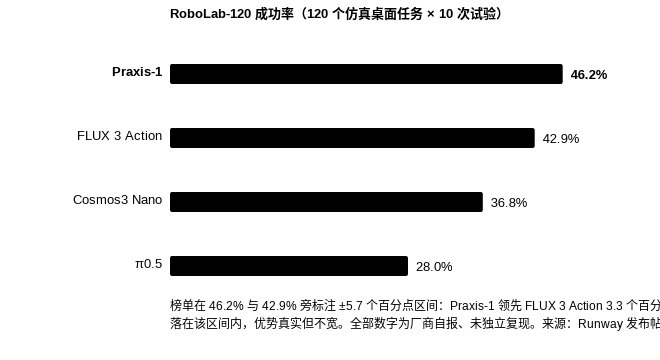
| FLUX 3 Action | 42.9% | Public weights (per Runway's launch-post table) | No public hosted price found | The 3.3 pp gap sits inside the ±5.7 pp interval |
| Cosmos3 Nano | 36.8% | Public weights (base May 31, checkpoints Nov 5) | No public hosted price found | NVIDIA's world model, a rival in the same table; this site's topic is in preparation |
| Gemini Robotics 2.5 | — (no public board score found) | Partners only, no public weights | No public price | The week's other robot model; this site built no topic for it |
RoboLab-120 is NVIDIA's public board: 120 simulated tabletop tasks × 10 trials = 1,200 episodes. All figures are vendor-reported with no independent replication; the board marks ±5.7 pp intervals next to 46.2% and 42.9%. No public RoboLab-120 score exists for Gemini Robotics 2.5, and this site invents none for it.
03Charts
RoboLab-120 success rates for four models: Praxis-1 leads, but its 3.3 pp advantage sits inside the board's ±5.7 pp interval — the lead is real, but not wide.
04Top 3 reads
Short on time? Start with these three: the benchmark tally explains "first, fifth, and ±5.7 pp" in one place, the pricing breakdown traces the $1.80/hour Reactor figure to its single secondary source, and the three-way comparison measures the real gap to FLUX 3 Action and Cosmos3 Nano.
05Timeline
The name has been public since September 30; the news is the November 11 weights opening. Two waves of coverage arrived within six days — first the release wires, then analytical pieces that re-read the board — and the second wave is the one worth reading.
- 2026-09-30
Runway announces Praxis-1 at its AI Summit: the post "Introducing Praxis-1" (17:00 UTC) calls it "our first open-weight world action model", but open to partners only — Noble Machines, Standard Bots and Ultra get pre-launch access; public weights are promised "in the coming months" with no firm date. X announcement the same day (18:06 UTC). Trade coverage follows on Oct 1–2 (The Robot Report, Superpower Daily).
- 2026-11-11
Weights open: Runway publishes "Praxis-1 Is Now Available" (15:00 UTC) — weights plus inference and fine-tuning code open to everyone under Apache 2.0, including commercial use; the technical report "Praxis-1: From Video Pretraining to Robot Control" is published the same day; the HF collection runwayml/praxis-1-oss, GitHub repo runwayml/praxis-1-oss, native LeRobot support, vLLM-Omni, Reactor hosted inference and NeMo Automodel tutorials all go live the same day.
- 2026-11-11
Technical report's three-task comparison with GPT-6 Astra: same YAM bimanual station, same console, same three tasks (pen-cap removal, sponge bagging, dice bagging), data collected Nov 9; three-task average 0:16 for Praxis-1 vs 4:13 for Astra (about 15.6x), $0.04 vs $1.87 per task (about 51x); the pen-cap task took 13 seconds vs 7 minutes 48 seconds (per the secondary cross-check, 13 seconds was a single recorded run; the average was 15 seconds vs 7:48). Costs are priced at $3.95/hour for one H100 for Praxis-1 and at the API bill for Astra. All vendor-reported, a three-task sample only, no independent evaluation; Runway calls the two approaches complementary. See section 09.
- 2026-11-11–12
First wave: madrobot, dev.to, senqice.net (Nov 11), NewToken, fourweekmba, BigGo finance (Nov 12, including the Germanidis podcast interview).
- 2026-11-12–13
A fourth checkpoint, praxis-1-so101, is added: a fine-tune for the LeRobot SO-100 / SO-101 desktop arm, HF repo runwayml/praxis-1-so101 (Apache 2.0, repo last modified Nov 12, 2026); about 1,070 hours of training data from 3,814 public LeRobot datasets, with 102 datasets held out for validation; 27.2B-parameter MoE, bf16 54.4 GB, joint-space control, 15 Hz, 24-step action chunks. An NVFP4 build (so101-nvfp4) also exists, but its peak VRAM is unmeasured and it is unverified closed-loop; the technical report publishes no repeated-trial success rate for SO-101. See section 06.
- 2026-11-13–14
Second wave of analysis: seoml.com's technical-report deep dive (Nov 13), The Decoder (Nov 14, the strongest English piece), que.com, windowsforum, techjacksolutions (board re-checked Nov 13).
- 2026-11-15–16
llmmatchmaker updates (Nov 16): a live read of the RoboLab-120 board confirms Praxis-1 fifth overall, and raises the conflict-of-interest note that NVIDIA co-founded the Cosmos Coalition with Runway.
- Nov 14, 2026
ic.work publishes a deep dive (citing NVIDIA's external NeMo evaluation): Praxis-1 scores 0/500 zero-shot on LIBERO-Spatial, 451/500 after full fine-tuning and 457/500 with LoRA; RoboLab-120 No. 5 overall (46.2%); a real Franka arm scores 88/100 vs FLUX 3 Action's 80/100 (Positronic, Nov 2 — needs independent replication). See section 09.
- 2026-11-21
This site's topic page goes live (this page). As of publication: no independent replication exists; Artificial Analysis, LiveBench and LMArena have not listed it (VLA robotics models are outside their scope); no systematic tier-1 Chinese tech-media coverage yet.
06Official specs
As published by Runway (launch post and technical report, Nov 11, 2026). Undisclosed items are written as "not disclosed", not guessed.
- Status
- Weights open (Nov 11, 2026); partners only when announced on Sep 30, 2026
- Model ID
- Praxis-1 (HF collection runwayml/praxis-1-oss; GitHub repo runwayml/praxis-1-oss)
- Positioning
- World action model (WAM): predicts the next video frames and the robot's actions together, from camera images, a text instruction and the robot's current pose, for robot control; built on large-scale video pretraining
- Architecture / parameters
- 27B-parameter (27.2B per the technical report) mixture-of-experts diffusion transformer; video backbone 26.9B + 314M action expert; about 2.8B active parameters per token (10.3%); 17 of 20 FFN layers are MoE, with 1 shared + 128 routed experts per layer and top-8 routed experts per token (9 including the shared expert)
- Encoders
- Frozen Wan2.2 VAE (latent space); frozen Qwen3.5-2B text encoder (for instructions); both carry separate licences
- Action output
- 1.6 s of motion per call — 24 action steps at 15 Hz (first chunk 1.4 s, then 1.6 s); about 0.55 s per call on one H100 (545 ms bimanual YAM / 522 ms single-arm Franka, p50)
- Checkpoints
- Four: base mid-trained model; DROID fine-tuned single-arm; YAM fine-tuned bimanual; SO-101 fine-tuned desktop-arm (added Nov 12–13, HF repo runwayml/praxis-1-so101)
- Weight size
- bf16 54.4 GB; NVFP4 4-bit version 17.5 GB (32% of the original)
- Hardware
- Standard build: a single 80GB GPU (H100/B200). The NVFP4 build targets 32GB SM120 cards (RTX 5090 class), but per the GitHub docs it had not yet been run closed-loop on an SM120 GPU at release; RTX PRO 6000 and Jetson Thor on-robot options are also listed
- Fine-tuning
- Full fine-tuning + LoRA; the LoRA recipe needs 1× 80GB GPU, the example full fine-tune 8× GPUs; NeMo Automodel tutorials
- Data efficiency (vendor claim)
- Adapting to a new embodiment is claimed to need under 30 minutes of demo data (Germanidis, MTS podcast); RT-1 adaptation example: 32× H100, about 28 hours of fine-tuning; the Franka/DROID adaptation used about 277 hours of public DROID recordings
- Adaptation scale (vendor claim)
- 9 robot hardware platforms adapted; launch partners: Noble Machines (legged humanoid), Standard Bots (RO1 six-axis industrial arm), Ultra (dual-arm warehouse robot)
- Benchmarks
- Vendor-reported: RoboLab-120 46.2% (555/1,200), first among world action models, fifth overall; SimplerEnv 80.0% vs 52.4% for the original RT-1 policy; real-robot Franka 88/100 vs 80/100 for FLUX 3 Action; no independent replication
- Licence
- Apache 2.0 — weights, inference code, fine-tuning code, including commercial use. Note: the Wan2.2 VAE and Qwen3.5 text encoder carry separate licences, and the DROID checkpoint requires agreeing to share HF information before download
- Known limits (vendor's own report)
- Confuses similar-looking objects; struggles with vague instructions; cannot reliably plan complex multi-step sequences on its own (steps must be spelled out)
07How to try it: four routes
Praxis-1 has no official API price list and no waitlist: the weights, code and tutorials are all in public repos, and the real barrier is hardware — the standard build needs a single 80GB GPU.
1GitHub source and weights (main route)
The repo runwayml/praxis-1-oss holds the weights, inference code and fine-tuning code under Apache 2.0. Read the repo docs first — the NVFP4 consumer-path validation status and the DROID checkpoint's download terms are both spelled out there. See our deployment guide.
2Hugging Face + LeRobot
The HF collection runwayml/praxis-1-oss holds the four checkpoints (base, DROID single-arm, YAM bimanual, SO-101 desktop-arm) with native LeRobot support. Note: the DROID checkpoint requires agreeing to share HF information before download; this site could not read the HF pages directly this round (HTTP 401), so per-checkpoint download counts are unverified.
3vLLM-Omni and Reactor hosted inference
To skip self-hosting: vLLM-Omni serves inference, and Reactor offers hosted inference, with the single-arm and two-arm checkpoints priced separately at a stated $1.80/hour (single secondary source, to be verified). Runway Dev offers a trial path, with no published price.
4Fine-tuning and new-embodiment adaptation
LoRA fine-tuning starts on 1× 80GB GPU; the example full fine-tune uses 8× GPUs; NeMo Automodel has hands-on tutorials. The vendor says adapting to a new embodiment needs under 30 minutes of demo data (vendor claim); the RT-1 adaptation example ran 32× H100 for about 28 hours.
Also: the NVFP4 quantized build measured 46.5% on a 600-episode RoboLab subset, vs 47.8% for bf16 (technical-report data, vendor-reported); that subset score is higher than the full board's 46.2%, and the two use different scopes — do not compare them directly.
08Pricing
The weights themselves are free; the real costs are hardware and hosting. Runway has published no official API price list, and the only hosted price anyone has seen comes from a single secondary source. The rate card comes first, then the three bills hiding behind "free". Prices checked Nov 21, 2026; the checkout page and official pages are authoritative.
| Cost item | Amount | Source and label |
|---|---|---|
| Weights (4 checkpoints) | Free | Apache 2.0, including commercial use (Runway launch post, Nov 11, 2026) |
| Inference and fine-tuning code | Free | Apache 2.0, opened with the weights (Runway launch post) |
| Reactor hosted inference (single-arm / two-arm priced separately) | $1.80/hour | Single secondary source, to be verified: techjacksolutions' Nov 13 read of Reactor's page; this site has not checked Reactor's own page directly |
| Reactor latency | Under 260 ms at p99 (stated) | Same source, single secondary, to be verified |
| Runway Dev trial | No price published | The launch post mentions a trial path; no price list found |
| Self-hosted hardware (standard build) | One 80GB GPU | H100/B200 class (Runway launch post); cloud rental prices vary by provider and are not listed here |
Free weights, but three bills come with them
The first bill is hardware: the standard build needs a single 80GB GPU, which is most readers' real cost; the NVFP4 17.5 GB build lowers the floor to 32GB cards but was unverified closed-loop at release. The second is licence fine print: the Wan2.2 VAE and Qwen3.5 text encoder carry separate licences, and the DROID checkpoint requires agreeing to share HF information before download — "Apache 2.0" covers the weights and code themselves, not the whole usage chain. The third is hosting: if Reactor's $1.80/hour holds, metered hosted inference is still an ongoing charge, and that figure has only one secondary source so far.
No official API price list
Runway has published no official API price list for Praxis-1; the model itself has no price. The only public pay-per-use path is Reactor hosted inference (single source, to be verified), plus the Runway Dev trial with no published price. Don't read "weights free" as "free to use".
Official pages: Runway — Launch post "Praxis-1 Is Now Available" · Runway Research — Announcement "Introducing Praxis-1" · GitHub — runwayml/praxis-1-oss
09First hands-on reviews
All from the first wave, Nov 11–16: there is no independent measurement yet — every score comes from Runway, and third parties can only re-read the board and check the wording, not reproduce the scores. Every entry carries a verdict badge; "Read on this site" opens our rewritten deep-dive article, with the original source at the end.
Runway launch post: the source of every fact
Verdict: Vendor-reported; the weights opening and licence wording are confirmedSource: Runway, Nov 11, 2026 Original →
The post "Praxis-1 Is Now Available" is the source of all the facts: weights plus inference and fine-tuning code open on Nov 11 under Apache 2.0, including commercial use; the 27B MoE diffusion transformer, about 2.8B active, 1.6 s action chunks, about 545 ms latency; the RoboLab-120 table (46.2% / 42.9% / 36.8% / 28.0%); four checkpoints (three at launch, SO-101 desktop-arm added Nov 12–13), GitHub and HF entry points, LeRobot and vLLM-Omni support, Reactor hosted inference, NeMo Automodel tutorials. Its "top world action model" and "outperforms every open-weight VLA" wordings are category-scoped; the post does not claim first place overall.
Read on this site → (original ModelBrief rewrite)
Technical report: the source of the specs and the limits
Verdict: Vendor-reported; the MoE structure and NVFP4 subset scores come from hereSource: Runway technical report "Praxis-1: From Video Pretraining to Robot Control", Nov 11, 2026
The report gives every spec detail: 27.2B parameters, 17/20 MoE layers, 1 shared + 128 routed experts with top-8 routing; the Wan2.2 VAE and Qwen3.5-2B encoder; the NVFP4 build at 46.5% vs 47.8% for bf16 on a 600-episode RoboLab subset. It also states the model's own limits: confusing similar-looking objects, struggling with vague instructions, and being unable to reliably plan complex multi-step sequences alone.
Read on this site → (original ModelBrief rewrite)
The Astra comparison in the technical report: same YAM station, three tasks, 15.6x faster and 51x cheaper
Verdict: Vendor-reported; a three-task sample only, no independent evaluationSource: Runway technical report "Praxis-1: From Video Pretraining to Robot Control", Nov 11, 2026 · Cross-check: dev.to — Praxis-1 teardown (verifies the 15.6x / 51x figures and the cost basis)
Runway's technical report includes a head-to-head it ran itself: the same YAM bimanual station, the same console, the same three tasks (pen-cap removal, sponge bagging, dice bagging), with data collected on Nov 9. Averaged across the three tasks, Praxis-1 took 16 seconds per task against GPT-6 Astra's 4 minutes 13 seconds — about 15.6x — and cost $0.04 per task against $1.87 — about 51x; the pen-cap task took 13 seconds vs 7 minutes 48 seconds (per the secondary cross-check, 13 seconds was a single recorded run; the average was 15 seconds vs 7:48). The cost basis is not symmetric: Praxis-1 is priced at one H100 at $3.95/hour, Astra at its API bill. Read it narrowly: a vendor testing its own product against a rival on three tasks, with no independent evaluation behind it, and a three-task speed and cost gap is not general superiority; Runway itself calls the two approaches complementary — a generalist plans, a specialist policy executes each step. For balance, the same secondary cross-check notes Astra leads on the RoboLab-120 simulation at 74.8% vs Praxis-1's 46.2% — simulation and the real robot are two different races.
The Decoder: the strongest English piece
Verdict: In-depth niche-media coverage; states plainly that results are "not independently verified"Source: The Decoder, Nov 14, 2026 Original →
"Runway's open-source Praxis-1 turns video AI into a robot controller" is the strongest English report: a full release story that states the fifth-overall scope, that the results are "not independently verified", the roughly 277 hours of DROID recordings, and the real-robot Franka 88/100. Several later English write-ups cite or derive from it. Note: no TechCrunch, The Verge, Reuters, Bloomberg, Wired or Ars Technica coverage has been found.
Read on this site → (original ModelBrief rewrite)
NewToken: the strongest Chinese piece
Verdict: Analytical Chinese coverage; its headline already says "fifth on the board"Source: NewToken, Nov 12, 2026 Original →
"读懂|Runway 的开源机器人模型在英伟达榜上排第五" is the strongest Chinese piece: a full board read (top four named), the ±5.7 pp interval analysis, Spearman 0.94, Franka 88/100, RT-1 SimplerEnv 80.0%, and the submission-provenance caveat. Critical framing, not a rewrite. Note: no systematic coverage from 机器之心, 新智元, 量子位 or IT之家 has been found.
Read on this site → (original ModelBrief rewrite)
seoml.com: the Chinese technical deep dive
Verdict: The most detailed Chinese technical read; the binomial interval math comes from hereSource: seoml.com, Nov 13, 2026 Original →
"Praxis-1 开源解读:27.2B 参数、46.2% 成功率与 545ms 延迟" digs into the technical report: the MoE structure, 2.8B active parameters, the NVFP4 17.5 GB build, the 600-episode quantized check, and the binomial interval calculation. The most detailed Chinese technical piece so far.
Read on this site → (original ModelBrief rewrite)
llmmatchmaker and techjacksolutions: the two board re-readers
Verdict: Independent board re-reads; the conflict note and the Reactor price come from hereSource: llmmatchmaker (Nov 11, updated Nov 16, 2026) Original → · techjacksolutions (Nov 13–14, 2026) Original →
llmmatchmaker reads the RoboLab-120 board live, confirms Praxis-1 fifth overall, and raises the conflict-of-interest note that NVIDIA co-founded the Cosmos Coalition with Runway while Cosmos3 Nano sits in the same table (a note, not evidence the score is wrong). techjacksolutions re-checks the board on Nov 13 and reads out Reactor's $1.80/hour hosted price — still the only secondary source for that figure.
Read on this site → (original ModelBrief rewrite)
ic.work: a deep dive citing NVIDIA's external evaluation
Verdict: usable after fine-tuning, still zero zero-shot; mind the bundled licencesSource: ic.work, Nov 14, 2026 (citing NVIDIA's external NeMo evaluation)
Citing NVIDIA's external NeMo evaluation: Praxis-1 scores 0/500 zero-shot on LIBERO-Spatial, 451/500 after full fine-tuning and 457/500 with LoRA; on RoboLab-120 it ranks No. 5 overall (46.2%, 555/1200), losing the easy tier to FLUX 3 Action (46.9% vs 49.1%) but winning medium (47.9% vs 39.2%) and hard (40.0% vs 28.2%); on a real Franka arm it scores 88/100 vs 80/100 (Positronic, Nov 2 — needs independent replication). Licensing note: the base bundles a frozen Wan2.2 VAE and a Qwen3.5-2B text encoder (each under its own licence), and downloading the base model from Hugging Face requires registration and agreeing to an information-sharing clause; the standard build needs 80 GB of VRAM, and the compressed build is said to fit a 32 GB RTX 5090, but peak VRAM use still has no measured data.
Read the original → (ic.work, English)
10Articles: our deep dives
The six articles below are original ModelBrief rewrites and reorganization — restructured with added conclusions and buying advice, with facts and numbers checked against the original sources. Read them on this site; each ends with its original source.
11Related topics
Topic pages for the other models on this site.
 HeyGen Avatar 6Released Nov 17, 2026 · HeyGen's audio-driven avatar model, native 2K, 30-second context window, #1 in New Measure's Avatar Arena in both categories, $0.10/s on OpenRouter. The topic page covers official specs, pricing, benchmarks and 6 in-depth reviews.
USA · LLM · Open Weights · Released Nov 20, 2026
 Inkling 2 MiniReleased Nov 20, 2026 · Thinking Machines Lab's open-weight looped model, 26.4B parameters with 3.4B active per token, AA Index 20.1 tied with Qwen3.8-27B, $0.15/$0.50 per 1M tokens. The topic page covers official specs, pricing, benchmarks and 6 in-depth reviews.
USA · LLM · GA · Nov 20, 2026
 Baseten Bison-1Released Nov 20, 2026 · Baseten's decision model on Gemma 4, #1 on the AA Decision Index at 76 (1 point ahead of d1.2-ultra), $0.10 per 1M input tokens. The topic page covers official specs, pricing, benchmark analysis and 6 in-depth reviews.
China · LLM · GA · Nov 16, 2026
 Sage S2.1 FlashReleased Nov 16, 2026 · Shanghai AI Lab's 320B science-agent model, 18B active, MLE-bench Lite 90.3 (vendor-reported), MIT open weights. The topic page covers official specs, pricing, benchmark analysis and 6 in-depth reviews.
ModelBrief homeAll topicsBack to the home page: browse all model topics by release date — LLMs, image models, video models and robot models.
China · Image · GA · Nov 17, 2026Kling Image 4.0Released Nov 17, 2026 · Kuaishou's native 8K image model, 2,000 characters per image, AA 1181 text-to-image / 1183 editing. The topic page covers official specs, pricing, benchmarks and 6 in-depth reviews.
China · LLM · GA · Nov 23, 2026
 GLM-5.4Released Nov 23, 2026 · Zhipu's flagship coding model, vision, 1M context, Coding Plan $18/$80/$168, KingBench 4 at 55.3% (one private test). The topic page covers official specs, pricing, benchmark analysis and 6 in-depth reviews.
USA · Image · GA · Nov 19, 2026
 Ideogram 4.6Released Nov 19, 2026 · Ideogram's native 4K image editing model, #1 on Rapidata's multi-step edit board at 1,892, API $0.008–$0.60 per image. The topic page covers official specs, pricing, benchmarks and 7 in-depth reviews.
USA · LLM · GA · Nov 18, 2026
 Cloudflare ClairicReleased Nov 18, 2026 · Cloudflare's extraction-model pair, 27B and 9B flash, Apache 2.0 open weights, $0.24/$0.10 per 1M input tokens. The topic page covers official specs, pricing, benchmarks and 6 in-depth reviews.
USA · LLM · GA · Nov 16, 2026
 Liquid d1.2Released Nov 16, 2026 · Liquid AI's omnimodal decision-model pair, d1.2-ultra #2 on the AA Decision Index at 75, audio input and five new tasks, $0.02/$0.042 per 1M input tokens with output free. The topic page covers official specs, pricing, benchmark analysis and 6 in-depth reviews.
LLM · Open Weights · Nov 13, 2026
 Maxwell V1 FlashWeights public Nov 13, 2026 · Maxwell Team's 35B/3B-active open MoE, 256K context, Apache 2.0; vendor-reported table leads same-scale Qwen3.6 with no independent score yet. The topic page covers official specs, pricing, benchmark analysis and 8 in-depth reviews.
China · Image Model · Open Weights · Released Nov 24, 2026
 SenseNova U1.6Released Nov 24, 2026 · SenseTime's 8B unified image model with native self-correction, UltraTextBench 86.04 to 92.28 (vendor-reported), Apache 2.0 open weights. The topic page covers official specs, pricing, benchmarks and 7 in-depth reviews.
South Korea · LLM · Preview · Released Nov 23, 2026
 Solar Mini 4.5 PreviewReleased Nov 23, 2026 · Upstage's preview agentic light model, 35B/3B MoE, 512K context, $0.01 per 1M tokens at 90% off, GA Dec 3; 4 of 5 in-house tests won, all vendor-reported. The topic page covers official specs, pricing, benchmarks and 6 in-depth reviews.
China · LLM · Medical Model · Released Nov 23, 2026
 LingSanteReleased Nov 23, 2026 · Ant Group's medical model family: 560B flash and 124B air-VL under MIT open weights, HealthBench Professional 65.72 (vendor-reported); not a medical device. The topic page covers official specs, benchmarks and 6 in-depth reviews.
China · Video Understanding · Open Weights · Released Nov 17, 2026
 WeMM-VideoWeights public Nov 17, 2026 · Tencent's omni-modal video-understanding family in 2B/4B/9B/35B-A3B, Apache 2.0 open weights; 9B beats a 30B baseline (vendor-reported), no API or price. The topic page covers official specs, benchmarks and 6 in-depth reviews.
China · LLM · Vision-Language Model · Released Nov 23, 2026
 Ling-3.2-airReleased Nov 23, 2026 · Ant Group's general-purpose VLM, 124B/5.5B hybrid-linear MoE, MIT open weights, AutomationBench-AA 61.0, AA Index 23.4; no hosted API. The topic page covers official specs, benchmarks and 6 in-depth reviews.
12Benchmarks: vendor-reported scores on a public board
Praxis-1 has no independent replication anywhere: RoboLab-120 is NVIDIA's public board and the score is listed on it — stronger than a purely self-published number, but still a vendor-submitted figure on a public board. Everything below is vendor-reported; check the methodology and the wording before the scores.
Vendor-reported (Runway launch post, Nov 11, 2026; technical report same day)
| Test | Source | Result | Label |
|---|---|---|---|
| RoboLab-120 (120 simulated tabletop tasks × 10 trials) | Runway launch post; NVIDIA public board | 46.2% (555/1,200), first among world action models, fifth overall | Vendor-reported; listed on a public board, no independent replication |
| RoboLab-120: FLUX 3 Action | Runway launch-post table | 42.9% | Vendor-reported; the 3.3 pp gap sits inside the ±5.7 pp interval |
| RoboLab-120: Cosmos3 Nano | Runway launch-post table | 36.8% | Vendor-reported |
| RoboLab-120: π0.5 | Runway launch-post table | 28.0% | Vendor-reported |
| SimplerEnv (RT-1 robot, unseen embodiment, after fine-tuning) | Runway launch post / technical report | 80.0%, vs 52.4% for the original RT-1 policy | Vendor-reported; simulator, not a real robot |
| Real-robot Franka test (Positronic-operated arm, Runway-arranged; 10 tasks × 10 trials) | Runway launch post / technical report | 88/100, vs 80/100 for FLUX 3 Action | Vendor-reported; real hardware, but no third-party re-run |
| Three-task comparison with GPT-6 Astra (same YAM bimanual station, data collected Nov 9) | Technical report | Average 0:16 vs 4:13 (about 15.6x); $0.04 vs $1.87 per task (about 51x) | Vendor-reported; three-task sample only, no independent evaluation |
| NVFP4 quantized build, RoboLab subset (600 episodes) | Technical report | 46.5%, vs 47.8% for bf16 | Vendor-reported; subset scope, not the full board's 46.2% |
| NVFP4 quantized build, harder simulation suite (352 episodes, early checkpoint) | GitHub README | 138/352, vs 188/352 for bf16 | Vendor-reported; early checkpoint, includes the extra-training gap; the README advises testing on the hard suite before deploying |
The quantized build cuts two ways: on the 600-episode standard subset NVFP4 trails bf16 by only 1.3 points (46.5% vs 47.8%), but on the harder suite recorded in the GitHub README, an earlier NVFP4 checkpoint manages only 138/352 against 188/352 for bf16 — a much wider gap. The README itself notes that this compares against an earlier bf16 starting checkpoint, so the extra training is part of the gap, and it advises testing on the hard suite before deploying. "NVFP4 is near-lossless" is a misreading — at least on hard tasks, it is not.
Methodology: what RoboLab-120 is, and who the top four are
RoboLab-120 is NVIDIA's public board: 120 simulated tabletop tasks, 10 trials each, 1,200 episodes in total. Live board reads (llmmatchmaker, Nov 15–16; techjacksolutions, Nov 13) put the top four as AMP1 (an agentic language model) at 86.0% (2,579/3,000), SenseNova-RoboRSI at 57.1%, Lakeside at 51.0% and BiMind v0.5 at 49.2%, with Praxis-1 fifth at 46.2%. Runway's "top world action model" and "outperforms every open-weight VLA" are category-scoped; the launch post itself does not claim first place overall — but careless retellings easily lose the scope. NVIDIA says RoboLab rankings correlate strongly with real-robot RoboArena Elo (Spearman 0.94, per NewToken).
The statistical caveat: how wide is a 3.3 pp lead
The board marks ±5.7 pp intervals next to both 46.2% and 42.9%; Praxis-1's 3.3 pp lead over FLUX 3 Action sits inside that interval. A binomial calculation on 555/1,200 gives a 95% interval of roughly ±2.8 pp. The lead is real on the board but not a wide margin. Also: 46.2% means failing more than half of simulated attempts, on simulated tabletop tasks, not a factory floor.
Full tally: our benchmarks article →
13Comparisons
vs FLUX 3 Action (the nearest rival)
| Dimension | Praxis-1 | FLUX 3 Action |
|---|---|---|
| RoboLab-120 (vendor-reported) | 46.2% (555/1,200) | 42.9% |
| What the gap means statistically | A 3.3 pp lead, inside the board's ±5.7 pp interval | Same |
| Real-robot Franka 10×10 test (vendor-reported) | 88/100 | 80/100 |
| Latency per call (vendor-reported) | ~545 ms (one H100, p50) | No public figure found |
| Weights | Public, Apache 2.0 | Public weights (per Runway's launch-post table) |
FLUX 3 Action is the nearest rival in the RoboLab-120 table and the direct control in the real-robot Franka test. Both tests were arranged or submitted by Runway, with no independent replication. See our comparison article.
vs Cosmos3 Nano (NVIDIA's world model)
| Dimension | Praxis-1 | Cosmos3 Nano |
|---|---|---|
| RoboLab-120 (vendor-reported) | 46.2% | 36.8% |
| Positioning | World action model: predicts video frames + robot actions | World model: video generation and robot-simulation base |
| Parameters | 27B MoE, about 2.8B active | See the comparison article for background; this site's Cosmos topic is in preparation |
| What counts as "new" | Announced Sep 30, weights opened Nov 11 | Base May 31, checkpoints Nov 5 |
| Weights | Public, Apache 2.0 | Public weights |
Cosmos3 Nano is the rival in the same board table and the other world-model topic this site is preparing; the two topics are siblings. Note the conflict-of-interest point from section 12: NVIDIA co-founded the Cosmos Coalition with Runway while Cosmos3 Nano sits in the same table. See our comparison article.
vs Gemini Robotics 2.5 (the week's other robot model: compare openness, not scores)
| Dimension | Praxis-1 | Gemini Robotics 2.5 |
|---|---|---|
| Public weights | Yes, Apache 2.0 | No, partners only |
| Public API / price | Weights free; hosted price single-source $1.80/hour (to be verified) | No public API, weights or price |
| RoboLab-120 score | 46.2%, fifth overall | No public board score found |
| How this site treats it | Topic built (this page) | No topic: no public product, not enough material for a hub + 6 articles |
Read the deep comparison: Praxis-1 vs FLUX 3 Action vs Cosmos3 Nano →
14What's missing (as of Nov 21)
- Any independent replication: no independent lab has reproduced the RoboLab-120 46.2%, the SimplerEnv 80.0% or the real-robot Franka 88/100; the board page does not state whether the 555 successes are Runway-submitted or NVIDIA-reproduced
- Direct verification of Reactor's $1.80/hour: only one secondary source so far (techjacksolutions); this site has not read Reactor's own page directly
- A direct read of the HF collection pages: this site's fetch returned HTTP 401, so per-checkpoint download counts and the exact gated-download wording for the DROID checkpoint are unverified
- Closed-loop validation of the NVFP4 build on an SM120 GPU (RTX 5090 class): per the GitHub docs, it had not been run at release
- Repeated-trial success rates for the SO-101 checkpoint: not published in the technical report; so101-nvfp4 peak VRAM is unmeasured and closed-loop validation is missing
- The full licence texts for the VAE and the encoder: the Wan2.2 VAE and Qwen3.5 text encoder carry separate licences whose terms are unverified — "Apache 2.0, no strings attached" does not hold
- Listings on Artificial Analysis, LiveBench or LMArena: VLA robotics models are outside their scope and none is expected
- A per-task RoboLab-120 breakdown: not published, so there is no way to tell which tasks drive the 46.2% and which drag it down
- Systematic coverage from tier-1 English media (TechCrunch, The Verge, Reuters, Bloomberg, Wired, Ars Technica) or tier-1 Chinese tech media (机器之心, 新智元, 量子位, IT之家)
- GR00T 2's code and weights landing (expected in December): a comparison with Praxis-1 will be worth updating then
15Rumor check
Most confusion about Praxis-1 comes from six places: the board ranking, the verification status of the score, the RTX 5090, the licence, the hosted price and "mass production within a year" — clarified one by one below.
Partly true "Praxis-1 tops RoboLab-120"
True only within its category: Praxis-1 is first among world action models and first among open-weight VLAs, but fifth overall — AMP1 leads at 86.0%, followed by SenseNova-RoboRSI at 57.1%, Lakeside at 51.0% and BiMind v0.5 at 49.2%. Without the "among world action models" qualifier, "tops" misleads.
Not true "46.2% is an independently verified score"
46.2% is listed on NVIDIA's public board, but the figure is Runway's own submission; The Decoder and multiple write-ups state the results "have not been independently verified", and the board page does not say whether the 555 successes are submissions or reproductions. The accurate label is "a public-board listing of a vendor-run result", not an independently verified score.
Unverified "Praxis-1 runs on an RTX 5090"
The NVFP4 17.5 GB build targets 32GB SM120 cards (RTX 5090 class), but per the GitHub docs it had not yet been run closed-loop on an SM120 GPU at release. The quantized build's 46.5% on a 600-episode RoboLab subset (vs 47.8% for bf16) is an offline benchmark, not closed-loop real-robot validation. Cite it only with the "not yet validated closed-loop at release" caveat. The SO-101 NVFP4 build (so101-nvfp4) also exists, but its peak VRAM is unmeasured and it is unverified closed-loop — don't cite it as validated either.
Not true "Apache 2.0, no strings attached"
The weights, inference code and fine-tuning code are indeed Apache 2.0, including commercial use — but the Wan2.2 VAE and Qwen3.5 text encoder carry separate licences, and the DROID checkpoint requires agreeing to share HF information before download. Check both before commercial use.
Unverified "Reactor hosted inference at $1.80/hour is the official price"
$1.80/hour comes from techjacksolutions' Nov 13 read of Reactor's page — the only secondary source so far; Runway has published no official API price list. Check Reactor's own page before paying.
A prediction, not a fact "Mass production within a year"
Germanidis predicted in the MTS podcast interview that robot mass production is about a year away — a prediction, not an observed result; the same interview's line that "China leads the US in robot world models, and open weights are the West's way to catch up" is likewise a view, not a fact.
16FAQ
When was Praxis-1 released?
In two steps: announced on September 30, 2026 at the Runway AI Summit, open to partners only at the time; weights plus inference and fine-tuning code opened to everyone on November 11, 2026 under Apache 2.0. This topic dates the release to the November 11 weights opening; see section 05 for the timeline.
Is Praxis-1 really No. 1 on RoboLab-120?
First in its category, fifth overall: first among world action models and first among open-weight VLAs; the top four overall are AMP1 (86.0%), SenseNova-RoboRSI (57.1%), Lakeside (51.0%) and BiMind v0.5 (49.2%), with Praxis-1 fifth at 46.2%. See our benchmarks article.
Can I use Praxis-1 commercially?
Yes: the weights, inference code and fine-tuning code are Apache 2.0, including commercial use. But note two conditions — the Wan2.2 VAE and Qwen3.5 text encoder carry separate licences, and the DROID checkpoint requires agreeing to share HF information before download. Check both before commercial use.
Can I run Praxis-1 on my own GPU?
The standard build needs a single 80GB GPU (H100/B200 class); the NVFP4 17.5 GB build targets 32GB cards (RTX 5090 class), but per the GitHub docs it had not yet been run closed-loop on an SM120 GPU at release. See our deployment guide.
Is there a desktop-arm version of Praxis-1?
Yes: the fourth checkpoint, praxis-1-so101, added Nov 12–13, targets the LeRobot SO-100 / SO-101 desktop arm — HF repo runwayml/praxis-1-so101, Apache 2.0, with about 1,070 hours of training data from 3,814 public LeRobot datasets. Note that the technical report publishes no repeated-trial success rate for SO-101, and the NVFP4 build so101-nvfp4 has unmeasured peak VRAM and no closed-loop validation. See sections 05 and 06.
How much does hosted inference cost?
Reactor lists $1.80/hour (single-arm and two-arm checkpoints priced separately), but that figure has only one secondary source so far (techjacksolutions' Nov 13 read of Reactor's page) and this site has not checked Reactor's own page directly; Runway has published no official API price list. See our pricing article.
Does Praxis-1 have an API?
There is no Runway official API price list. The public paths are the GitHub and HF weights and code (self-hosting), vLLM-Omni serving, Reactor hosted inference, and a Runway Dev trial path (no published price).
How is Praxis-1 different from Gemini Robotics 2.5?
The core difference is openness: Praxis-1's weights, inference and fine-tuning code are all public (Apache 2.0), with hosted inference and a single-source hosted price; Gemini Robotics 2.5 is partners only, with no public API, weights or price. That is why this site built a topic for Praxis-1 and not for Gemini Robotics 2.5.
17Sources
Every fact on this page comes from the public sources below (the Runway launch post and technical report published Nov 11, 2026; this site's research on Nov 17, 2026, fact-checked Nov 21, 2026).
Official
- Runway — Launch post "Praxis-1 Is Now Available" (weights opened under Apache 2.0, RoboLab-120 table, three checkpoints, GitHub/HF/LeRobot/vLLM-Omni/Reactor/NeMo Automodel entry points) Published Nov 11
- Runway Research — Announcement "Introducing Praxis-1" (Sep 30 announcement, partners only, public weights promised "in the coming months") Published Sep 30
- Runway — Technical report "Praxis-1: From Video Pretraining to Robot Control" (27.2B parameters, MoE structure, Wan2.2 VAE and Qwen3.5-2B encoder, NVFP4 600-episode subset scores, self-stated limits) Published Nov 11
- GitHub — runwayml/praxis-1-oss (weights + inference + fine-tuning code; NVFP4 build not yet run closed-loop on an SM120 GPU at release) Opened Nov 11
- Hugging Face — runwayml/praxis-1-so101 (fourth checkpoint, SO-100 / SO-101 desktop arm, Apache 2.0; repo last modified Nov 12, 2026) Added Nov 12–13
- AI Ping — "Runway Praxis-1 SO101 robot arm NVFP4 RTX 5090" (cross-report on the so101 checkpoint and the NVFP4 build) Nov 13
- dev.to — "The Generalist Won the Simulation. The Specialist Won the Real Robot" (verifies the technical report's Astra comparison: 15.6x / 51x, the pen-cap task and the cost basis) Around Nov 16
English reporting and analysis
- The Decoder — "Runway's open-source Praxis-1 turns video AI into a robot controller" (fifth-overall scope, "not independently verified", 277 hours of DROID recordings, Franka 88/100) Nov 14
- techjacksolutions — "Praxis-1: What It Is, What Changed and Who Can Use It" (board re-checked Nov 13, Reactor $1.80/hour) Nov 13–14
- llmmatchmaker — "Runway's Praxis-1 Robot Model Is Apache 2.0…" (live board read, Cosmos Coalition conflict note) Nov 11, updated Nov 16
- que.com — Praxis-1 launch report (from Runway and The Decoder) Nov 14
- windowsforum — Praxis-1 launch report (NVFP4 caveats) Nov 14
- dev.to — "Runway Just Open-Sourced a Robot Brain…" (built from Runway's announcement, checked the same day) Nov 11
Chinese
- NewToken — "读懂|Runway 的开源机器人模型在英伟达榜上排第五" (full board read, ±5.7 pp interval, Spearman 0.94, submission-provenance caveat) Nov 12
- seoml.com — "Praxis-1 开源解读:27.2B 参数、46.2% 成功率与 545ms 延迟" (technical-report deep dive, MoE structure, NVFP4 subset, binomial interval) Nov 13
- senqice.net — Launch wire (full RoboLab table, GitHub/HF/vLLM-Omni/Reactor entry points, SimplerEnv 80.0%) Nov 11
- BigGo finance — Germanidis MTS podcast interview (9 embodiments, under 30 minutes of demo data, one-year mass-production prediction) Nov 12
- This site's research, Nov 17, 2026: Google Autocomplete in both English and Chinese produced no usable long tail (only the "runway praxis-1" compound suggests); one Google Trends attempt returned HTTP 411, so no Trends data; no systematic tier-1 Chinese tech-media coverage found Nov 17
- ic.work — "Runway releases open-source Praxis-1 robot model" (citing NVIDIA's external NeMo evaluation: 0/500 zero-shot, 451/500 fine-tuned, 457/500 LoRA; RoboLab-120 No. 5; Franka 88/100; bundled-licence note) Nov 14
More indexes: All models · All Runway models · All robot / world models