 Ling-3.2-air: The Topic Page
Ant Group's Bailing team's general-purpose vision-language model, silently listed on Hugging Face on November 23, 2026 at 03:55 UTC — first, the positioning: this release had no launch post, no technical report, no press release; the only vendor statement is a single X post. Every vendor benchmark is Ant-run, but an independent score has appeared: Artificial Analysis' Intelligence Index 23.4 (v5.0.1, Nov 23, 2026, see section 11) — and AA's rerun of three vendor figures lands within a point of each. The headline AutomationBench-AA 61.0 beats both closed comparison models, but the same table shows DeepSWE at 42.48, far behind; AA measured a hallucination rate of 49.3% — when it does not know the answer, it invents one about half the time instead of saying so; and there is no hosted API and no per-token price — self-hosting is the only way in. One more thing to settle first: it is not the same model as the medical LingSante-3.1-air-VL, which shares its name and shape (see section 13). This page collects the official specs, the ways to try it, a pricing breakdown and 6 in-depth reviews — with unverified claims clearly marked.
01Key facts
What is confirmed: Ling-3.2-air is Ant Group's Bailing team's general-purpose vision-language model — 124B total parameters with only 5.5B active per token — silently listed on Hugging Face on November 23 under MIT open weights; the release had no launch post, and the only vendor statement is a single X post; the benchmark table is vendor-reported, but Artificial Analysis scored it 23.4 independently the same day and reproduced three vendor figures within a point; there is no hosted API and no price.
- Released
- 2026-11-23 (Monday) 03:55 UTC: inclusionAI/Ling-3.2-air was created on Hugging Face (HF API createdAt: 2026-11-23T03:55:12Z), 13 FP8 shards, ~129GB, with no launch post, technical report or press release. Later that day Ant Ling's X account (@AntLingAGI) posted the only vendor announcement; the repo was last modified Nov 24, 08:31 UTC
- Developer
- Ant Group (Bailing team); open-source org inclusionAI (Hugging Face); the same team runs the Afu health app and the LingSante medical model family
- Positioning
- A general-purpose vision-language model: text, image and video input, text output; built for workflow automation and professional document reasoning, with terminal tasks and coding assistance on the side — not a medical model
- Parameters
- 124B total MoE (model-card headline), 5.5B active per token (4.4% activation — the same ratio as the same-generation Ling 3.2 Flash's 25B/560B and LingSante-3.1-flash's 25B/560B, suggesting Ant standardised the ratio across the Ling family). But the HF page also lists the model size as 128B, unexplained — community reads say 124B is the language model and ~127–128B counts the vision encoder plus the MTP layer; both figures are stated, 124B is the headline
- Architecture
- Hybrid-linear MoE: 42-layer text backbone — 35 KDA (Kimi Delta Attention) + 7 Gated MLA layers (5:1), 2 dense layers, 512 routed experts + 1 shared expert, 8 active per token, 32 attention heads, hidden size 2,560, expert intermediate 768, dense intermediate 6,144, 157,184-token vocabulary; MTP (NEXTN) speculative-decoding layer; the same native multimodal architecture as its predecessor Ling-3.0-flash-VL
- Vision encoder
- Native multimodal (vision tower + linear projector, not an external bolt-on); the config confirms vision hidden size 1,152 and patch 16; the 27-layer vision tower is OrcaRouter's secondary read (the config does not expose the layer count in the field checked — cite it as secondary-sourced)
- Context
- Native 262,144 tokens (config.json sets max_position_embeddings to 262,144; the card's serving recipe provisions 256K); 1M (1,048,576) via YaRN extension — the figure AA lists — but not the default (the vLLM recipe PR describes 4× YaRN to reach 1M). The same 256K-vs-1M gap as LingSante-3.1-flash: headline 256K native, 1M always qualified
- Weight size
- FP8 (E4M3, 128×128 weight blocks, dynamic activations) ~129.3GB (10.6GB × 12 + 1.59GB), 13 safetensors shards; the vision tower, embeddings, router gates and linear_proj are held out of quantisation (BF16/FP32). No BF16 release — the config's dtype: bfloat16 field is misleading, the same trap as LingSante
- Hardware
- Official recipe: 256K context on 4× 141GB-class GPUs (H20-3e / H200) or 4-GPU Blackwell nodes (B300 / GB300); --tp 8 on 80GB H100/H800; SGLang and vLLM both supported from day 0; loading requires trusting custom code
- Weights / licence
- MIT (HF tag license:mit, model card declares MIT, commercial use allowed); note the repo carries no separate licence file (checked by tech360) — the tag plus the card text are the licence evidence
- Benchmarks
- Vendor-reported (model-card evaluation table, transcribed via i10x / IT之家): AutomationBench-AA 61.0, Terminal-Bench 4.0 27.0, TAU3-Banking 50.5, SWE-bench Pro 58.28, DeepSWE 42.48, HLE 31.42, OmniDocBench 1.5 92.3, GDP.pdf all-pass 16.0%, Harvey LAB-AA v1.1 legal benchmark 87.7% criterion pass but only 0.8% all-pass after the hallucination check; no classic VLM benchmark figures (MMMU / ChartQA / OCRBench / MathVista) are published anywhere
- Independent scores
- Artificial Analysis Intelligence Index 23.4 (v5.0.1, #102); the page now displays 23 on v5.0.2. AA reproduced three vendor figures within a point: AA-Briefcase Elo 1,339.45 (card: 1,340), Terminal-Bench 4.0 26.8% (card: 27%), GDP.pdf all-pass 15.8% (card: 16%). Weak spots measured independently: FrontierCode-AA 2.0 8.1%, Terminal-Bench Science 3.8%, AA-Omniscience accuracy 24.0% / hallucination rate 49.3%; no LiveBench / LMArena entry
- Price
- Weights free (MIT); no hosted API, no per-token price. The card states the model "isn't deployed by any Inference Provider"; AA lists zero providers and no price; AnyRouter shows "coming soon"; it is not on OpenRouter's public list. The cost is your own GPU bill
- Access
- Hugging Face (inclusionAI/Ling-3.2-air, FP8 weights) and a ModelScope mirror; day-0 SGLang and vLLM support; community quantisations within ~24 hours (bartowski GGUF Q4_K_M 80.4GB, primitive-ai NVFP4A16 77.9GB, INT4 W4A16 ~72.5GiB); no hosted inference endpoint anywhere
- Media coverage
- Chinese: IT之家 on Nov 24 (the strongest Chinese piece), 动点科技 (TechNode CN) on Nov 25; English: niche trackers i10x, stackfutures, orcarouter (two deep pieces) and second-wave blogs; no TechCrunch / The Verge / Reuters / Bloomberg-tier English outlet, no TechNode English piece; no 机器之心 / 新智元 / 量子位 / 36氪
- Search interest
- Google Autocomplete returns nothing in English or Chinese (this site, Nov 26, 2026: the bare term and all vs/price/API/benchmark suffixed queries — 6 English, 3 Chinese — all empty; the space form returns only an echo and an air-fryer query); one Google Trends attempt returned HTTP 411, no data obtained
- Community traction
- 1,467 downloads / 241 likes on Hugging Face as of Nov 26 (a moving figure — cite it with the date); community quantisations appeared within ~24 hours, faster than LingSante's "very few downloads and likes"; r/LocalLLaMA discussion ("New 128B MoE FTW!")
- Disambiguation
- Four easily confused models: this page's Ling-3.2-air (general-purpose VLM, 124B/5.5B, MIT weights, Nov 23, 2026); LingSante-3.1-air-VL (medical model, also 124B/5.5B, built on Ling-3.0-flash-VL, separate topic on this site); Ling 3.2 Flash (same-generation 560B/25B flagship, API-only, no weights, no topic on this site); Ling-3.1-flash (general text base, 560B/25B, AA 30). See section 13
02Quick comparison
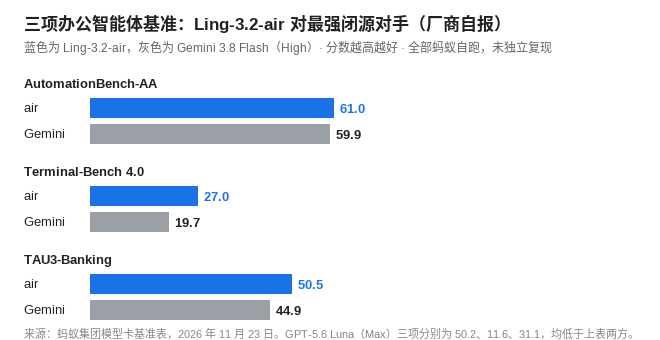
Ling-3.2-air's place in one table: it leads both closed comparison models on three agentic office benchmarks — but this is Ant's own comparison table, and the same table has it trailing on SWE-bench Pro, HLE, DeepSWE and GDP.pdf. All figures vendor-reported.
| Model | Size / active | AutomationBench-AA | Terminal-Bench 4.0 | TAU3-Banking | Weights |
|---|---|---|---|---|---|
| Ling-3.2-air | 124B / 5.5B active | 61.0 (#1) | 27.0 (#1) | 50.5 (#1) | MIT |
| GPT-5.6 Luna (Max) | Not in this round's research | 50.2 | 11.6 | 31.1 | Closed |
| Gemini 3.8 Flash (High) | Not in this round's research | 59.9 | 19.7 | 44.9 | Closed |
| Ling-3.0-flash-VL (predecessor) | 124B / 5.5B active | 15.7 | 0.0 | 34.4 | MIT |
| Qwen3.8-Flash-Next | Not in this round's research | Not in this round's research | Not in this round's research | Not in this round's research | Open weights |
On Qwen3.8-Flash-Next: Ant's comparison table includes Qwen rows, close to or ahead of air on several — this round's research did not capture the figures, so no numbers are written and none are guessed; see section 13. The other half of the numbers is in section 11: SWE-bench Pro 58.28 vs Luna's 62.7, DeepSWE 42.48 vs Luna's 67.2 and Gemini's 73.7, HLE 31.42 vs Luna's 39.5 and Gemini's 47.8, GDP.pdf 16.0% vs Luna's 24.0% and Gemini's 21.0%.
03Charts
Ling-3.2-air vs the strongest closed rival on three agentic office benchmarks: air leads on all three, but AutomationBench-AA by only 1.1 points over Gemini 3.8 Flash and TAU3-Banking by only 5.6 — narrow leads. All figures vendor-reported, not independently reproduced (AA's rerun of Terminal-Bench 4.0 came out at 26.8%, within 0.2 points of the card's 27.0%).
04Top 3 reads
Short on time? Start with these three: the benchmark tally, the specs breakdown and the deployment guide — all three take apart the line "61.0, 124B, 256K", and what a 49.3% hallucination rate means.
05Timeline
Four months, start to finish: the predecessor Ling-3.0-flash-VL went open in July, the general base and the same-generation flagship followed in October and early November, air's weights were silently listed in the small hours of November 23 with a single X post as the announcement; as of November 26, no tier-1 outlet has covered it and there is no hosted API.
- 2026-07
Predecessor Ling-3.0-flash-VL goes open: 124B total, 5.5B active, native multimodal architecture; air shares the same architecture.
- 2026-10-13
General base Ling-3.1-flash goes open under MIT (560B/25B); the same weight and config release already carries the 1M-vs-256K context gap.
- 2026-11-05
Same-generation flagship Ling 3.2 Flash goes live: 560B/25B, API-only (vendor API + OpenRouter free tier), no weights; the ¥2/¥6 per 1M tokens price is its, not air's.
- 2026-11-19
The same inclusionAI org silently posts the LingSante medical model family weights (announced at a conference Nov 23); LingSante-3.1-air-VL shares air's 124B/5.5B shape — the easiest pair of names to confuse.
- 2026-11-23 03:55 UTC
inclusionAI/Ling-3.2-air is created on Hugging Face: 13 FP8 shards, ~129GB, with no announcement, blog post or technical report.
- 2026-11-23, daytime
The repo is briefly visible to logged-in users only, while three serving PRs land ahead of publication: 11:40 UTC Ant's own SGLang fork PR #23 (YaRN fix), 13:00 UTC vLLM recipe PR #1286, 14:25 UTC SGLang mainline PR #52593 (native MTP and DSpark support). The same day, Ant Ling's X account posts the only vendor announcement, and Artificial Analysis puts up the model page with an independent index of 23.4 (v5.0.1).
- 2026-11-24
IT之家 reports (the strongest Chinese piece); the vLLM X account announces day-0 support; community quantisations appear within 24 hours (bartowski GGUF, primitive-ai NVFP4A16). Repo last modified 08:31 UTC.
- 2026-11-25
动点科技 (TechNode CN) reports: "Ant open-sources Ling-3.2-air, strengthening office and tool-operation capabilities".
- 2026-11-26
This topic page goes live. As of publication: no hosted API, no per-token price, no technical report; vendor benchmarks have no independent reproduction beyond AA's three rerun figures; no tier-1 coverage; Google Autocomplete returns nothing in English or Chinese.
06Specs
Official figures below (Hugging Face model card and config.json, the Ant Ling X post, and repo-level checks by i10x / stackfutures / orcarouter, Nov 23–26, 2026). Anything unpublished is marked "not published", not guessed; conflicting figures are stated side by side.
- Status
- Released (weights silently listed Nov 23, 03:55 UTC; one X post as the only vendor announcement; no launch post, no technical report)
- Model ID
- inclusionAI/Ling-3.2-air (FP8); ModelScope mirror under the same name
- Positioning
- General-purpose vision-language model: text, image and video input, text output; built for workflow automation and professional document reasoning, with terminal tasks and coding assistance on the side; not a medical model
- Parameters
- 124B total (model-card headline), 5.5B active per token (4.4% activation); the HF page also lists the model size as 128B, unexplained — the community read is that 124B is the language model and ~127–128B counts the vision encoder plus the MTP layer
- Architecture
- Hybrid-linear MoE: 42-layer text backbone — 35 KDA (Kimi Delta Attention) + 7 Gated MLA layers (5:1), 2 dense layers, 512 routed experts + 1 shared expert, 8 active per token, 32 attention heads, hidden size 2,560, expert intermediate 768, dense intermediate 6,144, 157,184-token vocabulary; MTP (NEXTN) speculative-decoding layer; the same native multimodal architecture as its predecessor Ling-3.0-flash-VL
- Vision encoder
- Native multimodal (vision tower + linear projector); the config confirms vision hidden size 1,152 and patch 16; the 27-layer vision tower is OrcaRouter's secondary read — the config does not expose the layer count in the field checked
- Context
- Native 262,144 tokens (config.json sets max_position_embeddings to 262,144; the card's serving recipe provisions 256K); 1M (1,048,576) via YaRN extension, not the default (the vLLM recipe PR describes 4× YaRN to reach 1M); AA lists the 1M figure
- Sampling defaults
- temperature 1.0, top_p 0.95, top_k 20, enable_thinking: true for best performance; reasoning and tool-call parsers both resolve to ling3
- Training method
- Not published (no training-method section in the model card; no technical report)
- Weight size
- FP8 (E4M3, 128×128 weight blocks, dynamic activations) ~129.3GB (10.6GB × 12 + 1.59GB), 13 safetensors shards; vision tower, embeddings, router gates and linear_proj held out of quantisation (BF16/FP32); no BF16 release
- Hardware
- 256K context: 4× 141GB-class GPUs (H20-3e / H200) or 4-GPU Blackwell nodes (B300 / GB300); --tp 8 on 80GB H100/H800; loading requires trusting custom code
- Serving frameworks
- SGLang (day-0 support, lmsysorg/sglang:dev-Ling-3.0-flash-VL, --tp 4 --context-length 262144 --speculative-algorithm NEXTN) and vLLM (inclusionAI fork vllm-ling-v3, day-0 support)
- API
- No hosted API: the card states it "isn't deployed by any Inference Provider"; AA lists zero providers; AnyRouter shows "coming soon"; it is not on OpenRouter's public list
- Weights / licence
- MIT (HF tag license:mit, model card declares MIT, commercial use allowed); no separate licence file in the repo — the tag plus the card text are the licence evidence; custom modeling code (configuration_bailing_moe_v3_vl.py, modeling_bailing_moe_v3_vl.py, model type bailing_moe_v3_vl) should be reviewed first
- Benchmarks
- 9 vendor-reported comparisons (see section 11) and the AA Intelligence Index 23.4 (v5.0.1, #102); AA reproduced three vendor figures within a point; no LiveBench / LMArena entry; no classic VLM benchmark figures (MMMU / ChartQA / OCRBench / MathVista) published
- Not published
- Per-token pricing and hosted API; training data, training method and compute; inference speed (tokens/second); a technical report; why the default config is 262,144 while AA lists 1M; why the HF page lists 128B against the card's 124B; why only one X post (no official explanation)
07How to try it: 3 routes
There are two real ways to try Ling-3.2-air, plus one "wait for it" route: self-hosting the weights is the main route, a community quantisation is the light route, and a hosted API does not exist yet — fix that sentence first, then talk about getting started.
1Self-host the weights (main route)
Download the weights from Hugging Face (inclusionAI/Ling-3.2-air, FP8 ~129.3GB, 13 shards) and serve with SGLang or vLLM: the 256K reference config is 4× 141GB-class GPUs (H20-3e / H200) or 4-GPU Blackwell nodes (B300 / GB300); loading requires trusting custom code, which should be reviewed first. See our deployment & access guide.
2Community quant on one card (light route)
Use a community quantisation released within 24 hours to run on a single card: bartowski GGUF Q4_K_M 80.4GB, primitive-ai NVFP4A16 77.9GB (one 96GB card), INT4 W4A16 ~72.5GiB. These are third-party builds with no quality figures — verify them yourself and do not treat them as official. See our deployment & access guide.
3Wait for hosted access (does not exist yet)
There is no hosted endpoint right now: it is not on OpenRouter's public list, no HF inference provider serves it, and AnyRouter only shows "coming soon". Readers who want an API can only wait — the 8-hour tracking loop watches AnyRouter / OpenRouter / Computrix for a listing, and this page will update the moment one appears. Do not try Ling 3.2 Flash's ¥2/¥6 pricing or its OpenRouter free tier: that is a different model's price.
Also: sampling defaults are temperature 1.0, top_p 0.95, top_k 20, with enable_thinking: true for best performance; reasoning and tool-call parsers both resolve to ling3.
08Pricing & access
Two price lines: weights are free (MIT), and self-hosting hardware is the cost. The key point: there is no per-token price, because there is no hosted API at all — no per-token price has been published and no inference provider runs the model. Prices as checked Nov 26, 2026; the platform's own page is authoritative.
| Channel | Price | Terms |
|---|---|---|
| Weights (Hugging Face / ModelScope) | Free | MIT licence, commercial use allowed; FP8 ~129.3GB, 13 shards; no BF16 release |
| Hosted API (usage-based) | Does not exist | Card states it is not deployed by any inference provider; AA lists zero providers; not on OpenRouter |
| AnyRouter | Coming soon | Shows "coming soon" only; not routable, no price |
| Community quants (third-party) | Free download | GGUF Q4_K_M 80.4GB / NVFP4A16 77.9GB / INT4 ~72.5GiB; third-party builds, no quality figures |
| Self-host hardware (256K reference) | 4× 141GB-class GPUs | H20-3e / H200, or 4-GPU Blackwell (B300 / GB300); rental cost unpublished |
| Inference-cost note | Verbose output | AA measured 199M output tokens across the index, ~2.7× the 72.4M median for comparable open-weight models — the 5.5B-active headline understates real inference cost |
The real cost is hardware and output volume
Free weights do not mean free inference: FP8 is ~129.3GB and the official reference config is 4× 141GB-class GPUs or 4-GPU Blackwell; for almost every reader, a community single-card quantisation is the realistic way to try it, and full 256K self-hosting is an institutional option. There is also a hidden cost: AA measured 199M output tokens across the index, ~2.7× the 72.4M median for comparable open-weight models — verbose output means a bigger token bill (or compute bill, when self-hosting) than the 5.5B-active figure suggests.
Official pages: Hugging Face — inclusionAI/Ling-3.2-air (MIT licence, benchmark table, deployment guide) · Artificial Analysis — Ling-3.2-air (independent index 23.4)
09First coverage & reviews
Everything below is first coverage and analysis from November 23–26: tier-1 media are absent in both languages; the three deepest English pieces are niche trackers, and the Chinese side is IT之家 and 动点科技. The independent score comes from Artificial Analysis; vendor benchmarks have no independent reproduction beyond AA's three rerun figures. Each entry carries a verdict badge; "Read the full article" opens our in-depth rewrite, with the original source at the end.
i10x: the strongest English report, full vendor table transcribed
Verdict: the source for English launch facts and benchmark figures; all 9 comparisons transcribedSource: i10x, Nov 24–25, 2026 Original →
i10x's November 24–25 article is the strongest English report on the release: a full transcription of the vendor benchmark table (AutomationBench-AA 61.0, TAU3-Banking 50.5, OmniDocBench 1.5 92.3, DeepSWE 42.48 and all 9 items), the Harvey legal benchmark's 87.7% criterion rate with its 0.8% all-pass framing, and quotes from Ant Ling's X post.
Read the full article → (rewritten by ModelBrief)
stackfutures: the best critical read — the version trap and the hallucination rate
Verdict: the critical view; "no launch post", "AA 42 vs 23 are two different rulers", "49% hallucination" all come from hereSource: stackfutures, Nov 24, 2026 Original →
stackfutures' November 24 article is the best critical read on the release: "no launch post — the model card is the entire vendor statement"; the predecessor's advertised AA 42 was measured on index v4.1.1 and cannot be compared with 23.4 on v5.0.1; the AA leaderboard placement and the 199M-token verbosity penalty; and the 49.3% hallucination rate's spread starts here.
Read the full article → (rewritten by ModelBrief)
orcarouter: the deepest repo-level reads — three serving PRs and the FP8 config
Verdict: the deepest secondary analysis; the 03:55 UTC creation, the three advance PRs, the FP8 config and the "one you cannot download, the other you cannot call" framing all come from hereSource: orcarouter, Nov 24–25, 2026 (two posts + CMS versions) Original →
orcarouter's two November 24–25 posts plus CMS versions are the deepest repo-level reads: the 03:55 UTC creation, the three serving PRs' timeline (11:40 / 13:00 / 14:25 UTC), the FP8 E4M3 128×128-block config, the card's own line "isn't deployed by any Inference Provider", AA's sub-score reproduction (Briefcase Elo 1,339.45 vs the card's 1,340), and the air-vs-Ling 3.2 Flash framing "one you cannot download, the other you cannot call"; Flash's ¥2.00/¥6.00/¥0.40 pricing and its free tier ending Nov 28, 10:00 (UTC+8) also come from here.
Read the full article → (rewritten by ModelBrief)
IT之家: the strongest Chinese piece, first on Nov 24
Verdict: the source for Chinese launch facts; 124B total parameters and the HLE / SWE-bench Pro generation gains in one pieceSource: IT之家, Nov 24, 2026 Original →
IT之家's November 24 article is the strongest Chinese report: 124B total parameters and 5.5B active, the generation gains HLE 21.96 → 31.42 and SWE-bench Pro 26.40 → 58.28 in one piece, with Hugging Face and ModelScope links.
Read the full article → (rewritten by ModelBrief)
动点科技 (TechNode CN): the Nov 25 Chinese report, office and tool capabilities
Verdict: the second Chinese piece; AutomationBench 15.7% → 61% and SGLang/vLLM deployment in one pieceSource: 动点科技, Nov 25, 2026 Original →
动点科技's November 25 article is the second Chinese report: headlined "Ant open-sources Ling-3.2-air, strengthening office and tool-operation capabilities", with AutomationBench-AA 15.7% → 61%, GDP.pdf 8.4% → 16%, Terminal-Bench 4.0 0 → 27% and SGLang/vLLM deployment in one piece.
Read the full article → (rewritten by ModelBrief)
Second-wave trackers: explainx, aiweekly, bridgecode, llmtest, freakyjolly and more
Verdict: secondary transcriptions and community deployment guides; no new independent measurementsSource: explainx, aiweekly, bridgecode, llmtest, freakyjolly, ailyre, deai.org, tech360.tv, pulse, promptblueprints, Nov 24–26, 2026
The second-wave tracker blogs did card transcriptions, community deployment guides and r/LocalLLaMA reaction roundups: freakyjolly's single-card guide (GGUF Q4_K_M 80.4GB, NVFP4A16 77.9GB, INT4 ~72.5GiB) and its 124B-vs-128B explanation come from here; llmtest confirmed it is not on OpenRouter's public list and no HF inference provider serves it. All secondary; none adds an independent measurement.
Read the full article → (rewritten by ModelBrief)
Independent reproduction: AA reproduced three figures within a point; the rest, none
Verdict: AA's independent run is the only third-party measurement; six vendor figures still have no independent reproductionSource: Artificial Analysis (read via orcarouter), Nov 23–25, 2026
Artificial Analysis independently ran the model and scored it 23.4, reproducing three vendor figures in the process: AA-Briefcase Elo 1,339.45 (card: 1,340), Terminal-Bench 4.0 26.8% (card: 27%), GDP.pdf 15.8% (card: 16%) — all within a point. That is the only third-party measurement of this release. The other six vendor figures still have no independent reproduction, and no evaluation harness files or run logs were published with the scores. Note the distinction: AA's 23.4 is an independent score, not a reproduction of the vendor's 9-item table.
10Articles: our in-depth reviews
The 6 articles below are ModelBrief's own rewritten, restructured in-depth reviews — new structure, added conclusions and selection advice, with facts and figures checked against the original sources. Open any of them to read on this site; original sources are listed at the end of each article.
11Benchmarks: mostly vendor-reported, AA independent score 23.4
Ling-3.2-air's scores come in two layers, and they must be read apart: the first is Ant's own 9-item comparison table (vendor-reported, comparison models chosen by Ant); the second is Artificial Analysis' independent index of 23.4 — and AA also reproduced three vendor figures within a point. Fix that sentence first, then look at the numbers: air leads both closed comparison models on three agentic office benchmarks, but trails on SWE-bench Pro, HLE, DeepSWE and GDP.pdf.
Vendor-reported: 9 comparisons (vs predecessor Ling-3.0-flash-VL / GPT-5.6 Luna Max / Gemini 3.8 Flash High)
| Benchmark | Ling-3.2-air | Ling-3.0-flash-VL (predecessor) | GPT-5.6 Luna (Max) | Gemini 3.8 Flash (High) |
|---|---|---|---|---|
| AutomationBench-AA | 61.0 | 15.7 | 50.2 | 59.9 |
| Terminal-Bench 4.0 | 27.0 | 0.0 | 11.6 | 19.7 |
| TAU3-Banking | 50.5 | 34.4 | 31.1 | 44.9 |
| SWE-bench Pro | 58.28 | 26.40 | 62.7 | n/a |
| DeepSWE | 42.48 | n/a | 67.2 | 73.7 |
| HLE (Humanity's Last Exam) | 31.42 | 21.96 | 39.5 | 47.8 |
| OmniDocBench 1.5 | 92.3 | 91.4 | n/a | 90.8 |
| GDP.pdf all-pass | 16.0% | 8.4% | 24.0% | 21.0% |
| Harvey LAB-AA v1.1 (legal) | 87.7% criterion pass | — | — | — |
On Harvey LAB-AA v1.1: 87.7% is the per-criterion pass rate; the all-pass rate was 8.3% before the material-hallucination check and only 0.8% after it — the card's own candid soft spot. Also: Ant's table includes Qwen3.8-Flash-Next rows, close to or ahead of air on several — this round's research did not capture the figures. All figures vendor-reported (the model-card evaluation table is an image; figures transcribed via i10x / IT之家), not independently reproduced.
Independent score: AA Index 23.4 (v5.0.1, #102)
| Item | Score | Note |
|---|---|---|
| AA Intelligence Index v5.0.1 | 23.4 (#102) | Independent score; the page now displays 23 on v5.0.2; orcarouter reads 23.39 |
| AA-Briefcase v1.1 Elo | 1,339.45 | AA reproduction; card: 1,340, within 0.55 points |
| Terminal-Bench 4.0 | 26.8% | AA reproduction; card: 27%, within 0.2 points |
| GDP.pdf all-pass | 15.8% | AA reproduction; card: 16%, within 0.2 points |
| FrontierCode-AA 2.0 | 8.1% | Independently measured weak spot |
| Terminal-Bench Science | 3.8% | Independently measured weak spot |
| AA-Omniscience accuracy / hallucination | 24.0% / 49.3% | Independently measured; invents an answer about half the time when it does not know |
| Output volume across the AA index | 199M tokens | ~2.7× the 72.4M median for comparable open-weight models; AA classes it "very verbose" |
How to read 23.4: it is the only figure on the AA model page that does not come from the vendor. v5.0.1 comprises 9 evaluations (AA-Briefcase v1.1, AutomationBench-AA, Terminal-Bench 4.0, FrontierCode-AA 2.0, AA-Omniscience, GDP.pdf, HLE-Diamond, CritPt v2, Terminal-Bench-Science 0.1). On the board it sits level with DeepSeek V4 Pro 0813 (Max) and GLM-5.3 (Low), 1 point below Agnes 2.5 Pro Theta (24), 3 points above Inkling 2 Mini and Qwen3.8 27B (xhigh, both 20), and well above the open-weight median of 5 — but Ant's own previous general model, the Ling 3.1 Flash 1019 checkpoint, scores 30 on the same index, 7 points above air. And the version trap: the predecessor Ling-3.0-flash-VL's card advertises AA 42, measured on index v4.1.1; version bumps rebase the scale, so 42 → 23 is not a regression — two different rulers.
The shape of the wins and losses: office agents yes, hard reasoning no
The shape is clear and worth stating plainly: air's strength is agentic office work — AutomationBench-AA 61.0, Terminal-Bench 4.0 27.0, TAU3-Banking 50.5 all lead both closed comparison models, and all three are generational jumps over the predecessor (15.7 → 61.0, 0 → 27.0, 34.4 → 50.5); its weakness is harder general reasoning and long software engineering — HLE 31.42 vs Luna's 39.5 and Gemini's 47.8, SWE-bench Pro 58.28 vs Luna's 62.7, DeepSWE 42.48 vs Luna's 67.2 and Gemini's 73.7, GDP.pdf 16.0% vs Luna's 24.0% and Gemini's 21.0%. Not a sweep — a scorecard with clear strengths and weaknesses.
Classic VLM benchmarks: no figures
MMMU, ChartQA, OCRBench, MathVista and other classic vision-language benchmarks have no figures in the card's evaluation table or in any secondary coverage — the card's evaluation table is an image, and its text gives only the agentic and legal figures above. This site invents none of them; if the model card later adds figures, the 8-hour tracking loop will update this section.
Full tally in our benchmarks article →
12Related topics
Other ModelBrief topics. LingSante is the same-vendor, same-shape medical twin — the disambiguation is required reading; Kimi K3.1 Pro and Qwen4-Max are the open-weight AA Index references; Inkling 2 Mini sits 3 points below air on the AA Index; Edge0-145B is the closest built precedent (open weights + vendor-reported benchmarks + deployment guide); WeMM-Video was built the same week from the same zero-search-signal start.
 LingSanteReleased Nov 23, 2026 · Ant Group's medical model family: 560B flash and 124B air-VL under MIT open weights, HealthBench Professional 65.72 (vendor-reported); not a medical device. The topic page covers official specs, benchmarks and 6 in-depth reviews.
China · LLM · Open weights · Nov 5, 2026
 Kimi K3.1 ProWeights public 2026-11-05 · Moonshot AI Kimi K3.1 Pro, AA Index 46. Specs, pricing, benchmarks and in-depth articles.
China · LLM · GA · Nov 16, 2026
 Qwen4-MaxReleased Nov 16, 2026 · Alibaba's first Qwen4 flagship, AA Index 43. The topic page covers official specs, Token Plan pricing and 18 in-depth reviews.
USA · LLM · Open Weights · Released Nov 20, 2026
 Inkling 2 MiniReleased Nov 20, 2026 · Thinking Machines Lab's open-weight looped model, 26.4B parameters with 3.4B active per token, AA Index 20.1 tied with Qwen3.8-27B, $0.15/$0.50 per 1M tokens. The topic page covers official specs, pricing, benchmarks and 6 in-depth reviews.
LLM · Open weights · Released Nov 12, 2026
 Edge0-145BReleased Nov 12, 2026 · Edge0's first 145B on-device model, a latent MoE on a Qwen3.8-Flash-Next base, 256K context, weights public on HF under a custom community license (not open source). The topic page covers official specs, pricing, benchmark analysis and 6 in-depth reviews.
China · Video Understanding · Open Weights · Released Nov 17, 2026
 WeMM-VideoWeights public Nov 17, 2026 · Tencent's omni-modal video-understanding family in 2B/4B/9B/35B-A3B, Apache 2.0 open weights; 9B beats a 30B baseline (vendor-reported), no API or price. The topic page covers official specs, benchmarks and 6 in-depth reviews.
13Comparisons
vs Ling 3.2 Flash: one you can download, the other you can call
| Dimension | Ling-3.2-air (this page) | Ling 3.2 Flash |
|---|---|---|
| Size / active | 124B / 5.5B active | 560B / 25B active |
| Positioning | General-purpose VLM (small) | Same-generation flagship (large) |
| Weights | MIT open weights, downloadable | No weights, not downloadable |
| API | No hosted API, not callable | Vendor API + OpenRouter free tier, callable |
| Price | Weights free; no per-token price | ¥2/¥6 per 1M tokens (free tier ends Nov 28, 10:00 UTC+8) |
| Released | Listed silently Nov 23, 2026 | Live Nov 5, 2026 |
orcarouter's framing is precise: "one you cannot download, the other you cannot call" — air can be downloaded but not called, Flash can be called but not downloaded. The ¥2/¥6 price and the OpenRouter free tier are Flash's — never reuse them for air. Flash has no topic on this site (decided Nov 15, 2026 — not even a single article); it appears here only as a comparison. See our comparisons article.
vs predecessor Ling-3.0-flash-VL: gains across the board
| Dimension | Ling-3.2-air | Ling-3.0-flash-VL (predecessor, Jul 2026) |
|---|---|---|
| AutomationBench-AA | 61.0 | 15.7 |
| Terminal-Bench 4.0 | 27.0 | 0.0 |
| TAU3-Banking | 50.5 | 34.4 |
| SWE-bench Pro | 58.28 | 26.40 |
| HLE | 31.42 | 21.96 |
| GDP.pdf all-pass | 16.0% | 8.4% |
| Size / active | 124B / 5.5B | 124B / 5.5B (same size) |
| Architecture | Same native multimodal architecture as the predecessor | — |
All figures vendor-reported. Same size, same architecture, all six figures more than doubled — the gains come from the 3.2 generation's training, not scale. But do not compare the predecessor's advertised AA 42 with air's 23.4 directly: that was index v4.1.1, not the same ruler. See our comparisons article.
vs Qwen3.8-Flash-Next: split results, figures not fully captured
Ant's comparison table includes Qwen3.8-Flash-Next rows, close to or ahead of air on several — this round's research (via the i10x transcription) did not capture the figures, so this site writes no numbers and guesses none. One thing is certain: Edge0-145B is built on a Qwen3.8-Flash-Next base, and air faces Qwen3.8-Flash-Next directly in Ant's own table. Once the figures are captured, the 8-hour tracking loop will fill in this section.
vs AA Index neighbours: level with GLM-5.3, below the house base
On the AA Index v5.0.1, air's 23.4 sits level with DeepSeek V4 Pro 0813 (Max) and GLM-5.3 (Low), 1 point below Agnes 2.5 Pro Theta (24), 3 points above Inkling 2 Mini and Qwen3.8 27B (xhigh, both 20), and well above the open-weight median of 5. But Ant's own previous general model, the Ling 3.1 Flash 1019 checkpoint, scores 30 on the same index — the new air sits 7 points below the house's older base, a gap worth recording.
Disambiguation from LingSante-3.1-air-VL: not the same model
LingSante-3.1-air-VL is a medical model built on Ling-3.0-flash-VL, 124B/5.5B, MIT, silently listed Nov 19 and announced at a conference Nov 23; Ling-3.2-air is a general-purpose model of the Ling-3.2 generation sharing Ling-3.0-flash-VL's architecture, also 124B/5.5B and MIT, listed Nov 23. Same vendor, same size, similar names — but different lineage, different positioning, different purpose: one reads imaging reports and skin photos, the other automates office work and reasons over professional documents. LingSante-3.1-air-VL has its own topic on this site; do not confuse them.
Read the in-depth comparison: Ling-3.2-air vs Flash, Qwen and its medical twin →
14What's missing (as of Nov 26)
- A hosted API and per-token pricing: neither exists; AnyRouter shows coming soon only, OpenRouter has no listing
- Classic VLM benchmark figures: MMMU / ChartQA / OCRBench / MathVista all unpublished
- Independent reproduction of the vendor benchmarks: none beyond AA's three rerun figures (Briefcase, Terminal-Bench, GDP.pdf); no evaluation run logs
- A technical report and launch documentation: none; the model card plus one X post are the entire vendor statement
- An official explanation of the 124B vs 128B discrepancy: the HF page lists 128B, the card headline says 124B, no official word
- An explanation of the 1M context default: 1M needs a 4× YaRN extension, not the default; no official word on why AA lists 1M
- Qwen3.8-Flash-Next comparison figures: Ant's table has Qwen rows; this round's research did not capture the numbers
- Tier-1 media coverage: no TechCrunch / The Verge / Reuters / Bloomberg / Wired in English; no 机器之心 / 新智元 / 量子位 / 36氪 in Chinese
- LiveBench / LMArena entries: no scores on either
- Inference speed (tokens/second): not published
- Training data, training method and compute: not published
- Self-host rental cost: no published price for the 4× 141GB-class GPU reference config
15Rumor check
Confusion around Ling-3.2-air comes from eight places: the release date, 1M context, "beats Luna", the AA 42 figure, Flash's price, OpenRouter, the parameter count and local deployment — each clarified below.
False "Released November 25"
The weights were created on November 23 at 03:55 UTC (HF API createdAt), with the X post the same day; some aggregators write November 25, which is their coverage date, not the listing date — this site's own Nov 26 AI briefing made the same error and corrected it the same day.
False "1M context out of the box"
The config's max_position_embeddings is 262,144; 1M needs a 4× YaRN extension, not the default. The 1M AA lists is the extended figure — do not cite it as native context.
False "Beats GPT-5.6 Luna / Gemini 3.8 Flash"
Air is 3–4 against the two: wins on AutomationBench-AA 61.0 vs 50.2/59.9, Terminal-Bench 4.0 27.0 vs 11.6/19.7, TAU3-Banking 50.5 vs 31.1/44.9; losses on SWE-bench Pro 58.28 vs 62.7, HLE 31.42 vs 39.5/47.8, DeepSWE 42.48 vs 67.2/73.7, GDP.pdf 16.0% vs 24.0%/21.0%.
False "AA 42 → 23 is a regression"
The predecessor Ling-3.0-flash-VL's advertised AA 42 was measured on index v4.1.1; air's 23.4 is on v5.0.1 — version bumps rebase the scale, two different rulers, not a regression.
False "¥2/¥6 is air's price"
¥2.00/¥6.00/¥0.40 per 1M tokens is the same-generation Ling 3.2 Flash's vendor API price (free tier ending Nov 28, 10:00 UTC+8); air has no API and no price. Do not reuse Flash's price for air.
False "Free on OpenRouter"
Air is not on OpenRouter's public list, no HF inference provider serves it, and AnyRouter only shows "coming soon". Right now the only way to use it is self-hosting.
Unverified "124B is the whole parameter count"
The model-card headline is 124B, but the HF page also lists the model size as 128B, with no official explanation; the community read is that 124B is the language model and ~127–128B counts the vision encoder plus the MTP layer. This site states both figures and headlines 124B.
False "Runs on an ordinary laptop"
FP8 weights are ~129.3GB and the official recipe is 4× 141GB-class GPUs or 4-GPU Blackwell. "Local deployment" means the weights can be downloaded and run privately inside an institution — not on a personal laptop. Community GGUF/NVFP4 single-card builds are third-party quantisations with no quality figures, not the official line.
16FAQ
What is Ling-3.2-air?
Ant Group's Bailing team's general-purpose vision-language model, listed on Hugging Face on November 23, 2026: 124B total parameters with 5.5B active per token, hybrid-linear MoE, MIT open weights, FP8 ~129GB; built for workflow automation and professional document reasoning, with terminal tasks on the side. See sections 01 and 06.
Is it the same model as LingSante-3.1-air-VL?
No. Same vendor, same size (124B/5.5B), similar names — but different lineage, positioning and purpose: LingSante-3.1-air-VL is a medical model built on Ling-3.0-flash-VL that reads imaging reports and skin photos; Ling-3.2-air is a general-purpose model for office automation and professional document reasoning. See section 13 and our comparisons article.
How does it relate to Ling 3.2 Flash?
Two members of the same generation with opposite access: air is the 124B/5.5B small model — downloadable (MIT weights) but not callable (no API); Flash is the 560B/25B flagship — callable (vendor API + OpenRouter free tier, ¥2/¥6) but not downloadable (no weights). See section 13.
What does it score?
The independent score is Artificial Analysis' index of 23.4 (v5.0.1, #102); the vendor-reported headline figures are AutomationBench-AA 61.0, Terminal-Bench 4.0 27.0 and TAU3-Banking 50.5, all leading the two closed comparison models — but SWE-bench Pro, HLE, DeepSWE and GDP.pdf all trail. See section 11.
How much does it cost?
Weights are free (MIT) and downloadable; but there is no per-token price — because there is no hosted API at all. The cost is your own GPU bill: full 256K self-hosting needs 4× 141GB-class GPUs; community single-card quantisations lower the bar, but those are third-party builds. See section 08 and our deployment & access guide.
What hardware do I need to run it?
The official recipe: 256K context on 4× 141GB-class GPUs (H20-3e / H200) or 4-GPU Blackwell nodes (B300 / GB300); --tp 8 on 80GB H100/H800. Community GGUF Q4_K_M 80.4GB and NVFP4A16 77.9GB run on a single 96GB card, with no quality figures. See our deployment & access guide.
Is the context window 256K or 1M?
Native is 262,144 tokens (the config value; the card's serving recipe provisions 256K); 1M (1,048,576) needs a 4× YaRN extension, not the default. AA lists the 1M figure — cite it with the qualification. See section 06.
What are its weaknesses?
Measured independently by AA: a 49.3% hallucination rate (AA-Omniscience accuracy only 24.0%), FrontierCode-AA 2.0 at 8.1%, Terminal-Bench Science at 3.8%; the card itself states the Harvey legal benchmark's 87.7% criterion pass rate but only 0.8% all-pass after the hallucination check; and verbose output — 199M tokens across the AA index, ~2.7× the 72.4M median for comparable open-weight models. See our limits article.
Can I call it via API?
No. The card states it is not deployed by any inference provider; it is not on OpenRouter's public list; AnyRouter only shows "coming soon". The 8-hour tracking loop will update this page the moment a hosted endpoint appears. See section 08.
17Sources
All facts on this page come from the public sources below (Hugging Face model card and API: created and modified Nov 23–24, 2026; X post: Nov 23; IT之家: Nov 24; 动点科技: Nov 25; this site's research: Nov 26, 2026).
Official
- Hugging Face model card — inclusionAI/Ling-3.2-air (MIT licence, 9-benchmark table, deployment guide; created Nov 23, 03:55 UTC) Read by this site Nov 26, 2026
- Hugging Face API — inclusionAI/Ling-3.2-air (createdAt 2026-11-23T03:55:12Z, lastModified 2026-11-24T08:31:31Z, license:mit, 13 shards / 129.3GB, 1,467 downloads / 241 likes; config: max_position_embeddings 262144) Read by this site Nov 26, 2026
- Ant Ling (@AntLingAGI) X post — "Introducing Ling-3.2-air, an open-weight model that shares Ling-3.0-flash-VL's native multimodal architecture. 124B total, 5.5B active. Stronger workflow automation and professional document reasoning." (the only vendor announcement; no direct link — quoted in i10x / aiweekly) Nov 23, 2026
- Artificial Analysis — Ling-3.2-air (independent index v5.0.1 23.4, #102; sub-score reproduction and weak spots) Nov 23, 2026
Chinese coverage
- IT之家 — "Ant Ling-3.2-air model released and open-sourced: native multimodal architecture, 124B total parameters" (HLE 21.96 → 31.42, SWE-bench Pro 26.40 → 58.28, HF and ModelScope links) Nov 24, 2026
- 动点科技 (TechNode CN) — "Ant open-sources Ling-3.2-air, strengthening office and tool-operation capabilities" (AutomationBench-AA 15.7% → 61%, GDP.pdf 8.4% → 16%, Terminal-Bench 4.0 0 → 27%, SGLang/vLLM deployment) Nov 25, 2026
- DoNews, aisort.net, econews.cn syndication (Nov 23–24) Nov 23–24, 2026
English coverage & analysis
- i10x.ai — "Ling-3.2-air: Ant's Open 124B Workflow Model" (full transcription of the vendor's 9-benchmark table, Harvey 0.8% all-pass, X post quotes) Nov 24–25, 2026
- stackfutures.com — "Ant Group Posts Ling-3.2-air, a 124B MIT-Licensed Model, With No Launch Post: AA Index 23 and a 49% Hallucination Rate" (no launch post, the v4.1.1-vs-v5.0.1 version trap, AA leaderboard placement, 199M-token verbosity) Nov 24, 2026
- orcarouter.ai — "Ling-3.2-air Benchmarks: 61% Automation vs Index 23" (AA sub-score reproduction, 03:55 UTC creation, FP8 config) and "Ling-3.2-air vs Ling-3.2-flash: Open Weights or API?" (Flash ¥2.00/¥6.00/¥0.40 pricing, free tier ending Nov 28, 10:00 UTC+8, 27-layer vision tower) Nov 24–25, 2026
- explainx.ai — "Ling-3.2-air: 124B MoE Open Weights (MIT)" Nov 24–26, 2026
- aiweekly.co — "inclusionAI drops Ling-3.2-air, 124B MoE at 5.5B active" (SWE-bench Pro 58.28 / DeepSWE 42.48) Nov 24–26, 2026
- bridgecode.app — "Ling-3.2-air scores 23 on Intelligence Index with 5.5B active" Nov 24–26, 2026
- llmtest.io — "Ling-3.2-air explained" (not on OpenRouter's public list, no HF inference provider) Nov 24–26, 2026
- freakyjolly.com — "Ling-3.2-air: Run Ant's 124B Vision Model Locally" (community quants: GGUF Q4_K_M 80.4GB, NVFP4A16 77.9GB, INT4 ~72.5GiB; 124B-vs-128B explanation) Nov 24–26, 2026
- AnyRouter — Ling-3.2-air (shows coming soon, no hosting) Nov 26, 2026
- This site's research, Nov 26, 2026: Google Autocomplete — 6 English queries, 3 Chinese queries, all empty; Google Trends — one attempt returned HTTP 411, no data obtained; HF API read of creation time, licence, shard count and download figures; no tier-1 English or Chinese tech-media coverage found; no classic VLM benchmark figures published
More indexes: All Ant Group topics · All language models · All models