 WeMM-Video: The Topic Page
The positioning first: WeMM-Video is Tencent's WeChat Vision team and Tsinghua University's omni-modal video-understanding family — it watches the frames, listens to the original soundtrack, and answers in text; it does not generate video. On November 17, 2026, four checkpoints went public silently on Hugging Face, with no launch post, no product page and no price; the technical report followed on arXiv on November 19. All 120+ benchmarks are Tencent-run, with no Artificial Analysis, LMArena or LiveBench score to date, and no API or hosted service — self-hosting only. The flagship 35B-A3B wins 16 of 17 audio-visual benchmarks against Seed and Qwen3.5-Omni, but trails Gemini-3.0-Flash on nearly everything — the accurate phrase is "narrows the gap," not "beats." This page collects the official specs, benchmark analysis and 6 in-depth articles, with unverified claims clearly marked.
01Key facts
What is confirmed: a release with no ceremony — weights first, paper second, announcement still absent.
- Released
- Weights public: 2026-11-17 (silent Hugging Face upload, no announcement); Paper: 2026-11-19 (arXiv 2611.26409, WeChat Vision + Tsinghua, 12 authors)
- Developer
- Tencent WeChat Vision team with Tsinghua University
- Positioning
- Omni-modal video-understanding foundation family: text + image + audio + video in, text out; it watches frames, hears the soundtrack and reasons — it understands video — it does not generate it
- Sizes
- 2B / 4B / 9B dense + 35B-A3B MoE (35B total, ~3B active per token); the numbers name the language backbone — totals are ~3.28B / 5.61B / 10.49B / 36.18B (verified via the Hugging Face API, Nov 26, 2026)
- Bases
- 2B/4B/9B on Qwen3.5-2B/4B/9B; 35B-A3B on Qwen3.6-35B-A3B; audio encoders from Qwen2.5-Omni; architecture draws on video-SALMONN 2
- Audio front end
- Whisper-based encoder, 16 kHz audio in 30-second chunks; a window-level Q-Former compresses each 0.1-second window to one token — 10 audio tokens per second; visual and audio tokens interleave in time order with explicit text timestamps
- Modes
- Hybrid thinking: non-thinking instruct mode (fast, direct) + thinking mode (explicit step-by-step reasoning,
enable_thinking=True); most benchmark gains sit in thinking mode - Training
- ~1.2 trillion multimodal tokens; joint audio-visual data is the largest slice (45.4%), captioning the largest task (37.7%); three pre-training stages + three post-training stages (multi-teacher OPD → anti-repetition MrDPO → specialist RL)
- Context
- Config allows 262,144 positions, but every published serving example sets an 8,192-token limit; real long-video capacity is unproven in the served configs — state both numbers
- Languages
- Chinese–English bilingual
- License
- Apache License 2.0 (model cards and code; each checkpoint carries its own license and third-party attribution)
- Weights
- BF16: 2B 6.12 GiB, 4B 10.45 GiB, 9B 19.54 GiB, 35B-A3B 67.39 GiB; each size also ships FP8 Block128, AWQ W4A16, GGUF Q4_K_M and NVFP4 W4A16 — 20 repos in total
- Runtimes
- Transformers 5.2.0 (BF16), patched vLLM 0.18.0/0.31.0, patched SGLang 0.5.16/0.5.19, native GGUF runtime, Docker; Python 3.12, CUDA 12.9, FFmpeg;
trust_remote_code=Truerequired - Real-world use
- The paper says the models are already deployed across multiple core video services within WeChat (live-stream commerce, short-form drama analysis, interactive video) — a vendor claim with named applications
- API / price
- None. No hosted endpoint, no API, no price, no third-party host listing; self-hosting is the only way to run it
- Benchmarks
- All 120+ are Tencent-run: 35B-A3B thinking wins 16 of 17 against Seed2.0-Mini-0428 and Qwen3.5-Omni-Flash, but trails Gemini-3.0-Flash on nearly everything; no AA / LMArena / LiveBench entry, no third-party reproduction
- Traction
- Google Autocomplete is zero in both locales (the bare term returns only webm-format noise); no tier-1 Chinese media coverage; GitHub 21 stars, 0 forks on day 1 (explainx, Nov 20)
02Quick comparison
WeMM-Video at a glance: the 9B efficiency story shines brightest and the 35B flagship story is the most complete — but both sets of scores come from Tencent's own evaluation pipeline.
| Model | Video-MME with audio (vendor-reported) | BF16 weights | Scale | Open weights |
|---|---|---|---|---|
| WeMM-Video-35B-A3B (thinking) | 86.4 (still behind Gemini's 88.6) | 67.39 GiB | 36.18B total, ~3B active | Apache 2.0 |
| WeMM-Video-9B (thinking) | 85.1 (above the 30B baseline's 77.3) | 19.54 GiB | 10.49B total | Apache 2.0 |
| WeMM-Video-4B (thinking) | 83.9 (above the 30B baseline's 77.3) | 10.45 GiB | 5.61B total | Apache 2.0 |
| WeMM-Video-2B (thinking) | 72.4 (behind the baseline, ahead of MiniCPM-o's 69.2) | 6.12 GiB | 3.28B total | Apache 2.0 |
| Qwen3-Omni-30B-A3B-Instruct (baseline) | 77.3 | — | 30B MoE | Apache 2.0 |
| Gemini-3.0-Flash (closed benchmark) | 88.6 | — | Undisclosed | No |
WeMM-Video scores are all Tencent-run (paper Tables 1–2); Gemini and Seed scores are official results or Tencent's own evaluations as cited in the paper, see section 11. The "9B beats 30B" claim covers only verified table rows such as Video-MME with audio.
03Charts
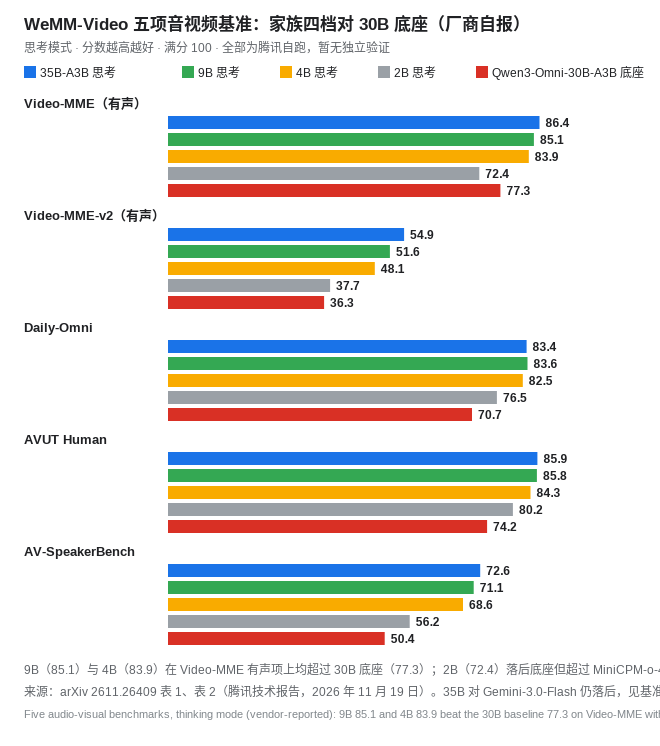
Five audio-visual benchmarks, thinking mode: the family against the 30B baseline — the 9B and 4B beat a baseline three times their size on video with audio; the 2B sits below it.
04Top 3 reads
Short on time? Start with these three: a release with no ceremony, what the 120+ benchmarks actually say, and how a 9B model beats a 30B one.
05Timeline
A release in reverse: weights first, paper second, announcement still missing — the news hook is "Tencent quietly open-sourced…", not "Tencent launches…".
- 2026-11-17
Weights go public silently on Hugging Face: the
tencent/WeMM-Video-2Brepository was created at 08:58 UTC (OrcaRouter's reading of the repo history); the other three base checkpoints and all 16 quantized builds went up the same day, the quantized builds within ~11 minutes of the base weights. No launch post, no product page, no pricing page, no executive announcement of any kind — the release was discovered from the repos themselves. - 2026-11-19
Technical report on arXiv (2611.26409, "WeMM-Video: Pushing the Frontiers of Open-Source Omni-Modal Video Understanding", 12 authors, WeChat Vision + Tsinghua). The first dated public document describing the family as a whole — and the closest thing to an official statement, though it is a research report, not a product launch.
- Nov 20–21, 2026
Niche-English coverage wave: explainx.ai writes the deepest piece; Medium/digitechinfo, alextech.ai, zicq.com, thenextgentechinsider.com, syncdev.com, ai.info and TokenPost follow — all secondary write-ups of the paper and the HF repos. zicq.com is the most sceptical, noting the paper provides "no absolute scores, run-to-run variance, confidence intervals…".
- 2026-11-20
explainx.ai readings: GitHub 21 stars, 0 forks; Hugging Face paper page 27 upvotes.
- Nov 22–23, 2026
OrcaRouter (Japanese) documents the silent release in full: the repo creation time, the 2B config read (3,283,624,264 total params), 2 likes and 0 downloads on the 2B repo six days after upload (a second-hand observation), and the "no independent evaluation of any kind" verdict. The HF paper page reaches ~35 upvotes.
- 2026-11-23
As of this date: still no Tencent official announcement (Hunyuan, Tencent Cloud and WeChat accounts all silent), no tier-1 Chinese media coverage, no TechCrunch / The Verge / Reuters / Bloomberg / Wired / Ars Technica / VentureBeat coverage, no AA / LMArena / LiveBench entry.
- 2026-11-26
This topic page goes live; pre-publication re-check (Nov 26, 2026): still no Tencent official announcement, tier-1 Chinese pickup or independent evaluation; total parameter counts verified via the Hugging Face API — 2B 3.28B, 4B 5.61B, 9B 10.49B, 35B-A3B 36.18B.
06Official specs
As published in the arXiv paper and the Hugging Face model cards (checked Nov 23, 2026; total parameters re-checked via the Hugging Face API on Nov 26, 2026). Benchmarks are in section 11; this section lists the specs only.
- Status
- Weights public (silent upload Nov 17, 2026); no formal launch announcement; paper Nov 19, 2026
- Model IDs
- tencent/WeMM-Video-2B, tencent/WeMM-Video-4B, tencent/WeMM-Video-9B, tencent/WeMM-Video-35BA3B (Hugging Face collection tencent/wemm-video, 20 repos)
- Type
- Omni-modal video-understanding foundation models: text + image + audio + video in, text out; it understands video — it does not generate it
- Sizes
- 2B / 4B / 9B dense + 35B-A3B MoE; the numbers name the language backbone — totals ~3.28B / 5.61B / 10.49B / 36.18B; 35B-A3B activates ~3B per token
- Bases
- Qwen3.5-2B/4B/9B; Qwen3.6-35B-A3B; audio encoders from Qwen2.5-Omni; architecture draws on video-SALMONN 2
- MoE config (35B-A3B)
- 40 language layers, 256 routed experts per layer, top-8 routing, 512-wide shared expert (thenextgentechinsider's config read, second-hand, not individually re-verified at build time)
- Audio front end
- Whisper-based encoder, 16 kHz, 30-second chunks; window-level Q-Former compresses each 0.1-second window to one token (10 audio tokens/second); visual and audio tokens interleave chronologically with text timestamps
- Modes
- Hybrid thinking: non-thinking instruct mode + thinking mode (
enable_thinking=True) - Training
- ~1.2 trillion multimodal tokens; joint audio-visual data 45.4%, captioning 37.7%; three pre-training stages (acoustic alignment → omni-modal injection → long-context scaling) + three post-training stages (multi-teacher OPD → anti-repetition MrDPO → specialist RL)
- Context
- Config 262,144 positions; published serving examples cap at 8,192 tokens
- Languages
- Chinese–English bilingual
- License
- Apache License 2.0 (model cards and code; each checkpoint carries its own license and third-party attribution)
- Weights / quantization
- BF16: 2B 6.12 GiB, 4B 10.45 GiB, 9B 19.54 GiB, 35B-A3B 67.39 GiB; each size also ships FP8 Block128, AWQ W4A16, GGUF Q4_K_M, NVFP4 W4A16; 9B-AWQ 12.86 GiB
- Runtimes
- Transformers 5.2.0 (BF16), patched vLLM 0.18.0/0.31.0, patched SGLang 0.5.16/0.5.19, native GGUF runtime, Docker; Python 3.12, CUDA 12.9, FFmpeg;
trust_remote_code=Truerequired - Hardware
- 2B/9B-AWQ checked on L20/H20; 35B-A3B serving recipes use two GPUs; 9B-AWQ loads on a single L20
- Price / API
- No API, no price, no hosted endpoint; weights free (Apache 2.0), self-hosting only, compute is yours
- Independent scores
- None. No AA / LMArena / LiveBench entry; no third-party reproduction; the evaluation and reproduction pipeline is public, so anyone can re-run the numbers
07How to try it: self-hosting is the only route
No API, no web demo, no hosted endpoint — to use WeMM-Video you run the weights yourself. The good news is the path is complete: weights, code, Docker and the evaluation pipeline were all public on day one.
1Transformers quick start (BF16)
Python 3.12, CUDA 12.9, FFmpeg, transformers==5.2.0; the example script in the repo root runs an MP4 with its original soundtrack, loading the model and processor from the Hub (start with tencent/WeMM-Video-2B, the lightest).
2Patched vLLM (serving)
Patched vLLM 0.18.0 (BF16, FP8, AWQ, NVFP4) or 0.31.0 (BF16), exposing an OpenAI-compatible chat endpoint; note it must be the patched build — stock vLLM will not run it directly.
3Patched SGLang (serving)
Patched SGLang 0.5.16/0.5.19, also with an OpenAI-compatible endpoint; pick either vLLM or SGLang based on the stack your team already runs.
4GGUF local run
Every size ships a GGUF Q4_K_M build with a native runtime; the 2B GGUF build is the lowest-bar local trial — but the paper does not quantify what 4-bit quantization does to benchmark scores.
5Docker deployment
The GitHub repo ships Docker images and serving recipes; the 35B-A3B recipe uses two GPUs, so check VRAM against the recipe before deploying.
6Reproducing the evaluation
The evaluation and reproduction pipeline is public — currently the only route to independently verifying the 120+ benchmark numbers. Read the paper's Tables 1–2 for the exact protocol first, then compare your re-run against them.
trust_remote_code=True is required — review the repo's custom code and pin a reviewed revision before running; do not blind-run against the latest main branch. Also note: the config allows 262,144 positions, but every published serving example caps at 8,192 tokens — test your own serving config before planning long-video work around 256K.08Family sizes: a four-rung ladder
The ladder is the selling point: one recipe, four scales, and the 9B and 4B beat a baseline three times their size on video with audio — pick by VRAM first, then by task.
| Checkpoint | Language backbone | Total params | BF16 weights | Quantized builds | Best for |
|---|---|---|---|---|---|
| WeMM-Video-2B | Qwen3.5-2B | 3.28B | 6.12 GiB | FP8 / AWQ / GGUF / NVFP4 | Single-GPU trial, edge and light deployment; Video-MME with audio 72.4 — behind the 30B baseline but ahead of MiniCPM-o-4.5-9B |
| WeMM-Video-4B | Qwen3.5-4B | 5.61B | 10.45 GiB | FP8 / AWQ / GGUF / NVFP4 | The balanced rung: Video-MME with audio 83.9, already above the 30B baseline's 77.3, at a fraction of the weight |
| WeMM-Video-9B | Qwen3.5-9B | 10.49B | 19.54 GiB | FP8 / AWQ / GGUF / NVFP4 | Best dense rung: Video-MME with audio 85.1; 9B-AWQ (12.86 GiB) loads on a single L20 |
| WeMM-Video-35B-A3B | Qwen3.6-35B-A3B | 36.18B | 67.39 GiB | FP8 / AWQ / GGUF / NVFP4 | Flagship: Video-MME with audio 86.4; serving recipe uses two GPUs; ~3B active per token |
Total parameters are Hugging Face API values (Nov 26, 2026); "2B/4B/9B/35B" name the language backbone, not the total. 9B-AWQ at 12.86 GiB is from its Hugging Face model card. See our size guide.
09First coverage
November 20–21 brought a single wave of English niche coverage — no Chinese coverage, no mainstream media, no hands-on test. This section lists that wave, then states plainly what is still missing.
explainx.ai (Nov 20): the deepest piece
Conclusion: the strongest English piece, still a paper rewrite, not a testSource: explainx.ai, Nov 20, 2026, "WeMM-Video: Tencent Open Models Hear and See (2B–35B)"
Architecture, training stages, benchmark tables, serving stack and license detail are all here, with the explicit caveat that every claim is Tencent's own and checkable yourself. The GitHub 21-star / 0-fork and HF paper-page 27-upvote readings come from here too. But it never ran the model: no hands-on use, no reproduced score.
Read our full article → (ModelBrief original)
syncdev.com (Nov 20–21): the fullest specs page
Conclusion: the fullest specs page, still second-handSource: syncdev.com, Nov 20–21, 2026, "WeMM-Video — Specs, Pricing & Use Cases"
Sizes, weight files and runtimes are complete, and it states the key fact — "there is no hosted endpoint" — plus the gap between the 262,144-position config and the 8,192-token serving cap. Its benchmark section only restates vendor claims, labelled as "publisher figures."
Read our full article → (ModelBrief original)
Medium / Shahbaz Ahmad (Nov 20–21): the plainest explainer
Conclusion: explains it clearly, and states "no independent tests yet"Source: Medium, Nov 20–21, 2026, "Tencent WeMM-Video: Open-Source Video and Audio AI Explained"
The clearest plain-language account of what "omni-modal" means — and it states plainly that it found no independent tests, and that the repo shows results as charts rather than checkable numbers. It also warns that the model license is set per checkpoint, so read the card before commercial use.
Read our full article → (ModelBrief original)
zicq.com (Nov 19–20): the most careful piece
Conclusion: the only report to flag the paper's statistics gapSource: zicq.com, Nov 19–20, 2026, "WeMM-Video Releases an Open-Source Omni-Modal Video Family, Led by 35B-A3B"
zicq.com notes the paper provides "no absolute scores, run-to-run variance, confidence intervals…" — the same gap section 11 stresses: 120+ benchmark numbers, but no error bars, so nobody knows how much the scores would move on re-runs.
Read our full article → (ModelBrief original)
OrcaRouter (Nov 22–23, Japanese): the only full record of the silent release
Conclusion: the factual source for this topic's timelineSource: OrcaRouter, Nov 22–23, 2026 (Japanese), "WeMM-Video-2B:誰も発表しなかった2Bオムニモーダルモデル"
Records the repo creation time (Nov 17, 08:58 UTC), the 2B config read, the observation of 2 likes and 0 downloads on the 2B repo six days after upload, and the "no independent evaluation of any kind" verdict. The download count is a second-hand observation we have not independently verified — the Hugging Face API returned 429 when we tried on Nov 23.
Read our full article → (ModelBrief original)
alextech.ai / thenextgentechinsider.com / ai.info / digitechinfo / TokenPost (Nov 20–21): a wave of short reports
Conclusion: the news travelled; depth did notSource: several English niche sites, Nov 20–21, 2026
Short rewrites of the paper and the HF repos: four sizes, Apache 2.0, benchmark headlines. thenextgentechinsider.com adds the 35B-A3B MoE config read (40 layers, 256 experts per layer, top-8 routing, 512-wide shared expert), which this topic's specs section marks as a second-hand read.
Three things still missing as of Nov 26
Conclusion: Chinese coverage, mainstream media and independent evaluation are all absentSource: ModelBrief pre-publication re-check, Nov 26, 2026
No tier-1 Chinese media coverage (机器之心, 新智元, 量子位, IT之家, 36氪 — none found), no TechCrunch / The Verge / Reuters / Bloomberg / Wired / Ars Technica / VentureBeat coverage, no Tencent official announcement, and no independent evaluation or public reproduction. Google Autocomplete is zero in both locales — the bare term returns only webm-format noise. These Chinese pages are among the first Chinese-language treatments; the factual sources are the arXiv paper and the Hugging Face model cards.
10Articles: our in-depth coverage
The 6 articles below are ModelBrief originals — restructured, with added conclusions and selection advice, facts and figures checked against the paper and the Hugging Face model cards. Click any article to read it on this site; sources are listed at the end of each piece.
11Benchmarks: 120+ scores, all vendor-run
WeMM-Video's benchmark picture in one sentence: plenty of numbers, zero independent verification. The paper evaluates 120+ benchmarks; Tables 1 and 2 are the core — but the paper's own footnote says that for baselines it reports "official results where available and our own evaluations otherwise," i.e. Tencent ran the comparison group itself.
| Table 1: 35B-A3B thinking vs proprietary models (17 general audio-visual benchmarks) | Gemini-3.0-Flash | Seed2.0-Mini-0428 | Qwen3.5-Omni-Flash | WeMM-35B-A3B |
|---|---|---|---|---|
| Video-MME (w/ audio) | 88.6 | 83.6 | 79.3 | 86.4 |
| Video-MME-v2 (w/ audio) | 63.2 | 51.7 | 36.6 | 54.9 |
| Daily-Omni | 82.4 | 82.5 | 81.8 | 83.4 |
| WorldSense | 63.8 | 61.3 | 57.9 | 62.7 |
| AVUT Human | 86.4 | 83.0 | 81.4 | 85.9 |
| AV-SpeakerBench | 75.9 | 68.5 | 65.2 | 72.6 |
| Video-Holmes | 71.2 | 62.1 | 61.7 | 63.4 |
| OmniVideoBench | 63.3 | 51.3 | 43.7 | 55.3 |
| RivaBench | 72.3 | 68.3 | 68.5 | 70.8 |
| LVOmniBench | 59.8 | 49.7 | 43.7 | 52.6 |
| FutureOmni | 65.3 | 52.2 | 55.4 | 56.2 |
| JointAVBench | 68.4 | 64.7 | 69.0 | 65.9 |
| SciVideoBench | 75.2 | 60.1 | 51.3 | 69.4 |
| MMOU (test-mini) | 84.7 | 65.8 | 69.9 | 74.5 |
| OmniCompass-AV | 50.8 | 47.9 | 39.5 | 46.3 |
| EvaOmni | 66.4 | 54.3 | 30.4 | 57.8 |
| OmniReasoningBench | 52.4 | 42.9 | 37.2 | 45.4 |
"16 of 17" checks out both ways: the only loss to Seed2.0-Mini-0428 is OmniCompass-AV (46.3 vs 47.9); the only loss to Qwen3.5-Omni-Flash is JointAVBench (65.9 vs 69.0). But against Gemini-3.0-Flash, 35B-A3B wins only Daily-Omni (83.4 vs 82.4) and loses the other 16 — "narrows the gap" is accurate, "beats Gemini" would be false. Thinking-mode gains: Video-MME with audio 84.2 → 86.4, Video-MME-v2 with audio 47.5 → 54.9 (instruct → thinking).
| Table 2: 2B / 4B / 9B thinking vs open-source baselines (same 17 benchmarks, headline rows) | Qwen3-Omni-30B-A3B-Instruct | MiniCPM-o-4.5-9B | WeMM-2B | WeMM-4B | WeMM-9B |
|---|---|---|---|---|---|
| Video-MME (w/ audio) | 77.3 | 69.2 | 72.4 | 83.9 | 85.1 |
| Video-MME-v2 (w/ audio) | 36.3 | 28.1 | 37.7 | 48.1 | 51.6 |
| Daily-Omni | 70.7 | 80.2 | 76.5 | 82.5 | 83.6 |
| AVUT Human | 74.2 | 78.6 | 80.2 | 84.3 | 85.8 |
| AV-SpeakerBench | 50.4 | 56.7 | 56.2 | 68.6 | 71.1 |
The 9B beats the 30B baseline on most benchmarks (Video-MME with audio 85.1 vs 77.3 is the headline); the 4B does the same (83.9 vs 77.3); the 2B roughly matches the baseline (72.4 vs 77.3) but beats MiniCPM-o-4.5-9B (69.2) and tops the baseline on AVUT Human (80.2 vs 74.2).
| Independent scores and gaps | Status | Note |
|---|---|---|
| Artificial Analysis | Not listed | No AA video-understanding board exists yet; no entry |
| LMArena / LiveBench | Not listed | Neither has listed any WeMM-Video model |
| Third-party reproduction | None | The evaluation pipeline is public, but as of Nov 26 nobody has publicly run it |
| Silent-video regression | Confirmed | On silent Video-MME, 35B-A3B thinking scores 80.4, below Gemini's 86.4 and below its own Qwen3.6-35B-A3B base's 82.5 — omni-modal training costs some silent-video performance |
| Statistics | Missing | The paper gives no run-to-run variance or confidence intervals (flagged by zicq.com); nobody knows how much scores would move on re-runs |
For the full analysis see our benchmarks article →
12Related topics
Other model topic pages on this site.
 Qwen4-MaxReleased Nov 16, 2026 · Alibaba's first Qwen4 flagship, AA Index 43. The topic page covers official specs, Token Plan pricing and 18 in-depth reviews.
China · LLM · GA · Nov 4, 2026
 Tencent Hunyuan Hy4Released Nov 4, 2026 · Tencent Hunyuan flagship MoE, 770B total params, AA Index 35, TokenHub ¥6/¥18 at 50% off through Dec 31. The topic page covers official specs, pricing and 12 in-depth reviews.
China · Video model · GA · Nov 4, 2026
 Kling 4.0 FlashGA Nov 4, 2026 · Kuaishou's cheap, fast Kling 4.0 tier, $0.094/s at 720p, about 40% below the full version. The topic page covers official specs, pricing, comparisons and 6 in-depth reviews.
China · Video model · GA · Nov 12, 2026
 Seedance 2.5 FlashReleased Nov 12, 2026 · ByteDance's cheap Seedance 2.5 tier, ¥0.99/s at 720p, about 34% below the flagship. The topic page covers official specs, pricing, benchmarks and 7 in-depth reviews.
USA · Robot / world model · Open weights · Weights open Nov 11, 2026
 Runway Praxis-1Weights open Nov 11, 2026 · Runway's first open world-action model, 27B MoE, RoboLab-120 46.2% — No. 1 among world-action models, No. 5 overall (vendor-reported). The topic page covers official specs, pricing, benchmarks and 6 in-depth reviews.
USA · LLM · GA · Nov 18, 2026
 Gemini 4 NeonReleased Nov 18, 2026 · Google's mid-tier Gemini 4 model, AA Index 61 (No. 3), No. 1 on the coding-agent index, $3/$15 per million tokens, 1M context. The topic page covers official specs, pricing, benchmarks and 6 in-depth reviews.
China · Medical model · Nov 2026
 LingSanteAnt Group's LingSante medical model topic page, launched alongside this one. The topic page covers official specs, benchmarks and in-depth articles.
ModelBrief homeAll topicsBack to the home page to browse all model topics by release date: LLMs, image models and video models.
China · LLM · Vision-Language Model · Released Nov 23, 2026
 Ling-3.2-airReleased Nov 23, 2026 · Ant Group's general-purpose VLM, 124B/5.5B hybrid-linear MoE, MIT open weights, AutomationBench-AA 61.0, AA Index 23.4; no hosted API. The topic page covers official specs, benchmarks and 6 in-depth reviews.
13Comparisons
vs Qwen3-Omni-30B-A3B-Instruct (the efficiency story)
| Dimension | WeMM-Video-9B (thinking) | Qwen3-Omni-30B-A3B-Instruct |
|---|---|---|
| Video-MME (w/ audio) | 85.1 | 77.3 |
| Video-MME-v2 (w/ audio) | 51.6 | 36.3 |
| Daily-Omni | 83.6 | 70.7 |
| AVUT Human | 85.8 | 74.2 |
| AV-SpeakerBench | 71.1 | 50.4 |
| Total params | 10.49B | 30B class |
| BF16 weights | 19.54 GiB | — |
| Base relationship | Built on Qwen3.5-9B; a different branch of the same Qwen family tree | The 30B instruct version of the Qwen3-Omni family |
The 9B-beats-30B result is the family's brightest efficiency story: about a third of the baseline's parameters, ahead on all five headline benchmarks. The 4B beats the baseline on most benchmarks too. Caveat: this is Tencent's own evaluation pipeline running the comparison, with baseline scores cited or self-evaluated by the paper. See our comparison article.
vs Qwen3.5-Omni-Flash / Seed2.0-Mini-0428 / Gemini-3.0-Flash (the gap story)
| Dimension | WeMM-Video-35B-A3B (thinking) | Qwen3.5-Omni-Flash | Seed2.0-Mini-0428 | Gemini-3.0-Flash |
|---|---|---|---|---|
| Wins across 17 general AV benchmarks | — | 16–1 (loss: JointAVBench) | 16–1 (loss: OmniCompass-AV) | 1–16 (only win: Daily-Omni) |
| Video-MME (w/ audio) | 86.4 | 79.3 | 83.6 | 88.6 |
| Video-MME-v2 (w/ audio) | 54.9 | 36.6 | 51.7 | 63.2 |
| OmniVideoBench | 55.3 | 43.7 | 51.3 | 63.3 |
| Daily-Omni | 83.4 | 81.8 | 82.5 | 82.4 |
| Weights / API | Apache 2.0 open weights, no API | Closed, API | Closed, API | Closed, API |
| Independent scores | None | No public AA video-understanding score | No public AA video-understanding score | No public AA video-understanding score |
The 35B-A3B sits clearly in the top open tier: 16 of 17 against two closed rivals, but still a distance behind Gemini-3.0-Flash — 2.2 points on Video-MME with audio, 8.3 on Video-MME-v2. The paper's own abstract says "narrowing the gap," not "surpassing." See our comparison article.
vs the Qwen3.5 / Qwen3.6 bases (the lineage story)
WeMM-Video is not trained from scratch: the 2B/4B/9B stand on Qwen3.5, the 35B-A3B on Qwen3.6-35B-A3B, the audio encoders on Qwen2.5-Omni, and the architecture on video-SALMONN 2. Tencent building on Alibaba's open bases is itself a story point — a reuse chain: Qwen open-sources, Tencent fine-tunes WeMM, Tencent open-sources again under Apache 2.0. But reuse has a cost: on silent Video-MME, 35B-A3B thinking scores 80.4, below its Qwen3.6-35B-A3B base's 82.5 — omni-modal training made the model better at listening and slightly worse at pure watching. See our comparison article.
14What's missing (as of Nov 26)
- A Tencent official announcement (Hunyuan, Tencent Cloud and WeChat accounts all silent)
- Tier-1 Chinese media coverage (机器之心, 新智元, 量子位, IT之家, 36氪 — none found)
- Mainstream English media coverage (TechCrunch, The Verge, Reuters, Bloomberg — none found)
- Independent scores: AA / LMArena / LiveBench entries
- Third-party reproduction using the released evaluation pipeline
- Third-party hosting and an API (self-hosting only for now)
- Download and usage figures (Hugging Face API returned 429 on Nov 23; OrcaRouter's 2 likes / 0 downloads is a second-hand observation)
- Paper statistics: run-to-run variance and confidence intervals
- Long-video capability in practice: 262,144 config positions vs the 8,192-token serving cap
- How the quantized builds (FP8/AWQ/GGUF/NVFP4) affect benchmark scores
15Rumor check
Confusion about WeMM-Video comes from four places: the category, the parameter numbers, the context figure, and the "beats Gemini" claim — each clarified below.
False "WeMM-Video generates videos"
It is a video-understanding model: video frames plus the original soundtrack in, text answers out. It does not generate video. Comparing it with Kling or Seedance in the same category is wrong; this site files it under video understanding.
False "WeMM-Video beats Gemini-3.0-Flash"
35B-A3B thinking is 1–16 against Gemini-3.0-Flash across the 17 benchmarks, winning only Daily-Omni (83.4 vs 82.4). The paper's own abstract says "narrowing the gap," not "surpassing." Writing the family score as "beats Gemini" is still wrong.
False "The 9B model has 9B parameters"
"9B" names the language backbone, not the total. The 9B checkpoint totals 10.49B parameters including the vision and audio encoders; the 2B totals 3.28B, the 4B 5.61B, the 35B-A3B 36.18B (verified via the Hugging Face API, Nov 26, 2026). Quoting only the backbone number understates the model.
Partly true "256K context"
The config does allow 262,144 positions, but every published serving example caps at 8,192 tokens. Quoting 256K alone overstates the proven long-video capability; this site states both numbers together.
False "WeMM-Video has an API and pricing"
There is no hosted endpoint, no API and no price. The weights are free (Apache 2.0) and self-hosting is the only way to run it; the cost is your own compute, not per-call billing.
False "Released November 19, 2026"
November 19 is only the day the paper reached arXiv; the weights were already public on Hugging Face on November 17. Writing only November 19 makes the model two days younger than it is; this site states both dates.
Unverified "The 2B repo has 0 downloads — nobody uses it"
OrcaRouter reports 2 likes and 0 downloads on the 2B repo six days after upload — a second-hand observation we have not independently verified (the Hugging Face API returned 429 when we tried on Nov 23). Traction is clearly very low, but the specific "0 downloads" figure should not be cited as our own measurement.
16FAQ
Can WeMM-Video generate videos?
No. It is a video-understanding model: video frames plus the original soundtrack in, text answers out — describing events, transcribing speech, reasoning about what is seen and heard. It does not generate video. See our omni-modal explainer.
What sizes exist?
Four: 2B, 4B and 9B dense models plus a 35B-A3B MoE, one family, one paper, one training recipe. The numbers name the language backbone; totals are ~3.28B / 5.61B / 10.49B / 36.18B. See our size guide.
How much does it cost? Is there an API?
The weights are free (Apache 2.0), but there is no API, no price and no hosted endpoint — self-hosting only, so the cost is your own compute. See our deployment guide.
Does it beat Gemini?
No. 35B-A3B thinking is 1–16 against Gemini-3.0-Flash across the 17 benchmarks, winning only Daily-Omni; the accurate phrase is "narrows the gap." It does take 16 of 17 from Seed2.0-Mini-0428 and Qwen3.5-Omni-Flash. See our benchmarks article.
What does "9B beats 30B" mean?
On Video-MME with audio, WeMM-Video-9B thinking scores 85.1 against Qwen3-Omni-30B-A3B-Instruct's 77.3 — vendor-reported, paper Table 2. The 4B (83.9) beats that baseline too. See our comparison article.
Can I run it locally?
Yes. The weights are public on Hugging Face: Transformers 5.2.0 (BF16), patched vLLM/SGLang, Docker, and a native GGUF runtime; the 2B BF16 weights are 6.12 GiB, and the 35B-A3B serving recipe uses two GPUs. Loading requires trust_remote_code=True — review the code and pin a version first. See our deployment guide.
Is there an independent benchmark score?
Not yet. No AA / LMArena / LiveBench entry and no third-party reproduction; all 120+ benchmarks are Tencent-run, and the paper's footnote admits some baseline scores are its own evaluations. The evaluation pipeline is public, so anyone can re-run it. See section 11.
Is the context really 256K?
The config allows 262,144 positions, but every published serving example caps at 8,192 tokens. Real long-video capability in a served config is unproven — do not plan around 256K alone. See our deployment guide.
17Sources
Every fact on this page comes from the public sources below (checked Nov 23–26, 2026). Entries without links are cited by name and date as read during verification; no link is invented.
Official sources and the paper
- arXiv 2611.26409 — "WeMM-Video: Pushing the Frontiers of Open-Source Omni-Modal Video Understanding" (Nov 19, 2026; WeChat Vision + Tsinghua, 12 authors; the source for specs, the training recipe and Tables 1–4) Nov 19
- Hugging Face collection tencent/wemm-video — 20 repos: 4 base checkpoints + FP8/AWQ/GGUF/NVFP4 × 4; total parameters verified via the Hugging Face API on Nov 26, 2026 (2B 3.28B, 4B 5.61B, 9B 10.49B, 35B-A3B 36.18B) Nov 17
- GitHub Tencent/WeMM-Video — code, Docker, evaluation and reproduction pipeline, serving recipes Nov 17
English coverage
- explainx.ai — "WeMM-Video: Tencent Open Models Hear and See (2B–35B)" (the deepest piece: architecture, training, benchmark tables, serving stack, licensing; GitHub 21 stars / 0 forks, HF paper page 27 upvotes) Nov 20
- syncdev.com — "WeMM-Video — Specs, Pricing & Use Cases" (sizes, runtimes, the 262,144-vs-8,192 context note, "no hosted endpoint") Nov 20–21
- Medium / Shahbaz Ahmad — "Tencent WeMM-Video: Open-Source Video and Audio AI Explained" (states "no independent tests yet") Nov 20–21
- alextech.ai — "Tencent opens WeMM-Video, four models that read video and audio together" Nov 20
- zicq.com — "WeMM-Video Releases an Open-Source Omni-Modal Video Family, Led by 35B-A3B" (notes the paper gives no run-to-run variance or confidence intervals) Nov 19–20
- thenextgentechinsider.com — "Tencent Opens WeMM-Video: Bilingual Omni-Modal Models Rival Proprietary Video AI" (35B-A3B MoE config read) Nov 20
- OrcaRouter (Japanese) — "WeMM-Video-2B:誰も発表しなかった2Bオムニモーダルモデル" (silent-release record: repo created Nov 17, 08:58 UTC; 2B config read; 2 likes / 0 downloads at day 6) Nov 22–23
- ai.info / digitechinfo.net / TokenPost — paper summaries and release notes Nov 19–21
Not found (re-checked Nov 26)
- Tencent official announcement (Hunyuan, Tencent Cloud and WeChat accounts all silent) As of Nov 26
- Tier-1 Chinese media coverage (机器之心, 新智元, 量子位, IT之家, 36氪 — none found) As of Nov 26
- Mainstream English media coverage (TechCrunch, The Verge, Reuters, Bloomberg, Wired, Ars Technica, VentureBeat — none found) As of Nov 26
- Independent scores: AA / LMArena / LiveBench entries; third-party reproduction As of Nov 26
More indexes: All Tencent model topics · All video models · All models