 LingSante: The Topic Page
Ant Group's Bailing team's medical model family, formally announced November 23, 2026 at its healthcare ecosystem conference — first, the positioning: the two core models' weights had actually been posted silently to Hugging Face on November 19, with no announcement at all, and the conference followed four days later; every benchmark is vendor-run with no independent reproduction — but the first independent score has appeared: Artificial Analysis' MLCR-AA (medical long-context reasoning) at 23.3% (Nov 23, 2026, see section 11) — and the headline HealthBench Professional 65.72 leads its closest rival, GPT-6 Astra, by only 1.54 points; air-VL listed on OpenRouter on Nov 26, 2026 — the first per-token hosted API ($0.06/$0.18 per 1M tokens) — while the 560B flash still has no per-token price; and the models are not medical devices and must not be used as an independent basis for diagnosis, prescriptions or treatment — research and evaluation only. This page collects the official specs, the ways to try it, a pricing breakdown and 6 in-depth reviews — with unverified claims clearly marked.
01Key facts
What is confirmed: LingSante is Ant Group's medical model family, built on the general Ling-3.1 base — five models announced on November 23, but only two ship full weights; both are MIT open weights, posted "weights first, announcement later"; and the benchmark table is vendor-reported, with nothing independently reproduced.
- Released
- 2026-11-23 (Monday), formally: five LingSante models announced at Ant's healthcare ecosystem conference. But the weights came earlier: inclusionAI/LingSante-3.1-flash and inclusionAI/LingSante-3.1-air-VL were created Nov 19, 04:30/04:31 UTC (12:30/12:31 Beijing time), with no announcement, blog post or benchmark note attached
- Developer
- Ant Group (Bailing team); open-source org inclusionAI (Hugging Face); the Afu app (formerly AQ) is the same team's consumer health app
- Chinese name
- 灵犀医疗 (LingSante); the five members are LingSante-3.1-flash, LingSante-3.1-air-VL, LingSante Live, LingSante Pulse and LingSante MedGuard
- Positioning
- A medical model family: air-VL reads materials, flash sorts out complex cases, Live fills the face-to-face gap, Pulse looks ahead at everyday signals, MedGuard guards the last safety gate — covering out-of-hospital, everyday and chronic-care scenarios
- flash parameters
- 560B total MoE (model-card headline; HF file metadata 572,120,680,768 parameters), 25B active per token, 63 KDA layers + 9 Gated MLA layers (7:1), 4 dense layers, 512 routed experts + 1 shared expert, 8 active per token, 157,184-token vocabulary
- air-VL parameters
- 124B total MoE (file metadata 124,848,460,496 parameters), 5.5B active per token, 42-layer text backbone, also 512 routed experts with 8 active per token; natively multimodal: text + images (the card also claims video input; the card body lists text and images only)
- Architecture
- Both open models use the same hybrid-linear MoE; flash is built on the general Ling-3.1-flash, air-VL on Ling-3.0-flash-VL; flash quantisation is FP8 E4M3 in 128×128 blocks
- Context
- The flash card claims 1M tokens, but the shipped config.json sets max_position_embeddings to 262,144 with rope_scaling null; a card footnote says 1M applies only to evaluations with context management such as BrowseComp and HLE. The air-VL card claims 256K, but text_config.max_position_embeddings is 131,072 and the launch command must inject a YaRN override to reach 262,144 — neither figure works out of the box
- Weight size
- flash FP8 ~573.8GB (54 safetensors shards, 1.49B parameters kept in BF16), plus an MXFP4 build ~313.2GB; air-VL BF16 ~249.7GB
- Hardware
- flash official recipe: SGLang with MTP speculative decoding on 8×H200 (TP8/EP8) or 4×GB300; air-VL official recipe: SGLang on 4×141GB-class GPUs (TP4) or 8×H100/H800; neither is a single-workstation job
- Weights / licence
- Both weight releases under MIT (model-card license: mit, gated=false, downloadable without application); MedGuard code Apache-2.0; Pulse encoder MIT (task heads not published)
- Benchmarks
- All vendor-reported except MLCR-AA 23.3% (AA's first independent score, Nov 23, 2026): flash HealthBench Professional 65.72, HLE (text-only, with tools) 72.22, BrowseComp (with context) 94.10; air-VL tops the table on imaging reports and skin assessment but trails by double digits on medical-knowledge items; on MedXpertQA-Text, flash trails Gemini 4 Argon by 14.08 points
- Independent scores
- First independent score: MLCR-AA 23.3% (Artificial Analysis, Nov 23, 2026). But no vendor-reported benchmark has been independently reproduced; AA has no Intelligence Index yet, and there is no LiveBench / LMArena entry; on the InclusionMed platform's inaugural ranking, flash ranks 5th of 23 configs (45.064) — a platform Ant co-launched with 29 institutions, not an independent third-party board
- Price
- Weights free (MIT); air-VL now has a per-token price: listed on OpenRouter on Nov 26, 2026, hosted exclusively by DeepInfra at $0.06/M input tokens and $0.18/M output tokens, with cache reads at $0.012 (see section 08); flash still has no per-token price. API access runs through Computrix and Ant Digital Technologies' MaaS platform, where free-tier use requires a $20/month Basic Token Plan; MedGuard weights are not public and need an API key via MaaS
- Access
- Hugging Face (two weight releases + Pulse encoder), ModelScope mirrors, GitHub (MedGuard code + 14,588 records, Pulse code + CGM weights, vLLM fork), Computrix and Ant MaaS hosted APIs, OpenRouter (air-VL, hosted exclusively by DeepInfra, listed Nov 26, 2026 — see section 08), the Afu app (Live video consultations and other product features)
- Afu background
- The Afu app (formerly AQ) serves 150 million users and handles nearly 20 million health consultations a day, about a quarter of them from older users (company figures, not independently audited); on Nov 23 it added real-time audio-video consultations, with human doctors across 16 specialties able to review AI answers; the Afu Fujie smart ring and Fuhuan wristband launched the same day
- Safety declaration
- The model cards state plainly: not a medical device; must not be used as an independent basis for diagnosis, prescriptions or treatment; research and evaluation use only, high-risk use requires review by qualified personnel, independent validation and compliance with privacy and healthcare regulations; "benchmark and simulated-environment results do not establish clinical effectiveness"
- Media coverage
- Chinese: Qubit's Nov 23 on-site report (the fullest Chinese piece, with hands-on testing); English: TechNode, Nov 24, 00:36 UTC; BusinessWire release, Nov 23 (via Morningstar); frontiernow.dev, Nov 23–24, the deepest secondary analysis; no TechCrunch / The Verge / Reuters / Bloomberg-tier English outlet
- Search interest
- Google Autocomplete in English returns 4 real suggestions for the bare term (lingsante 3.1, lingsante pulse among them); all suffixed vs/price/API queries return nothing; all four Chinese queries return nothing (this site, Nov 26, 2026); one Google Trends attempt returned HTTP 411, no data obtained
- Community traction
- Third-party counts as of Nov 23: flash 397 downloads, air-VL 206 — very low; Hugging Face on Nov 26 shows 4,635 downloads last month for air-VL (a monthly figure, a different basis from cumulative counts); third-party quantisations appeared within four days of release (air-VL GGUF, W4A16, MXFP4)
02Quick comparison
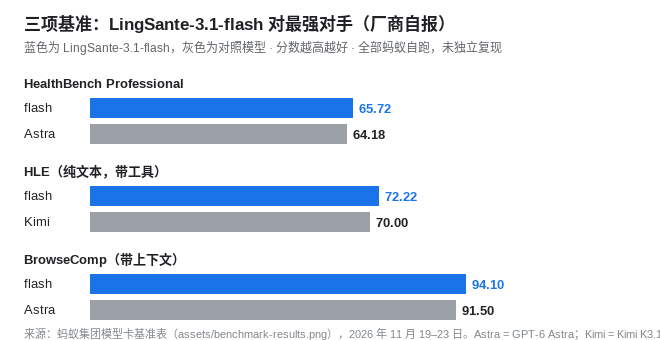
LingSante-3.1-flash's place in one table: it leads on HealthBench Professional, HLE with tools and BrowseComp, but trails badly on MedXpertQA-Text and InclusionMed-DxFiles — not a sweep, a scorecard with clear strengths and weaknesses. All figures vendor-reported.
| Model | Size / active | HealthBench Professional | HLE (with tools) | BrowseComp | Weights |
|---|---|---|---|---|---|
| LingSante-3.1-flash | 560B / 25B active | 65.72 (#1) | 72.22 (#1) | 94.10 (#1) | MIT |
| GPT-6 Astra | Not in this round's research | 64.18 | 63.59 | 91.50 | Closed |
| Kimi K3.1 Pro | Not in this round's research | Not in this round's research | 70.00 | Not in this round's research | Custom licence |
| Claude Opus 5.5 | Not in this round's research | 61.19 | 63.03 | 90.80 | Closed |
| Gemini 4 Argon | Not in this round's research | 55.91 | 61.17 | 77.52 | Closed |
| Ling-3.0-flash-Sante (predecessor) | 124B / 5.1B active | Not in this round's research | Not in this round's research | Not in this round's research | MIT |
On Kimi K3.1 Pro: HLE with tools 70.00, only 2.22 points behind flash; Tau3-Banking 58.08, ahead of flash's 53.61. On MedXpertQA-Text, flash's 57.27 trails Gemini 4 Argon's 71.35 by 14.08 points. Full table in section 11, comparisons in section 13.
03Charts
LingSante-3.1-flash vs the strongest rival on three benchmarks: flash leads on all three, but HealthBench Professional by only 1.54 points over Astra and HLE by only 2.22 points over Kimi K3.1 Pro — narrow leads. All figures vendor-reported, not independently reproduced.
04Top 3 reads
Short on time? Start with these three: the benchmark tally, the specs breakdown and the deployment guide — all three take apart the line "65.72, 560B, 1M context".
05Timeline
The family took shape in one month: the general base and the previous medical model went open in October, the weights were silently posted on November 19, and the conference, Qubit's on-site report and TechNode's coverage all landed on November 23–24; as of November 26, no benchmark has been independently reproduced, though the first independent score (MLCR-AA 23.3%) appeared on November 23.
- Oct 13, 2026
General base Ling-3.1-flash released under MIT; the same batch already carried the 1M-vs-256K context gap.
- Oct 19, 2026
Previous-generation medical model Ling-3.0-flash-Sante released under MIT: 124B total, 5.1B active, 127,486,405,600 parameters.
- Nov 13, 2026
The same inclusionAI org releases the Duo v1 audio-video world model: Apache-2.0 code, weights under MiniMax's community licence (excluding the EU, UK, South Korea and the US) — a different licensing posture from LingSante.
- Nov 19, 04:30/04:31 UTC
inclusionAI/LingSante-3.1-flash and inclusionAI/LingSante-3.1-air-VL are created on Hugging Face, with no announcement. The MedGuard technical report goes to arXiv the same day (2611.25509).
- Nov 22 (evening)
Model cards completed: benchmark image tables, deployment guides and safety declarations go up; English independent commentary appears (CellCog, thehype.news).
- Nov 23, 2026
Formal release: five LingSante models announced at Ant's healthcare ecosystem conference, two core models open-sourced the same day; the BusinessWire release goes out; Qubit's on-site report is published (the fullest Chinese piece, with hands-on testing); the Afu app adds real-time audio-video consultations, and the Afu Fujie ring and Fuhuan wristband launch.
- Nov 23, 2026
First independent score: Artificial Analysis lists MLCR-AA at 23.3%. AA has built a page for LingSante-3.1-flash (slug lingsante-3-1-flash-1119), with no Intelligence Index yet (shown as Unknown), but carrying MLCR-AA — a private medical long-context reasoning benchmark built with Wisedocs — at 23.3%. It is the model's first independent score; it contrasts sharply with Ant's own HealthBench Professional 65.72, but the two measure different things (HealthBench is a rubric-scored clinical-dialogue benchmark; MLCR-AA is long-context medical reasoning over private documents) and cannot be offset directly. The same source notes the medical-training gain on HealthBench is only 0.37 points (65.72 vs the Ling-3.1-flash base's 65.35), and the base's 1019 checkpoint scores 29.6 on the AA Intelligence Index v5.0.1. See section 11.
- Nov 24, 00:36 UTC
TechNode publishes "Ant Group releases LingSante medical AI models": both models, both sizes, both contexts, MIT licences, the Nov 23 conference framing.
- Nov 24, 2026
China Daily covers the LingSante launch: China Daily reports on Nov 24 that Ant has released its LingSante family of healthcare-specialised models and plans a gradual open-source rollout, with LingSante-3.1-flash ranking first among open-source models on InclusionMed; per the Nov 26, 2026 Medical AI Daily citing 21st Century Business Herald, Pulse, MedGuard and Live will follow in stages. This closes the watch item on a first tier-1 Chinese media report (Jiqizhixin and Xinzhiyuan still have no coverage — see section 14).
- Nov 25, 2026
The Bailing WeChat account separately announces LingSante-Pulse: a physiological-signal foundation model, one night of sleep data predicting six-year disease risk (a vendor claim, unverified).
- Nov 26, 2026
This site's topic page goes live (this page). As of publication: the vendor-reported benchmarks still have no independent reproduction; AA has a first independent score, MLCR-AA 23.3%, but no Intelligence Index yet, and LiveBench / LMArena still have no entry; flash still has no per-token price (air-VL gained one the same day — see the next entry); air-VL's benchmark table is still image-only, with no numeric text table.
- Nov 26, 2026
air-VL lists on OpenRouter: the first per-token hosted API. LingSante-3.1-air-VL listed on OpenRouter on Nov 26 (the OpenRouter vendor page's FAQ states it plainly: "the most recently added inclusionAI model on OpenRouter, listed on November 26, 2026"), hosted exclusively by DeepInfra at $0.06/M input tokens and $0.18/M output tokens, with cache reads at $0.012 (verified by this site reading the OpenRouter model page directly on the evening of Nov 26, 2026). First-day volume already passed 100M tokens: about 140M tokens as read on the evening of Nov 26 (this site read 140M at 20:16 UTC on Nov 26, 2026, and the number was still rising). Two wording points: first, the listing is for the 124B air-VL, not the 560B LingSante-3.1-flash — flash still has no per-token price; second, OpenRouter lists a 131K context against the model card's 256K — 131K matches the card's config value of 131,072, so it is probably the hosted effective value, and the discrepancy should be stated when citing it. Also note: Ling 3.2 Flash has a free tier on OpenRouter, but that is a different model (a 560B API-only flagship) and has nothing to do with this entry. See section 08.
06Official specs
As published (Hugging Face model cards, BusinessWire release, TechNode and frontiernow.dev's repo checks, Nov 19–26, 2026). Undisclosed items are written as "not disclosed", not guessed; conflicting figures are stated side by side.
- Status
- Released (formally announced 2026-11-23; weights silently posted Nov 19, model cards completed late Nov 22)
- Model ID
- inclusionAI/LingSante-3.1-flash (FP8) / inclusionAI/LingSante-3.1-flash-MXFP4 (MXFP4) / inclusionAI/LingSante-3.1-air-VL; Pulse encoder inclusionAI/LingSante-Pulse-1.0
- Positioning
- Medical model family: flash for complex clinical reasoning and long-horizon workflows, air-VL for imaging reports, skin and diet photos, medical search and appointment/pharmacy GUI agents, Live for in-Afu video consultations, Pulse for disease-risk prediction, MedGuard for safety review of medical answers
- Parameters
- flash: 560B total (model-card headline; file metadata 572.12B parameters), 25B active per token; air-VL: 124B total (file metadata 124.85B parameters), 5.5B active per token
- Architecture
- Hybrid-linear MoE: flash has 63 KDA (Kimi Delta Attention) layers + 9 Gated MLA layers (7:1), 4 dense layers, 512 routed experts + 1 shared expert, 8 active per token, 157,184-token vocabulary, 4,096 hidden size; air-VL is BailingMoeV3VLForConditionalGeneration with a 42-layer text backbone, also 512 experts with 8 active per token
- Context
- The flash card claims 1M tokens, but config.json sets max_position_embeddings to 262,144 with rope_scaling null; the air-VL card claims 256K, but text_config.max_position_embeddings is 131,072 and needs a manual YaRN override to reach 262,144. Neither figure works out of the box
- Training method
- flash uses ECM (evidence–capability matching) question generation: capabilities are fixed first, then questions are mined from cases and medical exam material, checked by the MEDPAR multi-agent system for facts and tested points, then split between supervised fine-tuning and reinforcement learning; verifiable-task RL on code is said to spill over to general ability (TerminalBench 42.00 → 50.84, GPQA 77.78 → 83.33, medical knowledge reasoning 80.13 → 81.51 — the team's figures as relayed by Qubit)
- air-VL capabilities
- Four clinical directions: medical imaging reports, multimodal health assessment (120+ skin diseases, diet and nutrition analysis, report interpretation), medical search and evidence synthesis, medical GUI agents (appointments: hospital, department, doctor, time slot; pharmacy purchases: prescriptions, addresses, pop-ups); general multimodal ability retained: OCR, document and chart understanding, multimodal search, GUI interaction; a single complex chest X-ray can surface 8–9 types of positive findings
- Weight size
- flash FP8 ~573.8GB (54 shards, E4M3, 1.49B parameters kept in BF16), MXFP4 ~313.2GB; air-VL BF16 ~249.7GB
- Hardware
- flash: SGLang with MTP speculative decoding, 8×H200 (TP8/EP8) or 4×GB300; air-VL: SGLang, 4×141GB-class GPUs (TP4, 256K context with YaRN) or 8×80GB H100/H800; both require trusting custom code at load time
- Deployment frameworks
- SGLang (recommended, with lmsysorg/sglang:dev-ling-3.0-flash-VL and dev-ling-3.1-flash images), vLLM (inclusionAI/vllm-ling-v3 fork); air-VL inference needs --reasoning-parser ling3 --tool-call-parser ling3
- API
- Computrix and Ant Digital Technologies' MaaS platform host the API (flash and MedGuard 4B listed); free-tier use requires a $20/month Basic Token Plan; flash has no published per-token price. air-VL listed on OpenRouter on Nov 26, 2026 (hosted exclusively by DeepInfra, model ID inclusionai/lingsante-3.1-air-vl): $0.06/M input tokens, $0.18/M output tokens, cache reads $0.012; OpenRouter lists a 131K context against the model card's 256K (see section 08); first-day volume was about 140M tokens as read on the evening of Nov 26
- Weights / licence
- Both weight releases MIT; Pulse encoder MIT (task heads not published, CGM weights in the GitHub repo); MedGuard code and 14,588 evaluation records Apache-2.0 (safety 10,248, compliance 3,808, ethics 532, including 578 images), weights via MaaS
- Benchmarks
- All vendor-reported except MLCR-AA 23.3% (AA's first independent score, Nov 23, 2026) — see section 11; AA has no Intelligence Index yet, no LiveBench / LMArena entry; InclusionMed inaugural ranking: flash 5th of 23 configs (45.064)
- MedGuard sizes
- 4B / 9B / 27B, with F1 of 82.3, 82.5 and 87.4 in the repo table; technical report arXiv:2611.25509 (Nov 19)
- Not disclosed
- flash's per-token pricing (air-VL's was published on OpenRouter on Nov 26 — see section 08); training data and compute; inference speed (tokens/second); Live's architecture; Pulse task-head release timing; why only two models shipped weights (no written reason from the developer)
07How to try it: three routes
Three routes exist: self-hosted weights, a hosted API, and the Afu app product experience. Realistically: the first is a datacenter-class setup, the second is the normal way to touch the models, and the third needs no model at all — just the product.
1Hosted API (main route)
Request an API key on Computrix or Ant Digital Technologies' MaaS platform to call flash (MedGuard 4B is also listed): note that free-tier use requires a $20/month Basic Token Plan first — not genuinely zero-barrier; flash has no published per-token price, so usage cost must be checked on the platform's actual page. air-VL has a more direct route: it listed on OpenRouter on Nov 26, 2026 (model ID inclusionai/lingsante-3.1-air-vl, hosted exclusively by DeepInfra) at $0.06/M input tokens and $0.18/M output tokens, with cache reads at $0.012 — the family's first per-token hosted API. Note the listing is for the 124B air-VL, not the 560B flash. See our deployment and access guide.
2Self-hosted weights (expert route)
Download the weights from Hugging Face (inclusionAI/LingSante-3.1-flash FP8 ~573.8GB, MXFP4 ~313.2GB; inclusionAI/LingSante-3.1-air-VL BF16 ~249.7GB) and deploy with SGLang or vLLM: flash's reference setup is 8×H200 or 4×GB300, air-VL's is 4×141GB-class GPUs; loading requires trusting custom code — review it first. See our deployment and access guide.
3Afu app (product route)
Try LingSante Live's real-time video consultations and report interpretation inside the Afu app (formerly AQ): no weights to download, no key to request; human doctors across 16 specialties can review AI answers. Note this is a product feature, not a model trial; model output does not replace a licensed physician's diagnosis. See our launch overview.
Also: unofficial community quantisations exist (mradermacher's air-VL GGUF, alesha-pro's W4A16, aitamedia's MXFP4) — third-party modifications made within four days of release, with no quality numbers; verify before deploying, and don't cite them as official.
08Pricing & access
Three price lines: weights free (MIT), the hosted API (a $20/month gate on the free tier), and self-hosting hardware (8×H200 or 4×GB300). The key point has changed: air-VL gained a per-token price on Nov 26 (OpenRouter, hosted exclusively by DeepInfra, $0.06/$0.18 per 1M tokens), while the 560B flash still has no published usage-based price; the rumoured "$0.25 per task" is unverified and not used on this site. Prices checked Nov 26, 2026; the platform page price is authoritative.
| Channel | Price | Basis |
|---|---|---|
| Weights (Hugging Face / ModelScope) | Free | MIT licence, commercial use allowed; flash FP8 ~573.8GB, MXFP4 ~313.2GB; air-VL BF16 ~249.7GB |
| Computrix API (free tier) | Requires a $20/month Basic Token Plan | Free-tier use requires buying that plan first; not zero-barrier free |
| Computrix / MaaS API (usage-based, flash) | Not published | No per-token price published for flash; check the platform's actual page |
| OpenRouter API (air-VL, hosted exclusively by DeepInfra) | $0.06 in / $0.18 out per 1M tokens, cache reads $0.012 | Listed Nov 26, 2026, the family's first per-token hosted API; model ID inclusionai/lingsante-3.1-air-vl; first-day volume about 140M tokens as read on the evening of Nov 26 (this site read 140M at 20:16 UTC) |
| MedGuard (MaaS) | Not published | Weights not public; API key required; price not published |
| Afu app (product features) | In-app experience | Live video consultations and other product features; human-doctor review in 16 specialties |
| Self-hosting hardware (flash reference) | 8×H200 or 4×GB300 | Datacenter-class setup; rental cost not published |
| Self-hosting hardware (air-VL reference) | 4×141GB-class GPUs or 8×H100/H800 | Datacenter-class setup; rental cost not published |
air-VL has the first usage-based hosted channel
Before Nov 26, no model in the family could be bought per token: weights were free, the Computrix free tier needed a $20/month plan first, and no usage-based price was published. air-VL's OpenRouter listing changes that — $0.06/M input tokens and $0.18/M output tokens, cache reads at $0.012, DeepInfra the sole host, with first-day volume already about 140M tokens as read on the evening of Nov 26. State two wording points clearly: first, this is air-VL's price, not flash's — the 560B flash still has no per-token price; second, OpenRouter lists a 131K context, not the model card's 256K — 131K matches the card's config value of 131,072 and is probably the hosted effective value, so check the OpenRouter model page before calling. The model is still not a medical device: research and evaluation only, no independent diagnosis, prescriptions or treatment.
"Free tier" is not zero-barrier
Computrix's free tier requires a $20/month Basic Token Plan first — the gating condition aireport.net verified. Calling it "free trial" would mislead readers: pay $20/month first, then use the free tier. No per-token price is published for usage-based billing, so don't convert from any third-party listing.
The real cost is hardware
Free weights don't mean free runs: flash FP8 is ~573.8GB with an official reference of 8×H200 or 4×GB300; air-VL BF16 is ~249.7GB with 4×141GB-class GPUs. For almost every reader, the hosted API is the realistic trial route; self-hosting is an institutional option.
Official pages: Hugging Face — inclusionAI/LingSante-3.1-flash (MIT licence, benchmark table, deployment guide) · Hugging Face — inclusionAI/LingSante-3.1-air-VL (MIT licence, image benchmark tables, deployment guide)
09First coverage
All of the following is first-wave coverage from Nov 22–26: the vendor-reported benchmarks still have no independent reproduction, but the first independent score appeared on Nov 23 (MLCR-AA 23.3%, see below); otherwise one tier-1 Chinese outlet's on-site report, a same-day English tech-media report, and first-hand repo/config/card reads from niche trackers. Each entry carries a verdict badge; "read our full article" opens this site's rewritten in-depth article, with the original source at the end.
Qubit: Nov 23 on-site report, the fullest Chinese piece, with hands-on testing
Verdict: the source for the launch facts; its hands-on test used the Ling-3.0-flash-VL base, not air-VL — cite with that noteSource: Qubit, Nov 23, 2026 on-site report (as quoted by frontiernow.dev and econews.cn)
Qubit's Nov 23 on-site report is the fullest Chinese piece: the five-model list, both open models' parameters and positioning, Afu's 150M users and ~20M daily consultations, the ECM training method and the RL spillover figures (TerminalBench 42.00 → 50.84 and others) all come from here. Two caveats: first, its hands-on test used the Ling-3.0-flash-VL base, not the released air-VL — reporters stripped units and reference ranges from a blood panel, hid haemoglobin and red-cell counts, and gave it to the base model and GPT-6.2 Sol; the base model refused to conclude and asked for more values, while GPT-6.2 Sol inferred moderate iron-deficiency anaemia from other markers. Second, its relayed benchmark figures disagree with the model card (HealthBench 66.03%, MentalHealthBench 55.58%, composite 58.35%; the card says 65.72 and 54.64 with no composite) — this site cites the card figures and flags the media figures separately.
Read our full article → (ModelBrief original)
TechNode: the strongest English report, both models and the conference framing in one piece
Verdict: the source for the English-language launch facts; both sizes, both contexts and the MIT licences checked in one passSource: TechNode, Nov 24, 00:36 UTC Original →
TechNode's Nov 24 article is the strongest English report on the release: both models, both sizes (560B/25B and 124B/5.5B), both contexts, the MIT licences and the Nov 23 conference framing, all in one piece. No tier-1 English outlet (TechCrunch / The Verge / Reuters / Bloomberg) has covered it, so TechNode is the strongest public English source.
Read our full article → (ModelBrief original)
frontiernow.dev: the deepest secondary analysis, first-hand repo and config checks
Verdict: the deepest secondary analysis; the 1M/262K gap, the air-VL image-table transcription and the composite-score mismatch all come from hereSource: frontiernow.dev, Nov 23–24 Original →
frontiernow.dev's analysis checks the repos and model cards first-hand: the Nov 19 04:30 UTC creation, 54 shards, 573,753,281,152 bytes, flash's config at 262,144 rather than 1M, air-VL's text_config at 131,072, and a full transcription of air-VL's benchmark image table (CheXpert Plus 46.21, AFUMED-Derm 70.01, AFUMED-Report 90.70 and others). It also flags that Qubit's composite 58.35% has no matching table in the model card, and that Gemini 3.8 Flash (73.13) beats air-VL (72.80) by 0.33 on AFUMED-Food — against the media claim that air-VL ranked first across the board.
Read our full article → (ModelBrief original)
BusinessWire release: the official launch wording, InclusionMed's first appearance
Verdict: the source for the official wording; Afu user figures and the InclusionMed ranking are release claims, not independently auditedSource: BusinessWire (via Morningstar), Nov 23 Original →
Ant's Nov 23 official release confirms the family picture: five models, two open-sourced the same day, Pulse covering 150+ disease-risk predictions, MedGuard for safety, compliance and bioethics review, Live designed around the traditional Chinese medicine principle of "look, listen, ask, and analyse"; it also announces the InclusionMed open evaluation and analytics platform, co-launched with researchers from 29 institutions including Stanford, Harvard and Peking Union Medical College, with flash ranked first among open-source medical models in its inaugural ranking; Afu's 150M users, ~20M daily consultations and a planned international version across 170+ countries and regions come from here too — all company-supplied figures, not independently audited.
Read our full article → (ModelBrief original)
CellCog and thehype.news: English independent commentary, flagging the verification gap on Nov 22
Verdict: the critical view; "no third-party re-testing, no pricing page, no clinical evidence" comes from hereSource: CellCog, thehype.news, Nov 22 (as quoted by frontiernow.dev)
Two English independent commentaries, published the day before the conference, note that every score comes from Ant's own harness — no third-party re-testing, no pricing page, no clinical evidence — and that the model card itself states "benchmark and simulated-environment results do not establish clinical effectiveness". thehype.news also counts 4 of 16 figures as internal evaluations and notes the comparison table omits the base model, so the leads are narrower than the launch wording suggests.
Read our full article → (ModelBrief original)
aireport.net and threatcluster.io: niche tracking at the deployment and repo level
Verdict: the source for deployment wording and repo history; the Computrix $20/month gate comes from hereSource: aireport.net (updated Nov 26) Original → · threatcluster.io Original →
aireport.net's flash deep dive gives the benchmark table, the context discrepancy, the hardware recipes, the Computrix $20/month gate and the model card's safety wording; threatcluster.io reads the repo history (04:30/04:31 UTC creation, no announcement) and deployment scale (~292GB quantised, 4 datacenter GPUs), and notes very few downloads and likes at launch.
Read our full article → (ModelBrief original)
China Daily: the Nov 24 launch report and gradual open-source plan
Verdict: the first tier-1 Chinese media coverage confirmed; the InclusionMed open-source #1 matches the BusinessWire wordingSource: China Daily, Nov 24, 2026 (via AIFOD) Original →
China Daily reported on Nov 24 that Ant has released its LingSante family of healthcare-specialised models and plans a gradual open-source rollout, with LingSante-3.1-flash ranking first among open-source models on InclusionMed — matching the BusinessWire wording of first among open-source healthcare models. Per the Nov 26, 2026 Medical AI Daily citing 21st Century Business Herald, Pulse, MedGuard and Live will follow in stages. This closes the watch item on a first tier-1 Chinese media report.
OrcaRouter: the first independent score, MLCR-AA 23.3% — read it with its limits
Verdict: the source of the first independent score; 23.3% and 65.72 measure different things and cannot be offset directlySource: OrcaRouter, Nov 23, 2026 Original →
OrcaRouter's Nov 23 direct read of Artificial Analysis' model page: LingSante-3.1-flash has a page (slug lingsante-3-1-flash-1119), with no Intelligence Index yet (shown as Unknown), but carrying MLCR-AA — a private medical long-context reasoning benchmark built with Wisedocs — at 23.3%. It is the model's first independent score; it contrasts sharply with Ant's own HealthBench Professional 65.72, but the two measure different things: HealthBench is a rubric-scored clinical-dialogue benchmark, MLCR-AA is long-context medical reasoning over private documents, so they cannot be offset directly. The same source's comparison analysis adds that the medical training gained only 0.37 points on HealthBench (65.72 vs the Ling-3.1-flash base's 65.35), and that the base's 1019 checkpoint scores 29.6 on the AA Intelligence Index v5.0.1.
Read our full article → (ModelBrief original)
OpenRouter lists air-VL: the first per-token hosted API
Verdict: the family's first hosted channel with a published usage-based price — note the listing is air-VL, not flashSource: OpenRouter, Nov 26, 2026 Vendor page → · Model page →
OpenRouter listed LingSante-3.1-air-VL on Nov 26 (the vendor page's FAQ states it is "the most recently added inclusionAI model on OpenRouter, listed on November 26, 2026"), hosted exclusively by DeepInfra at $0.06/M input tokens and $0.18/M output tokens, with cache reads at $0.012, a 131K context, up to 32,768 output tokens, and tool calling plus structured output. First-day volume already passed 100M tokens — about 140M as read on the evening of Nov 26 (this site read 140M at 20:16 UTC). State two wording points: first, OpenRouter's 131K context differs from the model card's 256K, and 131K matches the card's config value of 131,072, so it is probably the hosted effective value; second, the listing is for the 124B air-VL, while the 560B flash still has no per-token price. DeepInfra's model page also confirms it serves the official MXFP4 checkpoint and restates that the model is a research model, not a medical device.
Independent reproduction: none yet — but the first independent score has appeared
Verdict: no vendor benchmark has been independently reproduced; no evaluation run logs are published; MLCR-AA is a separate independent test, not a reproductionSource: this site's research, Nov 26, 2026
CellCog, thehype.news and frontiernow.dev all state explicitly that every benchmark figure is Ant's own run, with no independent lab or public leaderboard reproducing any of them, and no evaluation harness files or run logs published alongside the numbers. The weights are now open, so the community can run them itself — the first thing this site's 8-hour tracking loop will watch for. Keep the distinction clear: the MLCR-AA 23.3% that appeared on Nov 23 is an independent score on a different test — long-context medical reasoning over private documents — not a reproduction of the vendor's 41-row benchmark table, so it does not change the "no independent reproduction" conclusion.
10Article index: in-depth reads
The 6 articles below are all ModelBrief originals — rewritten and reorganised with added conclusions and selection advice, with facts and figures checked against the original sources. Click any article to read it on this site; original sources are listed at the end of each article.
11Benchmarks: vendor-reported, with a first independent score — MLCR-AA 23.3%
LingSante's benchmark story has only one set of numbers — Ant's own runs: flash's 8-benchmark comparison and air-VL's image table, with no independent score to check them against — until Nov 23, when Artificial Analysis listed a first independent score, MLCR-AA 23.3%. But it measures a different capability, not a reproduction of the vendor table, so read it with its limits. Fix that sentence first, then look at the numbers: flash takes three firsts (HealthBench Professional, HLE with tools, BrowseComp) but trails Gemini 4 Argon by 14.08 points on MedXpertQA-Text and by 17.31 on InclusionMed-DxFiles.
flash: 8-benchmark comparison (vendor-reported; vs GPT-6 Astra / Claude Opus 5.5 / Gemini 4 Argon)
| Benchmark | LingSante-3.1-flash | GPT-6 Astra | Claude Opus 5.5 | Gemini 4 Argon |
|---|---|---|---|---|
| HealthBench Professional | 65.72 | 64.18 | 61.19 | 55.91 |
| DiagnosisArena-MCQ | 83.9 | 84.7 | 82.6 | 77.8 |
| MentalHealthBench | 54.64 | 57.50 | 51.72 | 39.56 |
| MedXpertQA-Text | 57.27 | 63.22 | 67.14 | 71.35 |
| InclusionMed-DxFiles | 56.09 | 71.15 | 62.18 | 73.40 |
| BrowseComp (with context) | 94.10 | 91.50 | 90.80 | 77.52 |
| HLE (text-only, with tools) | 72.22 | 63.59 | 63.03 | 61.17 |
| MCP-Atlas | 83.98 | 81.60 | 85.40 | 88.30 |
Also: EHR-Complex 74.40 is the table's top score; Tau3-Banking 53.61 trails Kimi K3.1 Pro's 58.08 and Claude Opus 5.5's 57.39; PhysicianBench, CHI-Bench, EHR-Complex and PatientAgentBench rank in the top two of their agent category. All figures vendor-reported (flash model card assets/benchmark-results.png, the team's own harness, not cross-checked with any third party), not independently reproduced.
air-VL: image-table transcription (vendor-reported; vs GPT-6.1 Sol / Claude Opus 5.5 / Gemini 3.8 Flash)
air-VL's benchmark table exists only as images on the model card (assets/benchmark-results.png), with no numeric text table — verified by this site reading the model card directly on Nov 26, 2026. The figures below are frontiernow.dev's transcription of that image table, cited as a transcription: imaging reports CheXpert Plus 46.21, IU X-RAY 64.34, MIMIC-CXR 47.20; skin assessment AFUMED-Derm 70.01; medical report interpretation AFUMED-Report 90.70; document recognition OmniDocBench 91.20 — all six the table's top scores; diet and nutrition AFUMED-Food 72.80, below Gemini 3.8 Flash's 73.13; HealthBench Professional only 49.59; MedXpertQA-MM, MMMU-Pro-Med, GMAI-MMBench and CharXiv-RQ — the medical-knowledge and chart-understanding items — trail by double digits (MedXpertQA-MM 14.40 points behind Gemini 3.8 Flash).
First independent score: MLCR-AA 23.3% (Artificial Analysis, Nov 23, 2026)
| Item | Score | Note |
|---|---|---|
| MLCR-AA (medical long-context reasoning, a private AA/Wisedocs benchmark) | 23.3% | First independent score; direct read of the AA model page, Nov 23, 2026 (OrcaRouter) |
| AA Intelligence Index | Unknown (not listed) | The AA model page shows Unknown; no index score yet |
| HealthBench Professional (vendor-reported) | 65.72 | Measures a different thing from MLCR-AA; cannot be offset directly |
| HealthBench gain from medical training (vs the Ling-3.1-flash base's 65.35) | Only +0.37 points | Same source's comparison analysis (OrcaRouter) |
| Base Ling-3.1-flash 1019 checkpoint, AA Intelligence Index v5.0.1 | 29.6 | Same source's comparison analysis (OrcaRouter) |
How to read the 23.3%: it is the only figure on the AA model page that does not come from the vendor, and it measures long-context medical reasoning over private documents — a harder task than HealthBench's rubric-scored clinical dialogue, so the lower number does not prove the vendor's 65.72 is false. But it does show that the "on par with closed-source flagships" claim currently rests only on the vendor's own harness, and the single external harness gives a much lower number. Two further independent restatements (aiweekly, emergent.sh) corroborate the 23.3% reading. The base comparison is also worth recording: the medical training moved HealthBench only from 65.35 to 65.72 (+0.37 points); the real gains are in general reasoning (HLE text-only without tools 37.44 → 44.07), at the cost of some general agent ability falling back — see OrcaRouter's base comparison analysis for the detail.
The shape of the wins and losses: retrieval and long tasks ahead, exam-style medical knowledge behind
The shape is clear and worth stating plainly: flash's strengths are retrieval and long tasks — BrowseComp 94.10, HLE 72.22 and EHR-Complex 74.40 are all table-topping; its weaknesses are exam-style medical knowledge — MedXpertQA-Text 14.08 points behind Gemini 4 Argon, InclusionMed-DxFiles 17.31 behind, MentalHealthBench behind both Astra and Opus 5.5. air-VL has the same shape: imaging reports and skin assessment ahead, medical knowledge and chart understanding behind. This is not a sweep; it is a scorecard with clear strengths and weaknesses.
Qubit's figures disagree with the model card's
Qubit relays HealthBench Professional 66.03%, MentalHealthBench 55.58%, a self-built Chinese set MedBehave-ZH 53.44% and a composite 58.35%, calling the composite "second only to GPT-6 Astra, open-source SOTA"; the model card's table lists the first two as 65.72 and 54.64, with no composite and no MedBehave-ZH entry. Both figures come from the team, and the difference is probably in the evaluation configuration — this site cites the model card's figures and flags the media figures separately. A 61.21% composite relayed by another aggregator matches neither; this site uses no composite score.
Full tally in our benchmark article →
12Related topics
Other ModelBrief topics. GPT-6 Astra and Kimi K3.1 Pro are the direct rivals in LingSante's benchmark table; ERNIE 5.5 Flash Preview, Sage S2.1 Flash and Edge0-145B are contemporary Chinese / open-weight topics; WeMM-Video is a video-understanding topic built in the same round as this one.
 GPT-6.2 AstraReleased 2026-11-17 · OpenAI GPT-6.2 model, AA Index 62. Specs, pricing, benchmarks and in-depth articles.
China · LLM · Open weights · Weights public Nov 5, 2026
 Kimi K3.1 ProWeights public 2026-11-05 · Moonshot AI Kimi K3.1 Pro, AA Index 46. Specs, pricing, benchmarks and in-depth articles.
China · LLM · Preview intermediate · Nov 11, 2026
 ERNIE 5.5 Flash PreviewReleased 2026-11-11 · Baidu 280B/14B MoE, a self-described unfinished Preview, 1M context, all benchmarks vendor-reported. Specs, pricing, benchmarks and in-depth articles.
China · LLM · GA · Nov 16, 2026
 Sage S2.1 FlashReleased 2026-11-16 · Shanghai AI Lab 320B scientific multimodal agent model, MIT open weights; MLE-bench Lite 90.3 (vendor-reported). Specs, pricing, benchmarks and 6 in-depth articles.
LLM · Open weights · Nov 12, 2026
 Edge0-145BReleased 2026-11-12 · Open-weight language model. Specs, pricing, benchmark analysis and in-depth articles.
China · Video understanding · Built in the same round
 WeMM-VideoTencent video-understanding model family, built in the same round as LingSante. Specs, benchmark analysis and in-depth articles.
China · LLM · Vision-Language Model · Released Nov 23, 2026
 Ling-3.2-airReleased Nov 23, 2026 · Ant Group's general-purpose VLM, 124B/5.5B hybrid-linear MoE, MIT open weights, AutomationBench-AA 61.0, AA Index 23.4; no hosted API. The topic page covers official specs, benchmarks and 6 in-depth reviews.
13Comparisons
vs GPT-6 Astra (the headline rival)
| Dimension | LingSante-3.1-flash | GPT-6 Astra |
|---|---|---|
| HealthBench Professional | 65.72 (#1, vendor-reported) | 64.18 |
| HLE (with tools) | 72.22 | 63.59 |
| BrowseComp | 94.10 | 91.50 |
| MedXpertQA-Text | 57.27 | 63.22 |
| InclusionMed-DxFiles | 56.09 | 71.15 |
| MentalHealthBench | 54.64 | 57.50 |
| Weights / licence | MIT open weights | Closed |
| Price | Weights free; air-VL has an OpenRouter usage-based price ($0.06/$0.18), flash still has no per-token price | Not in this round's research |
All figures vendor-reported (Ant model cards), not independently reproduced. flash vs Astra is 4 wins and 4 losses — don't write "beats Astra". See our comparison article.
vs Kimi K3.1 Pro (the HLE and Tau3 rival)
| Dimension | LingSante-3.1-flash | Kimi K3.1 Pro |
|---|---|---|
| HLE (with tools) | 72.22 | 70.00 |
| Tau3-Banking | 53.61 | 58.08 |
| Independent score | None (no AA entry) | AA Index 46 (this site's topic-page figure) |
| Weights / licence | MIT open weights | Open weights, custom licence |
On HLE, flash leads Kimi by only 2.22 points; on Tau3-Banking it trails by 4.47 — a win apiece. See our comparison article.
vs the predecessor Ling-3.0-flash-Sante and the general Ling-3.1-flash base
The predecessor Ling-3.0-flash-Sante (Oct 19, 2026, 124B/5.1B, MIT) was a single-model release aimed at medical Q&A; the LingSante family turns it into five roles: flash for complex clinical reasoning and long-horizon workflows, air-VL for multimodal material interpretation. flash's base is the general Ling-3.1-flash (Oct 13, 2026, MIT open weights), but the comparison table omits the base model, so there is no way to tell how much the medical fine-tuning actually bought — a gap thehype.news flags. air-VL's base is Ling-3.0-flash-VL, and Qubit's hands-on test used exactly that base model, not air-VL itself.
Disambiguation from Ling-3.2-air: not the same model
LingSante-3.1-air-VL is a medical model built on Ling-3.0-flash-VL, 124B/5.5B, MIT; Ling-3.2-air is a general-purpose model built on Ling-3.2, also 124B/5.5B and MIT — same vendor, same size, similar names, but different bases, positioning and release dates. Don't confuse them. Ling-3.2-air has its own topic page queued on this site and is not covered here.
Read the deep comparison: LingSante vs Astra, Kimi K3.1 Pro and Ling-3.2-air →
14What's missing (as of Nov 26)
- Any independent reproduction of any benchmark: all vendor-reported, no independent lab reproduction, no evaluation run logs
- AA entry: first independent score MLCR-AA 23.3% exists, but no Intelligence Index; LiveBench / LMArena still no scores
- Per-token pricing: air-VL's was published on OpenRouter on Nov 26 ($0.06/$0.18 — see section 08); flash's is still unpublished; Computrix usage-based pricing must be checked on the platform's actual page
- A numeric text table for air-VL benchmarks: the model card has only two benchmark images, no numeric table; this site's figures are frontiernow.dev's transcription of the image table
- An explanation for the gap between Qubit's composite 58.35% and the model card's figures: both come from the team, the difference is probably in the evaluation configuration, and the developer has not explained it
- Live's architecture: no public material
- Pulse task-head release timing: the encoder is public, the task heads are not, with no timetable
- MedGuard weight publication plans: weights go via MaaS, with no public timetable
- Why only two models shipped weights: no written reason from the developer
- Tier-1 English media coverage: no TechCrunch / The Verge / Reuters / Bloomberg / Wired
- Jiqizhixin / Xinzhiyuan Chinese coverage: not found in this round's searches (Qubit has reported on site). China Daily (Nov 24) and 21st Century Business Herald (cited by Medical AI Daily, Nov 26) have covered it, closing the watch item on a first tier-1 Chinese media report
- Inference speed (tokens/second): not published
- Training data and compute: not published
- Self-hosting rental costs: no published rental price for 8×H200 / 4×GB300 / 4×141GB-class GPUs
15Rumor check
Confusion around LingSante comes from eight places: the release date, the 1M context, "beats Astra", "open-source SOTA", the composite score, local deployment, Pulse and pricing — each clarified below.
False "Released on November 23"
November 23 is the conference announcement date; the weights were silently created on November 19 at 04:30/04:31 UTC, four days earlier; the model cards were only completed late on November 22.
False "1M context out of the box"
flash's config is 262,144 with rope_scaling null; the card footnote says 1M applies only to evaluations with context management such as BrowseComp and HLE. air-VL's text_config is 131,072 and needs a manual YaRN override to reach 262,144.
False "Beats GPT-6 Astra"
flash vs Astra is 4 wins and 4 losses: HealthBench 65.72 vs 64.18, HLE 72.22 vs 63.59, BrowseComp 94.10 vs 91.50 and MCP-Atlas 83.98 vs 81.60 are wins; DiagnosisArena-MCQ 83.9 vs 84.7, MedXpertQA-Text 57.27 vs 63.22, InclusionMed-DxFiles 56.09 vs 71.15 and MentalHealthBench 54.64 vs 57.50 are losses.
False "Open-source SOTA is an independent conclusion"
"Open-source SOTA" is the team's own phrase: the card says "leading among open-source models" on complex medical reasoning and "second overall, behind only GPT-6 Astra" on professional behaviour, with no third-party re-testing. On InclusionMed's inaugural ranking, flash ranks 5th of 23 configs (45.064) — a platform Ant co-launched, not an independent third-party board.
Unverified "Composite score 58.35% (or 61.21%)"
Qubit's relayed composite 58.35% has no matching table in the model card, which lists 65.72 and 54.64 for the first two items; another aggregator's 61.21% matches neither. Both figures come from the team and the difference is probably in the evaluation configuration — this site uses no composite score, only the card's per-benchmark table.
False "air-VL runs on an ordinary laptop"
air-VL's BF16 weights are ~249.7GB and the official recipe is 4×141GB-class GPUs or 8×H100/H800. "Supports local deployment" means the weights can be downloaded and run privately inside an institution's network — not on a personal laptop.
False "Pulse is a downloadable model"
What Pulse put on Hugging Face is only a signal encoder (inclusionAI/LingSante-Pulse-1.0, MIT, feature-extraction); the card states explicitly that it contains no task heads; CGM weights sit in the GitHub repo; disease-specific risk prediction still needs matching task models.
Unverified "$0.25 per task pricing"
The rumoured "$0.25 per task" is unverified and not used on this site. flash still has no published per-token price (air-VL's was published on OpenRouter on Nov 26 — $0.06/$0.18, see section 08); Computrix's free tier requires a $20/month Basic Token Plan first.
16FAQ
What is LingSante?
Ant Group's medical model family (Chinese name 灵犀医疗), announced November 23, 2026 at its healthcare ecosystem conference, with five members: LingSante-3.1-flash (560B/25B text medical reasoning model), LingSante-3.1-air-VL (124B/5.5B multimodal medical model), LingSante Live (in-Afu video consultations), LingSante Pulse (disease-risk prediction encoder) and LingSante MedGuard (safety review of medical answers). Only the first two ship full weights, both MIT open weights. See sections 01 and 06.
Can it diagnose patients or prescribe medicine?
No. The models are not medical devices, and the model cards state explicitly that they must not be used as an independent basis for diagnosis, prescriptions or treatment — research and evaluation only; high-risk use requires review by qualified personnel, independent validation and compliance with privacy and healthcare regulations. In the Afu app, human doctors across 16 specialties can review AI answers, but that is a product workflow, not permission for the model to practise medicine independently. See our safety and limits article.
What sizes exist?
Two weight releases: flash at 560B total with 25B active per token (file metadata 572.12B parameters) and air-VL at 124B total with 5.5B active per token. MedGuard also comes in 4B/9B/27B sizes, but its weights are not public and go via MaaS. Pulse ships only a signal encoder, with no task heads. See section 06.
Is it really stronger than GPT-6 Astra?
Don't write that. flash vs Astra is 4 wins and 4 losses: HealthBench Professional 65.72 vs 64.18, HLE 72.22 vs 63.59, BrowseComp 94.10 vs 91.50 and MCP-Atlas 83.98 vs 81.60 are wins; DiagnosisArena-MCQ 83.9 vs 84.7, MedXpertQA-Text 57.27 vs 63.22, InclusionMed-DxFiles 56.09 vs 71.15 and MentalHealthBench 54.64 vs 57.50 are losses. All figures are vendor-reported, with no independent reproduction. See sections 11 and 13.
How much does it cost?
The weights are free (MIT) to download; air-VL now has a per-token price — listed on OpenRouter on Nov 26, 2026 (hosted exclusively by DeepInfra) at $0.06/M input tokens and $0.18/M output tokens, with cache reads at $0.012. flash still has no per-token price: the hosted API runs through Computrix and Ant MaaS, where free-tier use requires a $20/month Basic Token Plan first; usage-based pricing is unpublished and must be checked on the platform's actual page. The rumoured "$0.25 per task" is unverified and not used here. See section 08 and our deployment and access guide.
Is there any independent evaluation?
Yes, one. The first independent score is Artificial Analysis' medical long-context reasoning benchmark MLCR-AA at 23.3% (Nov 23, 2026), but AA has no Intelligence Index yet and LiveBench / LMArena still have no score; none of the vendor's 41-row benchmark table has been independently reproduced. Note that 23.3% and the vendor's HealthBench 65.72 measure different things and cannot be offset directly. See section 11.
Are LingSante and Ling-3.2-air the same model?
No. LingSante-3.1-air-VL is a medical model built on Ling-3.0-flash-VL; Ling-3.2-air is a general-purpose model built on Ling-3.2. Same vendor, same size (124B/5.5B), similar names — but different bases, positioning and release dates. See our comparison article.
What is LingSante Pulse?
A physiological-signal foundation model (a signal encoder); the vendor claims one night of sleep data can predict six-year disease risk across 150+ conditions — unverified. Hugging Face hosts only the encoder (inclusionAI/LingSante-Pulse-1.0, MIT), and the card states explicitly that it contains no task heads; disease-specific risk prediction still needs matching task models. See our safety and limits article.
17Sources
Facts on this page come from the public sources below (Hugging Face model cards published and completed Nov 19–22, 2026; the conference and Qubit's report Nov 23; TechNode Nov 24; this site's research Nov 26, 2026, including a direct read of the air-VL model card).
Official
- Hugging Face model card — inclusionAI/LingSante-3.1-flash (MIT licence, 8-benchmark table, deployment guide, safety declaration; created 2026-11-19) Read directly Nov 26, 2026
- Hugging Face model card — inclusionAI/LingSante-3.1-air-VL (MIT licence, image benchmark tables, SGLang/vLLM guide, safety declaration; created 2026-11-19) Read directly Nov 26, 2026
- Hugging Face — inclusionAI/LingSante-Pulse-1.0 (signal encoder, MIT, feature-extraction, no task heads) 2026-11-19
- arXiv:2611.25509 — LingSante MedGuard technical report (4B/9B/27B, F1 82.3/82.5/87.4) 2026-11-19
- BusinessWire (via Morningstar) — "Ant Group's AI App Afu Open Sources Medical and Health AI Model Family" (five-model family, InclusionMed platform, Afu user figures) 2026-11-23
Chinese coverage
- Qubit — "蚂蚁医疗健康 AI 五连发!开源、本地部署、望闻问切全安排上了" (Nov 23 on-site report, the fullest Chinese piece, with hands-on testing; the test used the Ling-3.0-flash-VL base) 2026-11-23
- China Daily (via AIFOD) — "Ant Group unveils specialized LingSante healthcare AI models, plans gradual open-source release" (LingSante family released with a gradual open-source plan; LingSante-3.1-flash first among open-source models on InclusionMed) 2026-11-24
- Bailing WeChat account — LingSante-Pulse announcement (physiological-signal foundation model, one night of sleep data predicting six-year disease risk) 2026-11-25
- Medical AI Daily — citing 21st Century Business Herald: Pulse, MedGuard and Live to follow in stages 2026-11-26
English coverage and analysis
- TechNode — "Ant Group releases LingSante medical AI models" (both models, both sizes, MIT licences, conference framing) 2026-11-24 00:36 UTC
- frontiernow.dev — "LingSante: Ant opens two medical models" (five-model table, repo checks, 1M/262K gap, air-VL image-table transcription, composite-score mismatch) 2026-11-23–24
- aireport.net — "LingSante-3.1-flash: 560B MoE with 25B active, MIT weights, HealthBench Professional 65.72, HLE with tools 72.22" (benchmark table, hardware recipes, Computrix $20/month gate) Updated 2026-11-26
- threatcluster.io — "Ant Group's LingSante Medical AI Models Released on Hugging Face Without Announcement" (repo history, deployment scale, download counts) 2026-11-23–24
- anchorterminal.com — "LingSante-3.1-flash review (2026)" (54 shards, custom code files, MXFP4 build) 2026-11-23–24
- CellCog and thehype.news — English independent commentary (no third-party re-testing, no pricing page, no clinical evidence; comparison table omits the base model) 2026-11-22
- OrcaRouter — "LingSante-3.1-flash Medical Parity: One Independent Score" (direct read of the AA model page: first independent score MLCR-AA 23.3%, no Intelligence Index yet; measures a different thing from the vendor's HealthBench 65.72 and cannot be offset directly) 2026-11-23
- OpenRouter — inclusionAI vendor page (air-VL is the most recently added inclusionAI model, listed Nov 26, 2026; first-day volume about 140M tokens) Read directly Nov 26, 2026, 20:16 UTC
- OpenRouter — inclusionAI/LingSante-3.1-air-VL model page (hosted exclusively by DeepInfra: $0.06/$0.18 per 1M tokens, cache reads $0.012; 131K context, up to 32,768 output tokens) Read directly on the evening of Nov 26, 2026
- OrcaRouter — "LingSante-3.1-flash vs Ling-3.1-flash" (medical training gained only 0.37 points on HealthBench; base Ling-3.1-flash 1019 checkpoint at 29.6 on the AA Intelligence Index v5.0.1) 2026-11-22
- This site's research, Nov 26, 2026: Google Autocomplete — 4 suggestions for the bare English term, none for the four Chinese queries; Google Trends — one attempt returned HTTP 411, no data; HF direct read of the air-VL model card (benchmark tables image-only, no numeric text table) and 4,635 downloads last month; no tier-1 English media coverage; all benchmarks confirmed vendor-reported, none independently reproduced
More indexes: All Ant Group models · All Language Models · All models