 Sage S2.1 Flash: The Topic Page
Shanghai AI Laboratory's (InternLM team) scientific multimodal agent model, formally released November 16, 2026 — first, the positioning: the weights actually appeared quietly on Hugging Face on November 15, with a one-line model card and no announcement; the formal release (technical report + project homepage + Jiqizhixin coverage) came on November 16; all 33 benchmarks are vendor-reported with no independent reproduction, and the headline MLE-bench Lite 90.3 leads its closest rival, DeepSeek-V4.1-Flash, by only 1.1 points; the API has no published absolute price, only a 1%/10% peg to GLM 5.3 Flash; and self-hosting needs 8×H200 with ~645GB of BF16 weights — almost nobody can run it locally. This page collects the official specs, the ways to try it, a pricing breakdown and 6 in-depth reviews — with unverified claims clearly marked.
01Key facts
What is confirmed: Sage S2.1 Flash is Shanghai AI Laboratory's scientific multimodal agent model — a 320B-parameter MoE with MIT open weights and a 1M context window, able to read 10+ scientific input types and operate 3D Slicer, Blender and Fiji. It launched "weights first, announcement later", and its benchmark table is the most complete vendor-reported table this site has seen — 33 benchmarks with 33 evaluation-setting notes — but not one figure has been independently reproduced.
- Released
- 2026-11-16 (Monday), formally: technical report arXiv:2611.21072 (v1 submitted that day, v2 revised Nov 17) + project homepage live + Jiqizhixin coverage at 19:37 the same day. But the weights came earlier: the BF16 repo internlm/Sage-S2.1-Flash was created Nov 15, 02:34 UTC, and the FP8 repo internlm/Sage-S2.1-Flash-FP8 on Nov 13, 15:04 UTC — with no announcement attached
- Developer
- Shanghai Artificial Intelligence Laboratory (InternLM team), jointly with Fudan University, Institute of Software CAS, Institute of Automation CAS, Renmin University, East China Normal University, Harbin Institute of Technology, Peking University
- Chinese name
- 书生 S2.1 Flash (Sage S2.1 Flash); the predecessor is Sage S2 (Sep 13, 397B multimodal base model, Apache-2.0)
- Positioning
- Scientific multimodal agent model: reasons over scientific evidence, acts in interactive environments, operates professional scientific software, checks intermediate results and adjusts strategy
- Parameters
- 320B total MoE (321.3B by HF file metadata; "3200 亿" on the homepage), 18B active per token, 45 layers, 288 routed experts, top-8 routing
- Architecture
- Reuses the GLM-5.3-Flash architecture (deployment-guide wording; HF config architecture tag glm5_next); whether it is a fine-tune of GLM-5.3-Flash is being asked in the community with no developer confirmation — unverified
- Context
- 1,048,576 tokens (1M) maximum position limit (config.json)
- Scientific inputs
- Sage SciPerception unified representation for 10+ scientific input types: molecular graphs, crystal structures, protein sequences and 3D structures, DNA/RNA sequences, spectra, mass spectra, X-ray diffraction, ECG, EEG, light curves; dedicated encoders per input type + trainable modality-specific projectors into the shared backbone
- Software it operates
- 3D Slicer (CT reconstruction demo), Blender + CAD (3D modelling demo), Fiji (microscopy segmentation demo), plus interactive HTML visualisation for deep-research answers
- Benchmarks
- All 33 benchmarks vendor-reported: 4 firsts among the 15 headline comparisons (MLE-bench Lite 90.3, OfficeQA Pro 72.2, Harvey LAB 25.0, SpreadsheetBench 2 37.1) and 7 seconds; MLE-bench Lite leads DeepSeek-V4.1-Flash-1017's 89.2 by 1.1 points; Claude Opus 5 leads most coding and computer-use rows, Qwen3.8-Max leads PaperBench by 7 points
- Independent scores
- None. No benchmark has been independently reproduced, and no evaluation run logs are published; no AA / LiveBench / LMArena entry (science-agent models are outside those boards' scope)
- Weights / licence
- Code and weights under MIT (model-card body text and GitHub README; the HF API licence metadata field is empty — MIT lives in the card body, not repo metadata); the separate Sage-SciPerception repo's licence is unspecified — its README states "License metadata has not yet been specified for this release", verified by this site against Hugging Face on Nov 23, 2026
- Weight size
- BF16 ~645GB (129 files), FP8 ~321GB; reference setup 8×H200 tensor parallel; on Hopper GPUs the KV cache must stay BF16 (FP8 KV caching unsupported)
- Price
- Weights free (MIT); API on the Discovery platform (discovery.intern-ai.org.cn), free credits for new users; API pricing is relative only — 1% of the GLM 5.3 Flash price until 2026-12-09, 10% from Dec 10 to Dec 31, with no absolute per-million-token price; AnyRouter lists $0/$0 with a 524K context (third-party figure, conflicts with the official 1M — secondary only)
- Access
- Hugging Face (BF16 + FP8 + SciPerception projectors), ModelScope mirror, GitHub code and deployment guides, Discovery API, AnyRouter third-party routing; MetaX completed a Day0 domestic-GPU adaptation on Nov 16
- Community traction
- HF BF16 repo: 1,068 downloads, 245 likes (Nov 21, 2026, HF API); FP8 repo: 435 downloads, 16 likes; GitHub: 35 stars, 19 commits; around #30 on HF trending; unofficial community quantisations within 2 days (EXL3 4-bit, NVFP4, GGUF, experimental 2-bit)
- Search interest
- Google Autocomplete is zero in both locales: the bare term and 21 suffixed EN/ZH queries returned no suggestions (this site, Nov 21, 2026); one Google Trends attempt returned HTTP 411, no data obtained
- Media coverage
- Chinese: Jiqizhixin same-day coverage at 19:37 on Nov 16 (tier-1 Chinese tech media), plus Sina Finance and JW Insights the same day; English: ~15 analytical outlets Nov 16–19 (GPUJournal, mer.vin, curiouslm strongest), no TechCrunch / The Verge / Reuters / Bloomberg-tier outlet
02Quick comparison
Sage S2.1 Flash's place in one table: it is one of the smaller models in its own five-way benchmark table (320B vs Qwen3.8-Max, GPT-5.6 Sol and Claude Opus 5), yet it takes 4 firsts in ML engineering and office documents — but every first is vendor-reported, and the MLE-bench Lite lead is only 1.1 points.
| Model | Size / active | MLE-bench Lite (vendor-reported) | 15 headline comparisons | Price basis | Weights |
|---|---|---|---|---|---|
| Sage S2.1 Flash | 320B / 18B active | 90.3 (#1) | 4 firsts, 7 seconds | API at 1%/10% of GLM 5.3 Flash (pegged) | MIT |
| DeepSeek-V4.1-Flash-1017 | Not in this round's research | 89.2 (#2) | Leads most search and office benchmarks | Not in this round's research | Not in this round's research |
| GLM-5.3-Flash | Not in this round's research | Not in this round's research | BrowseComp-VL 61.0, just above Sage's 60.5 | The price the Sage API is pegged to | Not in this round's research |
| Qwen3.8-Max | Not in this round's research | Not in this round's research | PaperBench 95.1, 7 points ahead of Sage | Not in this round's research | Not in this round's research |
| Claude Opus 5 | Not in this round's research | Not in this round's research | Leads most coding and computer-use rows | Not in this round's research | Closed |
| Sage S2 (predecessor) | 397B | Not in this round's research | Multimodal base model, released Sep 13 | Not in this round's research | Apache-2.0 |
On PostTrainBench, GLM-5.3-Flash scores 36.8 vs Sage's 39.2 (only those two models ran it); on BrowseComp-VL, GLM-5.3-Flash's 61.0 is just above Sage's 60.5. Full 33-benchmark table in section 12, comparisons in section 13. This site has no standalone topic pages for GLM-5.3-Flash or DeepSeek V4.1 Flash, so no internal links are made to them.
03Charts
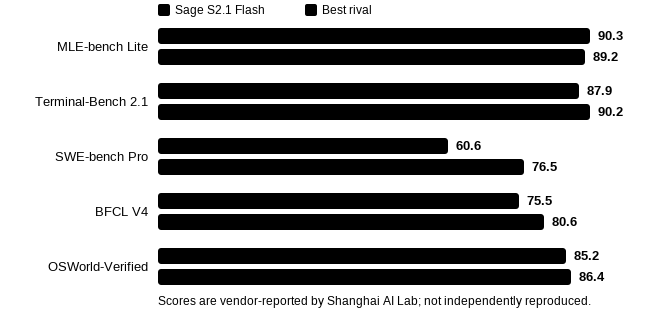
Sage S2.1 Flash vs the strongest rival on five benchmarks: Sage leads on only one, MLE-bench Lite (90.3 vs 89.2), and trails on the other four — the gaps on Terminal-Bench 2.1 and SWE-bench Pro vs Claude Opus 5 are especially wide. All figures vendor-reported, not independently reproduced.
04Top 3 reads
Short on time? Start with these three: the benchmark tally, the pricing breakdown and the three-way comparison — all three take apart the line "90.3, MIT, 1% peg".
05Timeline
One week after launch: the weights were quietly created on Nov 13–15, the technical report, project homepage and Jiqizhixin coverage all landed on Nov 16, English analysis followed Nov 17–19; as of Nov 23, no benchmark has been independently reproduced.
- Sep 13, 2026
Predecessor Sage S2 released: a 397B multimodal base model under Apache-2.0.
- Nov 6, 2026
The Sage-SciPerception repo on Hugging Face last modified (HF API record); its licence metadata is still unspecified.
- Nov 13, 15:04 UTC
The FP8 weight repo internlm/Sage-S2.1-Flash-FP8 is created on Hugging Face, with no announcement.
- Nov 15, 02:34 UTC
The BF16 weight repo internlm/Sage-S2.1-Flash is created; the model card at first contains a single line (the MIT licence) and there is no blog post, press release or mention on the lab's homepage — a "quiet" release, in OrcaRouter's word.
- Nov 16, 03:34 UTC
The GitHub repo InternLM/Sage-S2.1-Flash is created (code, tech-report PDF, deployment guides, EN + CN README).
- Nov 16, 2026
Formal release: technical report arXiv:2611.21072 v1 submitted; the project homepage goes live (full 33-benchmark table, 4 demo scenarios, 33 evaluation-setting notes); Jiqizhixin publishes at 19:37; Sina Finance covers it the same day; JW Insights reports MetaX's Day0 adaptation.
- Nov 17, 2026
Second wave: tech-report v2 revised; English analysis appears (GPUJournal, mer.vin, curiouslm, neuralwire 07:01 UTC, emergent.sh, aiweekly.co) and Chinese explainers (ai-bio.cn 23:25 and others); the HF model card is completed with the full benchmark table and deployment guides.
- Nov 18–19, 2026
Third wave: blockchain.news, techfastforward.com, postcutoff.com (verification note Nov 18), AnyRouter lists intern/sage-s2.1-flash ($0/$0, 524K context — third-party figures); unofficial community quantisations appear (EXL3 4-bit, NVFP4, GGUF, experimental 2-bit).
- Nov 21, 2026
This site's research: HF BF16 repo at 1,068 downloads and 245 likes; Google Autocomplete zero in both locales; no tier-1 English media; all 33 benchmarks confirmed vendor-reported.
- Nov 23, 2026
This site's topic page goes live (this page). As of publication: no independent reproduction, no AA / LiveBench / LMArena entry, no absolute API price; the 1% API window ends Dec 9.
06Official specs
As published (project homepage, Hugging Face model card, technical report arXiv:2611.21072, Nov 16–17, 2026). Undisclosed items are written as "not disclosed", not guessed.
- Status
- Released (GA, 2026-11-16; weights posted Nov 15, technical report and project homepage Nov 16)
- Model ID
- internlm/Sage-S2.1-Flash (BF16) / internlm/Sage-S2.1-Flash-FP8 (FP8); ModelScope: Shanghai_AI_Laboratory/Sage-S2.1-Flash
- Positioning
- Scientific multimodal agent model: reasons over scientific evidence, acts in interactive environments, operates professional scientific software, checks intermediate results and adjusts strategy
- Parameters
- 320B total MoE (321.3B by HF file metadata; "3200 亿" on the homepage), 18B active per token, 45 layers, 288 routed experts, top-8 routing
- Architecture
- Reuses the GLM-5.3-Flash architecture (deployment-guide wording; HF config architecture tag glm5_next); whether it is a fine-tune of GLM-5.3-Flash is unverified — discussed in the community, not confirmed by the developer
- Context
- 1,048,576 tokens (1M) maximum position limit
- Scientific inputs
- Sage SciPerception unified representation for 10+ scientific input types: molecular graphs, crystal structures, protein sequences and 3D structures, DNA/RNA sequences, spectra, mass spectra, X-ray diffraction, ECG, EEG, light curves; dedicated encoders per input type + trainable modality-specific projectors into the shared backbone; projector files ship in the repo under projectors/sage-s2.1-flash/, loading scripts from the separate internlm/Sage-SciPerception repo
- Agent training
- Trained in verifiable environments for tool use, search, coding, ML experiments and scientific software; task completion checked against execution results, environment state, or submitted artifacts; recursive self-improvement (RSI) exploration stops at task-level strategy iteration — the official wording includes no weight self-updating, no iteration counts and no before/after numbers
- Software it operates
- 3D Slicer (CT reconstruction), Blender + CAD (3D modelling), Fiji (microscopy segmentation), plus interactive HTML visualisation (deep-research answers)
- Weight size
- BF16 ~645GB (129 files), FP8 ~321GB
- Hardware
- Reference setup 8×NVIDIA H200 tensor parallel (vLLM / SGLang / LMDeploy deployment guides); FP8 halves memory; on Hopper GPUs the KV cache must stay BF16 (FP8 KV caching unsupported)
- Deployment frameworks
- vLLM, SGLang, LMDeploy; trust custom code at load time; scientific-projector inference requires --enable-prompt-embeds
- API
- Discovery platform (discovery.intern-ai.org.cn), free credits for new users; pricing is a relative peg to GLM 5.3 Flash only (1% until Dec 9, 10% Dec 10–31), no absolute price published; AnyRouter third-party route intern/sage-s2.1-flash at $0/$0, 524K context (conflicts with the official 1M)
- Weights / licence
- Code and weights under MIT (model-card body and GitHub README; HF API licence metadata field is empty); the separate Sage-SciPerception repo's licence is unspecified (its README states so explicitly, verified by this site on Nov 23, 2026)
- Benchmarks
- 33 benchmarks, all vendor-reported — see section 12; no AA / LiveBench / LMArena entry
- Demos
- 4 demo scenarios on the project homepage: 3D Slicer CT reconstruction, Blender + CAD 3D modelling, Fiji microscopy segmentation, interactive HTML deep-research visualisation
- Domestic GPU
- MetaX completed a Day0 adaptation on Nov 16 (JW Insights, same day)
- Not disclosed
- Absolute API price; training data and compute; inference speed (tokens/second); whether a 753B Sage S2.1 sibling (mentioned only as a collection grouping by one secondary source) is released
07How to try it: three routes
Three routes exist: self-hosted weights, the Discovery API, and third-party routing. Realistically: the first is out of reach for almost everyone (8×H200, ~645GB), the second is the normal way to try it, and the third is a free side route with conflicting figures.
1Discovery API (main route)
Try the API on the Discovery platform (discovery.intern-ai.org.cn): free credits for new users, priced at 1% of the GLM 5.3 Flash price until Dec 9, 2026 and 10% from Dec 10–31; no absolute price is published — it sits behind login on the platform page. The project homepage links to it with a "try the API" button. See our pricing breakdown.
2Self-hosted weights (expert route)
Download the weights from Hugging Face (internlm/Sage-S2.1-Flash BF16 ~645GB, internlm/Sage-S2.1-Flash-FP8 ~321GB) or ModelScope, and deploy with vLLM / SGLang / LMDeploy on the 8×H200 reference setup; scientific-projector inference needs --enable-prompt-embeds. Loading requires trusting custom code. See our deployment guide.
3AnyRouter third-party routing (free side route)
AnyRouter lists intern/sage-s2.1-flash at $0/$0 — but its 524K context conflicts with the official 1M, and the $0 is not the official price, so treat it as a secondary mention only; check that platform's actual page before using it. See our pricing breakdown.
Also: unofficial community quantisations exist (EXL3 4-bit, NVFP4, GGUF, experimental 2-bit) — third-party modifications with no quality numbers; verify before deploying, and don't cite them as official.
08Pricing
Three price lines: weights free (MIT), the API peg (1% until Dec 9, 10% Dec 10–31), and self-hosting hardware (8×H200). The key point: the API has no absolute price — only a relative peg to GLM 5.3 Flash — and the price after Dec 31 is also unpublished. Prices checked Nov 21, 2026; the platform page price is authoritative.
| Channel | Price | Basis |
|---|---|---|
| Weights (Hugging Face / ModelScope) | Free | MIT licence, commercial use allowed; BF16 ~645GB, FP8 ~321GB |
| Discovery API (until 2026-12-09) | 1% of the GLM 5.3 Flash price | Official peg; no absolute price published |
| Discovery API (2026-12-10 to 12-31) | 10% of the GLM 5.3 Flash price | Official peg; no absolute price published |
| Discovery API (from 2027-01-01) | Not published | Price after Dec 31 not published |
| Free credits for new users | Free credits (amount not published) | Officially offered; the amount is not published |
| AnyRouter (third party) | $0/$0 per 1M tokens | Third-party figure; 524K context conflicts with the official 1M — not the official price |
| Self-hosting hardware (reference) | 8×H200 | GPUJournal estimates 8×H200 rental at ~$28.72/hour (third-party estimate) |
What 1%/10% means: a peg, not a price
The official API price is relative: 1% of the GLM 5.3 Flash price until Dec 9, 2026, 10% from Dec 10 to Dec 31. No absolute per-million-token figure appears in the announcement or on the public pages; the platform page itself shows the price behind login (not verified this round). Don't convert the 1% into a concrete ¥/token or $/token figure as fact — a conversion needs Zhipu's own GLM 5.3 Flash price list as the base, and even then it is a calculation, not a published price.
The real cost is hardware
Free weights don't mean free inference: BF16 is ~645GB with an 8×H200 reference setup; FP8 is ~321GB, half the size but still datacenter-class. GPUJournal estimates 8×H200 rental at ~$28.72/hour (a third-party estimate, for reference only). For almost every reader, the API promo (the 1% window until Dec 9) is the cheap way to try it; self-hosting is an institutional option.
"One tenth the inference cost of Sage S2 for the same task"
This is an official relative claim (via Jiqizhixin and ai-bio.cn), measured against the lab's own earlier model Sage S2, with no published measurement methodology. Quote it as an official relative claim, never as an API price or a measured saving.
Official pages: Project homepage — Sage S2.1 Flash (try-the-API button) · Hugging Face — internlm/Sage-S2.1-Flash (MIT licence, deployment guides) · GitHub — InternLM/Sage-S2.1-Flash
09First hands-on reviews
All from the first wave, Nov 16–21: no independent reproduction exists — only same-day tier-1 Chinese coverage and English analytical media re-reading the repos, configs and model card first-hand. Every entry carries a verdict badge; "Read on this site" opens our rewritten deep-dive article, with the original source at the end.
Jiqizhixin: same-day tier-1 Chinese coverage, the source of the launch facts
Verdict: Launch facts confirmed; "self-evolving scientist" is headline language — read it under the official RSI wordingSource: Jiqizhixin, Nov 16, 2026, 19:37 Original →
Jiqizhixin's Nov 16, 19:37 piece "Let AI become a self-evolving scientist! Sage S2.1 Flash tops the ML engineering benchmark" is the strongest tier-1 Chinese signal of this release: the 90.3 MLE-bench Lite score, 4 firsts / 7 seconds, 33 benchmarks, the 1%/10% pricing peg, free credits and links to the trial, API, ModelScope, HF and tech report are all covered. Note the "self-evolving" in the headline is media language: the official RSI wording stops at task-level strategy iteration, with no weight self-updating.
Read on this site → (original ModelBrief rewrite)
GPUJournal: the most solid English analysis, repos and configs read first-hand
Verdict: Specs and hardware figures verified; states explicitly that every benchmark is vendor-runSource: GPUJournal, Nov 17, 2026 Original →
GPUJournal's piece re-read the HF repos and config first-hand: 45 layers, 288 experts, 1M context, file sizes (642.8GB / 321GB), the 8×H200 reference setup and a ~$28.72/hour rental estimate — and states explicitly that every benchmark figure is the maker's own.
Read on this site → (original ModelBrief rewrite)
mer.vin: the deepest English analysis, source of the licence caveat
Verdict: The deepest English analysis; the SciPerception licence gap and the projector-path caveat come from hereSource: mer.vin, Nov 17–18, 2026 Original →
mer.vin's analysis built a release-facts table from the model card, config and HF API (repo creation dates Nov 13/15, arXiv v1/v2) and flagged two caveats: the SciPerception repo's licence metadata is unspecified, and the projector-path caveat (glm-5.3-flash/ vs projectors/sage-s2.1-flash/); the community quantisations (EXL3 4-bit, NVFP4, GGUF, experimental 2-bit) come from here too.
Read on this site → (original ModelBrief rewrite)
curiouslm.com: the critical view, the "quiet launch" framing
Verdict: A critical framing of the launch; advises treating the scores as claims until outside tests appearSource: curiouslm.com, Nov 17, 2026 Original →
curiouslm frames the release as "quietly posted": weights first, no launch post; it notes OrcaRouter's repo-date tracking and the 753B Sage S2.1 sibling in the same HF collection (mentioned by one secondary source only, unverified), and concludes: "treat them as claims until outside tests appear".
Read on this site → (original ModelBrief rewrite)
ai-bio.cn: the strongest Chinese analysis, source of the RSI wording limit
Verdict: The strongest Chinese analysis; the RSI-stops-at-task-level note comes from hereSource: ai-bio.cn, Nov 17, 2026, 23:25 Original →
ai-bio.cn's analysis lists five capability areas and a comparison table vs Sage S2 (Sep 13, 397B, Apache-2.0) and DeepSeek V4.1 Flash (Sep 10), and states explicitly: the one-tenth cost claim has no published methodology, and the RSI wording stops at task-level strategy iteration — no iteration counts, no before/after numbers, no weight self-updating.
Read on this site → (original ModelBrief rewrite)
Sina Finance and JW Insights: same-day Chinese coverage
Verdict: Same-day Chinese corroboration of the launch factsSource: Sina Finance, JW Insights, Nov 16, 2026
Sina Finance covered the launch the same day ("Sage S2.1 Flash officially open-sourced, MLE-bench Lite at 90.3"); JW Insights reported MetaX's Day0 adaptation of Sage S2.1 Flash (domestic-GPU adaptation news) the same day.
Read on this site → (original ModelBrief rewrite)
English analysis wave: emergent.sh, aiweekly.co, neuralwire, techfastforward and others
Verdict: Analytical coverage exists; tier-1 English media still absentSource: emergent.sh, aiweekly.co, neuralwire.co (Nov 17, 07:01 UTC), techfastforward.com, blockchain.news and others, Nov 16–19, 2026
The second and third English waves are release reports and explainers, mostly sourced from the model card and tech report; several independently flag the same caveats (no independent reproduction, no launch post, the GLM-5.3-Flash architecture question). This site's Nov 21, 2026 search found no TechCrunch / The Verge / Reuters / Bloomberg / Wired / Ars Technica coverage.
Read on this site → (original ModelBrief rewrite)
Independent reproduction: none so far
Verdict: None of the 33 benchmarks has been independently reproduced; no evaluation run logs are publishedSource: This site's research, Nov 21, 2026
GPUJournal, curiouslm, techfastforward and OrcaRouter (via postcutoff) all state it explicitly: every benchmark figure is Shanghai AI Lab's own run; no independent lab or public leaderboard has reproduced any of them, and no evaluation harness files or run logs are published alongside the numbers. The homepage's 33 numbered evaluation-setting notes (harness versions, timeouts, judge models, sampling) let readers judge the setup — more transparent than a numbers-only vendor table, but still not independent verification.
10Articles: our in-depth reviews
The 6 articles below are original ModelBrief rewrites and reorganisations — restructured, with conclusions and buying advice added, and facts and figures checked against the original sources. Click any article to read it on this site; original sources are at the end of each piece.
11Related topics
Other LLM topics on this site. Qwen3.8-Max is a direct rival in Sage S2.1 Flash's five-way benchmark table; GPT-6.2 Sol, Gemini 4 Neon, Kimi K3.1 Pro, Qwen4-Max, Inkling 2 Mini and Nex-N2.6 are same-era LLM topics.
 Qwen4-MaxReleased Nov 16, 2026 · Alibaba's Qwen4 flagship, AA index 43. The topic covers official specs, pricing, benchmarks and in-depth articles.
China · LLM · Open weights · Weights public Nov 5, 2026
 Kimi K3.1 ProWeights public Nov 5, 2026 · Moonshot AI's Kimi K3.1 Pro, AA index 46. The topic covers official specs, pricing, benchmarks and in-depth articles.
USA · LLM · GA · Nov 18, 2026
 Gemini 4 NeonReleased Nov 18, 2026 · Google's Gemini 4 model. The topic covers official specs, pricing, benchmarks and in-depth articles.
USA · LLM · GA · Nov 17, 2026
 GPT-6.2 SolReleased Nov 17, 2026 · OpenAI's GPT-6.2 model, #3 on DesignArena's game-development board. The topic covers official specs, pricing, benchmarks and in-depth articles.
USA · LLM · Open weights · Nov 20, 2026
 Inkling 2 MiniReleased Nov 20, 2026 · Thinking Machines Lab's open-weight recurrent model, 26.4B parameters, 3.4B active per token, AA index 20.1. The topic covers official specs, pricing, benchmarks and 6 in-depth articles.
China · LLM · Open weights · Nov 10, 2026
 Nex-N2.6Released Nov 10, 2026 · Nex AGI's open-weight model. The topic covers official specs, pricing, benchmarks and in-depth articles.
USA · LLM · GA · Nov 20, 2026
 Baseten Bison-1Released Nov 20, 2026 · Baseten's decision model on Gemma 4, #1 on the AA Decision Index at 76 (1 point ahead of d1.2-ultra), $0.10 per 1M input tokens. The topic page covers official specs, pricing, benchmark analysis and 6 in-depth reviews.
China · LLM · GA · Nov 23, 2026
 GLM-5.4Released Nov 23, 2026 · Zhipu's flagship coding model, vision, 1M context, Coding Plan $18/$80/$168, KingBench 4 at 55.3% (one private test). The topic page covers official specs, pricing, benchmark analysis and 6 in-depth reviews.
USA · Image · GA · Nov 19, 2026
 Ideogram 4.6Released Nov 19, 2026 · Ideogram's native 4K image editing model, #1 on Rapidata's multi-step edit board at 1,892, API $0.008–$0.60 per image. The topic page covers official specs, pricing, benchmarks and 7 in-depth reviews.
USA · LLM · GA · Nov 18, 2026
 Cloudflare ClairicReleased Nov 18, 2026 · Cloudflare's extraction-model pair, 27B and 9B flash, Apache 2.0 open weights, $0.24/$0.10 per 1M input tokens. The topic page covers official specs, pricing, benchmarks and 6 in-depth reviews.
USA · LLM · GA · Nov 16, 2026
 Liquid d1.2Released Nov 16, 2026 · Liquid AI's omnimodal decision-model pair, d1.2-ultra #2 on the AA Decision Index at 75, audio input and five new tasks, $0.02/$0.042 per 1M input tokens with output free. The topic page covers official specs, pricing, benchmark analysis and 6 in-depth reviews.
LLM · Open Weights · Nov 13, 2026
 Maxwell V1 FlashWeights public Nov 13, 2026 · Maxwell Team's 35B/3B-active open MoE, 256K context, Apache 2.0; vendor-reported table leads same-scale Qwen3.6 with no independent score yet. The topic page covers official specs, pricing, benchmark analysis and 8 in-depth reviews.
China · Image Model · Open Weights · Released Nov 24, 2026
 SenseNova U1.6Released Nov 24, 2026 · SenseTime's 8B unified image model with native self-correction, UltraTextBench 86.04 to 92.28 (vendor-reported), Apache 2.0 open weights. The topic page covers official specs, pricing, benchmarks and 7 in-depth reviews.
South Korea · LLM · Preview · Released Nov 23, 2026
 Solar Mini 4.5 PreviewReleased Nov 23, 2026 · Upstage's preview agentic light model, 35B/3B MoE, 512K context, $0.01 per 1M tokens at 90% off, GA Dec 3; 4 of 5 in-house tests won, all vendor-reported. The topic page covers official specs, pricing, benchmarks and 6 in-depth reviews.
China · LLM · Medical Model · Released Nov 23, 2026
 LingSanteReleased Nov 23, 2026 · Ant Group's medical model family: 560B flash and 124B air-VL under MIT open weights, HealthBench Professional 65.72 (vendor-reported); not a medical device. The topic page covers official specs, benchmarks and 6 in-depth reviews.
China · Video Understanding · Open Weights · Released Nov 17, 2026
 WeMM-VideoWeights public Nov 17, 2026 · Tencent's omni-modal video-understanding family in 2B/4B/9B/35B-A3B, Apache 2.0 open weights; 9B beats a 30B baseline (vendor-reported), no API or price. The topic page covers official specs, benchmarks and 6 in-depth reviews.
China · LLM · Vision-Language Model · Released Nov 23, 2026
 Ling-3.2-airReleased Nov 23, 2026 · Ant Group's general-purpose VLM, 124B/5.5B hybrid-linear MoE, MIT open weights, AutomationBench-AA 61.0, AA Index 23.4; no hosted API. The topic page covers official specs, benchmarks and 6 in-depth reviews.
More indexes: All models · All Shanghai AI Lab topics · All language models
12Benchmarks: 33 scores, all vendor-reported; MLE-bench Lite 90.3 leads by 1.1
Sage S2.1 Flash's benchmark table is the most complete vendor-reported table this site has seen: 33 benchmarks across seven domains, with 33 numbered evaluation-setting notes (harness versions, timeouts, judge models, sampling). The caveat first: every figure is Shanghai AI Laboratory's own run — none has been independently reproduced, and no evaluation run logs are published; AA / LiveBench / LMArena have no entry.
The 15 headline comparisons (vendor-reported; vs GLM-5.3-Flash / DeepSeek-V4.1-Flash-1017 / Qwen3.8-Max / GPT-5.6 Sol / Claude Opus 5)
| Category | Benchmark | Sage S2.1 Flash | Strongest rival | Rank |
|---|---|---|---|---|
| Agentic coding | Terminal-Bench 2.1 | 87.9 | Claude Opus 5, 90.2 | #2 |
| Agentic coding | DeepSWE | 67.9 | DeepSeek-V4.1-Flash, 73.9 | #2 |
| Agentic coding | NL2Repo-Bench | 57.2 | Claude Opus 5, 79.9 | #3 or lower |
| Agentic coding | SWE-bench Pro | 60.6 | Claude Opus 5, 76.5 | #2 |
| Productivity | SpreadsheetBench 2 | 37.1 | DeepSeek-V4.1-Flash, 35.8 | #1 |
| Productivity | ALE-CLI | 32.4 | DeepSeek-V4.1-Flash, 35.4 | #2 |
| Productivity | APEX-Agents | 61.7 | DeepSeek-V4.1-Flash, 69.2 | #2 |
| Productivity | GDPval | 78.0 | Claude Opus 5, 80.0 | #2 |
| Productivity | Workspace-Bench-Lite | 67.1 | Claude Opus 5, 68.1 | #2 |
| Productivity | Workspace-Bench | 61.7 | Qwen3.8-Max, 63.9 | #2 |
| Tool use | OfficeQA Pro | 72.2 | DeepSeek-V4.1-Flash, 69.7 | #1 |
| Tool use | Harvey LAB | 25.0 | Qwen3.8-Max, 24.2 | #1 |
| Tool use | AutomationBench | 56.7 | DeepSeek-V4.1-Flash, 57.8 | #2 |
| Tool use | BFCL V4 | 75.5 | Claude Opus 5, 80.6 | #2 |
| Tool use | JobBench | 58.8 | Claude Opus 5, 68.0 | #2 |
| Tool use | SkillsBench | 62.3 | Qwen3.8-Max, 66.7 | #2 |
| Tool use | τ³-bench Banking | 45.4 | Qwen3.8-Max, 55.2 | #2 |
| ML engineering | MLE-bench Lite | 90.3 | DeepSeek-V4.1-Flash, 89.2 | #1 |
| ML engineering | PostTrainBench | 39.2 | GLM-5.3-Flash, 36.8 (DeepSeek/Qwen not run) | #1 (two models ran) |
| ML engineering | PaperBench | 88.0 | Qwen3.8-Max, 95.1 | #2 |
| ML engineering | MLS-Bench | 42.0 | Claude Opus 5, 49.8 | #2 |
| Deep research | DeepResearch Bench II | 54.2 | DeepSeek-V4.1-Flash, 55.1 | #2 |
| Search | DeepSearchQA | 94.4 | DeepSeek-V4.1-Flash, 95.3 | #2 |
| Search | BrowseComp-VL | 60.5 | GLM-5.3-Flash, 61.0 | #2 |
| Search | WideSearch | 81.5 | DeepSeek-V4.1-Flash, 86.3 | #2 |
| Search | BrowseComp | 91.2 | DeepSeek-V4.1-Flash, 93.8 | #2 |
| Vision / computer use | OSWorld v2.1 | 69.3 | Claude Opus 5, 74.0 | #2 |
| Vision / computer use | OSWorld-Verified | 85.2 | Claude Opus 5, 86.4 | #2 |
| Vision / computer use | WebArena-Verified | 67.6 | Claude Opus 5, 69.1 | #2 |
| Vision / computer use | Vision2Web | 78.0 | Claude Opus 5, 80.2 | #2 |
| Vision / computer use | WeaveBench | 68.4 | Claude Opus 5, 86.4 | #2 |
| Vision / computer use | OSWorld-G | 84.8 | Qwen3.8-Max, 88.6 | #2 |
| Vision / computer use | BabyVision | 75.8 | Qwen3.8-Max, 83.8 | #2 |
Rank note: 4 firsts (MLE-bench Lite, OfficeQA Pro, Harvey LAB, SpreadsheetBench 2) and 7 seconds among the 15 headline comparisons; Sage is outside the top two on the other 4. PostTrainBench ran only Sage and GLM-5.3-Flash, so that "first" carries less weight. All figures vendor-reported (project homepage and HF model card, Nov 16, 2026), not independently reproduced.
Reading MLE-bench Lite 90.3
MLE-bench Lite is a 75-task Kaggle-derived ML engineering benchmark, scored as a HumanRank metric under the Claude Code harness with 12-hour limits. Sage's 90.3 leads DeepSeek-V4.1-Flash-1017's 89.2 by 1.1 points. Some coverage calls it "the first open-weight model above 90" — the correct statement is "vendor-reported 90.3, 1.1 points ahead of its closest rival", not "beats every model": the same table has Claude Opus 5 ahead on Terminal-Bench 2.1 (90.2 vs 87.9) and SWE-bench Pro (76.5 vs 60.6).
The shape of the wins and losses
The shape is clear and worth stating plainly: Sage's 4 firsts sit in ML engineering (MLE-bench Lite), office documents (OfficeQA Pro, SpreadsheetBench 2) and legal documents (Harvey LAB); it trails Claude Opus 5 on most coding rows (NL2Repo-Bench 57.2 vs 79.9, SWE-bench Pro 60.6 vs 76.5), trails DeepSeek-V4.1-Flash on most search rows (WideSearch 81.5 vs 86.3, BrowseComp 91.2 vs 93.8), and trails Qwen3.8-Max on PaperBench by 7 points (88.0 vs 95.1). This is a scorecard with clear strengths and weaknesses, not a sweep.
Evaluation-setting notes: more transparent than a numbers-only vendor table, still not independent verification
The project homepage additionally publishes 33 numbered evaluation-setting notes (harness versions, timeouts, judge models, sampling), so readers can judge each setup — more transparent than a numbers-only vendor table, and more substantial than some six-benchmark vendor tables this site has covered. But notes are not reproduction: no independent lab has run any of the 33, and no harness files or run logs are published.
Full tally in our benchmark article →
13Comparisons
vs DeepSeek-V4.1-Flash (the closest rival)
| Dimension | Sage S2.1 Flash | DeepSeek-V4.1-Flash-1017 |
|---|---|---|
| MLE-bench Lite | 90.3 (#1, vendor-reported) | 89.2 (#2) |
| DeepSWE | 67.9 | 73.9 |
| Search | DeepSearchQA 94.4, WideSearch 81.5, BrowseComp 91.2 | 95.3, 86.3, 93.8 (ahead on all three) |
| Office documents | OfficeQA Pro 72.2, SpreadsheetBench 2 37.1 | 69.7, 35.8 |
| Positioning | Scientific multimodal agent: 10+ scientific input types, operates research software | General-purpose agent flagship (no scientific-input figures in this round's research) |
| Weights / licence | MIT open weights | Not in this round's research |
All figures vendor-reported (Shanghai AI Lab model card and project homepage), not independently reproduced. The gap to DeepSeek-V4.1-Flash is 1.1 points — don't write "a big lead". See our comparison article.
vs GLM-5.3-Flash (architecture source and price anchor)
| Dimension | Sage S2.1 Flash | GLM-5.3-Flash |
|---|---|---|
| Architecture link | Reuses the GLM-5.3-Flash architecture (deployment-guide wording; HF config tag glm5_next) | The architecture's source model |
| Is it a fine-tune? | Asked in the community, not confirmed by the developer — unverified | — |
| PostTrainBench | 39.2 | 36.8 (only two models ran it) |
| BrowseComp-VL | 60.5 | 61.0 |
| Price link | API pegged to GLM 5.3 Flash: 1% until Dec 9, 10% Dec 10–31 | The price being pegged to |
| Positioning | Scientific multimodal agent | General-purpose flagship (no scientific-input figures in this round's research) |
"Reuses the architecture" is not "is a fine-tune": the deployment guide and config tag establish architecture reuse only; whether training continued from GLM-5.3-Flash weights is unconfirmed. See our comparison article.
vs Qwen3.8-Max and Claude Opus 5 (frontier rivals)
Qwen3.8-Max scores 95.1 on PaperBench, 7 points ahead of Sage (88.0), and also leads on τ³-bench Banking (55.2 vs 45.4), BabyVision (83.8 vs 75.8) and OSWorld-G (88.6 vs 84.8). Claude Opus 5 leads Sage on most coding rows (NL2Repo-Bench 79.9, SWE-bench Pro 76.5, Terminal-Bench 2.1 90.2) and computer-use rows (WeaveBench 86.4, OSWorld v2.1 74.0). Sage's edge sits in ML engineering and office/legal documents — pick by task, not by the "#1" label.
Read the deep comparison: Sage S2.1 Flash vs DeepSeek-V4.1-Flash and GLM-5.3-Flash →
14What's missing (as of Nov 23, 2026)
- Independent reproduction of any benchmark: all 33 are vendor-reported, with no independent lab reproduction and no evaluation run logs
- AA / LiveBench / LMArena entries: science-agent models are outside those boards' scope, so no scores exist yet
- An absolute API price: only the 1%/10% peg to GLM 5.3 Flash is published; the per-million-token price is unpublished (the platform page shows it behind login; not verified this round)
- The API price after Dec 31, 2026: not published
- An official answer to the GLM-5.3-Flash lineage question: whether it is a fine-tune of GLM-5.3-Flash is unconfirmed
- The Sage-SciPerception repo's licence: its README states explicitly that it is unspecified
- Inference speed (tokens/second): not published
- Training data and compute: not published
- Tier-1 English media coverage: no TechCrunch / The Verge / Reuters / Bloomberg / Wired / Ars Technica
- Xinzhiyuan / QbitAI / ITHome / 36Kr Chinese coverage: none found in this round's search
- Whether a 753B Sage S2.1 sibling is released: mentioned only as a collection grouping by one secondary source, unverified
- The new-user free-credit amount: officially offered, amount not published
15Rumor check
Confusion around Sage S2.1 Flash comes from seven places: the release date, what 90.3 means, "beating Claude", self-evolution, the licence, the price, and single-GPU running — checked one by one.
False "Formally released on November 15"
Nov 15 is only when the BF16 weight repo was quietly created, with a one-line model card and no announcement; the formal release (technical report + project homepage + Jiqizhixin coverage) was Nov 16. The FP8 repo was created even earlier (Nov 13).
False "MLE-bench Lite 90.3 is independently verified"
90.3 is Shanghai AI Lab's own run, with no independent reproduction; it leads DeepSeek-V4.1-Flash-1017's 89.2 by 1.1 points. The correct statement is "vendor-reported 90.3, 1.1 points ahead of its closest rival".
False "Beats Claude Opus 5"
Claude Opus 5 leads Sage on most coding and computer-use rows: NL2Repo-Bench 79.9 vs 57.2, SWE-bench Pro 76.5 vs 60.6, Terminal-Bench 2.1 90.2 vs 87.9, WeaveBench 86.4 vs 68.4. Sage takes 4 of 15 headline firsts.
False "A self-evolving scientist that improves its own weights"
"Self-evolving scientist" is headline language from Jiqizhixin; the official RSI wording stops at task-level strategy iteration, with no iteration counts, no before/after numbers and no weight self-updating. Don't present "self-evolution" as a weight-improving capability.
Partly true "MIT open source, no strings attached"
Code and weights are indeed MIT (model-card body and GitHub README; the HF API licence metadata field is empty — MIT lives in the card body). But the separate Sage-SciPerception repo's licence is unspecified — its README states "License metadata has not yet been specified for this release", verified by this site against Hugging Face on Nov 23, 2026. Don't describe the science-projector part as "MIT, no strings attached".
False "The API costs 1% of the GLM 5.3 Flash price, which equals ¥X per million tokens"
1% is a relative peg, not an absolute price; no per-million-token price is published. Any conversion needs Zhipu's own GLM 5.3 Flash price list as the base, and the result can only be labelled a calculation, not a published price.
False "Runs on a single GPU"
BF16 weights are ~645GB and the official reference setup is 8×H200; FP8 is ~321GB, still datacenter-class. Almost nobody can run it locally; the API is the realistic trial route.
Unverified "Sage S2.1 Flash is a fine-tune of GLM-5.3-Flash"
The model does reuse the GLM-5.3-Flash architecture (deployment-guide wording; HF config tag glm5_next), and the community is discussing whether it is a fine-tune, but the developer has not confirmed it. Architecture reuse is not fine-tuning — don't present community speculation as fact.
16FAQ
When was Sage S2.1 Flash released?
The formal release was November 16, 2026: technical report arXiv:2611.21072 v1 submitted that day, the project homepage live, Jiqizhixin coverage at 19:37. But the weights appeared quietly earlier: the BF16 repo was created Nov 15 and the FP8 repo Nov 13, with no announcement. See section 05.
Is the MLE-bench Lite 90.3 score independently verified?
No. All 33 benchmarks are Shanghai AI Lab's own runs, with no independent reproduction and no published evaluation run logs; AA / LiveBench / LMArena have no entry. The 90.3 leads DeepSeek-V4.1-Flash-1017's 89.2 by 1.1 points. See section 12.
Is it really better than Claude Opus 5?
Don't write it that way. Sage takes 4 of 15 headline firsts (MLE-bench Lite, OfficeQA Pro, Harvey LAB, SpreadsheetBench 2), concentrated in ML engineering and office/legal documents; Claude Opus 5 leads most coding and computer-use rows (NL2Repo-Bench 79.9 vs 57.2, SWE-bench Pro 76.5 vs 60.6, WeaveBench 86.4 vs 68.4). See sections 12–13.
Can I use it commercially? What is the licence?
Code and weights are MIT, so commercial use is allowed (model-card body and GitHub README; the HF API licence metadata field is empty). But note: the separate Sage-SciPerception repo's licence is unspecified — its README states so explicitly, verified by this site against Hugging Face on Nov 23, 2026; don't describe the science-projector part as "MIT, no strings attached". See our pricing breakdown and deployment guide.
Can I run it on my GPU?
Almost certainly not: BF16 weights are ~645GB and the official reference setup is 8×H200; FP8 is ~321GB, still datacenter-class. Don't build on "runs on a single GPU" — the API is the realistic trial route. See our deployment guide.
How much does the API cost?
Only a relative figure is published: 1% of the GLM 5.3 Flash price until Dec 9, 2026 and 10% from Dec 10 to Dec 31; no absolute per-million-token price is published, the price after Dec 31 is also unpublished, and the new-user free-credit amount is unpublished. Don't convert the 1% into an absolute price as fact. See our pricing breakdown.
Is it a fine-tune of GLM-5.3-Flash?
Unverified. The model reuses the GLM-5.3-Flash architecture (deployment-guide wording; HF config tag glm5_next), and the community is discussing whether it is a fine-tune, but the developer has not confirmed it. Architecture reuse is not fine-tuning. See our comparison article.
How is it different from the predecessor, Sage S2?
Sage S2 is the 397B multimodal base model released Sep 13 under Apache-2.0; Sage S2.1 Flash is the 320B scientific multimodal agent model released Nov 16 under MIT, built for scientific reasoning, operating research software, and 33 agent benchmarks. Different scale, licence and positioning. See our launch overview.
17Sources
Facts on this page come from the public sources below (project homepage, HF model cards, technical report and GitHub repo, Nov 16–17, 2026; Jiqizhixin, Nov 16, 19:37; this site's research Nov 21, 2026, topic fact-check Nov 23, 2026).
Official
- Project homepage — Sage S2.1 Flash (full 33-benchmark table, 33 evaluation-setting notes, 4 demo scenarios) Live Nov 16, 2026
- Hugging Face model card — internlm/Sage-S2.1-Flash (full benchmark table, deployment guides, MIT licence in the card body; BF16 repo created 2026-11-15) Read directly Nov 21, 2026
- Hugging Face model card — internlm/Sage-S2.1-Flash-FP8 (FP8 repo created 2026-11-13) Read directly Nov 21, 2026
- Hugging Face — internlm/Sage-SciPerception (projector repo; README states the licence metadata is unspecified) Read directly Nov 23, 2026
- arXiv:2611.21072 — Sage S2.1 Flash Technical Report (v1 submitted Nov 16, 2026, v2 revised Nov 17) Nov 16, 2026
- GitHub — InternLM/Sage-S2.1-Flash (code, tech-report PDF, deployment guides, EN + CN README; created Nov 16, 2026) Read directly Nov 21, 2026
Chinese coverage
- Jiqizhixin — "Let AI become a self-evolving scientist! Sage S2.1 Flash tops the ML engineering benchmark" (90.3, 4 firsts / 7 seconds, 1%/10% pricing peg) Nov 16, 2026, 19:37
- ai-bio.cn — "Sage S2.1 Flash – Shanghai AI Lab's scientific multimodal agent model" (five capabilities, comparison vs Sage S2 and DeepSeek V4.1 Flash, RSI wording note) Nov 17, 2026, 23:25
- Sina Finance — "Sage S2.1 Flash officially open-sourced, MLE-bench Lite at 90.3" Nov 16, 2026
- JW Insights — MetaX completes Day0 adaptation of Sage S2.1 Flash Nov 16, 2026
- cn.ai123.com — "Sage S2.1 Flash open-sourced: ML engineering benchmark at 90.3" Nov 16–18, 2026
English coverage and analysis
- GPUJournal — "Sage S2.1 Flash: a 320B open science-agent model under MIT, with weights live and an eight-H200 reference setup" (45 layers, 288 experts, 1M context, file sizes, 8×H200) Nov 17, 2026
- mer.vin — "Sage S2.1 Flash: Open 320B Science Agent Model, Benchmarks and Setup" (repo creation dates, SciPerception licence caveat, community quantisations) Nov 17–18, 2026
- curiouslm.com — "Sage S2.1 Flash: Shanghai AI Lab's 321B Open-Weight Science Model" ("quietly posted" framing, 753B sibling mention) Nov 17, 2026
- neuralwire.co — "InternLM Releases Sage-S2.1-Flash Model" Nov 17, 2026, 07:01 UTC
- techfastforward.com — "InternLM Sage 2.1 Tops MLE-Bench at 90.3 With MIT License" Nov 18, 2026
- postcutoff.com — "Sage S2.1-Flash open weights" (verification note Nov 18, 2026) Nov 18, 2026
- AnyRouter — intern/sage-s2.1-flash ($0/$0, 524K context — third-party figures, conflict with the official 1M) Read Nov 21, 2026
- This site's research, Nov 21, 2026: Google Autocomplete zero on 21 EN/ZH queries; one Google Trends attempt returned HTTP 411, no data; HF API: BF16 repo 1,068 downloads, 245 likes; no tier-1 English media; all 33 benchmarks confirmed vendor-reported, no independent reproduction