Maxwell V1 Flash: The Topic Page
A team calling itself "Maxwell Team" opened the weights of a 35B-total, 3B-active-per-token MoE on Hugging Face on November 13, 2026: Apache 2.0 licence, 256K context, a free playground and an official vLLM Docker image all included. Its technical report carries a benchmark table of about 40 rows that, on the vendor's own numbers, leads same-scale Qwen3.6-35B-A3B on nearly every row — but as of November 23, 2026, there is no independent score (no AA / LiveBench / LMArena listing), no tier-1 media coverage, and the team was unidentified until Nov 25, 2026, when the operating company was verified as InfiniteAI Private Limited, registered in Singapore (see sections 01 and 11): the report is signed only "Maxwell Team", its appendix lists about 75 author names with no affiliation of any kind. This page collects the official specs, the deployment requirements and the first coverage in English — with unverified claims clearly marked.
01Key facts
What is confirmed: this site's first topic on a team whose identity was a mystery — the operating company was only verified on Nov 25, 2026 as InfiniteAI Private Limited, registered in Singapore, while the authors' affiliations remain undisclosed — "weights, Docker image, playground, third-party loading" is a real product, while "the vendor table leads same-scale Qwen3.6" is an unverified claim.
- Released
- 2026-11-13 (Friday, first Hugging Face commit at 13:40 UTC, 35 BF16 shards, about 75GB; a fix commit followed on 2026-11-14 at 03:50 UTC). The technical report is dated 2026-10-30, the GitHub repository was created 2026-09-28, and the Docker image was pushed 2026-10-21 — all three are pre-release preparation; the release date is the day the weights went public, Nov 13
- Developer
- Maxwell Team (self-styled); the technical report is signed only "Maxwell Team", and Appendix A lists about 75 authors alphabetically by first name (Anxiang Zeng, Ao Sun, … Zi Qin Liew) with no affiliation, no corresponding author, no company, no location and no contact. The Hugging Face account maxwell-model leaves the company and location fields empty. Verified Nov 25, 2026: the operating company is InfiniteAI Private Limited, registered in Singapore (per the aiview.tw Nov 19 test, which checked the company registration; the authors' affiliations remain undisclosed)
- Positioning
- Text-only causal language model, decoder-only sparse MoE: 35B total parameters with only 3B active per token (both excluding embeddings), built for agentic work, grounded research and software engineering; no vision, no audio
- Base model
- No base model named. config.json declares its own model_type, maxwell_moe (not llama/qwen), the README names no base model, and the hands-on tester confirmed the same from the files — this site phrases it as "self-owned architecture, no base model named"; "trained from scratch" is strongly indicated, not proven
- Architecture
- 45 layers (3 dense SwiGLU + 42 MoE), hidden size 2,048; 256 routed experts with 12 active per token, plus 2 shared experts per MoE layer, expert intermediate size 512; 32 Q heads / 4 KV heads; RoPE base 10,000,000; 1 MTP auxiliary layer; Maxwell Block Sparse Attention (MBSA): 8 prefix + 8 local + up to 16 learned-indexed remote 128-token blocks; main attention bounded at 4,096 tokens per KV group, full-history KV cache retained; Manifold-Constrained Hyper-Connections (mHC, 4 residual streams); fine-grained MoE with dynamic routing-correction bias and sequence-wise load-balancing loss
- Training
- About 26T multilingual tokens; Muon optimizer on most hidden matrices; dense start, with block-sparse attention entering at 128K mid-training; staged long-context extension from 4K to 256K; post-training is two-stage all-domain SFT, then three separate RL branches (general / verifiable reasoning / agentic), merged by multi-teacher on-policy distillation (MOPD)
- Context
- 256K tokens (the vendor's claimed supported window). Note: config.json sets max_position_embeddings to 524,288, but the vendor's claimed supported window is 256K — this site reports 256K
- Tokenizer
- Script-aware multilingual tokenizer, 200,704 vocabulary; the vendor emphasizes compactness for low-resource Southeast Asian languages: Thai, Lao, Myanmar, Khmer, Shan (the tester also mentions Balinese, Sundanese, Javanese)
- Weights
- Open weights on Hugging Face, maxwell-model/Maxwell-V1-Flash: 35 safetensors shards, BF16, about 75GB; custom modeling code required (modeling_maxwell_moe.py and configuration_maxwell_moe.py bundled); stock llama.cpp / LM Studio / Ollama cannot load it yet
- Benchmarks (vendor-reported)
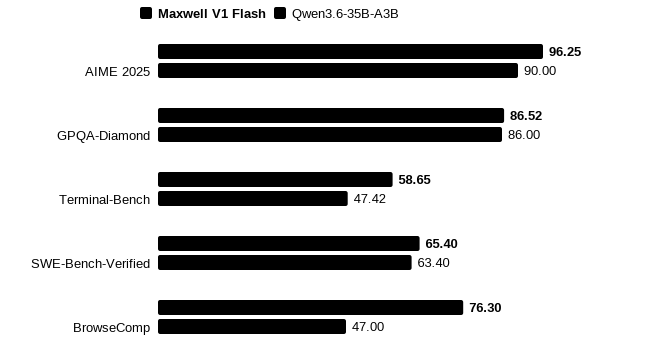
- A benchmark table of about 40 rows on the vendor's own evaluation framework (post-training evals mostly at temperature 0.6, top-p 0.95, top-k 20, 32K context; AA-LCR / math / HLE at 128K; SWE-Bench-Verified run with Claude Code, 4-hour limit per task). Against same-scale Qwen3.6-35B-A3B it leads on nearly every row: AIME 2025 at 96.25 (Qwen3.6 at 90.00), Terminal-Bench at 58.65 (47.42), SWE-Bench-Verified at 65.40 (63.40), BrowseComp at 76.30 (47.00); the trailing rows are RULER at 95.81 vs 97.08, instruction-following average at 76.37 vs 75.30 (Glimmer at 84.60), and AA-LCR at 75.60 vs 71.70 (Glimmer at 79.60); no independent verification as of Nov 23
- Licence
- Apache 2.0 (the LICENSE file, the model card and the GitHub repository licence field all agree)
- Price
- No API, no price, no paid tier of any kind. The product is: free open weights (Apache 2.0) plus a free playground; no hosted API, no pricing page
- Access
- Hugging Face weight download (live 2026-11-13); free playground at maxwell-llm.ai/playground (verified HTTP 200 by this site on 2026-11-23); official vLLM OpenAI-compatible Docker image maxwellmodel/vllm-openai:v0.30.0 (9.0GB, pushed 2026-10-21, pulled as recently as 2026-11-22); community GGUF builds by AtomicChat (BF16 72GB, Q8_0 38.4GB) with a llama.cpp port patch
- Traction
- As of 2026-11-23: 3,317 Hugging Face downloads, 359 likes; the Docker image was still being pulled on 2026-11-22; the GGUF port appeared within 5 days of release; no autocomplete signal (all 12 EN + ZH queries empty), no tier-1 media coverage; Chinese coverage is a single Traditional Chinese test by aiview.tw on Nov 19 (see section 09)
02Quick comparison
Where it stands in the same 35B/3B class: on the vendor's own numbers it leads Qwen3.6 on nearly every row — but every number comes from the vendor's own evaluation framework, with no independent verification yet.
| Model | AIME 2025 (vendor-reported) | Terminal-Bench (vendor-reported) | SWE-Bench-Verified (vendor-reported) | BrowseComp (vendor-reported) | Weights / API |
|---|---|---|---|---|---|
| Maxwell V1 Flash | 96.25 | 58.65 | 65.40 | 76.30 | Apache 2.0 open weights / no API |
| Qwen3.6-35B-A3B | 90.00 | 47.42 | 63.40 | 47.00 | Open weights / cloud API |
| Gemma-4-26B-A4B-it | — | — | — | — | Open weights / cloud API |
All benchmark scores are vendor-reported (Maxwell's own evaluation framework) with no independent verification as of Nov 23, 2026. In the vendor table, Maxwell leads Qwen3.6 on nearly every row, including all three coding / agent rows (LiveCodeBench v6, Terminal-Bench, SWE-Bench-Verified); the trailing rows are RULER (95.81 vs 97.08) and the instruction-following average (76.37 vs 75.30, with Glimmer at 84.60). Gemma-4-26B-A4B-it is the fourth comparison model in the vendor table; its per-row figures are in section 13.
03Charts
Five selected benchmarks: on the vendor's own numbers, Maxwell V1 Flash leads Qwen3.6-35B-A3B most on BrowseComp and Terminal-Bench, and GPQA-Diamond is essentially level.
04Top 3 reads
Short on time? Start with these three: the benchmark table, the row-by-row comparison with Qwen3.6, and the deployment guide — "can it be trusted", "where is it stronger", "can it run" in one pass.
05Timeline
Discovered 10 days after the weights went public: the repository was created Sep 28, the Docker image pushed Oct 21, the technical report written Oct 30, and the weights only went public Nov 13; a Reddit post surfaced it Nov 17, and the first hands-on test and GGUF port arrived Nov 18.
- 2026-09-28
GitHub repository maxwell-model/Maxwell-V1-Flash created (GitHub API created_at).
- 2026-10-21
Docker image maxwellmodel/vllm-openai:v0.30.0 pushed (Docker Hub last_pushed); the image predates the public weights by about 3 weeks.
- 2026-10-30
Technical report dated (PDF header date); the report predates the public weight release by two weeks.
- 2026-11-13
Weights go public: first Hugging Face commit at 13:40 UTC, maxwell-model/Maxwell-V1-Flash live, 35 BF16 shards, about 75GB, Apache 2.0. This site treats this day as the release date.
- 2026-11-14
Hugging Face fix commit at 03:50 UTC (model-card dark-mode table backgrounds).
- 2026-11-17
Reddit discovery: r/LocalLLaMA user /u/pmttyji posts at 04:04, summarizing the model card — the source the whole wave cites; zicq, neuralwire, agihunt and mindpattern follow the same day.
- 2026-11-18
goremy.ai publishes the only hands-on review (coding, language and research tests) plus a local-run guide; AtomicChat publishes the first GGUF port with a llama.cpp patch.
- 2026-11-19
aiview.tw publishes the first Traditional Chinese test (GB10): short answers at 59 tok/s, 3.5x Qwen 3.8 27B (different runtimes — see the qualifier), a 22,000-token summary in 24 seconds vs 59; but Traditional Chinese verdicts are unreliable — a 39.2% false-rejection rate on true messages (Qwen 27B: 13.0%), rising to 61.9% with retrieved material, and 1 in 11 answers mixing in simplified characters or typos (8.9%); the same piece checks the company registration and confirms the operator as InfiniteAI Private Limited, registered in Singapore. See sections 09 and 10.
- 2026-11-20
bitwidth.ai publishes the RTX 5090 head-to-head (runs done Nov 17): same-class GGUF on one card — Maxwell generates 216.8 tok/s with 8,825 tok/s prompt processing, vs Qwen3.6-35B-A3B's 281.8 / 13,702 tok/s, about 30% slower; a 300-question MMLU-Pro slice at 42.67% vs 44.0%, tool use 9/10 vs 8/10; the HumanEval-style 93-vs-30 gap is format-sensitive and must not be read as a coding ranking. See sections 09 and 10.
- 2026-11-23
This site completes its research: 3,317 Hugging Face downloads, 359 likes; the ~40-row vendor-reported table, the Docker image, the playground and the GGUF port confirmed — the verdict is that the material supports a hub + 6 articles, and the topic is approved.
- 2026-11-25
This site's topic page goes live (this page). As of today: no AA, LiveBench or LMArena listing for Maxwell V1 Flash, no tier-1 English coverage; Chinese coverage is a single Traditional Chinese test by aiview.tw (Nov 19); the operator was verified the same day as InfiniteAI Private Limited, registered in Singapore, while the authors' affiliations remain undisclosed.
- Nov 25, 2026
First consumer-grade numbers from the community llama.cpp port: Hugging Face discussion #6 — a community team runs a stepped pp512/tg128 test with an AD-Q5_K-Q4_K GGUF build on 2× RTX 5060 Ti 16GB; generation speed (tg) falls from 113.8 tok/s at empty context to 25.2 tok/s at 128k context, about 2.5–2.9x faster than a dense 27B NVFP4 quant (Qwen3.8-27B) on the same hardware; a 131k context fits on 2×16GB; no MTP (no speculative decoding) yet. The official Maxwell account has replied with thanks. Limits: a community test, not an official benchmark. See section 09.
06Official specs
As published by the vendor (Hugging Face model card and technical report, read directly by this site on Nov 23, 2026).
- Status
- Released (Nov 13, 2026, weights public), Apache 2.0 open weights
- Total / active parameters
- 35B / 3B (per token, both excluding embeddings); about 36.8B including embeddings (third-party estimate by ResearchAudio: 36.81B)
- Architecture
- Decoder-only sparse MoE, text-only: 45 layers (3 dense SwiGLU + 42 MoE), hidden size 2,048; 256 routed experts with 12 active per token, plus 2 shared experts per MoE layer, expert intermediate size 512; 32 Q heads / 4 KV heads; RoPE base 10,000,000; 1 MTP auxiliary layer
- Attention (MBSA)
- Maxwell Block Sparse Attention: 8 prefix + 8 local + up to 16 learned-indexed remote 128-token blocks; main attention bounded at 4,096 tokens per KV group; full-history KV cache retained; the vendor claims the MBSA kernel is 6.7x faster than dense GQA at 256K (kernel-level, hardware / precision / batch conditions undisclosed)
- Other design
- Manifold-Constrained Hyper-Connections (mHC, 4 residual streams); fine-grained MoE with dynamic routing-correction bias and sequence-wise load-balancing loss
- Context window
- 256K tokens (the vendor's claimed supported window; config.json sets max_position_embeddings to 524,288 — this site does not report that figure as the context window)
- Input / output
- Text input only; text output (no vision, no audio)
- Training
- About 26T multilingual tokens; Muon optimizer on most hidden matrices; dense start, with block-sparse attention entering at 128K mid-training; staged long-context extension from 4K to 256K; post-training: two-stage all-domain SFT, then three separate RL branches (general / verifiable reasoning / agentic), merged by multi-teacher on-policy distillation (MOPD)
- Tokenizer
- Script-aware multilingual tokenizer, 200,704 vocabulary; the vendor emphasizes compactness for low-resource Southeast Asian languages: Thai, Lao, Myanmar, Khmer, Shan (the tester also mentions Balinese, Sundanese, Javanese)
- Weights
- BF16, 35 safetensors shards, about 75GB (maxwell-model/Maxwell-V1-Flash); custom modeling code required (modeling_maxwell_moe.py and configuration_maxwell_moe.py bundled)
- Base model
- No base model named: config.json declares its own model_type, maxwell_moe, and the README names no base model; this site phrases it as "self-owned architecture, no base model named"
- Licence
- Apache 2.0 (the LICENSE file, the model card and the GitHub repository licence field all agree)
- Benchmarks (vendor-reported)
- A table of about 40 vendor-reported rows: AIME 2025 at 96.25, GPQA-Diamond at 86.52, Terminal-Bench at 58.65, SWE-Bench-Verified at 65.40, BrowseComp at 76.30 (82.20* with context management enabled), DeepSearchQA at 83.30 (89.50*); no independent verification. Asterisked scores are the "context management enabled" variant, not a second model
07How to try it: three routes
There is no cloud API, so trying it means three routes: the free playground is the easiest, the official Docker image is the proper path, and GGUF is the community shortcut for local players.
1Free playground (easiest)
maxwell-llm.ai/playground, free hosted chat (verified HTTP 200 by this site on 2026-11-23). No weight download, no environment setup — check whether the model talks before deciding on a local deployment.
2Official vLLM Docker image (official main route)
Model card §4 gives the full recipe: first hf download maxwell-model/Maxwell-V1-Flash for the weights, then start the OpenAI-compatible service with image maxwellmodel/vllm-openai:v0.30.0. Requirements: NVIDIA driver ≥ 580 / CUDA 13.0. See our deployment guide.
3Community GGUF + llama.cpp patch (local shortcut)
AtomicChat published the first GGUF port on Nov 18, 2026 (BF16 72GB, Q8_0 38.4GB) with llama.cpp maxwell-moe support; stock llama.cpp / LM Studio / Ollama cannot load it yet — the patch is required. Prompt processing at 6,398 tok/s on 1× H100 (AtomicChat's local measurement). See our deployment guide.
Also: the weights need custom modeling code (modeling_maxwell_moe.py and configuration_maxwell_moe.py bundled) — stock tooling does not support them yet; about 22GB at INT4 (third-party estimate by ResearchAudio, plus headroom).
08Pricing
There is no price table to write — Maxwell V1 Flash has no API, no pricing page, and no paid tier of any kind. Prices checked Nov 23, 2026 (model card and maxwell-llm.ai, read directly).
| Cost item | Maxwell V1 Flash | Cloud API models (comparison) |
|---|---|---|
| API calls (per 1M tokens) | None (no hosted API) | Billed per use |
| Weight download | Free (Apache 2.0 open weights) | — |
| Playground | Free (maxwell-llm.ai/playground) | — |
| Docker image | Free (public Docker Hub image) | — |
| Hardware (one-off) | BF16 weights about 75GB; about 130GB VRAM at a full 256K load (tester-measured under vLLM); about 22GB at INT4 (third-party estimate) | None |
"Free" means: no bill, and no service
The weights and the playground are free because nobody is selling a service: no hosted API, no per-token billing, no paid tier to upgrade to. The other side of free is: no support desk when something breaks, no notice when a new version lands, no official response when independent evaluations arrive — the team has not even published a way to contact them. For someone who just wants to try it, the playground is enough; for someone who wants it in a production pipeline, "free" is followed by the full cost of running the service yourself.
The real self-hosting bill: VRAM
Compare it with cloud API models this way: cloud bills per use with zero fixed cost; Maxwell V1 Flash pays its fixed cost once — about 75GB of disk for the BF16 weights, about 130GB VRAM at a full 256K load (tester-measured), about 22GB at INT4 (third-party estimate). The heavier your usage, the better the local route looks; light usage is cheaper in the cloud. Do not read "no token bill" as "free".
Official pages: Hugging Face model card · maxwell-llm.ai · GitHub repository
09First hands-on reviews
The ten entries below are the coverage and tests from Nov 17–25: three actually ran the model (goremy.ai, bitwidth.ai and aiview.tw), Hugging Face discussion #6 gives the first community consumer-grade numbers, and the rest re-analyse the model card and technical report. Every entry carries a verdict badge; "Read on this site" opens our rewritten deep-dive article, with the original source at the end.
Reddit r/LocalLLaMA discovery post: the source of the whole wave
Verdict: a discovery channel, not a measurementSource: Reddit r/LocalLLaMA, /u/pmttyji, Nov 17, 2026, 04:04
Four days after the weights went public, /u/pmttyji posted a model-card summary to r/LocalLLaMA, and every piece in the wave cites it. The post itself restates the model card with no independent measurement; its value is the timestamp — proof the model only entered public view four days after its Nov 13 release.
zicq deep dive: the deepest piece of the round
Verdict: the most detailed architecture coverage, and the first to flag the evidence gapsSource: zicq.com, Nov 17, 2026
"Maxwell-V1.0-Flash Debuts 35B MoE with 3B Active Parameters and 256K Context": the most detailed treatment of the architecture, MBSA and the training recipe, while explicitly flagging the evidence gaps — at the time of writing there was no auditable unified benchmark table, and the 6.7x kernel-speedup conditions were undisclosed. This page's architecture wording agrees with it.
Read on this site → (original ModelBrief rewrite)
goremy.ai single-tester review: the only piece that actually ran the model
Verdict: mixed results; the author calls them "signals, not verdicts"Source: goremy.ai, Nov 18, 2026 (two pieces: the review + a local-run / VRAM guide)
Three test groups — coding, languages, research: it fixed a hidden Flask bug with no hints and completed a 67-language list in about 42 seconds — the good side; it failed a browser-game build and produced a weak research report with mismatched source labels and stale-looking numbers — the bad side. The author states plainly that these are "signals, not verdicts": one tester, one run, a tiny sample. The VRAM guide's figure of about 130GB at a full 256K load is the number our deployment guide cites.
Read on this site → (original ModelBrief rewrite)
mindpattern.ai: the most skeptical piece of the round
Verdict: the skepticism itself is the conclusion, and worth citingSource: mindpattern.ai, Nov 17, 2026
Headlined as a piece about an unknown "Maxwell Team", it states plainly that "Nobody has published independent evals and the team is unidentified". The only piece in the round that puts the doubt in the headline; this page's honest framing agrees with it. Note: the site's trail mixes in a different product also called "Maxwell" (see section 16) — keep the two apart when citing.
neuralwire and agihunt: same-day wire-up and listing
Verdict: propagation signals, not measurementsSource: neuralwire.co (Nov 17 afternoon wire-up), agihunt.info (Nov 17 listing)
neuralwire's "Nov 17 Afternoon Wire-Up" lists Maxwell V1 Flash alongside Qwen4 updates as the day's news; agihunt is a listing entry that recaps the full spec. Both are evidence of same-day propagation, not independent measurement — do not cite them as verification.
AtomicChat GGUF port: the strongest third-party engineering validation
Verdict: the weights load and run — hard evidence the product is realSource: AtomicChat, Nov 18, 2026 (Hugging Face AtomicChat/Maxwell-V1-Flash-GGUF)
The first GGUF port within 5 days of release (BF16 72GB, Q8_0 38.4GB) with llama.cpp maxwell-moe support; a local run measured 6,398 tok/s prompt processing on 1× H100. This verifies that "the weights load and run", not capability scores — do not read it as benchmark verification.
Read on this site → (original ModelBrief rewrite)
bitwidth.ai RTX 5090 head-to-head: ~30% slower, ahead on tool use
Verdict: The first independent test with a control group and measured speedsSource: bitwidth.ai, Nov 20, 2026 (runs done Nov 17) Original →
Same-class GGUF on a single RTX 5090: Maxwell generates 216.8 tok/s with 8,825 tok/s prompt processing, vs Qwen3.6-35B-A3B's 281.8 / 13,702 tok/s — about 30% slower to generate; a 300-question MMLU-Pro slice at 42.67% vs 44.0%, tool use 9/10 vs 8/10. The HumanEval-style 93-vs-30 gap is format-sensitive and must not be read as a coding ranking (the official LiveCodeBench v6 is 85.66 vs 85.32, essentially level). The test also corroborates the self-owned architecture at the config and tokenizer level, and confirms the vendor vLLM image maxwellmodel/vllm-openai:v0.30.0 and the playground at maxwell-llm.ai. Limits: the quantization levels are not fully matched (community AD mixed quantization vs the official Q4_K_M) — the author states it is not an equal-bpw comparison.
Read on this site → (original ModelBrief rewrite)
aiview.tw GB10 Traditional Chinese test: 3.5x faster, unreliable at verdicts
Verdict: Clean on speed, a hard weakness on Chinese judgement — and it verifies the operatorSource: aiview.tw, Nov 19, 2026 Original →
On a GB10, short answers run 59 tok/s — 3.5x Qwen 3.8 27B — and a 22,000-token summary finishes in 24 seconds vs 59; but Traditional Chinese verdicts are unreliable — across 300 messages the false-rejection rate on true messages is 39.2% (Qwen 27B: 13.0%), rising to 61.9% once retrieved material is supplied, and 1 in 11 answers mixes in simplified characters or typos (8.9%), with no improvement on the 30GB build. The same piece checks the company registration and confirms the operator as InfiniteAI Private Limited, registered in Singapore. Limits: the two models ran on different stacks (patched llama.cpp vs Ollama) — the author states this is "the difference you actually get when you install them", not a pure model comparison; the verdict test is only 300 messages on a single task.
Read on this site → (original ModelBrief rewrite)
Tier-1 media and Chinese coverage: still zero tier-1 as of Nov 25, one Traditional Chinese test
Verdict: zero tier-1 coverage is itself a factSource: this site's search, Nov 23, 2026; aiview.tw, Nov 19, 2026
No TechCrunch / The Verge / Reuters / Bloomberg / Wired / Ars Technica coverage; in Chinese, no tier-1 outlet (Jiqizhixin / Xinzhiyuan / QbitAI / IT Home) has covered it, but aiview.tw published a Traditional Chinese hands-on test on Nov 19 (GB10, see above). interfaze.ai, aidaily.fyi, ResearchAudio and localllmrig.com are model-card mirrors, VRAM tables and aggregator listings — not reporting.
Hugging Face discussion #6: community llama.cpp port posts the first consumer-grade numbers on 2× RTX 5060 Ti
Verdict: a 131k context fits on 2×16GB consumer cards, generating about 2.5–2.9x faster than a dense 27B on the same hardware — but it is only a community testSource: Hugging Face discussion #6, ca. Nov 25, 2026 Original →
A community team runs a stepped pp512/tg128 test with an AD-Q5_K-Q4_K GGUF build on two RTX 5060 Ti 16GB cards: generation speed falls from 113.8 tok/s at empty context to 25.2 tok/s at 128k context; on the same hardware it is about 2.5–2.9x faster than a dense 27B NVFP4 quant (Qwen3.8-27B); a 131k context fits on 2×16GB; and there is no MTP yet, so no speculative-decoding acceleration. The official Maxwell account has replied with thanks. The limits travel with the numbers: a community test, not an official benchmark, on a single hardware pair and a single quantization level, with speed falling steeply as context grows.
10Articles: our deep dives
The eight articles below are original ModelBrief rewrites and reorganization — restructured with added conclusions and buying advice, with facts and numbers checked against the official sources. Read them on this site; each ends with its original source.
11The team mystery
The most unusual section of this topic: a team of about 75 people released a 35B model and left no traceable identity behind — "what was found" and "what was not found", item by item.
What was found
The technical report's only author line is "Maxwell Team"; Appendix A lists about 75 authors alphabetically by first name (Anxiang Zeng, Ao Sun, … Zi Qin Liew), with no affiliation, no corresponding author and no institution. The Hugging Face account maxwell-model carries only a one-line bio ("Maxwell builds efficient open models for agentic work, grounded research, and software engineering.") plus website and GitHub links; the company and location fields are empty. The maxwell-llm.ai "About Maxwell" section states a mission ("cost, not intelligence, is what stops agents scaling") and the Apache 2.0 release — no company, location, people, funding or contact. Added Nov 25, 2026: aiview.tw's Nov 19 test checked the company registration and confirmed the operating company as InfiniteAI Private Limited, registered in Singapore — the first verifiable operating entity.
What was not found
The operating company is now verified as InfiniteAI Private Limited, registered in Singapore (Nov 25, 2026, per aiview.tw's company-registration check); but the office location, funding and contact details are all still absent, and the ~75 technical-report authors' affiliations remain undisclosed.
What this means — and what it does not mean
It does NOT mean the model is fake. The weights are public and independently loadable (AtomicChat built a working GGUF port with a llama.cpp patch within 5 days, and a tester ran them under vLLM); config.json declares its own model type, maxwell_moe, with custom modeling code and no base model named; the team is large (about 75 named authors), not a single anonymous account.
It DOES mean the capability claims rest entirely on the vendor's word. No institution vouches for the team, no independent lab has replicated the ~40-row benchmark table, and there is no accountable entity behind the numbers. That is the largest credibility discount on this topic — and it is the situation the Edge0-145B precedent covers: Edge0 likewise never disclosed its company location, but the weights, the benchmark table and the install guide were all there, and stating the shortfalls plainly was enough to build the topic. Maxwell goes further than Edge0 on that shape (a bigger table, a technical report, a Docker image, a playground, a third-party port, a hands-on test).
See the identity-mystery section of our launch overview.
12Related topics
Topic pages for the other models on this site.
 Edge0-145BReleased Nov 12, 2026 · AutoArk's 145B latent MoE, open weights, built on Qwen3.8-Flash-Next, mean only +1.1 over its base, 29GB is GPU-side peak only. The topic page covers official specs, the install guide, the licence and 6 in-depth reviews.
China · Open weights · Nov 5, 2026Kimi K3.1 ProReleased Nov 5, 2026 · Moonshot's 2.8T open-weight MoE, AA Index 47 (v5.0.2), LMArena 1488, $2/$10. The topic page covers official specs, pricing, benchmark analysis and 8 in-depth reviews.
China · GA · Nov 16, 2026Qwen4-MaxReleased Nov 16, 2026 · Alibaba's first Qwen4 flagship, AA Index 43. The topic page covers official specs, Token Plan pricing and 18 in-depth reviews.
China · LLM · Open weights · Nov 10, 2026Nex-N2.6Released Nov 10, 2026 · Nex-AGI's computer-use agent, post-trained on GLM-5.3-Flash, OSWorld 83.0, Apache 2.0 open FP8 weights. The topic page covers official specs, pricing, benchmark analysis and 6 in-depth reviews.
China · LLM · GA · Nov 23, 2026
 GLM-5.4Released Nov 23, 2026 · Zhipu's flagship coding model, vision, 1M context, Coding Plan $18/$80/$168, KingBench 4 at 55.3% (one private test). The topic page covers official specs, pricing, benchmark analysis and 6 in-depth reviews.
USA · LLM · GA · Nov 20, 2026
 Baseten Bison-1Released Nov 20, 2026 · Baseten's decision model on Gemma 4, #1 on the AA Decision Index at 76 (1 point ahead of d1.2-ultra), $0.10 per 1M input tokens. The topic page covers official specs, pricing, benchmark analysis and 6 in-depth reviews.
China · LLM · GA · Nov 16, 2026
 Sage S2.1 FlashReleased Nov 16, 2026 · Shanghai AI Lab's 320B science-agent model, 18B active, MLE-bench Lite 90.3 (vendor-reported), MIT open weights. The topic page covers official specs, pricing, benchmark analysis and 6 in-depth reviews.
USA · LLM · Open Weights · Released Nov 20, 2026
 Inkling 2 MiniReleased Nov 20, 2026 · Thinking Machines Lab's open-weight looped model, 26.4B parameters with 3.4B active per token, AA Index 20.1 tied with Qwen3.8-27B, $0.15/$0.50 per 1M tokens. The topic page covers official specs, pricing, benchmarks and 6 in-depth reviews.
USA · LLM · GA · Nov 16, 2026
 Liquid d1.2Released Nov 16, 2026 · Liquid AI's omnimodal decision-model pair, d1.2-ultra #2 on the AA Decision Index at 75, audio input and five new tasks, $0.02/$0.042 per 1M input tokens with output free. The topic page covers official specs, pricing, benchmark analysis and 6 in-depth reviews.
ModelBrief homeAll topicsBack to the home page: browse all model topics by release date — LLMs, image models and video models.
USA · Image · GA · Nov 19, 2026
 Ideogram 4.6Released Nov 19, 2026 · Ideogram's native 4K image editing model, #1 on Rapidata's multi-step edit board at 1,892, API $0.008–$0.60 per image. The topic page covers official specs, pricing, benchmarks and 7 in-depth reviews.
USA · LLM · GA · Nov 18, 2026
 Cloudflare ClairicReleased Nov 18, 2026 · Cloudflare's extraction-model pair, 27B and 9B flash, Apache 2.0 open weights, $0.24/$0.10 per 1M input tokens. The topic page covers official specs, pricing, benchmarks and 6 in-depth reviews.
China · Image Model · Open Weights · Released Nov 24, 2026
 SenseNova U1.6Released Nov 24, 2026 · SenseTime's 8B unified image model with native self-correction, UltraTextBench 86.04 to 92.28 (vendor-reported), Apache 2.0 open weights. The topic page covers official specs, pricing, benchmarks and 7 in-depth reviews.
South Korea · LLM · Preview · Released Nov 23, 2026
 Solar Mini 4.5 PreviewReleased Nov 23, 2026 · Upstage's preview agentic light model, 35B/3B MoE, 512K context, $0.01 per 1M tokens at 90% off, GA Dec 3; 4 of 5 in-house tests won, all vendor-reported. The topic page covers official specs, pricing, benchmarks and 6 in-depth reviews.
China · LLM · Medical Model · Released Nov 23, 2026
 LingSanteReleased Nov 23, 2026 · Ant Group's medical model family: 560B flash and 124B air-VL under MIT open weights, HealthBench Professional 65.72 (vendor-reported); not a medical device. The topic page covers official specs, benchmarks and 6 in-depth reviews.
China · Video Understanding · Open Weights · Released Nov 17, 2026
 WeMM-VideoWeights public Nov 17, 2026 · Tencent's omni-modal video-understanding family in 2B/4B/9B/35B-A3B, Apache 2.0 open weights; 9B beats a 30B baseline (vendor-reported), no API or price. The topic page covers official specs, benchmarks and 6 in-depth reviews.
China · LLM · Vision-Language Model · Released Nov 23, 2026
 Ling-3.2-airReleased Nov 23, 2026 · Ant Group's general-purpose VLM, 124B/5.5B hybrid-linear MoE, MIT open weights, AutomationBench-AA 61.0, AA Index 23.4; no hosted API. The topic page covers official specs, benchmarks and 6 in-depth reviews.
13Benchmarks: all vendor-reported, no independent verification
Maxwell V1 Flash has no score on any independent board yet: no AA, LiveBench or LMArena listing. The ~40 scores below all come from the technical report and model card, run on the vendor's own evaluation framework. Check the conditions and wording before the scores.
| Benchmark (instruct model) | Maxwell V1 Flash | Qwen3.6-35B-A3B | Best of the other four |
|---|---|---|---|
| AIME 2025 (mean@8) | 96.25 | 90.00 | 92.08 (Glimmer) |
| AIME 2026 (mean@8) | 95.00 | 91.25 | 94.17 (Glimmer) |
| Math average (mean@8, 6 benchmarks) | 92.61 | 87.36 | 87.90 (Glimmer) |
| GPQA-Diamond (pass@1) | 86.52 | 86.00 | 83.50 (Glimmer) |
| MMLU-Pro | 85.46 | 85.20 | 83.16 (Glimmer) |
| MMLU-Redux | 93.59 | 93.30 | 93.10 (Gemma 4) |
| LiveCodeBench v6 (pass@1 / pass@8) | 85.66 / 93.74 | 85.32 / 92.32 | 85.96 / 92.89 (Gemma 4) |
| Terminal-Bench (mean@5) | 58.65 | 47.42 | 48.50 (Glimmer) |
| SWE-Bench-Verified (Claude Code, pass@1) | 65.40 | 63.40 | 47.60 (Glimmer) |
| BrowseComp (pass@1) | 76.30 (82.20*) | 47.00 | 55.60 (Glimmer) |
| DeepSearchQA (pass@1) | 83.30 (89.50*) | 71.10 | 81.80 (Glimmer) |
| WideSearch (max@4) | 74.40 (75.80*) | 70.40 | 70.70 (Glimmer) |
| HLE w/ Tools (pass@1) | 46.10 (55.10*) | 28.30 | 34.40 (Glimmer) |
| Tau3-Bench (pass@1) | 67.37 | 64.00 | 63.20 (Glimmer) |
| RULER (instruct) | 95.81 | 97.08 | 96.75 (Glimmer) |
| AA-LCR (mean@5) | 75.60 | 71.70 | 79.60 (Glimmer) |
| Instruction-following average | 76.37 | 75.30 | 84.60 (Glimmer) |
| Multilingual average | 89.6 | 88.0 | 88.3 (Gemma 4) |
| HLE (128K, no tools) | 24.79 | 21.40 | 21.83 (Glimmer) |
All scores are vendor-reported (Maxwell's own evaluation framework) with no independent verification as of Nov 23, 2026. Asterisked scores (BrowseComp 82.20*, DeepSearchQA 89.50*, WideSearch 75.80*, HLE w/ Tools 55.10*) are the "context management enabled" variant, not a second model. The other four comparison models are Gemma-4-26B-A4B-it, Nemotron-3.5-Lightning, Muse Glimmer-30B and one further vendor model; the "best of the other four" column gives the best value and the model it belongs to. Evaluation conditions: post-training evals mostly at temperature 0.6, top-p 0.95, top-k 20, 32K context; AA-LCR / math / HLE at 128K; SWE-Bench-Verified run with Claude Code, 4-hour limit per task.
Full tally: our benchmarks article →
14Comparisons
vs Qwen3.6-35B-A3B (same 35B/3B class)
| Dimension | Maxwell V1 Flash | Qwen3.6-35B-A3B |
|---|---|---|
| AIME 2025 (vendor-reported) | 96.25 | 90.00 (+6.25) |
| LiveCodeBench v6 (vendor-reported) | 85.66 / 93.74 | 85.32 / 92.32 |
| Terminal-Bench (vendor-reported) | 58.65 | 47.42 (+11.23) |
| SWE-Bench-Verified (vendor-reported) | 65.40 | 63.40 (+2.00) |
| BrowseComp / DeepSearchQA (vendor-reported) | 76.30 / 83.30 | 47.00 / 71.10 |
| RULER / instruction-following avg (vendor-reported) | 95.81 / 76.37 | 97.08 / 75.30 (leads on RULER) |
| Deployment | Open weights + free playground, no API | Open weights + cloud API |
| Context | 256K | 256K |
On the vendor's own numbers, the biggest leads are on search tasks (BrowseComp +29.30, DeepSearchQA +12.20, HLE w/ Tools +17.80), then Terminal-Bench (+11.23); the two coding leads are small (LiveCodeBench v6 pass@1 by only 0.34, SWE-Bench-Verified by only 2.00). See our comparison article.
vs Claude Haiku 5.5 (technical report Appendix F, vendor-reported)
| Dimension | Maxwell V1 Flash | Claude Haiku 5.5 |
|---|---|---|
| MultiChallenge | 72.20 | 67.67 |
| MT-Bench-101 | 93.30 | 92.70 |
| LongMemEval | 86.18 | 94.48 |
The report's abstract says Maxwell "scores higher than a proprietary reference model on both BrowseComp and DeepSearchQA" — that reference is Haiku 5.5. But the main table's fourth comparison column, "Muse Glimmer-30B", does not line up with Appendix F's Haiku 5.5: LongMemEval is 94.48 in both, while MultiChallenge is 70.45 for Glimmer vs 67.67 for Haiku 5.5 — and the report never explains what "Muse Glimmer-30B" is. Do not equate Glimmer with Haiku 5.5. See our benchmarks article.
Base model vs Qwen base models (vendor-reported): the Chinese-score reversal
Base model vs Qwen3.5-w35a3-base: MATH-500 at 71.40 (vs 57.50), MinervaMath at 74.56 (vs 58.62), HumanEval at 78.05 (vs 67.68), MMLU-Pro at 65.25 (vs 64.68), ARC-Challenge at 65.78 (vs 62.12); the trailing rows are GPQA-diamond at 51.52 (vs 54.04), MMLU at 79.85 (vs 82.85), CMMLU at 79.41 (vs 86.17) and C-Eval at 77.41 (vs 86.33). Long context (base): RULER 256K at 93.35 (vs 85.75), HELMET 128K at 56.55 (vs 52.35). Note the reversal: the base model's Chinese scores trail Qwen's base models by about 7–9 points, while the instruct model's C-Eval at 91.0 leads Qwen3.6's 88.3 — state both, do not cherry-pick. See our Southeast Asian languages article.
15What's missing (as of Nov 23)
- The first independent benchmark scores: an Artificial Analysis, LiveBench or LMArena listing (none of the three has one yet)
- An independent replication of the vendor-reported table (any third party re-running the same protocol)
- A full official statement of the team's identity / affiliation (the operator is verified as InfiniteAI Private Limited, registered in Singapore; office location, funding and contact are still absent, and the authors' affiliations remain undisclosed)
- An explanation of what "Muse Glimmer-30B" is (and the wording gap against Appendix F's Haiku 5.5)
- A hosted API or pricing announcement (currently no API, no price)
- Upstream llama.cpp / vLLM support landing (currently custom modeling code and a community patch are required)
- Verification of tier-1 English coverage (TechCrunch / The Verge / Reuters / Bloomberg)
- Systematic tier-1 Chinese tech-media coverage (Jiqizhixin / Xinzhiyuan / QbitAI / IT Home) — currently only one Traditional Chinese test (aiview.tw)
- The specific numbers for the Southeast Asian regional benchmark rows (MMLU SEA, XCOPA SEA, ARC-Challenge SEA) — not collected in this round
- Speed decay and accuracy at a full 256K context load (not published in the model card; only the tester's ~130GB VRAM figure)
16Rumor check
Most confusion about Maxwell V1 Flash comes from six places: from-scratch training, beating Qwen3.6, the context window, the name collision, the API, and Glimmer — clarified one by one below.
Unverified "Maxwell V1 Flash was trained from scratch"
Strongly indicated, not proven. config.json declares its own model_type, maxwell_moe (not llama/qwen), the README names no base model, and the hands-on tester confirmed the same from the files — and bitwidth.ai's Nov 20, 2026 test corroborated the self-owned architecture at the config and tokenizer level. But the technical report never uses the words "from scratch". The accurate phrasing is "self-owned architecture, no base model named" — do not write it as a proven fact.
Unverified "Maxwell V1 Flash beats Qwen3.6"
On the vendor's own table it leads same-scale Qwen3.6-35B-A3B on nearly every row — but every number comes from Maxwell's own evaluation framework, with no independent replication as of Nov 23, 2026. The correct phrasing is "leads Qwen3.6 on the vendor's own table", not "beats Qwen3.6".
Not true "The context window is larger than 256K"
config.json sets max_position_embeddings to 524,288, but the vendor's claimed supported window is 256K. This site reports 256K and does not present that figure as the context window.
Not true "This is doubleAI's Maxwell"
A Tel Aviv startup, doubleAI, launched a product also called "Maxwell" on October 19, 2026 — an agent that rewrites running program machine code. That is a different product from a different company, unrelated to the Maxwell Team's model; mindpattern.ai's trail mixes the two names.
Not true "There is an API to call, and a price"
Maxwell V1 Flash has no hosted API, no pricing page and no paid tier of any kind. Calls go only through the local vLLM Docker service (OpenAI-compatible) or the free playground; the cost is hardware and electricity only.
Unverified "Muse Glimmer-30B is Claude Haiku 5.5"
The main vendor table's fourth comparison column is "Muse Glimmer-30B", while Appendix F separately compares against Claude Haiku 5.5; the two do not line up cleanly (LongMemEval is 94.48 in both, but MultiChallenge is 70.45 for Glimmer vs 67.67 for Haiku 5.5), and the report never explains what Glimmer is. Do not equate the two.
17FAQ
When was Maxwell V1 Flash released?
November 13, 2026 (Friday), when the weights went public: first Hugging Face commit at 13:40 UTC, 35 BF16 shards, about 75GB. The technical report is dated Oct 30, the GitHub repository was created Sep 28, and the Docker image was pushed Oct 21 — all three are pre-release preparation; the release date is the day the weights went public, Nov 13. See section 05 for the timeline.
Which company is the Maxwell Team?
Partly known. The operating company is InfiniteAI Private Limited, registered in Singapore (verified Nov 25, 2026, per aiview.tw's company-registration check); but the technical report is signed only "Maxwell Team", its appendix lists about 75 authors with no affiliation; the Hugging Face account leaves the company and location fields empty; maxwell-llm.ai states only a mission — no company, location, people, funding or contact. The authors' affiliations and the office location remain undisclosed. See section 11.
Was it really trained from scratch?
Strongly indicated, not proven. config.json declares its own model_type, maxwell_moe (not llama/qwen), the README names no base model, and the hands-on tester confirmed the same from the files — but the technical report never uses the words "from scratch". The accurate phrasing is "self-owned architecture, no base model named".
How much does Maxwell V1 Flash cost?
There is no price: no hosted API, no pricing page, no paid tier of any kind. The weights (Apache 2.0) and the playground are free, and the Docker image is free; the cost is local hardware only (BF16 weights about 75GB, about 130GB VRAM at a full 256K load) and electricity. See section 08.
Can I run it locally?
Yes, but the bar is not low. The official route is the vLLM Docker image maxwellmodel/vllm-openai:v0.30.0 (NVIDIA driver ≥ 580 / CUDA 13.0); the community offers AtomicChat's GGUF port (BF16 72GB, Q8_0 38.4GB) with a llama.cpp patch — stock llama.cpp / LM Studio / Ollama cannot load it yet. About 130GB VRAM at a full 256K load (tester-measured), about 22GB at INT4 (third-party estimate). See our deployment guide.
Is it really better than Qwen3.6?
On the vendor's own table, yes: it leads same-scale Qwen3.6-35B-A3B on nearly every row, most on the search tasks (BrowseComp 76.30 vs 47.00, DeepSearchQA 83.30 vs 71.10) and Terminal-Bench (58.65 vs 47.42); but it trails on RULER (95.81 vs 97.08), and its instruction-following average trails Glimmer. All numbers are vendor-reported, with no independent verification as of Nov 23. See our benchmarks article.
What is the 524,288 number in config.json?
config.json sets max_position_embeddings to 524,288, but the vendor's claimed supported window is 256K. This site reports 256K and does not present that figure as the context window.
What is "Muse Glimmer-30B"?
Unknown. The main vendor table's fourth comparison column is called "Muse Glimmer-30B", while Appendix F separately compares against Claude Haiku 5.5; the two do not line up cleanly (LongMemEval is 94.48 in both, but MultiChallenge is 70.45 for Glimmer vs 67.67 for Haiku 5.5), and the report never explains what Glimmer is. Do not equate the two.
18Sources
Every fact on this page comes from the public sources below (the Hugging Face model card and the technical report read directly on Nov 23, 2026; Docker Hub and the playground checked the same day).
Official and model cards
- Hugging Face — maxwell-model/Maxwell-V1-Flash model card (35B/3B, 256 experts, 256K context, Apache 2.0, the ~40-row vendor-reported benchmark table; read directly by this site Nov 23, 2026) Weights public Nov 13
- GitHub — maxwell-model/Maxwell-V1-Flash (repository created 2026-09-28, technical report PDF dated 2026-10-30, Appendix A with ~75 authors, Appendix F vs Haiku 5.5) Last push Nov 13
- maxwell-llm.ai — homepage and /playground (free playground, verified HTTP 200 by this site Nov 23, 2026) Verified Nov 23
- Docker Hub — maxwellmodel/vllm-openai:v0.30.0 (9.0GB image, pushed 2026-10-21, pulled as recently as 2026-11-22) Checked Nov 23
English coverage and hands-on tests
- Reddit r/LocalLLaMA — /u/pmttyji discovery post (the source of the whole wave) Nov 17
- zicq.com — "Maxwell-V1.0-Flash Debuts 35B MoE with 3B Active Parameters and 256K Context" (the most detailed architecture and training coverage; flags the evidence gaps) Nov 17
- goremy.ai — "Maxwell V1 Flash Review: Coding, Languages and Research Tests" (the only hands-on test: fixed a hidden Flask bug, 67 languages in about 42 s; failed a browser-game build, weak research report) Nov 18
- bitwidth.ai — "Maxwell V1 Flash vs Qwen3.6-35B-A3B on an RTX 5090" (RTX 5090 head-to-head: 216.8 vs 281.8 tok/s, tool use 9/10 vs 8/10; the 93-vs-30 coding gap is format-sensitive; quantization levels not fully matched) Nov 20
- neuralwire.co — "Nov 17 Afternoon Wire-Up: Maxwell V1-Flash, Qwen4 updates, and more" (same-day wire-up) Nov 17
- mindpattern.ai — "An unknown 'Maxwell Team' posts Maxwell-V1-Flash…" (the most skeptical piece: "Nobody has published independent evals and the team is unidentified") Nov 17
- agihunt.info — listing entry (full spec recap) Nov 17
- AtomicChat — Maxwell-V1-Flash-GGUF (first GGUF port + llama.cpp patch; 6,398 tok/s prompt processing on 1× H100) Nov 18
Chinese
- As of Nov 23, 2026, no tier-1 Chinese outlet (Jiqizhixin / Xinzhiyuan / QbitAI / IT Home) had covered the model; but a Traditional Chinese hands-on test appeared Nov 19, below.
- aiview.tw — GB10 Traditional Chinese test (short answers 59 tok/s, 39.2% false-rejection rate on true messages, 8.9% simplified-character mixing; company-registration check confirms the operator as InfiniteAI Private Limited, registered in Singapore) Nov 19
More indexes: All Maxwell Team models · All LLMs · All models