 Kling Image 4.0: The Topic Page
Kuaishou's still-image model, released on the evening of November 17, 2026 — first, what it is not: it is not the video model Kling 4.0 (full release October 15, 2026), nor the Kling 4.0 Flash video tier already covered on this site; it is the next generation of Kling's image line, headlined by native 2K/4K/8K output, 2,000 characters in a single image and up to 10 images per set. The positioning needs stating first too: the Artificial Analysis ranks — #7 in text-to-image (1181 Elo) and #6 in editing (1183 Elo) — come from a preview build that was already on the boards on November 15, not from the GA build tested after launch; the model is closed, with no parameter count, no technical report and no weights; and "native 8K" is a vendor claim — AA scores fixed 2K square outputs, so no independent test verifies 8K quality. This page collects the official specs, the ways to try it, a pricing breakdown and 6 in-depth reviews — with unverified claims clearly marked.
01Key facts
What is confirmed: Kling's image line puts native 8K, 2,000-character typesetting and a top-10 independent-board finish together for the first time — but the board scores belong to the preview build, and 8K quality has no independent verification.
- Released
- 2026-11-17 (Tuesday evening, Beijing time; Kling AI announced on X at 15:04 UTC): a Media OutReach press release and the Kling AI blog "Meet Kling Image 4.0"; Creative Studio, the developer API and the fal listing went live the same day; ITHome reported first in Chinese that night
- Listed on AA early
- 2026-11-15 (or earlier), "Kling Image 4.0 Preview" was already on the Artificial Analysis boards; a WaveSpeed blog dated Nov 15 says the preview ranked sixth on the AA image boards; the launch press release itself says the preview "maintains a leading position in both text-to-image and image editing" — the AA scores measure the preview build, not the GA build tested after launch
- Developer
- Kuaishou Kling AI, China
- Positioning
- Still-image generation: text-to-image, image-to-image / editing, image sets, long images; not video
- Architecture
- The vendor calls it a "Native Unified Understanding and Generation Architecture" — visual understanding and image generation inside a single autoregressive framework; no further architecture detail beyond that one line
- Resolution
- Single images and image sets in native 2K / 4K / 8K (2K default); long images 1K/2K only; "native 8K" means the image is generated at 8K directly, not rendered small then upscaled (vendor claim, no independent verification)
- Text in image
- Up to 2,000 characters in a single image; 70+ preset commercial fonts; 7 languages (Simplified Chinese, Traditional Chinese, English, Japanese, Korean, Spanish, Portuguese); a reference image can guide the typography
- Prompt
- Up to 15,000 tokens per input
- Image sets
- Up to 10 images from a single prompt (Series Mode), shared creative direction with a distinct focus per image; the vendor says the set's content split is planned "agentically" (vendor wording)
- References
- Up to 10 reference images per input; the API allows up to 10 reference images plus subject elements combined per request
- Long images
- Long-form generation for e-commerce product detail pages and branded web designs, on a separate endpoint /long-image-generation/kling-4.0; 1K/2K only (no 8K long images)
- Colour and aspect ratios
- 110+ preset colour-grading / tone styles; aspect ratios Auto, 3:4, 4:3, 9:16, 16:9, 2:3, 3:2, 21:9, 1:1
- Benchmarks
- AA text-to-image #7, 1181 ±12 (5,635 votes, rank range 6–9), editing #6, 1183 ±13 (5,678 votes, range 5–7); top Chinese model on both boards; up +256 / +229 Elo from the predecessor Kling Image 3.0 Omni
- Price
- The official API bills in units: 2K 16 units, 4K 24 units, 8K 40 units; reference images and reference elements cost 0.8 units each (newly billable, previously free); converts to about $0.063 / $0.094 / $0.157 per image; AA's listed prices ($63/1k text-to-image, $66/1k editing) match that arithmetic
- Access
- Kling Creative Studio (web + App), Kling API, fal (listed Nov 17 with text-to-image / image-to-image / long-image endpoints); also Runware, eachlabs, Higgsfield (Nov 18), Krea, OpenArt, PixelDojo, Venice, Lovart; kie.ai resells about 10% under fal; OrcaRouter explicitly does not serve it
- Weights / open source
- Closed, no public weights; runs only on Kuaishou's own services and third-party hosts, not locally
- Parameters / technical report
- None published — no parameter count, no model card, no technical report
- Not the video model
- The video model Kling 4.0 launched in full on October 15, 2026, with its Flash tier generally available November 4 — 33 days before the image model; the image model is a separate product line with its own endpoints and price sheet; there is no "Kling Image 4.0 Flash" image tier
02Quick comparison
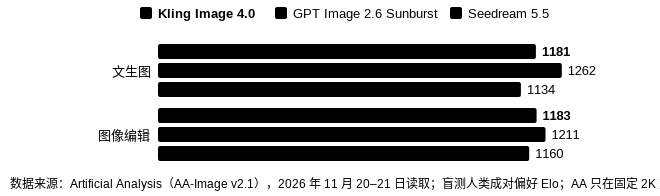
Kling Image 4.0's place among image models in one table: scores are Artificial Analysis blind-vote Elo (read Nov 20–21, 2026), prices are AA listed prices. Its quality scores sit in the second tier; its advantages are native 8K, long-text typesetting and a relatively low price.
| Model | AA text-to-image / editing Elo | Price (AA listed, per 1k) | Max resolution | Open weights |
|---|---|---|---|---|
| Kling Image 4.0 | Text-to-image 1181 (#7), editing 1183 (#6) | $63 / $66 | Native 8K | No |
| GPT Image 2.6 | Text-to-image 1262 (#1), editing 1211 (#2, Sunburst max) | $210.72 / $210.72 | Not listed in this round's research (this site's GPT Image 2.6 topic records 4K max, hands-on basis) | No |
| Seedream 5.5 | Text-to-image 1134 (#14), editing 1160 (#8) | $20 / $28 | 1K / 1.5K / 2K | No |
| MiniMax H3-Image | Text-to-image 1066 (#27); editing Elo not in this round's research | $21.79 (text-to-image) | Not listed in this round's research (this site's H3-Image topic records native 4K) | Weights public (custom licence) |
AA scores are blind human-preference Elo and move with votes; this site's Seedream 5.5 topic records a Nov 19 snapshot (1135/1159), 1 point off this read — normal board drift. Price bases differ (AA listed prices are per-1k default prices), so per-image prices are order-of-magnitude only; 8K resolution has no independent verification, and AA scores only fixed 2K square outputs. Full benchmarks in section 12.
03Charts
Grouped AA Elo comparison for text-to-image and image editing: Kling Image 4.0 leads the second tier on both boards, trailing GPT Image 2.6 Sunburst by 81 and 28 points and leading Seedream 5.5 by 47 and 23.
04Top 3 reads
Short on time? Start with these three: the benchmark tally, the pricing breakdown and the three-way comparison — all three take apart the line "AA #7/#6, native 8K, $0.063 an image".
05Timeline
Four days after launch, the official blog, user guide and tier-1 coverage all arrived in the same week; the AA preview listing predates the formal launch by two days — the first thing to understand about this topic's timeline.
- Feb 2026
Predecessor Kling Image 3.0 Omni launches (per the AA boards); today it sits at 925 Elo (#87) in text-to-image and 954 Elo (#68) in editing — the baseline for the 4.0 jump.
- Oct 15, 2026
The video model Kling 4.0 launches in full, with its Flash tier generally available November 4 — same name, different product, 33 days before the image model; the two lines run in parallel with different endpoints and price sheets.
- Nov 15, 2026 (or earlier)
Kling Image 4.0 Preview is already on the Artificial Analysis image boards: a WaveSpeed blog dated Nov 15 says the preview ranked sixth on the AA image boards, and the launch press release says the preview "maintains a leading position in both text-to-image and image editing". The AA scores measure the preview build, not the GA build tested after launch.
- Nov 17, 2026
Formal launch in the evening: the Media OutReach press release and the Kling AI blog "Meet Kling Image 4.0"; Creative Studio, the developer API and the fal listing go live the same day; ITHome reports first in Chinese that night; Kling AI announces on X at 15:04 UTC.
- Nov 18, 2026
Kling AI publishes the Image 4.0 user guide; TechNode (English, 06:43 UTC) and TechNode China report; QbitAI publishes a hands-on test; foxlab, photoworkout and SpicyAPI run hands-on tests; Runware, eachlabs and Higgsfield list it.
- Nov 18, 2026
OmniArt measures fal's billing header: 2K is 1.0 unit ($0.063), 4K 1.4921 units (about $0.094), 8K 2.4921 units (about $0.157), plus about $0.003 per reference image; Long Image is $0.235 per unit; the 8K output measures 10880×6144 at 108.7 MB. $0.063 is the 2K unit price, reconciling the earlier 4K figures of $0.063 and $0.097. See section 08.
- Nov 18, 2026
Foxlab publishes seven hands-on tests on Medium: the 8K output is 9,984×6,656, 66MP, an 88 MB PNG, still detailed at 100% zoom; a Chinese bubble-tea menu gets all five prices right; a poster schedule is spelled out in full; six ad images keep the can identical; the long image's lower half fails (size-table numbers lost, garbled text); in a same-prompt perfume-bottle comparison, H3-Image trails. See section 09.
- Nov 18, 2026
Zhidongxi publishes a launch hands-on (around Nov 18): the 8K realistic portrait keeps hair and leather texture on zoom; a laptop e-commerce long image comes out in one shot; a poster of about 400 words mostly holds its layout, with some text errors at high word counts; font changes and local text edits are precise; two 10-frame comic storyboards stay narratively coherent, with some shots looking plasticky; a Phantom Blade Zero character swaps outfits and weapons in one pass. See section 09.
- Nov 19, 2026
Artificial Analysis posts on X: #7 in text-to-image, #6 in editing, "at under a third of OpenAI's price", UI/UX design up to #4. This site read the AA text-to-image board at 1180 Elo that day and 1181 Elo on Nov 20.
- Nov 21, 2026
This site's topic page goes live (this page). As of publication: LMArena has not listed it; the official pricing page could not be read directly (JS-rendered); fal's per-resolution prices disagree across secondary sources and are unverified; App per-image credit prices and whether free accounts can use Image 4.0 are both unconfirmed.
- Nov 24, 2026
SpicyAPI's anchored blind test: 14 prompts, three judges, Kling Image 4.0 scores 78.0/100 (prompt adherence 8.07, visual quality 7.99, editing consistency 7.95), ahead of Seedream 5.5 (76.8) and MiniMax H3-Image (76.0); the same piece confirms 8K output at 8192×8192 and an 8K PNG of about 103 MB, and finds a new flaw: posters gain text nobody asked for (dates, venues, admission details). Limits: a small self-run sample, and text rendering is not in the total score. See section 09.
- Nov 18, 2026
PhotoWorkout's independent hands-on (published within a day of launch; prices checked Nov 18): native 8K checks out — an 8K request returns 9984×6656, 66 MP, a 138 MB PNG, with detail leaning painterly at 100% zoom; a poster of about 450 words comes out nearly verbatim, and a denser test poster of about 1,400 words carries only three small errors; a four-frame series stays consistent (the camera body drifts); prices run about $0.06/2K, $0.09/4K, $0.15/8K, the free tier is capped at 2K output, and every output carries a C2PA provenance credential. Another independent verification of native 8K, complementing SpicyAPI's 8192×8192 measurement. See section 09.
- Nov 23, 2026
Siray AI's hands-on (prices checked Nov 23): an 8K request returns 7040×9344 in 144 seconds for $0.157; the $0.063/$0.094/$0.157 ladder (2K/4K/8K) matches the official figures, while fal.ai's alternative 4K figure of $0.097 is still unreconciled; a four-frame storyboard takes 279 seconds; a long e-commerce page at 1024×6585 takes 141 seconds and $0.235, skipping the closing line and adding a section — a first draft only. Limits: Siray sells API access. See section 09.
06Official specs
As published by Kling (Kling AI blog and user guide, Nov 17–18, 2026). Undisclosed items are written as "not disclosed", not guessed.
- Status
- Released (GA, 2026-11-17; the preview build was already on the AA boards on Nov 15)
- Model ID
- kling-4.0 (API model code)
- Positioning
- Still-image generation: text-to-image, image-to-image / editing, image sets, long images; advertising, film, e-commerce and web scenarios (vendor wording)
- Architecture
- The vendor calls it a "Native Unified Understanding and Generation Architecture" — visual understanding and image generation inside a single autoregressive framework; no further architecture detail beyond that one line
- Native resolution
- Single images and image sets in native 2K / 4K / 8K (2K default); long images 1K/2K only; "native" means generated at 8K directly, not rendered small then upscaled (vendor claim, no independent verification)
- Text in image
- Up to 2,000 characters in a single image; 70+ preset commercial fonts; 7 languages (Simplified Chinese, Traditional Chinese, English, Japanese, Korean, Spanish, Portuguese); a reference image can guide the typography
- Prompt
- Up to 15,000 tokens per input
- Image sets
- Up to 10 images from a single prompt (Series Mode), shared creative direction with a distinct focus per image; the vendor says the set's content split is planned "agentically" (vendor wording)
- References
- Up to 10 reference images per input; the API allows up to 10 reference images plus subject elements combined per request
- Long images
- Long-form generation for e-commerce product detail pages and branded web designs; 1K/2K only (no 8K long images)
- Colour and aspect ratios
- 110+ preset colour-grading / tone styles; aspect ratios Auto, 3:4, 4:3, 9:16, 16:9, 2:3, 3:2, 21:9, 1:1
- API endpoints
- POST /image-generation/kling-4.0 (standard + series) and /long-image-generation/kling-4.0 (long images)
- Generation modes
- Default Mode (single image) / Series Mode (up to 10 images); three task modes across the two endpoints with different limits — do not present 8K + 10-image sets + long pages as one capability
- Access
- Kling Creative Studio (web + App), Kling API, fal (text-to-image / image-to-image / long-image endpoints); also Runware, eachlabs, Higgsfield, Krea, OpenArt, PixelDojo, Venice, Lovart; kie.ai resells about 10% under fal; OrcaRouter explicitly does not serve it
- Billing
- Official API bills in units: 2K 16 units, 4K 24 units, 8K 40 units; reference images and reference elements 0.8 units each (newly billable); packages valid 180 days, no rollover
- Weights / licence
- Closed, no public weights
- Benchmarks
- AA text-to-image #7, 1181 ±12; editing #6, 1183 ±13 (preview build); DesignArena #15 (61% win rate, secondary board); LMArena not listed
- Parameters / technical report / model card
- None published
- Generation speed
- Not published by Kuaishou; third-party timings are single-source and not treated as specs (see section 14)
07How to try it: three routes
All three routes opened on launch day: Creative Studio, the official API and fal. No weights, no local run — all three are online calls.
1Creative Studio (web + App, main route)
Use it directly in Kling's creative studio: text-to-image, image-to-image, image sets and long images in one place; 2K by default, with 8K and long images in their own tiers. Suited to users who don't want to write code; note that App per-image credit prices and whether free accounts can use Image 4.0 are both unconfirmed — don't build a story on a "free trial". See our usage guide.
2Official API (developer route)
Two endpoints: POST /image-generation/kling-4.0 (standard + series) and /long-image-generation/kling-4.0 (long images), model code kling-4.0. Prepaid unit packages: 2K 16 units, 4K 24 units, 8K 40 units, with reference images and reference elements at 0.8 units each; packages valid 180 days, no rollover. See our pricing breakdown.
3fal and third-party hosts (per-image route)
fal listed text-to-image, image-to-image and long-image endpoints on launch day, billed per image; also Runware, eachlabs, Higgsfield (Nov 18), Krea, OpenArt, PixelDojo, Venice, Lovart, with kie.ai reselling about 10% under fal. Note that fal's per-resolution prices used to disagree across secondary sources (4K quoted at both $0.063 and $0.097); an OmniArt test on Nov 18 settled it by reading the billing header (see below). This site still could not read fal's pages directly — go by fal's checkout page.
OmniArt measured fal's billing header on Nov 18: 2K output is 1.0 unit ($0.063), 4K 1.4921 units (about $0.094), 8K 2.4921 units (about $0.157), with about $0.003 per reference image; Long Image is $0.235 per unit; the 8K output measured 10880×6144 at 108.7 MB. $0.063 is the 2K unit price — the earlier 4K figures of $0.063 and $0.097 are now reconciled ($0.097 was an approximation). Note this is fal.ai's measured pricing, not Kling's own direct price; Kling's own price sheet lists only older models, with no direct Image 4.0 price.
Also: OrcaRouter explicitly does not serve Kling Image 4.0; don't use the video model Kling 4.0's endpoints and price sheet to call the image model — they are separate product lines.
08Pricing
The official API's unit price sheet is quoted identically by four independent channels and corroborated by AA's listed prices: about $0.063 at 2K, $0.094 at 4K and $0.157 at 8K per image. But the price page itself could not be read directly, and references are now billed — the rate card first, then what actually changed. Prices checked Nov 21, 2026; the checkout page price is authoritative.
| Output | Units / image | About USD / image | Basis |
|---|---|---|---|
| Single / series image, 2K | 16 | $0.061–0.063 | Official API units; converted at $0.0035–0.00384/unit |
| Single / series image, 4K | 24 | $0.092–0.094 | Same |
| Single / series image, 8K | 40 | $0.154–0.157 | Same |
| Reference image / element (each) | 0.8 | About $0.003 | Newly billable; earlier Kling image models charged nothing for references |
| Long image (webpage), 1K / 2K | 140 / 152 | About $0.549 / $0.596 | Separate ladder; no 8K long images |
| E-commerce detail page, short / medium / long (1K) | 60 / 120 / 200 | About $0.235 / $0.470 / $0.784 | Image-to-image only; 2K tiers are 72 / 140 / 220 units |
| E-commerce detail page, short / medium / long (2K) | 72 / 140 / 220 | About $0.282 / $0.549 / $0.862 | Image-to-image only |
How the unit price converts
The official API sells prepaid packages and deducts units: about $0.00384/unit in the $300 package, about $0.0035/unit in the $350 package of 100,000 units, and about $0.00381/$0.00373 in the larger $999/$4,000 packages; packages are valid 180 days with no rollover. That converts to 2K at about $0.061–0.063, 4K at about $0.092–0.094 and 8K at about $0.154–0.157 — which package you buy decides where in the range a single image lands. AA's listed prices corroborate it from the side: $63/1k for text-to-image and $66/1k for editing (one reference image) both sit inside this arithmetic.
References are now billed — the real pricing change
Earlier Kling image models charged nothing for references; this one charges 0.8 units per reference image and per reference element. OrcaRouter worked the arithmetic: a 12-frame 2K set built from 4 references costs 230.4 units instead of 192 — about 20% more — because reference charges stack per frame. The bigger the set and the more references, the larger that surcharge's share — quoting only "$0.063 an image" understates what sets and multi-reference edits really cost.
fal prices: two versions, reconciled by a measured test
fal's per-image prices disagree across secondary sources: yir.ai (updated Nov 19) puts fal at $0.066 at 2K, $0.097 at 4K and $0.160 at 8K; thehype.news puts fal's 4K price at $0.063; SpicyAPI's Nov 18 hands-on test paid $0.063/$0.094/$0.157, matching the official conversion. This site tried twice to read fal's model pages directly and failed both times (the URL could not be confirmed, returning 404), so it cannot settle whether 4K is $0.063 or $0.097 — do not cite a fal per-resolution price table as verified fact; go by fal's checkout page.
App credits and the membership discount: unverified
There is no official App per-image credit price: a single early tester reports 4 credits for a 2K image, 6 for 4K, 10 for 8K, and 24 credits for a six-image 2K set (single source; this site treats it as unconfirmed); the membership page lists Standard $10/month, Pro $37, Premier 18K $207 and Ultra+ $619 (Nov 15 list prices) but does not say whether free accounts can use Image 4.0 or how many credits they get. One source also reports a limited-time 40% discount on 8K generation for members, with no end date found. None of this is stated as fact.
Official pages: Kling AI — Blog "Meet Kling Image 4.0" · Kling AI — API pricing (could not be read directly this round; JS-rendered) · OrcaRouter — Reference-billing analysis
09First hands-on reviews
All from the first wave, Nov 17–24: the independent board scores come from Artificial Analysis blind votes, the vendor claims from the official blog, and third parties check the wording, repeat the price sheet and run hands-on tests. Every entry carries a verdict badge; "Read on this site" opens our rewritten deep-dive article, with the original source at the end.
Kling AI official blog: the source of every spec claim
Verdict: Vendor-reported, no independent verification yetSource: Kling AI, Nov 17, 2026 Original →
The blog "Meet Kling Image 4.0" is the source of all the specs: native 8K, 2,000 characters per image, a 15,000-token prompt, 10-image sets, 10 reference images, 110+ colour styles, 70+ commercial fonts, 7 languages, and the "Native Unified Understanding and Generation Architecture" line. It gives no benchmark numbers at all, and no parameter count, technical report or model card.
Read on this site → (original ModelBrief rewrite)
Media OutReach press release: the launch notice and the "preview leads" wording
Verdict: Launch facts confirmed; the board claim needs the preview wordingSource: Media OutReach Newswire, Nov 17, 2026 Original →
The release "Kling AI Launches Kling Image 4.0 with Photographic Realism and Native 8K Generation" is the launch-night official notice, and it states that Kling Image 4.0 Preview "maintains a leading position in both text-to-image and image editing" — the AA scores belong to the preview build, and that sentence is itself the evidence. The release was syndicated by several business wires.
Read on this site → (original ModelBrief rewrite)
TechNode: the strongest English report, with an honest caveat
Verdict: Tier-1 launch-day coverage, with the right caveatSource: TechNode, Nov 18, 2026 Original →
TechNode's Nov 18 report (06:43 UTC) is the strongest English piece so far: launch facts, 2,000 characters, 7 languages, 70+ fonts and the API going live, sourced from Leiphone. TechNode Global's second version the same day adds the honest note: Kuaishou "did not provide comparative tests" and "did not publish independent benchmark results" — the candid footnote inside the same outlet.
Read on this site → (original ModelBrief rewrite)
QbitAI: the tier-1 Chinese AI-media hands-on
Verdict: The strongest Chinese hands-on test; its headline reads "#7 globally, #1 in China"Source: QbitAI, Nov 18–19, 2026 (via AGI Hunt) Summary →
QbitAI's Nov 18–19 hands-on covers native-8K deep zoom, 2,000 Chinese characters across 70+ fonts, 10-image sets, one-shot long e-commerce pages, multi-reference composition (six camping products in one scene) and storyboard consistency; its headline calls the AA text-to-image rank "#7 globally, #1 in China". It was the first tier-1 Chinese AI-media hands-on; 智东西 (Zhidongxi) has since published its own hands-on (see below).
Read on this site → (original ModelBrief rewrite)
Artificial Analysis on X: the independent board speaks
Verdict: Independent scores confirmed; they belong to the preview buildSource: Artificial Analysis, X, Nov 19, 2026 AA text-to-image board → · AA editing board →
AA's Nov 19 post (10:30 UTC+08:00) reads: #7 in text-to-image, #6 in editing, "at under a third of OpenAI's price", UI/UX design up to #4. This site read the AA text-to-image board directly on Nov 20 at 23:58 UTC: Kling Image 4.0 #7, 1181 ±12, 5,635 votes; the editing board at 1183 ±13, 5,678 votes. The boards still carry the preview-build wording, and the scores measure the preview build.
Read on this site → (original ModelBrief rewrite)
OrcaRouter series: the best English source on price and reference billing
Verdict: Price-sheet reporting and AA reading agree; the reference arithmetic is its own findSource: OrcaRouter, Nov 18–20, 2026 Original →
OrcaRouter's three pieces (the release and reference-billing analysis, vs GPT Image 2.5, vs MAI Image 2.7, vs Krea 3 Ultra) are the best English source on price and the AA reading: the 16/24/40 unit ladder, the newly billable 0.8-unit references and the 12-frame-set arithmetic (about 20% more) all come from here, which also states plainly that OrcaRouter itself does not serve the model.
Read on this site → (original ModelBrief rewrite)
dev.to synthesis: endpoints, AA tables and the 8K boundary
Verdict: Best single synthesis; the 8K vs long-image split is drawn most clearly hereSource: dev.to, Nov 18–19, 2026 Original →
dev.to's synthesis lists both API endpoints, the AA tables for both boards and DesignArena #15, and draws the 8K (single images and sets) vs long-image (1K/2K only) boundary most clearly; it also notes Kuaishou has not disclosed the model size, the structure of its autoregressive visual vocabulary or per-request inference time.
Read on this site → (original ModelBrief rewrite)
foxlab / SpicyAPI / photoworkout: hands-on tests, the only 8K measurement
Verdict: Hands-on tests exist, but the 8K measurement and speed figures are single-sourceSource: foxlab (cnblogs), SpicyAPI, photoworkout, Nov 18–19, 2026
Each of the three hands-on tests adds something exclusive: foxlab's 7-prompt test measured one 8K output at 9,984×6,656 px (about 66 MP, 88 MB PNG) with detail surviving 100% zoom, and ran a same-prompt MiniMax H3-Image comparison — the only public independent 8K measurement; SpicyAPI's Nov 18 test ran four generations, about a minute per image at 2K against 19 seconds for Nano Banana 2.1, at prices of $0.063/$0.094/$0.157 matching the official conversion; photoworkout calls 8K real and the text rendering "the scary part". The speed figures are single-source and not treated as specs.
Read on this site → (original ModelBrief rewrite)
Chinese coverage: ITHome first, QbitAI and Zhidongxi hands-on, TechNode China follows
Verdict: Tier-1 Chinese reporting exists, but no Jiqizhixin or Xinzhiyuan pieceSource: ITHome (late Nov 17, via tecll.com), TechNode China (Nov 18, 2026)
ITHome reported first in Chinese late on Nov 17, headlined "first native 8K, up to 2,000 characters in a single image"; TechNode China followed on Nov 18, covering the 2,000 characters, 70+ fonts, 7 languages and the advertising / film / e-commerce / web scenarios. Chinese coverage is the ITHome + QbitAI hands-on + TechNode China combination; no standalone Jiqizhixin piece or Xinzhiyuan piece has surfaced.
Foxlab (Medium): seven hands-on tests — 8K, long text and image sets
Verdict: 8K detail and long-text layout hold up; the long image's lower half failsSource: Foxlab (Medium), Nov 18, 2026 (tested on Kling's own site, seven prompts)
Seven prompts on Kling's own site: the 8K output is 9,984×6,656, 66MP, an 88 MB PNG, still holding gear brushing and screw slots at 100% zoom; a Chinese bubble-tea menu gets all five prices right; a poster schedule is spelled out in full; six ad images in a set keep the can identical; the long image's lower half fails (size-table numbers lost, garbled text). In a same-prompt perfume-bottle comparison with MiniMax H3-Image, Kling renders the liquid and glass more plausibly, while H3-Image's bottle bottom turns transparent and blue with a leftover amber band on the right. Limits: one tester, one run on the official site; long images are a known weak spot.
Read the original → (medium.com, English)
Zhidongxi: launch hands-on — 8K portraits, e-commerce long images and 10-frame storyboards
Verdict: A tier-1 Chinese media independent test; 8K detail and multi-image storytelling hold up, dense layouts still produce typosSource: Zhidongxi (via ZAKER), around Nov 18, 2026 Original →
An 8K realistic portrait keeps hair and leather texture on zoom; a laptop e-commerce long image comes out in one shot; a poster of about 400 words mostly holds its layout, with some text errors at high word counts; font changes and local text edits are precise; two 10-frame comic storyboards stay narratively coherent, with some shots looking plasticky, plus a Xinjiang documentary-style set; a Phantom Blade Zero character swaps outfits and weapons in one pass. Limits: a launch hands-on, prompts chosen by the author.
Read the original → (myzaker.com, Chinese)
SpicyAPI's Nov 24 anchored blind test: 78.0 leads Seedream 5.5 and H3-Image — but posters add words nobody asked for
Verdict: a small-sample blind lead, from a self-run test, with text scoring left outSource: SpicyAPI, Nov 24, 2026 (anchored blind test, 14 prompts, three judges; 8 text-to-image + 6 editing, all at 2K) Original →
Three judges scored against anchored rubrics: Kling Image 4.0 totals 78.0/100 (prompt adherence 8.07, visual quality 7.99, editing consistency 7.95), ahead of Seedream 5.5 (76.8) and MiniMax H3-Image (76.0). The same piece also confirms 8K output at 8192×8192 and an 8K PNG of about 103 MB, and surfaces a new flaw: posters pick up text the prompt never asked for (dates, venues, admission details). State the limits plainly: SpicyAPI sells access to the models it tests, so this is a self-run test; the sample is only 14 prompts; and text rendering is not part of the total (only 2 of the 14 prompts carry a text criterion), so the "extra words" flaw and the leading score coexist.
Read the original → (spicyapi.ai, English)
PhotoWorkout hands-on: native 8K checks out, a ~450-word poster nearly verbatim
Verdict: native 8K is real and long text holds up well; detail looks painterly at 100% zoomSource: PhotoWorkout, published within a day of the Nov 17 launch; prices checked Nov 18, 2026 Original →
The native-8K claim checks out: an 8K request returns 9984×6656, 66 MP, a 138 MB PNG — though at 100% zoom the detail leans painterly rather than camera-sharp. A poster of about 450 words comes out nearly verbatim; a denser test poster of about 1,400 words carries only three small errors. A four-frame series stays consistent, with the camera body drifting between frames. Prices run about $0.06 at 2K, $0.09 at 4K and $0.15 at 8K; the free tier is capped at 2K output; every output carries a C2PA provenance credential. This is another independent verification of native 8K, complementing SpicyAPI's 8192×8192 measurement.
Read the original → (photoworkout.com, English)
Siray AI hands-on: 8K at 7040×9344 in 144 seconds, prices matching the official sheet
Verdict: 8K and prices line up with the official figures; treat the long e-commerce page as a first draftSource: Siray AI, prices checked Nov 23, 2026 Original →
An 8K request returns 7040×9344 in 144 seconds for $0.157; the price ladder of $0.063/$0.094/$0.157 (2K/4K/8K) matches the official figures, while fal.ai's alternative 4K figure of $0.097 is still unreconciled. A four-frame storyboard takes 279 seconds; a long e-commerce page at 1024×6585 takes 141 seconds and $0.235, skipping the closing line and adding a section — usable as a first draft only. Limits: Siray sells API access (a vendor position).
Read the original → (dev.to, English)
10Articles: our deep dives
The six articles below are original ModelBrief rewrites and reorganization — restructured with added conclusions and buying advice, with facts and numbers checked against the original sources. Read them on this site; each ends with its original source.
11Related topics
Topic pages for the other models on this site.
Kling 4.0 FlashGenerally available Nov 4, 2026 · Kuaishou's cheap, fast Kling 4.0 video tier, 720p at $0.094/s, ~40% below the full model — not the same product as the image model on this page. The topic page covers official specs, pricing, comparisons and 6 in-depth reviews.
China · Image · GA · Nov 9, 2026 Seedream 5.5Released Nov 9, 2026 · ByteDance's image model, built for 100 rounds of editing and native transparent PNG; AA text-to-image 1134, editing 1160 (read Nov 20–21). The topic page covers official specs, pricing, API status and 7 deep dives.
USA · Image · GA · Nov 4, 2026
 GPT Image 2.6Released Nov 4, 2026 · OpenAI's image model, Flare and Sunburst tiers, new GIF and SVG export; #1 on the AA text-to-image board (1262 Elo). The topic page covers official specs, pricing, API and 6 deep dives.
China · Image · GA · Nov 10, 2026
 MiniMax H3-ImageReleased Nov 10, 2026 · MiniMax's first image model, native 4K at about 16.8 MP, 6-step sampling, weights public (community licence excluding the US, Europe, UK and Korea); AA text-to-image 1066 (#27). The topic page covers official specs, pricing, licence and 8 deep dives.
China · Video · GA · Nov 12, 2026
 Seedance 2.5 FlashReleased Nov 12, 2026 · ByteDance's cheap tier of Seedance 2.5, announced by Volcano Engine Nov 12 with the API live Nov 15; 720p at ¥0.99/s, about 34% below the flagship. The topic page covers official specs, pricing, benchmark analysis and 7 in-depth reviews.
USA · Robot / World Model · Open Weights · Weights Opened Nov 11, 2026
 Runway Praxis-1Weights opened Nov 11, 2026 · Runway's world-action model, Apache 2.0 open; RoboLab-120 46.2%, #1 among world-action models (vendor-reported, no independent reproduction). The topic page covers official specs, pricing, benchmark analysis and 6 in-depth reviews.
USA · Video · GA · Nov 17, 2026
 HeyGen Avatar 6Released Nov 17, 2026 · HeyGen's audio-driven avatar model, native 2K, 30-second context window, #1 in New Measure's Avatar Arena in both categories, $0.10/s on OpenRouter. The topic page covers official specs, pricing, benchmarks and 6 in-depth reviews.
USA · LLM · Open Weights · Released Nov 20, 2026
 Inkling 2 MiniReleased Nov 20, 2026 · Thinking Machines Lab's open-weight looped model, 26.4B parameters with 3.4B active per token, AA Index 20.1 tied with Qwen3.8-27B, $0.15/$0.50 per 1M tokens. The topic page covers official specs, pricing, benchmarks and 6 in-depth reviews.
USA · LLM · GA · Nov 20, 2026
 Baseten Bison-1Released Nov 20, 2026 · Baseten's decision model on Gemma 4, #1 on the AA Decision Index at 76 (1 point ahead of d1.2-ultra), $0.10 per 1M input tokens. The topic page covers official specs, pricing, benchmark analysis and 6 in-depth reviews.
China · LLM · GA · Nov 16, 2026
 Sage S2.1 FlashReleased Nov 16, 2026 · Shanghai AI Lab's 320B science-agent model, 18B active, MLE-bench Lite 90.3 (vendor-reported), MIT open weights. The topic page covers official specs, pricing, benchmark analysis and 6 in-depth reviews.
ModelBrief homeAll topicsBack to the home page: browse all model topics by release date — LLMs, image models and video models.
China · LLM · GA · Nov 23, 2026
 GLM-5.4Released Nov 23, 2026 · Zhipu's flagship coding model, vision, 1M context, Coding Plan $18/$80/$168, KingBench 4 at 55.3% (one private test). The topic page covers official specs, pricing, benchmark analysis and 6 in-depth reviews.
USA · Image · GA · Nov 19, 2026
 Ideogram 4.6Released Nov 19, 2026 · Ideogram's native 4K image editing model, #1 on Rapidata's multi-step edit board at 1,892, API $0.008–$0.60 per image. The topic page covers official specs, pricing, benchmarks and 7 in-depth reviews.
USA · LLM · GA · Nov 18, 2026
 Cloudflare ClairicReleased Nov 18, 2026 · Cloudflare's extraction-model pair, 27B and 9B flash, Apache 2.0 open weights, $0.24/$0.10 per 1M input tokens. The topic page covers official specs, pricing, benchmarks and 6 in-depth reviews.
USA · LLM · GA · Nov 16, 2026
 Liquid d1.2Released Nov 16, 2026 · Liquid AI's omnimodal decision-model pair, d1.2-ultra #2 on the AA Decision Index at 75, audio input and five new tasks, $0.02/$0.042 per 1M input tokens with output free. The topic page covers official specs, pricing, benchmark analysis and 6 in-depth reviews.
LLM · Open Weights · Nov 13, 2026
 Maxwell V1 FlashWeights public Nov 13, 2026 · Maxwell Team's 35B/3B-active open MoE, 256K context, Apache 2.0; vendor-reported table leads same-scale Qwen3.6 with no independent score yet. The topic page covers official specs, pricing, benchmark analysis and 8 in-depth reviews.
China · Image Model · Open Weights · Released Nov 24, 2026
 SenseNova U1.6Released Nov 24, 2026 · SenseTime's 8B unified image model with native self-correction, UltraTextBench 86.04 to 92.28 (vendor-reported), Apache 2.0 open weights. The topic page covers official specs, pricing, benchmarks and 7 in-depth reviews.
South Korea · LLM · Preview · Released Nov 23, 2026
 Solar Mini 4.5 PreviewReleased Nov 23, 2026 · Upstage's preview agentic light model, 35B/3B MoE, 512K context, $0.01 per 1M tokens at 90% off, GA Dec 3; 4 of 5 in-house tests won, all vendor-reported. The topic page covers official specs, pricing, benchmarks and 6 in-depth reviews.
China · LLM · Medical Model · Released Nov 23, 2026
 LingSanteReleased Nov 23, 2026 · Ant Group's medical model family: 560B flash and 124B air-VL under MIT open weights, HealthBench Professional 65.72 (vendor-reported); not a medical device. The topic page covers official specs, benchmarks and 6 in-depth reviews.
China · Video Understanding · Open Weights · Released Nov 17, 2026
 WeMM-VideoWeights public Nov 17, 2026 · Tencent's omni-modal video-understanding family in 2B/4B/9B/35B-A3B, Apache 2.0 open weights; 9B beats a 30B baseline (vendor-reported), no API or price. The topic page covers official specs, benchmarks and 6 in-depth reviews.
China · LLM · Vision-Language Model · Released Nov 23, 2026
 Ling-3.2-airReleased Nov 23, 2026 · Ant Group's general-purpose VLM, 124B/5.5B hybrid-linear MoE, MIT open weights, AutomationBench-AA 61.0, AA Index 23.4; no hosted API. The topic page covers official specs, benchmarks and 6 in-depth reviews.
12Benchmarks: top 10 on both AA boards, scores from the preview build
Kling Image 4.0 is the first Chinese image model on this site to reach the top 10 on both AA boards: #7 in text-to-image, #6 in editing. But the wording comes first — the scores measure the preview build that was already listed on November 15, and AA scores fixed 2K square outputs, so 8K quality is not in the numbers.
Artificial Analysis (independent blind votes, read Nov 20–21, 2026)
| Board | Rank | Elo | Votes | Rank range |
|---|---|---|---|---|
| AA text-to-image v2.1 | #7 | 1181 ±12 | 5,635 | #6–9 |
| AA image editing v2.1 | #6 | 1183 ±13 | 5,678 | #5–7 |
Text-to-image: second tier, top of it
| Rank | Model | Elo | Votes | AA listed price / 1k |
|---|---|---|---|---|
| 1 | GPT Image 2.6 Sunburst (max) | 1262 ±14 | 5,431 | $210.72 |
| 4 | MAI-Image-2.7 | 1216 ±14 | 5,112 | $34.82 |
| 6 | GPT Image 2 (high) | 1194 ±11 | 13,581 | $211.00 |
| 7 | Kling Image 4.0 | 1181 ±12 | 5,635 | $63.00 |
| 8 | Nano Banana 2.1 | 1176 ±12 | 6,872 | $33.60 |
| 14 | Seedream 5.5 | 1134 ±12 | 5,348 | $20.00 |
| 26 | H3-Image Highspeed | 1071 ±14 | 3,451 | $35.29 |
| 27 | H3-Image | 1066 ±14 | 3,344 | $21.79 |
| 87 | Kling Image 3.0 Omni (predecessor) | 926 ±15 | 3,395 | $28.00 |
Editing: #6 as well, slightly stronger than text-to-image
| Rank | Model | Elo | Votes | AA listed price / 1k |
|---|---|---|---|---|
| 1 | MAI-Image-2.7 | 1215 ±14 | 5,526 | $34.82 |
| 2 | GPT Image 2.6 Sunburst (max) | 1211 ±13 | — | $210.72 |
| 5 | GPT Image 2.5 Flare (max) | 1185 | — | $210.72 |
| 6 | Kling Image 4.0 | 1183 ±13 | 5,678 | $66.00 |
| 8 | Seedream 5.5 | 1160 ±14 | — | $28.00 |
| 10 | Nano Banana 2.1 | 1152 ±12 | — | $33.60 |
| 68 | Kling Image 3.0 Omni (predecessor) | 954 ±13 | 5,926 | $28.00 |
The generational jump: +256 / +229 Elo, the most useful number in the launch
Against the predecessor Kling Image 3.0 Omni: text-to-image 925 → 1181 (+256 Elo), editing 954 → 1183 (+229 Elo). Those numbers are not in Kuaishou's own announcement — they come from comparing the AA boards. AA's Nov 19 post adds: the biggest leaps in Layout and Text Rendering (both top 10), best capabilities Lighting and Material (#5); editing tops Object-Level Edits, top 5 in 5 of 7 actions, weakest at Identity Preserving Edits (#15); UI/UX Design #4 (from outside the top 80); Retail & Ecommerce and Social Media edits #4; Marketing & Advertising lowest (#11). The capability breakdowns are attributed to AA via AGI Hunt's summary of AA's Nov 19 post, not read directly by this site.
Four reminders before reading the scores
First, the rank intervals overlap: text-to-image #6–9, editing #5–7 — #7/#6 are not precise to one place, so cite the range. Second, AA scores fixed 2K square outputs and publishes no resolution benchmark — the Elo says nothing about 8K detail or about 2,000-character text, so don't let the AA score launder the 8K claim. Third, the benchmarklist.com mirror shows different ranks (#17 text-to-image, #12 editing) for the same Elo and vote counts, apparently a different snapshot; trust AA's own boards. Fourth, Kuaishou publishes no benchmark table of its own — beyond AA and DesignArena, every quality claim is words ("photographic realism", "precise control").
Full tally: our benchmarks article →
13Comparisons
vs GPT Image 2.6 (the board leader)
| Dimension | Kling Image 4.0 | GPT Image 2.6 Sunburst (max) |
|---|---|---|
| AA text-to-image Elo | 1181 (#7) | 1262 (#1) |
| AA editing Elo | 1183 (#6) | 1211 (#2) |
| AA listed price / 1k | $63 / $66 | $210.72 / $210.72 |
| Max resolution | Native 8K (vendor claim, no independent verification) | Not listed in this round's research (this site's GPT Image 2.6 topic records 4K max, hands-on basis) |
| Text capacity per image | 2,000 characters (vendor claim) | Not listed in this round's research |
| Weights | Closed | Closed |
Kling Image 4.0 trails by 81 and 28 Elo points, costs about a third as much ($63 vs $210.72 per 1k), and is the only one of the two claiming native 8K. See our comparison article.
vs Seedream 5.5 (the Chinese rival)
| Dimension | Kling Image 4.0 | Seedream 5.5 |
|---|---|---|
| AA text-to-image Elo | 1181 (#7) | 1134 (#14) |
| AA editing Elo | 1183 (#6) | 1160 (#8) |
| AA listed price / 1k | $63 / $66 | $20 / $28 |
| Max resolution | Native 8K (vendor claim, no independent verification) | 1K / 1.5K / 2K |
| Editing pitch | 10 reference images, multi-reference composition | 100 rounds of editing on one image, native transparent PNG |
| Weights | Closed | Closed |
Kling Image 4.0 leads by 47 and 23 Elo but costs about 3x as much ($63 vs $20 per 1k text-to-image); Seedream's strengths are multi-round editing and transparent PNG, Kling's are the resolution ceiling and long-text typesetting. See our comparison article.
vs MiniMax H3-Image (same-generation Chinese model)
| Dimension | Kling Image 4.0 | MiniMax H3-Image |
|---|---|---|
| AA text-to-image Elo | 1181 (#7) | 1066 (#27) |
| AA listed price / 1k | $63 | $21.79 |
| Max resolution | Native 8K (vendor claim, no independent verification) | Not listed in this round's research (this site's H3-Image topic records native 4K) |
| Weights | Closed | Weights public (custom licence) |
| Same-prompt hands-on | foxlab's 7-prompt test includes a same-prompt H3-Image comparison | Same |
Kling Image 4.0 leads by about 115 Elo, but H3-Image has public weights and costs about a third as much; foxlab's same-prompt test is the only hands-on comparison between the two so far. See our comparison article.
Kling Image 4.0 vs Kling 4.0 (video): not the same product
| Dimension | Kling Image 4.0 (this page) | Kling 4.0 (video model) |
|---|---|---|
| Modality | Still images | Video |
| Released | Nov 17, 2026 (evening) | Oct 15, 2026 full release; Flash tier GA Nov 4 |
| Headline | Native 8K, 2,000 characters, 10-image sets | 1080p video, 720p Flash tier, per-second billing |
| API endpoint | /image-generation/kling-4.0 | Video-generation endpoints (see this site's Kling 4.0 Flash topic) |
| Billing | Per image: 2K about $0.063 | Per second: Flash 720p at $0.094/s |
| Independent score | AA text-to-image #7, editing #6 | Not listed by AA or LMArena |
Read the deep comparison: Kling Image 4.0 vs Seedream 5.5 and GPT Image 2.6 →
14What's missing (as of Nov 21)
- A direct read of the official pricing page: kling.ai/dev/pricing is JS-rendered, and two direct reads this round returned only an empty shell; the unit ladder (16/24/40 units) is consistently reported by four channels and corroborated by AA's listed prices, while one Chinese guide says the public list still shows only 3.0 / 3.0-omni / O1 / 2.1 with no Image 4.0 row
- fal's per-resolution price table: 4K was quoted at $0.063 (thehype.news) and $0.097 (yir.ai); an OmniArt test on Nov 18 read the billing header and confirmed about $0.094, settling the two figures; two attempts to read fal's model pages directly both failed (URL could not be confirmed, 404)
- App per-image credit prices and whether free accounts can use Image 4.0: no official wording; one early tester reports 4 credits at 2K, 6 at 4K, 10 at 8K (single source, not stated as fact)
- An LMArena listing: no Kling Image 4.0 entry on the image boards, and no announced listing date
- Parameter count, technical report and model card: none published by Kuaishou
- A second independent test of native 8K: the only public measurement so far is foxlab's single 9,984×6,656 output
- An end date for the members' limited-time 40% discount on 8K generation: one source reports it as limited-time, with no end date found
- An official statement on generation speed: Kuaishou has published none; fal timings of about 48 seconds at 2K and about 2.2 minutes at 8K are single-source
- Why the benchmarklist.com mirror ranks differ from AA's own boards (text-to-image #17 vs #7, editing #12 vs #6)
- A second round of hands-on tests from tier-1 Chinese media (QbitAI and Zhidongxi have both run systematic tests now)
15Rumor check
Most confusion about Kling Image 4.0 comes from nine places: the video model's shared name, the preview-build scores, 8K verification, a Flash tier, fal prices, the official price list, the free tier, open weights and the "#1" claim — clarified one by one below.
Not true "Kling Image 4.0 is Kling 4.0"
Kling 4.0 is the video model (full release October 15, 2026; Flash tier generally available November 4); Kling Image 4.0 is the still-image model (released November 17, 2026), with different endpoints, price sheet and benchmark boards. The video model "Kling 4.0"'s search volume and reputation belong to the video tier — don't lend them to the image model.
Not true "The AA #7/#6 scores were measured on the GA build after launch"
"Kling Image 4.0 Preview" was already on the AA boards on November 15 (or earlier), two days before the November 17 formal launch, and the launch press release says the preview "maintains a leading position in both text-to-image and image editing". The scores measure the preview build — say so when citing them.
Not true "Native 8K is independently verified"
AA scores fixed 2K square outputs and publishes no resolution benchmark, so the Elo says nothing about 8K detail; the only public independent 8K measurement is foxlab's single 9,984×6,656 output (about 66 MP, 88 MB PNG). "First in the industry to support native 8K" is a vendor claim, unverified.
Not true "There is a Kling Image 4.0 Flash image tier"
No such image tier exists. "Flash" is the video model Kling 4.0's cheap, fast tier (720p, $0.094/s); one outlet's mention of "a Flash variant on its API price sheet" refers to the video Flash on the same sheet. Don't write "Kling Image 4.0 Flash".
Unverified "fal charges $0.063 for a 4K image"
Two versions exist: thehype.news puts fal's 4K price at $0.063, while yir.ai (updated Nov 19) puts fal at $0.097 at 4K, $0.066 at 2K and $0.160 at 8K; SpicyAPI's Nov 18 hands-on test paid $0.063/$0.094/$0.157, matching the official conversion. Two attempts to read fal's model pages directly both failed, so it cannot be settled — go by fal's checkout page.
Partly true "The official price list is published and checkable"
The unit ladder (2K 16 units, 4K 24 units, 8K 40 units) appears in the official API docs and the Nov 17 changelog, is quoted identically by four channels and is corroborated by AA's listed prices; but the public pricing page kling.ai/dev/pricing returned only a JS shell on two direct reads this round, and one Chinese guide says the public list still shows only 3.0 / 3.0-omni / O1 / 2.1 with no Image 4.0 row. Cite the ladder as reported-plus-corroborated, not as "read directly off the official pricing page".
Unverified "Free accounts can use Image 4.0"
Kuaishou's membership page does not say whether free accounts can use Image 4.0 or how many credits they get; there is no official App per-image credit price either. Don't build a story on "free".
Not true "There are open weights for a local run"
Kling Image 4.0 is closed with no public weights; access is Creative Studio, the official API and third-party hosts only, with no local-run route.
Not true "Kling Image 4.0 tops Artificial Analysis"
It is #7 in text-to-image and #6 in editing, not #1; the text-to-image leader is GPT Image 2.6 Sunburst (1262 Elo) and the editing leader is MAI-Image-2.7 (1215 Elo). "#7 globally, #1 in China" is the accurate version of QbitAI's headline.
16FAQ
When was Kling Image 4.0 released?
On the evening of November 17, 2026 (Tuesday), Beijing time; Kling AI announced on X at 15:04 UTC, with the Media OutReach press release and the Kling AI blog published the same day. Note the AA preview build was already listed on November 15, and the scores measure that preview. See section 05 for the timeline.
Is Kling Image 4.0 the same as Kling 4.0 (video)?
No. Kling 4.0 is the video model (full release October 15, 2026; Flash tier generally available November 4); Kling Image 4.0 is the still-image model (released November 17, 2026), with different endpoints, price sheet and benchmark boards. There is no "Kling Image 4.0 Flash" image tier. See section 13.
How much does Kling Image 4.0 cost?
The official API bills in units: 2K 16 units at about $0.063, 4K 24 units at about $0.094, 8K 40 units at about $0.157 per image; reference images and reference elements cost 0.8 units each (newly billable); long images have their own ladder (webpage 1K about $0.549, 2K about $0.596). fal's per-resolution prices used to disagree across secondary sources (4K quoted at both $0.063 and $0.097); an OmniArt test on Nov 18 read the billing header and settled it: 2K $0.063, 4K about $0.094, 8K about $0.157. See our pricing breakdown.
What is its Artificial Analysis ranking?
#7 in text-to-image (1181 ±12, 5,635 votes, range #6–9) and #6 in editing (1183 ±13, 5,678 votes, range #5–7) — top Chinese model on both boards; the scores measure the preview build listed on November 15. It is up +256/+229 Elo from the predecessor 3.0 Omni. See our benchmarks article.
Is native 8K real?
It is a vendor claim, with no independent verification. AA scores fixed 2K square outputs and publishes no resolution benchmark; the only public independent 8K measurement is foxlab's single 9,984×6,656 output (about 66 MP, 88 MB PNG). "First in the industry to support native 8K" is likewise a vendor claim.
Where can I use Kling Image 4.0?
Kling Creative Studio (web + App), the official API (two endpoints), fal and third-party hosts including Runware, eachlabs, Higgsfield, Krea, OpenArt, PixelDojo, Venice and Lovart; OrcaRouter explicitly does not serve it. See our usage guide.
Can I run Kling Image 4.0 locally?
No. The model is closed with no public weights; access is Creative Studio, the official API and third-party hosts only, with no local-run route.
Is there a free tier? Is there a Kling Image 4.0 Flash?
A free tier is unconfirmed: Kuaishou's membership page does not say whether free accounts can use Image 4.0 or how many credits they get. And there is no Flash tier: "Flash" is the video model Kling 4.0's cheap, fast tier, not an image-model tier.
17Sources
Every fact on this page comes from the public sources below (the Kling AI blog and Media OutReach release published Nov 17, 2026; the AA boards read directly by this site on Nov 20–21, 2026; this site's research on Nov 21, 2026, fact-checked Nov 21, 2026).
Official
- Kling AI — Blog "Meet Kling Image 4.0" (native 8K, 2,000 characters, 15,000-token prompt, 10-image sets, 10 reference images, 110+ colour styles, 70+ fonts, 7 languages, unified architecture) Published Nov 17–18
- Media OutReach Newswire — Release "Kling AI Launches Kling Image 4.0 with Photographic Realism and Native 8K Generation" (launch notice, preview-build wording) Published Nov 17
- Kling AI — Kling Image 4.0 User Guide (resolution tiers, long images at 1K/2K, set and reference limits, aspect ratios) Published Nov 18
- Kling AI — API pricing (official source of the 16/24/40 unit ladder; two direct reads this round returned only a JS shell) Direct read failed, Nov 21, 2026
Independent boards
- Artificial Analysis — AA-Image-T2I v2.1 text-to-image board (Kling Image 4.0 #7, 1181 ±12, 5,635 votes; GPT Image 2.6 Sunburst 1262, Seedream 5.5 1134, H3-Image 1066) Read directly Nov 20, 2026
- Artificial Analysis — AA-Image-Editing v2.1 editing board (Kling Image 4.0 #6, 1183 ±13, 5,678 votes; GPT Image 2.6 Sunburst 1211, Seedream 5.5 1160) Read Nov 20–21, 2026
- Artificial Analysis — X post (#7 text-to-image, #6 editing, "at under a third of OpenAI's price", UI/UX design #4) Nov 19
English reporting and analysis
- TechNode — "Kuaishou launches Kling Image 4.0 with native 8K generation" (strongest English report; sourced from Leiphone) Nov 18
- TechNode Global — "Kuaishou launches Kling Image 4 with 8K output" (Kuaishou provided no comparative tests, published no independent benchmark results) Nov 18
- OrcaRouter — "Kling Image 4.0: 8K stills and a new reference bill" (unit ladder, reference-billing analysis, 12-frame-set arithmetic) Nov 18–20
- dev.to — "Kling Image 4.0: Native 8K, 2,000 Characters, and 10-Image Sets" (endpoints, AA tables, DesignArena #15, the 8K vs long-image split) Nov 18–19
- AlphaSignal — "Kuaishou's Kling Image 4.0 Jumps 225 Elo Points to Challenge OpenAI" (AA tables, UI/UX #4) Nov 19–20
- chengrang.com — Kling Image 4.0 tool review (fullest spec + price table, Runware 8K at 10880×6144, members' 8K discount) Nov 18–19
- thehype.news — "Kling Image 4.0: Native 8K, Text, Price and Rank" (fal 4K at $0.063, one of the two versions) Nov 18
- yir.ai — "Kling Image 4.0 API Pricing per image" (fal at $0.066 2K / $0.097 4K / $0.160 8K; fal timings about 48 s at 2K, about 2.2 min at 8K) Prices updated Nov 19
- SpicyAPI — "Kling Image 4.0 Review: 8K Stills, Clean Type, Extra Words" (four generations tested Nov 18; prices $0.063/$0.094/$0.157; Nov 24 anchored blind test: 14 prompts, three judges, Kling Image 4.0 at 78.0/100, ahead of Seedream 5.5 at 76.8 and H3-Image at 76.0; 8K output 8192×8192, 8K PNG about 103 MB; posters add unrequested text) Nov 18, Nov 24
- photoworkout — "Kling Image 4.0 Tested: Native 8K Is Real, and the Text Rendering Is the Scary Part" (native 8K checks out: 8K returns 9984×6656, 66 MP, a 138 MB PNG; a ~450-word poster nearly verbatim, a ~1,400-word dense poster with only three small errors; a four-frame series stays consistent; about $0.06/$0.09/$0.15, free tier capped at 2K, C2PA credentials on every output) Nov 18
- Siray AI — "Kling Image 4.0 on Siray AI: Native 8K, Long Pages & Sets" (8K returns 7040×9344 in 144 seconds for $0.157; $0.063/$0.094/$0.157 matches the official figures, fal.ai's 4K $0.097 figure still unreconciled; a four-frame storyboard takes 279 seconds; a long e-commerce page at 1024×6585 takes 141 seconds and $0.235) Nov 23
- aiformortals — "Kling AI Image Generator 4.0: 8K, Pricing and How to Try It" (single-source App credits, membership list prices) Nov 18
- tokenstrom — "Kling Image 4.0: Kuaishou's image model goes native 8K and fits up to 2,000 characters" (from ITHome) Nov 17–18
- i10X News — "Kling Image 4.0: Native 8K AI Image Generation" ("first in the industry" flagged as unverified) Nov 18
- Asia Daily — "Kling Image 4.0 Launches With Native 8K, Editable Text…" Nov 18
- aicoreupdates — "Kling Image 4.0 Review: Native 8K Photos and 10-Image Sets" (membership list prices; its Nov 9 "no official price" claim is stale) Nov 18
- fluxbbs — "Kling Image 4.0 怎么用" (usage guide, including the price-list dispute) Nov 18–20
- aivs.tv — Launch roundup (X announcement timestamp Nov 17, 2026, 15:04 UTC) Nov 17
- benchmarklist.com — AA mirror snapshot (ranks differ from AA itself; see section 12) Nov 20 snapshot
- OmniArt — "Kling Image 4.0: API pricing, 8K output and image sets" (fal billing-header test: 2K $0.063, 4K about $0.094, 8K about $0.157; 8K output 10880×6144, 108.7 MB) Nov 18
- Foxlab (Medium) — "Kling Image 4.0 Review: 8K Photos, Long Text and Image Sets, Tested" (seven hands-on tests on the official site: 8K 66MP detail holds, long image's lower half fails; H3-Image trails in the perfume-bottle comparison) Nov 18
- Zhidongxi (via ZAKER) — Kling Image 4.0 launch hands-on (around Nov 18, 2026: 8K realistic portraits, e-commerce long images, a ~400-word poster, two 10-frame comic storyboards, a Phantom Blade Zero outfit/weapon swap) Around Nov 18
- 智东西(经 ZAKER 转载)— Kling Image 4.0 首发实测(约 2026-11-18:8K 写实人像、电商长图、约 400 字海报、两组 10 帧漫画分镜、《影之刃零》换装换武器) 约 11 月 18 日
Chinese
- ITHome (via tecll.com) — "快手可灵全新一代图像创作模型 Kling Image 4.0 上线:首次支持原生 8K,单图内可生成 2000 字" (first Chinese report) Late Nov 17
- QbitAI (via AGI Hunt) — Hands-on: native-8K deep zoom, 2,000 Chinese characters, 10-image sets, long e-commerce pages, multi-reference composition (headline "#7 globally, #1 in China") Nov 18–19
- TechNode China — "可灵上线 Image 4.0,支持原生 8K 生图和一次生成 10 张组图" Nov 18
- foxlab — "可灵 Kling Image 4.0 实测" (7-prompt hands-on; 8K output 9,984×6,656; same-prompt MiniMax H3-Image comparison) Nov 18–19
- This site's research, Nov 21, 2026: Google Autocomplete produced no usable suggestions in either language (English: the bare term only); one Google Trends attempt returned HTTP 411, no data obtained
More indexes: All models · All Kuaishou models · All Image Models