 GigaChat 4: The Topic Page
Sber (Russia's largest bank) announced GigaChat 4 on November 26, 2026 at its AI Journey conference — first, the positioning: this is a two-size family, a 708B-A41B flagship and a 37B-A4B compact, both posted to Hugging Face the same day; the flagship instruction-tuned model is MIT open weights, but the 37B is under a noncommercial licence — not MIT; every benchmark is vendor-run, with no independent score yet; and both models are already in the GigaChat assistant and the AI Studio hosted API (live November 26, 2026), but no price has been published — self-hosting remains an option. This page collects the official specs, the ways to try it, a pricing breakdown and 6 in-depth reviews — with unverified claims clearly marked.
01Key facts
What is confirmed: GigaChat 4 is Sber's two-size model family, announced November 26 at the AI Journey conference — the 708B flagship shipped the same day under MIT open weights, the 37B shipped the same day under a different licence; the benchmark table is vendor-reported, with nothing independently reproduced; and both models are already in the GigaChat assistant and the AI Studio hosted API (live November 26, 2026), though no price has been published — self-hosting remains an option.
- Released
- 2026-11-26 (Thursday), formally: Sber announced GigaChat 4 at the AI Journey conference in Moscow; the Hugging Face model cards, the technical report (GitHub) and the SGLang cookbook went live the same day
- Developer
- Sber (Russia's largest bank) and its AI team; Hugging Face org ai-sage; GigaChat is Sber's flagship model family, and GigaChat 4 succeeds GigaChat 3.5 (432B Ultra)
- Positioning
- A flagship hybrid large language model family: multilingual conversation, multi-step agentic tasks, tool calling, structured outputs, mathematical reasoning, coding, and long-document question answering
- Flagship parameters
- 708B total / 41B active per token, 64 layers, hidden size 7,168
- Compact parameters
- 37B total / ~3.8B active per token, 32 layers, hidden size 2,560; 192 routed experts
- Architecture
- Hybrid MoE + linear attention: 256 routed experts, 8 active + 1 shared per token; 48 Gated DeltaNet linear-attention layers + 16 DeepSeek Sparse Attention (DSA, on MLA) layers, interleaved 3:1; the first 3 decoder layers use dense FFNs; SwiGLU clipping at 10, final-logit soft-capping at 30
- Context
- 1,048,576 tokens (1M), progressively extended 32K → 128K → 1M during training; DSA selects 2,048 context positions per query; the SGLang cookbook notes a configured 1M window with a YaRN factor of 32 (32K base) and that the request length a server can admit also depends on cache memory
- Dual modes
- Instant and reasoning modes in one checkpoint, selectable per request (chat_template_kwargs.reasoning false/true; reasoning is enabled by default when the argument is omitted); GigaChat 3.5 needed separate checkpoints for the two modes
- Speculative decoding
- Two paths: recurrent MTP (an EAGLE-3-style drafter reusing one prediction layer, ~3× fewer drafter parameters than 3.5's three independent MTP blocks) and DFlash2 (a separate 5-layer BF16 drafter, 8-position blocks: 1 anchor + 7 draft positions)
- Training
- SFT → specialist RL (math, coding, tool use, multi-turn agent workflows) → multi-teacher on-policy distillation into one model; Muon optimizer; stability: progressive residual warm-up (ProRes), projection-specific z-loss + logit softcapping, dynamic learning-rate rescaling (DLR) for MoE load imbalance
- Weights / licence
- The 708B instruction-tuned model is MIT: FP8 / BF16 / GGUF instruction-tuned, BF16 base and BF16 intermediate checkpoints, all under ai-sage; the 37B is under the Noncommercial License for Individuals 1.0 — the compact is NOT MIT, and the licence split is a first-class topic fact, not a footnote
- Benchmarks
- All vendor-reported (Sber's own runs): reasoning-mode Terminal-Bench 2.0 71.26, SWE-bench Verified 80.89, LiveCodeBench v6 88.82, GPQA Diamond 82.83, BFCL v4 79.55 (best in the table), HLE 23.91, DeepSWE 35.40; instant-mode TB 2.0 60.47, SWE-bench 80.82. The AA-LCR row in the card is Sber's own run of the AA long-context-retrieval benchmark — not an AA score. The 37B also has three vendor-reported reasoning-mode figures (from the official 37B model card ai-sage/GigaChat4-37B-A4B-bf16, see section 11): SWE-bench Verified 70.8%, Terminal-Bench 2.1 39.33%, FCLv4 72.00%
- Independent scores
- None: no Artificial Analysis / LMArena / LiveBench entry, no third-party reproduction; the weights are public, so the community can run them itself
- Price
- Hosted API yes, price no: the AI Studio hosted API went live on Nov 26, 2026 (both models connected), but no price has been published; no third-party hosting; the weights are free to download and self-hosting remains an option; this site therefore has no pricing article to write, and the price slot is taken by the deployment guide
- Access
- The AI Studio hosted API (live Nov 26, 2026, endpoint https://api.aistudio.giga.chat/v1, both models connected to the GigaChat assistant and AI Studio), Hugging Face (708B and 37B repos + variants), the GitHub technical report and the SGLang cookbook; SGLang native support, vLLM also documented; OpenAI-compatible tool calling (GCML format)
- Hardware
- FP8 flagship: 2 nodes × 8×H100 80GB (TP16), as the weights exceed the combined capacity of eight H100 80GB GPUs; the 37B runs on a single H100 80GB at ~40 GB of weights (before KV cache and recurrent states); the 8×H200 TP8 recipe is unverified
- Media coverage
- English: unite.ai, gptonline.ai, dailyaibrief.com, artiverse.ca, fluidifia.com, neuralbridge.ru — all same-day short reports on Nov 26, none independently tested; no TechCrunch / The Verge / Reuters / Bloomberg-tier outlet; Chinese: zero coverage
- Search interest
- Google Autocomplete for the bare English term is polluted by a 4PDA forum and the gigachad meme; all suffixed price/review/vs queries return nothing; all Chinese queries return nothing (this site, Nov 27, 2026); Google Trends was not obtained (pytrends not installed, one attempt, no retry)
02Quick comparison
GigaChat 4 (reasoning mode) in one table: best in the table on tool calling, but badly behind on DeepSWE and HLE — not a sweep, a scorecard with clear strengths and weaknesses. All figures vendor-reported (Sber's model-card table).
| Model | Size / active | Terminal-Bench 2.0 | SWE-bench Verified | BFCL v4 | DeepSWE |
|---|---|---|---|---|---|
| GigaChat 4 | 708B / 41B active | 71.26 | 80.89 | 79.55 (#1) | 35.40 |
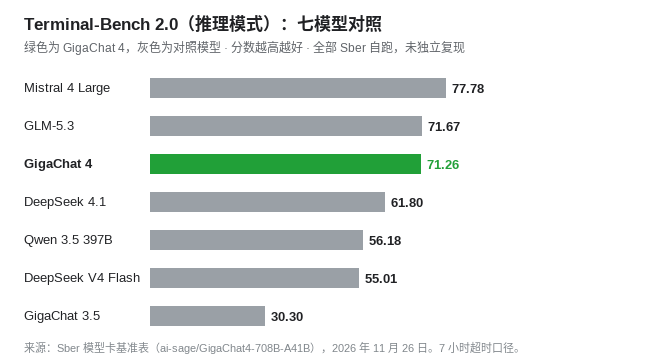
| Mistral 4 Large | Not in this round's research | 77.78 | 79.60 | 70.68 | 61.95 |
| GLM-5.3 | 750B | 71.67 | 86.67 | 68.29 | 67.26 |
| DeepSeek 4.1 | Not in this round's research | 61.80 | 79.40 | 72.18 | 74.34 |
| Qwen 3.5 397B | 397B | 56.18 | 73.00 | 69.10 | 3.54 |
| DeepSeek V4 Flash | Not in this round's research | 55.01 | 81.80 | 73.12 | 53.10 |
| GigaChat 3.5 Ultra (predecessor) | 432B | 30.30 | 64.70 | 58.59 | Not in this round's research |
On TB 2.0, GigaChat 4 trails Mistral 4 Large by 6.52 points and GLM-5.3 by 0.41 points; on DeepSWE it only beats Qwen 3.5's 3.54 and trails DeepSeek 4.1's 74.34 by a wide margin. Full table in section 11, comparisons in section 13.
03Charts
Terminal-Bench 2.0 (reasoning mode), seven models: GigaChat 4 at 71.26 ranks third, only 0.41 points behind GLM-5.3 — but 2.35× the 30.30 of its predecessor 3.5. All figures vendor-reported, not independently reproduced.
04Top 3 reads
Short on time? Start with these three: the benchmark tally, the architecture breakdown and the deployment guide — all three take apart the line "708B, 71.26, MIT".
05Timeline
The family reached 708B in four months: the 3.1 line updated in March, 3.5 Ultra open-sourced in July, 3.5 Reasoning in September, and on November 26 GigaChat 4 delivered two sizes, MIT weights, a technical report and a deployment cookbook in one day; as of November 27, no benchmark has been independently reproduced.
- Mar 24, 2026
GigaChat-3.1-Ultra and GigaChat-3.1-Lightning released (Sber blog record).
- Jul 6, 2026
GigaChat 3.5 Ultra open-sourced: a 432B model (Sber blog record).
- Sep 10, 2026
GigaChat 3.5 Reasoning released: the first full reasoning model, trained with online RL (Sber blog record).
- Nov 26, 2026
Formal release: Sber announces GigaChat 4 at the AI Journey conference — the 708B-A41B flagship and the 37B-A4B compact; the flagship instruction-tuned model ships the same day on Hugging Face under MIT (FP8 / BF16 / GGUF, base and intermediate checkpoints), the 37B under a noncommercial licence; the technical report goes to GitHub and the SGLang cookbook goes live the same day.
- Nov 26, 2026
English secondary coverage lands the same day: unite.ai, gptonline.ai, dailyaibrief.com, artiverse.ca, fluidifia.com and neuralbridge.ru — all short reads of the model card and blog, none independently tested; no tier-1 English outlet, no Chinese coverage.
- Nov 26, 2026
AI Studio hosted API goes live: this page's "no API" wording is corrected. Both models are connected to the GigaChat assistant and AI Studio, at the endpoint https://api.aistudio.giga.chat/v1; the per-user limit is 25 requests per minute (a single Russian secondary source, not independently verified); no price has been published. Separately, Izvestia is quoted (single source, not independently verified) as saying GigaChat 4 is 40% faster than GigaChat 3.5 (attributed to infrastructure and model changes) and can run 100+ consecutive actions in an agent environment. See section 09.
- Nov 27, 2026
A community GGUF mirror appears: AtomicChat/GigaChat4-37B-A4B-GGUF (Q4_K_M / Q6_K / Q8_0, sourced from the official ai-sage/GigaChat4-37B-A4B-bf16) under the giga-noncommercial-for-individuals-1.0 licence; its docs call for a build from llama.cpp PR 32767, commit 0541e50e — no released llama.cpp supports it yet. The mirror is third-party, and the article labels itself "not officially confirmed"; llama.cpp v1.1.0 (Nov 26) added no GigaChat model, and the patch is still unmerged. See section 07.
- Nov 27, 2026
This topic page goes live. As of publication: vendor-reported benchmarks still have no independent reproduction; no AA / LMArena / LiveBench entry; the AI Studio hosted API is live (no price published) and third-party hosting still has no listing; the 37B model card now carries three reasoning-mode figures (see section 11), and the technical report is still unpublished.
06Specs
The official figures below come from the Hugging Face model cards, the Sber blog, the GitHub technical report and the SGLang cookbook (Nov 26, 2026). Unpublished items are marked "not published" — nothing is guessed; conflicting figures are shown side by side.
- Status
- Released (formally announced Nov 26, 2026; weights posted to Hugging Face the same day)
- Model IDs
- ai-sage/GigaChat4-708B-A41B (FP8) / -GGUF / -bf16 / -base / -checkpoints; ai-sage/GigaChat4-37B-A4B (same variant categories)
- Positioning
- Flagship hybrid large language model family: multilingual conversation, multi-step agentic tasks, tool calling, structured outputs, mathematical reasoning, coding, long-document QA
- Parameters
- Flagship: 708B total, 41B active per token, 64 layers, hidden size 7,168; compact: 37B total, ~3.8B active per token, 32 layers, hidden size 2,560
- Architecture
- Hybrid MoE + linear attention: 256 routed experts, 8 active + 1 shared per token; 48 Gated DeltaNet layers + 16 DSA (MLA-based) layers, interleaved 3:1; the first 3 decoder layers use dense FFNs; GatedNorm, attention gates, SwiGLU clipping at 10, final-logit soft-capping at 30; the 37B uses 192 routed experts
- Context
- 1,048,576 tokens; progressively extended 32K → 128K → 1M in training, DSA introduced at the 128K stage; DSA selects 2,048 context positions per query; the SGLang cookbook notes a configured 1M window with a YaRN factor of 32 (32K base) and that the request length a server can admit also depends on cache memory
- Dual modes
- Instant and reasoning modes in one checkpoint, selectable per request (chat_template_kwargs.reasoning); reasoning is enabled by default when the argument is omitted; thinking and the final answer are returned separately (SGLang: message.reasoning_content; vLLM: message.reasoning)
- Speculative decoding
- Recurrent MTP (one built-in prediction layer, EAGLE-3 style, three draft steps, one candidate per step, four verification positions) and DFlash2 (a separate 5-layer BF16 drafter, 8-position blocks: 1 anchor + 7 drafts; the draft lives in the dflash_draft/ directory and must stay BF16)
- Training
- SFT → specialist RL (math, coding, tool use, multi-turn agent workflows) → multi-teacher on-policy distillation into one model; Muon optimizer; stability: ProRes progressive residual warm-up, projection-specific z-loss + logit softcapping, DLR dynamic learning-rate rescaling
- Weight size
- Not published: the model card gives no file size per variant; the SGLang cookbook only says the FP8 weights exceed the combined capacity of eight H100 80GB GPUs; the 37B weights are ~40GB (before KV cache and recurrent states)
- Hardware
- Flagship FP8: the official SGLang and vLLM recipes both use 2 nodes × 8×H100 80GB (TP16); the 8×H200 (141GB) TP8 recipe is unverified; the 37B runs on a single H100 80GB
- Serving frameworks
- SGLang (natively supported, with recurrent MTP and DFlash2, per-request mode selection and tool calling; cookbook at docs.sglang.io; tested on SGLang commit ff14289793) and vLLM (tested on commit c0c9083, with gigachat4 tool-call and reasoning parsers); recommended agent harnesses Pi, Codex CLI and DeepSeek Harness
- API
- Hosted API: AI Studio (https://api.aistudio.giga.chat/v1) — both models are connected to the GigaChat assistant and AI Studio, live Nov 26, 2026; per-user limit 25 requests per minute (a single Russian secondary source, not independently verified); no price published. A self-hosted server separately exposes an OpenAI-compatible interface (SGLang port 30000, vLLM port 8000), with tool calls in GCML format converted by the parser into OpenAI message.tool_calls
- Weights / licence
- The 708B instruction-tuned model is MIT; the 37B is under the Noncommercial License for Individuals 1.0; base and intermediate checkpoints are public
- Benchmarks
- All vendor-reported, see section 11; no AA / LMArena / LiveBench entry; the AA-LCR row in the card is Sber's own run, not an AA score
- Not published
- Per-variant weight file sizes; inference speed (tokens/second); training data and compute; the full 37B benchmark table and technical report (the model card now carries three reasoning-mode figures — see section 11; promised later); hosted API prices; third-party hosting plans; Hugging Face download counts
07How to try it: 3 routes
GigaChat 4 has three routes: flagship self-hosting, single-GPU 37B self-hosting, and the AI Studio hosted API. Plainly: all three work today — the hosted API went live on November 26, 2026, with no price published yet.
1Flagship self-hosting (main route)
Download ai-sage/GigaChat4-708B-A41B (FP8) from Hugging Face and serve it with SGLang: 2 nodes × 8×H100 80GB, TP16, --reasoning-parser auto --tool-call-parser auto, EAGLE speculative decoding; or vLLM (commit c0c9083), also two-node TP16. See our deployment guide.
2Single-GPU 37B route
Download ai-sage/GigaChat4-37B-A4B from Hugging Face: one H100 80GB, ~40GB of weights (before KV cache and recurrent states); an official GGUF variant also exists. There is also a community GGUF mirror, AtomicChat/GigaChat4-37B-A4B-GGUF (Q4_K_M / Q6_K / Q8_0, sourced from the official bf16 repo), which must be built from llama.cpp PR 32767, commit 0541e50e — no released llama.cpp supports it yet; the mirror is third-party and the article labels itself "not officially confirmed". Note the 37B is under a noncommercial licence — read the licence text before commercial use. See our deployment guide.
3AI Studio hosted API (new route)
Both models are connected to the GigaChat assistant and AI Studio, at the endpoint https://api.aistudio.giga.chat/v1 (live November 26, 2026), with a per-user limit of 25 requests per minute (a single Russian secondary source, not independently verified); no price has been published. Per-token access is available through AI Studio now; third-party hosting (OpenRouter and others) still has no listing. The 8-hour tracking loop watches for the first price. See our licence and access guide.
Also: the model card's recommended agent harnesses are Pi, Codex CLI and DeepSeek Harness, all over the OpenAI-compatible interface; SGLang serves on port 30000 by default, vLLM on port 8000.
08Pricing & access
Pricing splits two ways: the weights are free to download, and all running cost sits in hardware. The key point has changed: the hosted API is live, but there is no per-token price — the AI Studio API went live on November 26, 2026 (both models connected) with no price published, and third-party hosting still has no listing; any price circulating online is unverified and not used here. Prices checked Nov 27, 2026; the official pages are authoritative.
| Channel | Price | Terms |
|---|---|---|
| Weights (Hugging Face) | Free | Flagship instruction-tuned under MIT, commercial use allowed; the 37B is under a noncommercial licence; base and intermediate checkpoints also public |
| Hosted API (AI Studio) | Live, no price published | Live Nov 26, 2026, both models connected; endpoint https://api.aistudio.giga.chat/v1; per-user limit 25 requests/minute (single Russian secondary source, not independently verified); no per-token pricing published |
| Third-party hosting (OpenRouter etc.) | None | No third-party hosting listing as of Nov 27, 2026 |
| Self-hosted hardware (flagship FP8 reference) | 2 nodes × 8×H100 80GB | Data-centre configuration; rental cost not published |
| Self-hosted hardware (37B reference) | One H100 80GB | ~40GB weights, before KV cache and recurrent states; rental cost not published |
"Free" is the weights, not the service
MIT means the flagship weights can be downloaded and used commercially for free — but running them is not free: the FP8 flagship needs 2 nodes × 8×H100 80GB, and even the 37B needs one H100 80GB. For almost every reader, the realistic way to try it is the AI Studio hosted API (no price published yet); self-hosting is an institutional option. The 37B's noncommercial licence adds one more gate: personal noncommercial use is allowed, commercial use is not in the licence.
Why there is no pricing article
This site's topics usually carry a pricing guide, but GigaChat 4 cannot have one: the hosted API is live, yet there is no price list and no third-party hosting — there is nothing verifiable to price. Rather than invent a price, the price slot goes to the deployment guide — the serving recipe is this topic's unique value. The 8-hour tracking loop watches for the first price.
Official pages: Hugging Face — ai-sage/GigaChat4-708B-A41B (MIT licence, benchmark tables, deployment guide) · Hugging Face — ai-sage/GigaChat4-37B-A4B (noncommercial licence)
09First coverage
Everything below is first-day coverage from November 26: vendor-reported benchmarks with no independent reproduction, plus same-day short reports from English tech outlets and niche trackers reading the model card first-hand. Each carries a verdict badge; "Read the full article" opens this site's in-depth rewrite, with the original source at the end.
unite.ai: the deepest secondary read — architecture, two sizes and the licence split in one piece
Verdict: the source for the English launch facts; TB 2.0 figures, hardware recipe and the licence split checked in one placeSource: unite.ai, Nov 26, 2026 Original →
unite.ai's November 26 piece is the deepest secondary read on the release: the architecture (hybrid MoE + DSA + GDN), both sizes, the licence split, the TB 2.0 figures and the hardware recipe, all in one place. No tier-1 English outlet (TechCrunch / The Verge / Reuters / Bloomberg) has covered it, so unite.ai is the strongest public English source.
Read the full article → (Original reporting by ModelBrief)
gptonline.ai: the launch framing — AI Journey, Russia's largest language model to date
Verdict: the source for the launch framing; conference background, both sizes and MIT weights in one placeSource: gptonline.ai, Nov 26, 2026 Original →
gptonline.ai's November 26 piece gives the launch framing: the AI Journey conference, "Russia's largest language model to date", both sizes, MIT open weights and 1M context. "Russia's largest" is the outlet's wording — the model card itself only states 708B parameters.
Read the full article → (Original reporting by ModelBrief)
dailyaibrief.com: launch brief — 708B open-weights model on Hugging Face
Verdict: a launch brief; facts match the model card, no new checksSource: dailyaibrief.com, Nov 26, 2026 Original →
dailyaibrief.com's November 26 brief confirms Sber's release of GigaChat 4, a 708B open-weights model on Hugging Face; the facts match the model card, with no new checks or independent testing.
Read the full article → (Original reporting by ModelBrief)
artiverse.ca: one checkpoint, two modes in the headline; the licence split is noted
Verdict: a product-design brief; "one million tokens in one powerful checkpoint" is the headline, the licence split is notedSource: artiverse.ca, Nov 26, 2026 Original →
artiverse.ca's November 26 piece leads with "one million tokens in one powerful checkpoint" — the single-checkpoint dual-mode product design — and notes the licence split. No independent testing.
Read the full article → (Original reporting by ModelBrief)
fluidifia.com: a brief on instant and reasoning merging
Verdict: a product-design brief; the instant/reasoning merge is the headline, no new checksSource: fluidifia.com, Nov 26, 2026 Original →
fluidifia.com's November 26 piece covers the merging of instant response and reasoning; the facts match the model card, with no new checks or independent testing.
Read the full article → (Original reporting by ModelBrief)
neuralbridge.ru: the source for the 37B layer and expert counts
Verdict: the source for the 37B details; 32 layers and 192 routed experts come from hereSource: neuralbridge.ru, Nov 26, 2026 Original →
neuralbridge.ru's November 26 piece gives the parameter details for both sizes: the 37B is 32 layers with 192 routed experts. This site's 37B figures follow the model card first and this piece second; the 37B model card now carries three reasoning-mode figures (see section 11), and the technical report is still unpublished.
Read the full article → (Original reporting by ModelBrief)
T-Proger and llmtest.io: the AI Studio API is live — the old "no API" wording is void
Verdict: the source for the hosted API launch; the 25-requests-per-minute limit is a single Russian secondary source, and Izvestia's "40% faster" is single-sourced and unverifiedSource: T-Proger, Nov 26, 2026 Original → · llmtest.io Original →
T-Proger's November 26 Russian-language report confirms that both GigaChat 4 models are connected to the GigaChat assistant and AI Studio, at the endpoint https://api.aistudio.giga.chat/v1, with a per-user limit of 25 requests per minute and no price published in the announcement; GigaDev also mentions SGLang, vLLM and llama.cpp support, but as of November 26 the vLLM and llama.cpp patches had not been merged into the main branch (this site's vLLM recipe uses a pinned commit, c0c9083 — see section 06). This directly corrects the site's earlier "no API, self-hosting only" wording: a hosted API exists now — it is the price that is missing. The same chain carries one weak claim: Izvestia is quoted as saying GigaChat 4 is 40% faster than GigaChat 3.5 (attributed to infrastructure and model changes) and can run 100+ consecutive actions in an agent environment — single-sourced and not independently verified, so this site records it without treating it as fact.
Independent reproduction: still none — and no independent score either
Verdict: no vendor-reported benchmark has been independently reproduced; no evaluation run logs published; no AA / LMArena / LiveBench entrySource: this site's search, Nov 27, 2026
Every benchmark figure is Sber's own run — no independent lab or public leaderboard has reproduced any of them, and no evaluation run logs were published with the scores. The weights are now open, so the community can run them itself — the first thing this site's 8-hour tracking loop will watch for. And one distinction: the AA-LCR row in the model card is Sber's own run of the AA long-context-retrieval benchmark, not an Artificial Analysis score — do not write it as an "AA score".
10Articles: our in-depth reviews
The 6 articles below are this site's original rewrites and reorganisations — restructured, with conclusions and selection advice added, and facts and figures checked against the original sources. Click any one to read it on this site; the original sources are listed at the end of each article.
11Benchmarks: all vendor-reported — leads on tool calling, lags on knowledge
GigaChat 4's benchmark table has only one set of numbers — Sber's own reasoning and instant tables, with no independent score to check them against. Fix that sentence first, then look at the numbers: reasoning-mode TB 2.0 71.26, SWE-bench Verified 80.89 and BFCL v4 79.55 (best in the table), but DeepSWE 35.40, HLE 23.91, TB 2.1 69.66 and τ³-Banking 18.03 all far behind.
Reasoning mode: headline figures (708B, vendor-reported)
| Benchmark | GigaChat 4 708B | Strongest rival in the table | Reading |
|---|---|---|---|
| Terminal-Bench 2.0 | 71.26 | Mistral 4 Large 77.78 | Strong; 2.35× GigaChat 3.5's 30.30 |
| SWE-bench Verified | 80.89 | GLM-5.3 86.67 | Strong; 3.5 scored 64.70 |
| LiveCodeBench v6 | 88.82 | DeepSeek V4 Flash 90.00 | Near-best |
| GPQA Diamond | 82.83 | DeepSeek V4 Flash 91.00 | Mid-pack; 3.5 scored 82.30 — barely moved |
| AIME 2026 (mean@8) | 95.00 | Mistral 4 Large 99.17 | Mid-pack |
| HLE (text only, no tools) | 23.91 | DeepSeek 4.1 43.42 | Weak — trails badly |
| DeepSWE | 35.40 | DeepSeek 4.1 74.34 | Weak — less than half the leader |
| Terminal-Bench 2.1 | 69.66 | GLM-5.3 88.70 | Weak |
| BFCL v4 (tool calling) | 79.55 | — (best in the table) | Leads the table |
| τ²-Bench (mean@3) | 83.31 | — (best in the table) | Leads the table; DeepSeek V4 Flash 83.30 trails by 0.01 |
| IFBench | 80.33 | — (best in the table) | Leads the table |
| CoworkBench | 83.00 | — (best in the table) | Leads the table; 3.5 scored only 25.00 |
| τ³-Bench Banking | 18.03 | GLM-5.3 56.00 | Weak — far behind |
Instant mode: headline figures (708B, vendor-reported)
The instant mode (answering directly, without reasoning) has a full table of its own, and the numbers are news in themselves: TB 2.0 60.47 (3.5's instant mode scored only 12.94 — a 4.7× jump; the instant mode alone beats the old flagship's reasoning mode at 30.30), SWE-bench Verified 80.82 (nearly identical to reasoning mode's 80.89 — on SWE-bench, the instant/reasoning split barely matters), LiveCodeBench v6 78.77, GPQA 70.20, HLE 8.20. But it is still Sber's own evaluation.
The 37B compact: three reasoning-mode figures (vendor-reported, from the official 37B model card)
The 37B model card (ai-sage/GigaChat4-37B-A4B-bf16) carries three reasoning-mode figures; the full benchmark table and technical report are still unpublished:
| Benchmark | GigaChat 4 37B | 708B (reasoning mode) | Reading |
|---|---|---|---|
| SWE-bench Verified | 70.8% | 80.89% | Beats Qwen3.6-35B-A3B on coding (70.8% vs 67.8%) |
| Terminal-Bench 2.1 | 39.33% | 69.66% | Trails Qwen3.6-35B-A3B on terminal tasks (39.33% vs 49.4%) |
| FCLv4 (tool calling) | 72.00% | 79.55% | About 7.5 points below the flagship |
All three figures are vendor-reported, from the official 37B model card; the 37B beats Qwen3.6-35B-A3B on coding (70.8% vs 67.8%) and trails it on terminal tasks (39.33% vs 49.4%).
The AA-LCR row: Sber's own run, not an AA score
The reasoning table carries an AA-LCR row: GigaChat 4 at 70.33 (48.00 in instant mode), against Mistral 4 Large 73.67, Qwen 3.5 68.00, GLM-5.3 66.70 and 3.5 at 25.00. This is Sber's own run of the Artificial Analysis long-context-retrieval benchmark — it must never be written as an AA score: GigaChat 4 has no official Artificial Analysis listing.
The shape of the wins and losses: ahead on tool calling and agentic tasks, behind on knowledge and hard coding
The shape is clear and worth stating plainly: the strengths are tool calling and agentic tasks — BFCL v4 79.55, τ²-Bench 83.31, IFBench 80.33 and CoworkBench 83.00, all best in the table; the weaknesses are knowledge and hard coding — HLE 23.91, DeepSWE 35.40, TB 2.1 69.66 and τ³-Banking 18.03, all far behind. This is not a sweep; it is a scorecard with clear strengths and weaknesses.
The 3.5 → 4 jump: agentic tasks multiplied, knowledge barely moved
The generational jump sits in agentic tasks: TB 2.0 from 30.30 to 71.26 (2.35×), CoworkBench from 25.00 to 83.00 (3.32×), BFCL v4 from 58.59 to 79.55, SWE-bench Verified from 64.70 to 80.89; knowledge and reasoning barely moved: GPQA from 82.30 to 82.83, HLE from 13.16 to 23.91. In other words, GigaChat 4's progress over 3.5 is mostly about "getting work done", not about "knowing more".
Full tally in our benchmark article →
12Related topics
Other ModelBrief topics. MAGI-2 is a video-generation topic built in the same round as this one; GLM-5.3 is the closest rival in GigaChat 4's benchmark table; Kimi K3.1 Pro and Edge0-145B are contemporary open-weight topics; Qwen4-Max is this site's first topic.
 MAGI-2Released Nov 24, 2026 · Sand.ai 480B video-generation model, 30 s 1080p with native synchronised audio, AA image-to-video #1 (1163). Specs, pricing, benchmarks and in-depth articles.
China · LLM · GA · Nov 23, 2026
 GLM-5.4Released Nov 23, 2026 · Zhipu GLM-5.4, 750B parameters, 1M context, Coding Plan launched. Specs, pricing, benchmarks and in-depth articles.
China · LLM · Open weights · Weights public Nov 5, 2026
 Kimi K3.1 ProWeights public 2026-11-05 · Moonshot AI Kimi K3.1 Pro, AA Index 47 (v5.0.2). Specs, pricing, benchmarks and in-depth articles.
LLM · Open weights · Nov 12, 2026
 Edge0-145BReleased Nov 12, 2026 · Open-weight language model. Specs, pricing, benchmark analysis and in-depth articles.
China · LLM · GA · Nov 16, 2026
 Qwen4-MaxReleased Nov 16, 2026 · Alibaba Qwen4-Max, AA Index 43. Specs, pricing, benchmarks and in-depth articles.
13Comparisons
vs GLM-5.3 (the closest rival)
| Dimension | GigaChat 4 | GLM-5.3 |
|---|---|---|
| Terminal-Bench 2.0 | 71.26 | 71.67 |
| SWE-bench Verified | 80.89 | 86.67 |
| LiveCodeBench v6 | 88.82 | 82.67 |
| GPQA Diamond | 82.83 | 90.40 |
| HLE | 23.91 | 39.62 |
| DeepSWE | 35.40 | 67.26 |
| BFCL v4 | 79.55 | 68.29 |
| τ²-Bench | 83.31 | 78.70 |
| Weights / licence | MIT open weights (flagship) | Not in this round's research |
| Price | AI Studio API live, no price published | Not in this round's research |
All figures vendor-reported (Sber's model card), not independently reproduced. GigaChat 4 vs GLM-5.3 is 3 wins and 5 losses — do not write it as "beats GLM". See our comparison article.
vs DeepSeek V4 Flash and DeepSeek 4.1 (fellow November open-weight rivals)
| Dimension | GigaChat 4 | DeepSeek V4 Flash | DeepSeek 4.1 |
|---|---|---|---|
| Terminal-Bench 2.0 | 71.26 | 55.01 | 61.80 |
| SWE-bench Verified | 80.89 | 81.80 | 79.40 |
| LiveCodeBench v6 | 88.82 | 90.00 | 90.14 |
| GPQA Diamond | 82.83 | 91.00 | 90.91 |
| HLE | 23.91 | 37.80 | 43.42 |
| DeepSWE | 35.40 | 53.10 | 74.34 |
| BFCL v4 | 79.55 | 73.12 | 72.18 |
| τ²-Bench | 83.31 | 83.30 | 79.43 |
GigaChat 4 vs DeepSeek V4 Flash is 3 wins and 5 losses; vs DeepSeek 4.1, 4 wins and 4 losses: ahead on TB 2.0 and tool calling, behind on knowledge and hard coding. See our comparison article.
vs Qwen 3.5 397B and Mistral 4 Large
Qwen 3.5 397B trails GigaChat 4 on TB 2.0 (56.18), SWE-bench (73.00) and BFCL v4 (69.10), but leads on GPQA (85.35 vs 82.83) and on instant-mode HLE (19.83 vs 8.20); on DeepSWE, Qwen 3.5 scores only 3.54 — the lowest in the table. Mistral 4 Large leads the table on TB 2.0 (77.78) and AIME 2026 (99.17), but trails GigaChat 4 on BFCL v4 (70.68), τ²-Bench (80.60) and CoworkBench (59.27). None of the five wins everywhere.
vs GigaChat 3.5 (the generational jump)
3.5 Ultra is a 432B model (per-token active count not listed in the comparison table) that needed two checkpoints for its instant and reasoning modes; GigaChat 4 is 708B/41B with both modes in one checkpoint. The benchmark jump sits in agentic tasks: TB 2.0 from 30.30 to 71.26, CoworkBench from 25.00 to 83.00, BFCL v4 from 58.59 to 79.55, SWE-bench Verified from 64.70 to 80.89; GPQA barely moved, from 82.30 to 82.83. The 3.1 Ultra (702B) instant mode is the sharper contrast: SWE-bench 9.00 and TB 2.0 9.00, against GigaChat 4's instant mode at 80.82 and 60.47.
vs the 37B compact (the family's other half)
The 37B is 37B total, ~3.8B active, 32 layers, 192 routed experts, runnable on a single H100 80GB at ~40GB of weights — its model card now carries three reasoning-mode figures (SWE-bench Verified 70.8%, Terminal-Bench 2.1 39.33%, FCLv4 72.00% — see section 11), though the full benchmark table and technical report are still unpublished (promised later). On coding it beats Qwen3.6-35B-A3B (70.8% vs 67.8%) and on terminal tasks it trails (39.33% vs 49.4%). For selection: take the 708B for flagship capability and an MIT commercial licence; take the 37B for single-GPU, personal noncommercial use; and if you need a commercial licence on a single GPU, the 37B does not qualify — use the AI Studio hosted API instead (no price published).
Read the full comparison: GigaChat 4 vs GLM-5.3, DeepSeek, Qwen 3.5, Mistral 4 Large →
14What's missing (as of Nov 27, 2026)
- Any independent reproduction of any benchmark: all vendor-reported, no independent lab reproduction, no evaluation run logs
- Independent score listings: no AA / LMArena / LiveBench entry; the AA-LCR row in the model card is Sber's own run, not an AA score
- The full 37B benchmark table and technical report: the model card now carries three reasoning-mode figures (SWE-bench Verified 70.8%, Terminal-Bench 2.1 39.33%, FCLv4 72.00% — see section 11); the technical report is still unpublished
- Hosted API prices: the AI Studio API is live, but no price has been published; no third-party host has listed it
- Per-variant weight file sizes: not published by the model card; only that FP8 exceeds one node of 8×H100 80GB combined
- Inference speed (tokens/second): not published; the SGLang cookbook has deployment recipes but no measured throughput figures
- Training data and compute: not published
- Tier-1 English coverage: no TechCrunch / The Verge / Reuters / Bloomberg / Wired piece
- Chinese coverage: zero in this round's search — no Qubit / Xinzhiyuan / Jiqizhixin / IT Home piece
- Hugging Face download counts: not read this round
- Verification of the 8×H200 TP8 recipe: the SGLang cookbook states it is unverified
15Rumor check
The confusion around GigaChat 4 comes from six places: the win/loss wording, "open-source SOTA", the AA score, the 37B licence, the API, and the 1M context — each clarified below.
False "Beats DeepSeek/GLM"
GigaChat 4 vs GLM-5.3 is 3 wins and 5 losses, vs DeepSeek V4 Flash 3–5, vs DeepSeek 4.1 4–4: ahead on TB 2.0 and tool calling, behind on GPQA, HLE, DeepSWE, TB 2.1 and τ³-Banking. Any unqualified "beats" is wrong.
False "Open-source SOTA is an independent conclusion"
All figures are Sber's own runs, with no third-party reproduction and no AA / LMArena / LiveBench listing. The model card carries no "SOTA" wording; do not write "open-source SOTA" unqualified.
False "AA score 70.33"
The AA-LCR 70.33 in the model card's reasoning table is Sber's own run of the Artificial Analysis long-context-retrieval benchmark, not an Artificial Analysis score. GigaChat 4 has no official AA listing — do not write any AA Index score.
False "The 37B is MIT too"
The 37B is under the Noncommercial License for Individuals 1.0, not MIT. Only the 708B instruction-tuned model is MIT. Writing the family as "all MIT" would mislead anyone planning commercial use of the 37B.
False "GigaChat 4 has no API"
The old wording is out of date: both models are connected to the GigaChat assistant and the AI Studio hosted API, live November 26, 2026, at the endpoint https://api.aistudio.giga.chat/v1; no price has been published, and the per-user limit of 25 requests per minute comes from a single Russian secondary source and is not independently verified. The API in the model card is a separate path: the OpenAI-compatible interface of a self-hosted server (SGLang port 30000, vLLM port 8000).
Caution "1M context out of the box"
1M is the configured value: the SGLang cookbook states a YaRN factor of 32 (32K base) and that the request length a server can admit depends on cache memory — the startup log's context_len and max_total_num_tokens are authoritative. Do not write 1M as a length every request can reach.
16FAQ
What is GigaChat 4?
Sber's flagship hybrid large language model family, announced November 26, 2026 at the AI Journey conference: a 708B-A41B flagship and a 37B-A4B compact, with 1M context and instant and reasoning modes in a single checkpoint. The flagship instruction-tuned model ships under MIT open weights. See sections 01 and 06.
How much does it cost?
The weights are free to download (flagship MIT). A hosted API is live: both models are connected to the GigaChat assistant and AI Studio (endpoint https://api.aistudio.giga.chat/v1, live November 26, 2026), but no price has been published, and the per-user limit of 25 requests per minute comes from a single Russian secondary source and is not independently verified. To self-host, the FP8 flagship needs 2 nodes × 8×H100 80GB and the 37B needs one H100 80GB; third-party hosting still has no listing. Prices circulating online are unverified and not used here. See section 08 and our deployment guide.
Is it open source?
Split in two: the 708B instruction-tuned model is MIT (FP8 / BF16 / GGUF, base and intermediate checkpoints all public); the 37B is under the Noncommercial License for Individuals 1.0, not MIT. Calling the family "all MIT" is wrong. See our licence and access guide.
Does it really beat DeepSeek and GLM?
Not as written. GigaChat 4 vs GLM-5.3 is 3 wins and 5 losses, vs DeepSeek V4 Flash 3–5, vs DeepSeek 4.1 4–4: ahead on TB 2.0 and tool calling (BFCL v4 79.55, best in the table), behind on GPQA, HLE, DeepSWE, TB 2.1 and τ³-Banking; all figures vendor-reported, not independently reproduced. See sections 11 and 13.
What is the difference between instant and reasoning mode?
One checkpoint, switched per request: set chat_template_kwargs.reasoning to false for instant, true for reasoning; omitted, it defaults to reasoning. Instant mode scores TB 2.0 60.47 against reasoning mode's 71.26; on SWE-bench Verified the two are nearly identical (80.82 vs 80.89). GigaChat 3.5 needed two checkpoints for the two modes; GigaChat 4 does not. See our architecture article.
Can I run it locally?
The FP8 flagship needs 2 nodes × 8×H100 80GB (TP16) — not a personal setup; the 37B runs on a single H100 80GB at ~40GB of weights, with an official GGUF variant. SGLang supports it natively, and vLLM is documented too. See our deployment guide.
Is there an independent evaluation?
Not yet. No AA / LMArena / LiveBench entry, no third-party reproduction; the AA-LCR 70.33 in the model card is Sber's own run of the AA long-context-retrieval benchmark, not an AA score. The weights are public, so the community can run them itself — the first thing the 8-hour tracking loop watches for. See section 11.
What is GigaChat 3.5?
The previous flagship: 432B Ultra, open-sourced July 6, 2026, needing two checkpoints for its instant and reasoning modes. GigaChat 4's jump over it sits in agentic tasks: TB 2.0 from 30.30 to 71.26, CoworkBench from 25.00 to 83.00. See our comparison article.
17Sources
The facts on this page come from the public sources below (the Hugging Face model cards, technical report, SGLang cookbook and Sber blog are from Nov 26, 2026; the English secondary reports are from Nov 26; the community GGUF mirror report is from Nov 27; this site's research is from Nov 27, 2026, with the model card read directly the same day).
Official
- Hugging Face model card — ai-sage/GigaChat4-708B-A41B (MIT licence, reasoning and instant benchmark tables, SGLang/vLLM deployment guide; Nov 26, 2026) Read directly by this site, Nov 27, 2026
- Hugging Face model card — ai-sage/GigaChat4-37B-A4B (Noncommercial License for Individuals 1.0; Nov 26, 2026) Nov 26, 2026
- Sber blog — giga.chat/blog (GigaChat 4 launch article, Nov 26, 2026; plus GigaChat 3.5 / 3.1 launch records) Nov 26, 2026
- GitHub technical report — salute-developers/gigachat4 (GigaChat_4.pdf, 708B hybrid MoE, 1M context) Nov 26, 2026
- SGLang cookbook — GigaChat 4 deployment guide (two-node TP16 recipe, YaRN factor 32, DFlash2, GCML tool calling; updated Nov 26, 2026) Read directly by this site, Nov 27, 2026
English coverage
- unite.ai — "GigaChat 4 Debuts With 1M-Token Context and Two Model Sizes" (architecture, two sizes, licence split, TB 2.0 figures, hardware recipe) Nov 26, 2026
- gptonline.ai — "Sber Launches GigaChat 4: 708B Open Model, 1M Context" (AI Journey framing, both sizes, MIT) Nov 26, 2026
- dailyaibrief.com — "Sber releases GigaChat 4, a 708B open-weights model, on Hugging Face" Nov 26, 2026
- artiverse.ca — "GigaChat 4 Turns One Million Tokens Into One Powerful Checkpoint" (single-checkpoint dual modes, licence split) Nov 26, 2026
- fluidifia.com — "GigaChat 4 merges instant response and reasoning" Nov 26, 2026
- neuralbridge.ru — "GigaChat 4: models with 37 and 708 billion parameters" (37B layer and expert counts) Nov 26, 2026
- T-Proger — Russian-language report: Sber releases the GigaChat 4 models with open weights and an API (both models connected to the GigaChat assistant and AI Studio; the API endpoint, a 25-requests-per-minute per-user limit, no price published; GigaDev mentions SGLang/vLLM/llama.cpp support) Nov 26, 2026
- llmtest.io — GigaChat 4 explainer (quoting Izvestia: 40% faster than 3.5, 100+ consecutive actions in an agent environment; single-sourced, not independently verified) Nov 26, 2026
- Local Model Watch — "GigaChat4-37B-A4B GGUF released" (community GGUF mirror AtomicChat/GigaChat4-37B-A4B-GGUF, Q4_K_M/Q6_K/Q8_0; build from llama.cpp PR 32767, commit 0541e50e; the article labels itself "not officially confirmed") Nov 27, 2026
- This site's research, Nov 27, 2026: Google Autocomplete's bare English term is polluted by a 4PDA forum and the gigachad meme, all suffixed price/review/vs queries return nothing, and all Chinese queries return nothing; one Google Trends attempt obtained no data (pytrends not installed); the HF model card was read directly to verify every benchmark figure and deployment recipe; no tier-1 English coverage found; no Chinese coverage found; all benchmarks confirmed vendor-reported, with no independent reproduction
More indexes: All Sber models · All Language Models · All models